


Choosing between Dubai and Abu Dhabi is less about which city is “better” and more about which one fits the way you want to holiday. The two emirates offer very different neighborhood layouts, transport systems and resort styles, and your choice of area has a bigger impact on your trip than many first-time visitors expect. This guide compares the main hotel districts in both cities, uses real four and five star properties as benchmarks, and outlines sample budgets so you can choose the right base for a three, five or seven night stay.
Dubai vs Abu Dhabi: How the Cities Feel on the Ground
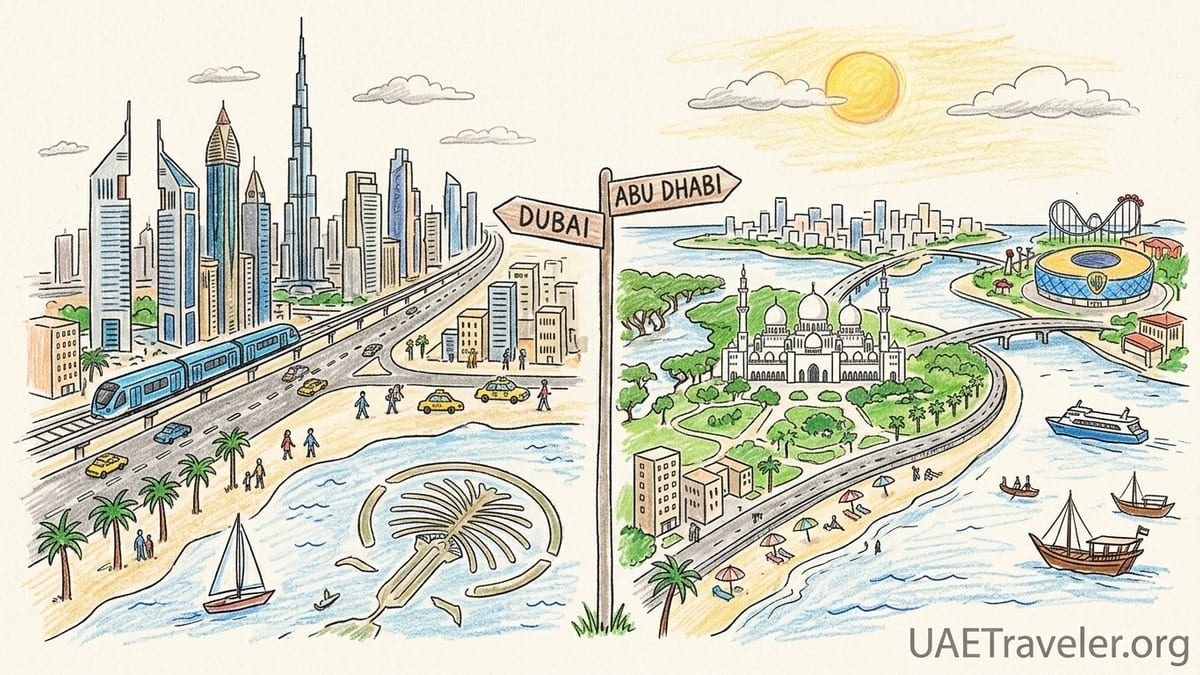
Dubai and Abu Dhabi sit only about 140 kilometers apart, yet they feel quite different once you check into a hotel. Dubai is more vertical and fast paced, with clusters of skyscrapers along Sheikh Zayed Road, man made islands and several distinct tourist hubs. It suits visitors who like variety in dining, malls and nightlife, and who are happy to use the Metro, trams and ride hailing apps to move between areas.
Abu Dhabi, by contrast, is more spread out and relaxed, built around natural islands connected by bridges. The city center along the Corniche has a traditional grid of streets, but key leisure areas such as Saadiyat Island, Yas Island and Al Maryah Island sit several kilometers apart. That shape, and the current lack of a metro system, means you rely more on taxis, hotel shuttles or private transfers, particularly if you want to combine museums, beaches and theme parks in one trip.
For travelers deciding where to base themselves in the United Arab Emirates, it often comes down to whether you prefer the intensity and choice of Dubai or the slower pace and slightly more compact set of attractions in Abu Dhabi. Practical questions matter too. A family keen on theme parks may lean toward Yas Island, while a couple focused on Burj Khalifa views and shopping may find Rove Downtown in Dubai a smart-value base. The sections below break down the key hotel areas and concrete examples so you can compare like for like.
Downtown & Business Bay vs Abu Dhabi Corniche: City Stays
Dubai Downtown and neighboring Business Bay form the modern heart of Dubai. This is where you find Burj Khalifa, Dubai Mall and the Dubai Fountain, all surrounded by a dense cluster of hotels that range from practical midscale brands to luxury towers. Properties such as Rove Downtown offer relatively compact but cleverly designed rooms for couples or small families, often with views toward Burj Khalifa, an all day café and a small pool. At the higher end, large international chains around the Boulevard and in Business Bay provide club lounges, multiple restaurants and larger suites that appeal to business travelers and city break visitors.
Downtown works particularly well if you care more about sightseeing and shopping than beaches. You can walk to Dubai Mall in the cooler months and rely on the Dubai Metro from Burj Khalifa / Dubai Mall station to reach other parts of the city. For a five night stay for a couple outside peak dates, midscale hotels in this area often fall in the range of roughly 500 to 800 UAE dirhams per night including taxes and Dubai’s Tourism Dirham. The Tourism Dirham is a small nightly fee per room that is added on top of the base rate and service charges, so always check the final price rather than the headline figure.
Abu Dhabi’s closest equivalent urban area is the Corniche and the streets behind it. Here you find a mix of local chain hotels and international brands facing the waterfront or a block or two inland. Corniche properties often have access to a public or semi private beach club, outdoor pools and city or sea views. Four star hotels on or near the Corniche tend to price slightly below similar city center hotels in Dubai, although exact numbers depend on dates, events and how far in advance you book. Room sizes are often generous, which can suit families using rollaway beds or connecting rooms.
In both Downtown Dubai and Abu Dhabi Corniche, you will usually find breakfast included or available as an add on, on site parking and at least one pool. The main difference is how you move around. In Downtown, the Metro and plentiful ride hailing cars make it easy to explore independently. Along the Corniche, you will use taxis or buses for most journeys, although many hotels run shuttles to nearby malls or, in Abu Dhabi, to Yas or Saadiyat on set schedules.
Dubai Marina, JBR & Palm Jumeirah vs Saadiyat Island: Beach & Resort Choices
If your priority is a beach holiday with city extras, the comparison that matters is Dubai Marina, JBR and Palm Jumeirah on one side, and Abu Dhabi’s Saadiyat Island on the other. Dubai Marina and JBR (Jumeirah Beach Residence) sit next to each other along a canal style marina and an open beachfront promenade. JBR beachfront hotels offer a mix of resort facilities and immediate access to cafés and casual restaurants along The Walk and The Beach. Many have family friendly pools, kids’ clubs and direct or short walking access to the public beach area, though not every property has a fully private stretch of sand.
Just offshore, Palm Jumeirah is a curved palm shaped island lined with premium resorts. Atlantis The Palm is one of the most famous, combining large rooms and suites with a private beach, an extensive pool complex and on site waterpark access included in many packages. Rooms here are generally larger than typical city hotels, and families often appreciate two queen bed configurations and access to kids’ clubs and children’s pools. Premium properties on the Palm frequently include buffet breakfast, complimentary parking and optional half board or dining credit offers that can significantly reduce food costs on a longer stay.
Abu Dhabi’s Saadiyat Island plays a similar role as a beach and culture hub. Resorts such as Park Hyatt Abu Dhabi sit on a long natural beach with soft sand and a lower rise, more tranquil feel than many of Dubai’s built up shorelines. The atmosphere is more about quiet pools, spa facilities and relaxed dining than constant entertainment, though children’s clubs and family pools are still standard at larger five star hotels. Saadiyat is also home to major museums, including Louvre Abu Dhabi, which are a short drive or shuttle ride from most beach resorts.
When you look at prices across comparable dates, five star beachfront resorts on Palm Jumeirah and Saadiyat Island often fall in a similar broad band, especially outside key holidays, though Saadiyat can at times be slightly better value relative to Dubai’s highest profile addresses. The crucial differences come in style. The Palm focuses on iconic architecture, multiple on site restaurants and resort style entertainment. Saadiyat emphasizes space, natural scenery and a quieter, more residential mood. That distinction can help couples seeking a calm stay lean toward Abu Dhabi, while families who want slides, aquariums and late night buzz might prefer Atlantis The Palm or neighboring Dubai beach districts.
Yas Island & Al Maryah Island vs Dubai for Theme Parks and Business Travel
Abu Dhabi stands out for theme park focused stays on Yas Island. Hotels such as Hilton Abu Dhabi Yas Island and The WB Abu Dhabi sit close to Yas theme parks, including a large waterpark, Ferrari branded roller coasters and an indoor Warner Bros themed park. Many packages at these hotels include complimentary park tickets for at least one park per day, or bundled access when you book a certain minimum number of nights. Families appreciate being able to walk or use short shuttles between hotel, parks and dining areas in Yas Bay, without long city transfers.
Hilton Abu Dhabi Yas Island is a full scale resort style hotel with a dedicated pool area, kids’ club, a small beach style waterfront and multiple restaurants. The WB Abu Dhabi has a strong design theme with film characters, yet still offers practical family rooms, pools and several dining options. Room sizes at these properties tend to be larger than at many city hotels, and family suites or interconnecting configurations are widely available. Parking is usually complimentary, and hotel operated shuttles link to the theme parks and nearby malls according to set timetables.
Al Maryah Island in Abu Dhabi serves a different purpose. It is primarily a business and upscale dining district, linked to large shopping malls and medical facilities. Hotels here lean more toward corporate and luxury city stays, with polished rooms, club lounges and high quality restaurants, but without the extensive beaches and children’s facilities found on Yas or Saadiyat. It compares more closely to Business Bay in Dubai, where new towers host five star business oriented hotels next to waterfront promenades and office blocks.
Dubai does have theme parks, but they are not as compactly clustered around a single hotel zone as on Yas Island. Instead, Dubai’s advantage for business travelers lies in the density of upscale properties in Downtown and Business Bay and the ease of using the Metro and taxis between offices, the financial district and the airport. For a traveler whose main purpose is meetings with occasional leisure, Business Bay or Al Maryah Island both make sense. For a family whose priority is riding coasters and spending full days in parks, Yas Island has a clear edge thanks to purpose built hotels like Hilton Abu Dhabi Yas Island and The WB Abu Dhabi that bundle tickets and shuttles.
Transport: Dubai Metro & Tram vs Abu Dhabi Taxis and Shuttles
Transport is one of the biggest practical differences between staying in Dubai and Abu Dhabi. Dubai has an elevated Metro system that runs along the main corridor between the airport, Deira, Bur Dubai, Downtown, Business Bay, Dubai Marina and beyond. Many hotels in Downtown, Business Bay and Deira sit within a short walk or a brief taxi ride of a station. For example, staying at a property like Rove Downtown allows you to use the Metro from Burj Khalifa / Dubai Mall or Financial Centre stations for predictable journeys to Dubai Marina or older districts along the Creek.
Dubai Marina and JBR are also connected by a tram line that loops through the area and links to the Metro at key stations. This combination means a visitor who is comfortable with public transport can keep taxi costs lower, especially on a longer stay. Resorts on Palm Jumeirah are connected by a monorail that links to the base of the Palm, although in practice many guests still rely on taxis or ride hailing apps for speed and comfort, particularly in the hotter months.
Abu Dhabi currently relies far more on buses, taxis and hotel shuttles. The city has an extensive bus network, but routes can be slower and less intuitive for short term visitors. Most tourists in areas such as the Corniche, Saadiyat, Yas and Al Maryah opt to use metered taxis or arrange private transfers. Many resorts operate scheduled shuttles to key malls or between Saadiyat and Yas so guests can reach theme parks or museums with minimal planning. When comparing budgets, it is worth factoring in that a visitor who makes frequent independent trips across Abu Dhabi may spend more on taxis than an equivalent traveler in Dubai who leans on the Metro for long hops.
For families, hotel operated shuttles in Abu Dhabi make theme park days straightforward. Hilton Abu Dhabi Yas Island and The WB Abu Dhabi, for example, focus on walking and shuttle access to the nearby parks, which reduces the need for separate taxis for each outing. In Dubai, hotels near Metro stations work well for independent explorers who want to combine different neighborhoods in a single day. If you plan many inter city journeys between Dubai and Abu Dhabi, dedicated intercity buses and private transfers are available, but travel time of roughly ninety minutes each way can eat into a short break.
Older Districts & Budget Options: Deira and Bur Dubai vs Central Abu Dhabi
Not every visitor wants a brand new tower or beachfront resort. Dubai’s older districts of Deira and Bur Dubai, along both sides of Dubai Creek, offer more budget friendly stays, along with souks, small restaurants and a taste of the city before its most recent wave of development. Here you will find three and four star hotels that may not have elaborate pools or private beaches, but that include comfortable rooms, breakfast buffets and easy access to traditional markets and abras across the Creek. Many properties also offer airport shuttles or are a short taxi ride from the older terminal buildings.
Deira and Bur Dubai appeal to budget travelers who plan to explore independently using the Metro, buses and walking. Dubai’s Tourism Dirham still applies to most paid hotel stays, but nightly room rates can sit well below those in Downtown or the Marina on the same dates. Simple city hotels in these districts can shave a significant amount off a five or seven night trip, money that can then be used for excursions such as desert safaris or entry to major attractions.
In Abu Dhabi, there is less contrast between “old” and “new” districts than in Dubai, but central areas behind the Corniche and around older malls host many mid range and budget properties. These may not have beach access, but often include small rooftop pools, basic gyms and breakfast. Room sizes can be generous compared with some Dubai equivalents, though décor and facilities may be simpler. For travelers who want to visit museums on Saadiyat or parks on Yas but keep hotel costs down, staying in a central Abu Dhabi city hotel and using taxis or shuttles out to the islands can be a workable compromise.
When comparing Deira or Bur Dubai with central Abu Dhabi for budget travel, the main difference comes back to transport and what you want from your surroundings. In Dubai’s older districts, the Metro and Creek create a lively urban atmosphere, and attractions are close together. In Abu Dhabi, budget city hotels may feel more car dependent, but you are closer to the Corniche beach and within reach of both Saadiyat and Yas for day trips.
Realistic Budget Ranges for Couples and Families
Because prices in the UAE fluctuate with seasons, events and demand, any budget comparison has to be treated as a range rather than a fixed figure. However, looking at four and five star properties such as Atlantis The Palm, Rove Downtown, JBR beachfront hotels, Hilton Abu Dhabi Yas Island, The WB Abu Dhabi, Park Hyatt Abu Dhabi and good Corniche hotels for typical off peak dates, some patterns emerge once all taxes, service charges and Dubai’s Tourism Dirham are included.
For a couple staying three nights in a midscale city hotel like Rove Downtown or a comparable Corniche property, realistic total accommodation costs including charges might sit in a broad band from roughly 1,800 to 3,000 dirhams, depending on how early you book and whether breakfast is included. The same couple choosing a beachfront resort on Palm Jumeirah, JBR, Saadiyat or Yas could see three night totals ranging from approximately 3,000 to 6,000 dirhams for four or five star options, again highly dependent on season and promotions.
For families of four, resort stays at Atlantis The Palm, Hilton Abu Dhabi Yas Island, The WB Abu Dhabi or Park Hyatt Abu Dhabi can add up more quickly, but they may include extras such as complimentary theme park tickets, kids’ club access and half board dining offers. Across three nights, a family room or interconnected setup in one of these properties can realistically run from around 4,500 to well above 9,000 dirhams once taxes and fees are counted, with higher figures more likely during school holidays or major events. City based four star hotels in Deira, Bur Dubai or central Abu Dhabi reduce that considerably, though you may then spend more on taxis or admission to paid beach clubs.
Extending to five and seven nights multiplies these totals, but longer stays often unlock better nightly rates or dining credits. A couple on a five night break in a midscale city hotel might budget in the region of 3,000 to 5,000 dirhams for accommodation, while a family of four in a full resort with included breakfast and some park access could be looking at the equivalent of 7,500 to 15,000 dirhams or more depending on exact property and timing. Because Dubai levies the Tourism Dirham as a nightly charge per room in addition to service charges, it is useful to look at the final confirmed total rather than comparing only base nightly prices on search results.
Recommendations by Traveler Type
First time visitors often want a balance of icons, beaches and easy transport. For many, that points to Downtown Dubai or Dubai Marina and JBR if the budget allows, combined with at least one day trip to Abu Dhabi’s museums or theme parks. Rove Downtown works well for those who want to walk around Burj Khalifa and Dubai Mall, then take the Metro to older districts. A first trip entirely based in Abu Dhabi also works, particularly if you choose a Corniche or Saadiyat hotel and plan focused excursions rather than nightly bar hopping.
Luxury couples who prioritize larger rooms, quiet pools and strong dining tend to favor Palm Jumeirah or Saadiyat Island. Atlantis The Palm appeals to couples who enjoy big resort energy, multiple restaurants and easy access to water based activities. Park Hyatt Abu Dhabi leans in the other direction, with a calmer beachfront and close access to cultural visits on Saadiyat and nearby islands. Al Maryah Island and Business Bay also offer sophisticated city hotels with high end dining but without direct beaches, which can appeal to travelers on shorter, restaurant focused breaks.
Theme park families are where Abu Dhabi really shines. Hilton Abu Dhabi Yas Island and The WB Abu Dhabi place you close to major parks and frequently offer bundles that include daily access, making budgeting more predictable. These hotels usually feature kids’ clubs, family pools and casual dining that suits younger travelers. In Dubai, families who want a mix of beach and attractions often split their time between a JBR beachfront hotel and a night or two in a city property like Rove Downtown to keep transfers shorter and experience both waterfront and urban sides of the city.
Budget travelers who want to explore independently may lean toward Deira or Bur Dubai, using savings on nightly rates to fund activities and dining. The Metro offers a clear advantage in controlling costs across a week long stay. Central Abu Dhabi city hotels near the Corniche can still be good value, particularly for those content to use taxis selectively and focus on a few key sights. In both cities, checking what is included in the rate, from breakfast to shuttle services and park tickets, matters as much as the basic nightly cost when you calculate a full three, five or seven night budget.
The Takeaway
Choosing between Dubai and Abu Dhabi, and between their main hotel areas, starts with being honest about the sort of trip you want. Dubai offers intense variety, with Downtown, Business Bay, Dubai Marina, JBR, Palm Jumeirah and the older Creek districts all delivering very different moods within one city and connected by a modern Metro and tram system. Abu Dhabi spreads its experiences over the Corniche, Saadiyat, Yas and Al Maryah, linked mostly by taxis and shuttles but with a calmer atmosphere and standout theme parks.
For first time visitors who want big skyline views and easy sightseeing, Downtown Dubai or Dubai Marina and JBR are natural choices, with perhaps a day reserved for Abu Dhabi’s museums or Yas Island. Couples focused on calm luxury and long beach walks may find Saadiyat Island or select Palm Jumeirah resorts more in tune with their style. Theme park families are often best served by basing themselves on Yas Island to minimize transfers and maximize time in the parks. Travelers watching their budget closely can look to Deira, Bur Dubai and central Abu Dhabi city hotels, using the savings on accommodation to invest in experiences.
Whatever you choose, always compare complete prices that include service charges, municipal fees and, in Dubai, the Tourism Dirham, and pay attention to what each rate includes, from breakfast and dining credits to kids’ clubs and complimentary park access. By matching neighborhood character, hotel style, transport options and realistic budgets, you can pick a UAE base that turns your three, five or seven night stay into the kind of trip you remember for the right reasons.
FAQ
Q1. Is Dubai or Abu Dhabi better for a first trip to the UAE?
For a first visit focused on iconic sights, shopping and variety in dining, Dubai usually works better, especially if you stay in Downtown or Dubai Marina and JBR. Abu Dhabi is also a strong option if you prefer a calmer pace and plan to focus on Saadiyat’s museums or Yas theme parks rather than nightlife.
Q2. Where should families who love theme parks stay?
Families who want multiple days in parks often get the best experience on Yas Island in Abu Dhabi, at hotels such as Hilton Abu Dhabi Yas Island or The WB Abu Dhabi, which frequently offer packages with park tickets and shuttles included. This reduces travel time and makes budgeting easier.
Q3. Which area in Dubai is best for couples who want city views and shopping?
Couples who value skyline views, restaurants and access to major malls tend to favor Downtown Dubai and Business Bay. Hotels close to Burj Khalifa and Dubai Mall provide an urban feel, and the Metro makes it simple to reach Dubai Marina, JBR and the Creek for varied evenings out.
Q4. How do Palm Jumeirah resorts compare with Saadiyat Island hotels?
Palm Jumeirah resorts, including Atlantis The Palm, focus on bold architecture, extensive pools, private beaches and many on site restaurants and activities. Saadiyat Island hotels, such as Park Hyatt Abu Dhabi, offer a quieter, more natural beachfront with a relaxed, low rise atmosphere and easy access to museums and cultural sites.
Q5. What is the main difference in public transport between the two cities?
Dubai has a modern Metro and tram system that links many hotel districts with the airport and each other, which helps keep transport costs predictable. Abu Dhabi relies more on taxis, buses and hotel shuttles, so visitors tend to plan day by day rather than hopping spontaneously between districts on rail lines.
Q6. Are private beaches common at city hotels?
In Dubai, full private beaches are more common at Palm Jumeirah, JBR and some other coastal resorts, while Downtown and Business Bay hotels focus on pools and city views instead. In Abu Dhabi, Saadiyat and Yas Island resorts typically have direct beach access, while Corniche and central city hotels may offer access to beach clubs or public beaches nearby.
Q7. How does the Dubai Tourism Dirham affect hotel costs?
Dubai levies a Tourism Dirham fee per room per night on most paid hotel stays, which is added on top of base rates and service charges. When you compare options, always look at the final total price, because two hotels with similar base rates can differ more than expected once all fees are included.
Q8. Is it realistic to visit both cities on a short trip?
It is possible to visit both Dubai and Abu Dhabi on a three to five night trip, but travel time of roughly ninety minutes each way by road can feel rushed. Many travelers base themselves in one city and take a single day trip to the other for key highlights, especially if traveling with children.
Q9. Which areas are best for travelers on a tighter budget?
In Dubai, Deira and Bur Dubai generally offer lower nightly rates and good access to the Metro and traditional markets, which helps control costs. In Abu Dhabi, central city hotels behind the Corniche often provide good value, though you may rely more on taxis or buses to reach Saadiyat and Yas.
Q10. Do hotels usually include breakfast and kids’ clubs in the rate?
Many four and five star hotels in both cities offer breakfast inclusive rates, and resort style properties commonly provide kids’ clubs at no extra or modest additional cost. However, the exact inclusions vary by hotel and date, so it is important to check whether breakfast, children’s activities, park tickets and shuttles are specifically listed in the package you book.