


Visiting both Jumeirah Mosque in Dubai and Sheikh Zayed Grand Mosque in Abu Dhabi changed the way I understood religion, culture and daily life in the United Arab Emirates. On paper, they are simply two famous mosques connected by a highway across the desert. In reality, they offer very different ways of welcoming non-Muslim visitors, teaching Islamic traditions and framing Emirati identity. By joining guided visits at both, I discovered that the contrast between an intimate neighborhood mosque and a monumental national landmark can tell you a great deal about how the country wants to be seen, and how locals hope you will understand their faith.
Booking, Registration and First Contact
My experience with both mosques began long before I removed my shoes at the prayer hall. It started on my phone, figuring out how to secure a place on the official guided visits. For Jumeirah Mosque in Dubai, the process was deliberately low-tech. The official program explains that no advance booking is required for the standard public visits, which run at 10:00 and 14:00 from Saturday to Thursday, with registration opening 30 minutes beforehand at the majlis just outside the mosque. You simply show up, pay the admission fee, and your name is written on a list. In a city where most attractions are app-driven and barcoded, it felt almost old-fashioned in a reassuring way.
Sheikh Zayed Grand Mosque in Abu Dhabi, by contrast, starts with an online form. The mosque’s visitor platform asks you to select a date and time slot, enter passport-style details, and generate a QR code for entry. Recently, the center introduced an entry fee for most visitors from outside the UAE, so the booking process also involves a small online payment, generally 10 dirhams for foreign adult visitors, while some categories such as young children and older visitors are exempt. The website clearly shows separate options for a general visit and for add-ons like premium or behind-the-scenes tours, so you need to pay attention to what you are booking.
Those two booking experiences already pointed to different identities. Jumeirah Mosque presents itself as a neighborhood institution run in partnership with a cultural center that has been running “Open Doors, Open Minds” events for decades. Its public visit is intimate enough that a handwritten list still works. The Grand Mosque in Abu Dhabi handles enormous daily volumes of visitors, plus worshippers and official delegations, and it shows. The online system feels closer to booking a museum time slot in Europe or a major theme park attraction, designed so that coaches of day trippers from Dubai and international tour groups can be processed efficiently.
On a practical level, the systems also affect your planning. In Dubai, I timed my arrival to be at Jumeirah Mosque’s majlis around 9:30 in the morning, which was perfectly adequate to join the 10:00 session. In Abu Dhabi, I booked a late afternoon slot at Sheikh Zayed Grand Mosque several days ahead, partly to secure a time that would let me see the building both in full daylight and in the blue hour as the exterior lights came on.
Getting There: Transport Logistics and Costs
Because many visitors link both mosques in a longer UAE trip, the journeys to each are worth understanding. Jumeirah Mosque sits in the older shoreline area of Dubai, just inland from Jumeirah Beach. From central Dubai, I used the city’s transport mix: metro plus taxi. I took the metro to Financial Centre Station on the Red Line, then a short onward taxi ride of about 10 to 15 minutes, which cost around 25 to 30 dirhams depending on traffic. Another time, I used a ride-hailing app directly from Business Bay and paid closer to 40 dirhams in mid-morning traffic. Public buses do run along Jumeirah Beach Road, but given the summer heat and the need to arrive in time for registration, a taxi or ride-hail felt like the more reliable option.
Sheikh Zayed Grand Mosque requires a bit more planning, especially if you are based in Dubai. On one visit I joined a shared day tour operated by a Dubai-based agency that included return transport, mosque entry process assistance and a brief drive around Abu Dhabi. That cost about 250 to 350 dirhams per person depending on the season and whether hotel pickup was included. On another occasion I traveled independently. The intercity buses from Dubai’s Ibn Battuta or Al Ghubaiba bus stations to Abu Dhabi Central Bus Station cost only a few dozen dirhams, and from there I took a city taxi to the mosque for around 25 to 35 dirhams. If you split those costs between two or three people, an independent visit can be quite economical, though you must factor in the extra time and connections.
Within Abu Dhabi itself, the mosque is located near a major highway, about a 20 minute drive from the central Corniche hotels depending on traffic. City taxis are metered and relatively affordable; on a recent weekday afternoon, my ride from a downtown hotel cost roughly 30 dirhams each way. I met other travelers who had rented cars at Dubai or Abu Dhabi airports and driven between the cities on their own, paying just for petrol and occasional tolls. The wide highways and clear signage make that a realistic choice for confident drivers, especially if they want to linger into the evening for sunset photography.
When comparing overall costs per person, my Jumeirah Mosque visit with public transport and the admission fee reached around 80 to 100 dirhams in total, including a return taxi. My independently organized Sheikh Zayed Grand Mosque visit, using the intercity bus and Abu Dhabi taxis plus the new entry fee, was in a similar ballpark but required more moving parts. The guided day tour from Dubai cost more upfront, though it bundled transport, commentary and the reassurance of not managing connections alone.
Clothing, Security and First Impressions on Arrival
Both mosques have detailed dress codes and security procedures, but the way you encounter them shapes your first emotional response. At Jumeirah Mosque, I approached a low, sand-colored building framed by palms and a modest courtyard. Signs reminded visitors that modest clothing was required: shoulders and knees covered for everyone, long loose trousers or skirts rather than shorts, and headscarves for women. I had already dressed conservatively in light trousers and a long-sleeved shirt, but female travelers who arrived in sleeveless tops or above-the-knee dresses were politely offered abayas and scarves from a rack inside the majlis at no extra charge. The atmosphere felt like a community center helping guests to fit in, not a checkpoint policing behavior.
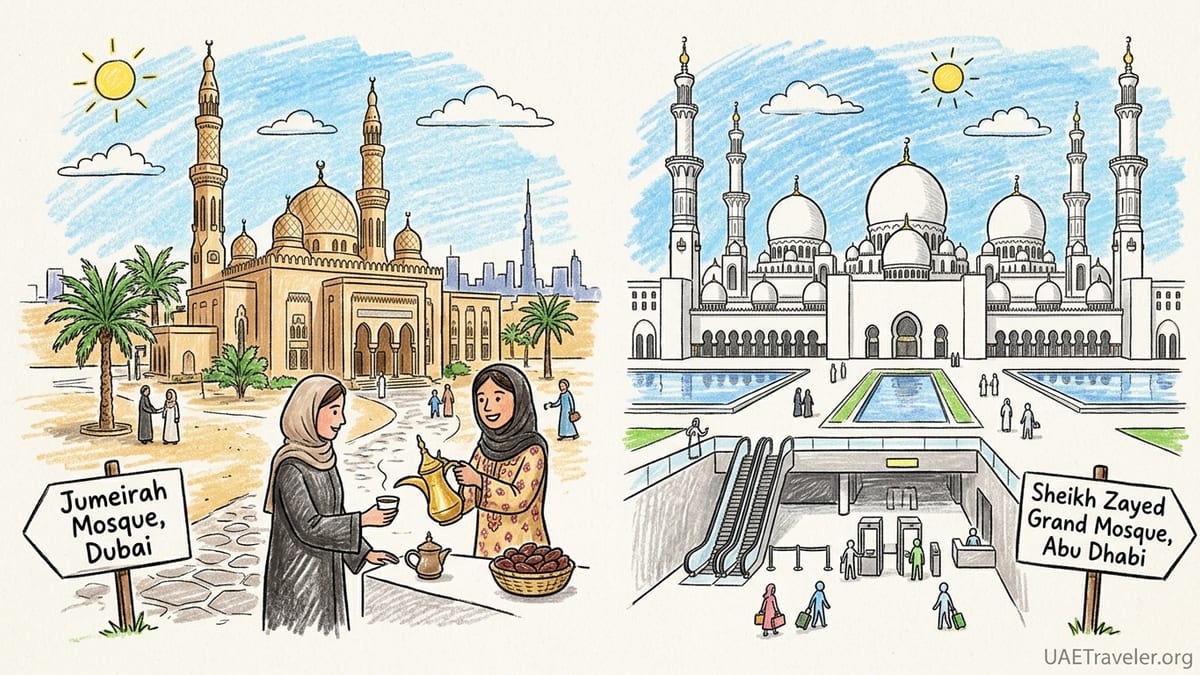
Security at Jumeirah Mosque was present but discreet. Bags were glanced at and there was a gentle reminder to turn phones to silent. Registration and payment took place inside an air-conditioned majlis tent furnished with carpets, cushions and low tables. Before the tour began, we were offered Arabic coffee poured from traditional dallah pots into small cups, trays of dates and small bites that introduced visitors to the Emirati concept of fawala, or the act of greeting guests with refreshments. The effect was of being welcomed into someone’s home.
At Sheikh Zayed Grand Mosque, the scale shifted immediately. The complex is approached through a large visitor center with parking garages, escalators and a long underground concourse of ticket counters, information desks and shops. Before reaching the courtyard, visitors pass through security screening with metal detectors and X-ray belts for bags, similar to an airport light version. Dress checks take place at several points. Staff make sure that tops are not transparent or tight, that arms are covered to the wrist, and that legs are fully covered to the ankle. Women are expected to cover their hair, and while many bring their own scarves or abayas, there are also robes available to rent or borrow when needed.
That stricter enforcement reflects both the mosque’s religious role and the sheer number of visitors. It also affects your state of mind. Emerging from the cool underground passage into the blinding white marble courtyard, I felt I had left the city behind and entered an almost theatrical space. The symmetry of arcades, the domes rising against the sky and the reflections in the elongated pools made it clear this was a national symbol as much as a place of worship.
Inside Jumeirah Mosque: Intimate Majlis and Open Conversation
Jumeirah Mosque’s public visit begins in the majlis, not immediately inside the prayer hall. Once our group of around 25 people had gathered, our Emirati presenter invited us to sit on the carpet, remove our shoes and accept another pour of coffee. The session was designed to be conversational. The guide introduced basic concepts of Islam, from the five daily prayers to the meaning of the call to prayer we could hear faintly from other mosques in the neighborhood.
One of the most memorable parts of the visit was a live demonstration of wudu, the ritual ablution performed before prayer. Our guide explained the steps at a small basin: washing hands, mouth, nose, face, arms, head and feet in a specific sequence. She emphasized that the point was not mechanical purity but a moment of mental preparation and resetting intention before standing before God. For non-Muslim visitors who may only have seen ablution areas as anonymous wash zones, this framed the practice as deliberate and meaningful.
We then moved into the main prayer hall, where visitors were invited to sit on the carpeted floor facing the mihrab, the niche that marks the direction of Mecca. Here the guide walked us through the rhythm of the daily prayers. She explained that although prayers are set at five broad times of day, many Emiratis plan their work and social schedule around at least some of them, especially the Friday noon congregational prayer. Rather than rush through a memorized list of facts, she told simple personal stories, like how her grandfather would always insist that family meals never interfere with prayer time, or how office workers in nearby towers sometimes keep a prayer rug in a meeting room so they can slip away briefly when the time comes.
The session remained open to questions throughout. Visitors asked about everything from the role of women in mosques to how Emiratis celebrate Ramadan and Eid. The guide welcomed questions that might be considered sensitive elsewhere, such as whether non-Muslims can marry Muslims, or how Islamic law relates to daily life in Dubai. Her answer was always to describe both the religious principle and the way Emiratis interpret it in practice, acknowledging that families and regions differ. That honesty, combined with the manageable group size, created a rare environment where cultural education and genuine curiosity met comfortably.
Inside Sheikh Zayed Grand Mosque: Scale, Splendor and Structured Movement
The guided visit at Sheikh Zayed Grand Mosque was a very different kind of experience. I joined one of the official cultural tours run by the mosque center, which are advertised as complimentary for visitors who have already registered their entry. Our group gathered near a signposted meeting point, where a cultural tour specialist handed out audio receivers so we could hear her commentary clearly even when the group stretched out.
From the first steps into the main courtyard, the tour focused on architecture and symbolism at a monumental scale. The guide described how the mosque combines design influences from Persian, Mughal and Moorish traditions, evident in the pointed arches, large domes and intricate floral stone inlays. She pointed out that some of the marble came from quarries in countries such as Italy and Greece, and that artisans from multiple countries contributed to the carving and inlay work. The courtyard’s floral patterns underfoot, which look like a giant marble carpet, became even more impressive when she explained that each petal was cut and set by hand.
Inside the main prayer hall, with its giant hand-tufted carpet and colossal chandeliers, the commentary shifted to the logistics of a functioning mosque. Our guide explained that the hall can accommodate thousands of worshippers at once, arranged in straight lines indicated by subtle markings in the carpet pile. She described how the mosque fills completely during Eid prayers, with additional lines extending into the colonnades and courtyard. She talked about the imam’s role in leading the prayer, the microphones and lighting systems that help worshippers follow, and the separate side areas that allow women and families to participate while maintaining modesty.
Unlike at Jumeirah Mosque, where we could sit on the carpet for an extended discussion, movement at the Grand Mosque was more structured. The group followed a fixed route, pausing at designated photo points and observation spots. Questions were welcomed but needed to fit into the flow, as security staff gently encouraged groups to keep moving so other visitors could pass. Still, the guide found opportunities to explain elements of religious practice: how worshippers perform the prayer movements, why shoes are removed, and how the calligraphy on the walls quotes verses that emphasize mercy and compassion.
Comparing Group Size, Interpretation and Photography
Experiencing both visits back to back made the differences in scale and interpretation stark. At Jumeirah Mosque, I shared the session with around two dozen visitors. The guide quickly learned where each of us came from and adapted her examples accordingly, referencing mosques in Istanbul for a Turkish couple, or explaining fasting similarities and differences to a visitor from India who was familiar with Hindu fasts. When someone asked a follow-up question, there was time for a real answer.
At Sheikh Zayed Grand Mosque, even though the official tour group itself was kept to a reasonable size, perhaps 30 to 40 people, it moved through shared spaces where several groups overlapped. The guide relied more on a set script about history, construction dates and materials, partly because the mosque serves as a flagship for the nation and partly because the tours need to be consistent. The interpretation was still high quality, but it felt less like a conversation and more like being walked through a living museum.
Photography rules also highlighted different priorities. In Dubai, the Jumeirah Mosque team was relaxed about photos as long as visitors were respectful and avoided taking close-ups of other guests without consent. During the wudu demonstration, the guide even encouraged us to take pictures and videos so we could remember the steps. Inside the prayer hall, we had time after the talk to wander quietly, look at details like the chandelier and mihrab and capture images, provided we did not disrupt anyone who came in to pray.
At Sheikh Zayed Grand Mosque, photography is explicitly allowed but subject to more specific rules. Staff pointed out areas where professional-style photo shoots were not acceptable and asked visitors to avoid poses seen as disrespectful, such as jumping photos or leaning against delicate railings. Certain zones near active prayer areas were off limits for cameras. The structured route includes a few designated viewpoints where the guide paused and mentioned that “this is a good spot for photos” before moving on. The message was clear: you are welcome to appreciate and document the beauty, but this is not a backdrop for fashion shoots or viral stunts.
Architecture, Atmosphere and Walking Distance
Architecturally, the two mosques tell different stories about Emirati culture. Jumeirah Mosque is built in a traditional style with elegant minarets, creamy stone and modest ornamentation. Inside, the prayer hall is proportioned for a neighborhood congregation. The carpet underfoot, chandeliers and decorative calligraphy are beautiful but not overwhelming. Sitting there during the visit, I could easily imagine the same space filled with local families on a regular weekday evening. The atmosphere was calm and human-scaled, with rays of sun from upper windows catching dust motes in a way that made the hall feel lived in rather than pristine.
At Sheikh Zayed Grand Mosque, the sheer size dominates your senses. Long marble colonnades with repeated arches and gold-tipped columns stretch away on either side. The main courtyard feels almost like a plaza, large enough that you are aware of clouds moving above and the changing angle of the sun reflected off the white surfaces. The main prayer hall, with its immense carpet and crystal chandeliers, seems designed to communicate abundance and generosity, from the floral motifs climbing the columns to the gleaming calligraphy bands running along the walls.
The practical implication of that scale is walking distance. At Jumeirah Mosque, once you are inside the compound, everything happens within a compact radius: majlis, courtyard, ablution area and prayer hall. The entire visit covers only a few hundred meters of walking. At Sheikh Zayed Grand Mosque, the official tour route can cover several kilometers, including the underground approach, colonnades, courtyards and interior halls. Comfortable footwear is one of the most useful pieces of visitor etiquette here, even though you will remove your shoes to enter some indoor areas. Travelers with mobility issues can request wheelchairs and use escalators and lifts, but they still need to allow extra time and energy.
Atmospherically, I found Jumeirah Mosque almost meditative. The limited visitor numbers, the smell of cardamom coffee lingering from the majlis and the soft hum of the air conditioning created a cocoon in which it was easy to focus on the guide’s stories. At the Grand Mosque, awe and movement defined the visit. There were quiet moments, especially when the group stepped briefly away from the main route and looked up at a dome from directly beneath it, but the general sensation was of participating in a grand procession through a national landmark.
What I Actually Learned About Prayer, Etiquette and Religious Life
Both mosques deepen your understanding of Islam in the UAE, but they emphasize different aspects. At Jumeirah Mosque, the educational focus is explicitly on questions and daily practice. By watching the wudu demonstration and hearing the guide’s explanation of how prayer times shape the day, I left with a clearer sense of how faith weaves through ordinary Emirati routines. She explained that in Dubai’s older neighborhoods, you can still see shopkeepers closing briefly around Friday noon prayers, and that many Emiratis plan family gatherings and meals during Ramadan so that everyone can break the fast together just after the evening call to prayer.
Visitor etiquette was also unpacked in detail. The guide did not simply say “dress modestly” but explained why loose, non-transparent clothing is valued and how the mosque’s role as a communal space means your behavior can influence the atmosphere for worshippers. She pointed out that visitors are welcome to sit on the carpet and reflect even if they are not Muslim, as long as they stay behind certain lines when a prayer is in progress. That nuance went beyond the usual list of do’s and do-nots printed on a sign.
At Sheikh Zayed Grand Mosque, the learning came as much from observing how the building operates during visiting hours as from the spoken commentary. I noticed how worshippers and visitors use different entrances, how some areas are roped off for prayer while others serve as viewing corridors, and how staff coordinate to protect the marble flooring and carpets. The guide spoke about the mosque’s role during Ramadan and Eid, describing how extra sound systems and lighting are used for night prayers and how the large courtyard is needed to accommodate overflow crowds.
She also highlighted theological themes expressed through architecture. The repeated floral motifs, she said, were chosen to evoke paradise gardens described in Islamic scripture, while the white color palette symbolizes purity and peace. The calligraphy circling the domes includes specific verses featuring the divine names that emphasize mercy and compassion, a deliberate reminder that the mosque is intended as a welcoming place for people of all backgrounds.
Do You Need a Private Guide, and Which Visit Feels More Educational?
Across both cities, I experimented with joining official mosque guides and, on one occasion, hiring a separate private guide through a local agency to accompany me between Dubai and Abu Dhabi. At Jumeirah Mosque, the official public visit is already intimate and highly interactive. An external private guide might enhance your broader Dubai orientation or handle transport, but inside the mosque itself all visitors feed into the same majlis session. The real value lies in listening to the in-house presenter, who is trained specifically to answer cultural and religious questions in that space.
At Sheikh Zayed Grand Mosque, the decision is more nuanced. The official cultural tour is free to join once you have your entry pass, and it covers the essential religious and architectural stories with professionalism. A private guide can add value on the journey from Dubai or around Abu Dhabi, explaining the mosque’s political and historical context, pointing out less obvious viewpoints after the official tour or synchronizing your visit with sunset for better lighting. However, they are still bound by the mosque’s visitor regulations and cannot take you into restricted zones. The additional cost might be better justified for travelers who want everything bundled transport, context and logistics rather than for those interested purely in the on-site religious explanation.
In terms of pure educational impact, I found Jumeirah Mosque more personal. The smaller group, the open Q&A format and the focus on everyday faith allowed me to engage with topics I had rarely felt comfortable asking about elsewhere. Sheikh Zayed Grand Mosque taught different lessons: how a modern Muslim-majority state chooses to represent its faith in marble and light, how large-scale architecture can be used to convey hospitality and power simultaneously, and how religious and touristic functions can be balanced on the same campus. Both broaden understanding, but Jumeirah feels like a classroom conversation while Sheikh Zayed is closer to an immersive lecture in a grand hall.
From a cost perspective, neither mosque is prohibitive. Jumeirah’s entry fee funds the cultural program and refreshments, while Sheikh Zayed’s new entry charge remains modest compared to the cost of transport between cities or to other regional attractions. The main financial question comes down to whether you choose to pay for private transport or guides, or whether you are comfortable stitching together buses, taxis and the official free tours yourself.
The Takeaway
If I had to name the single most surprising lesson from Jumeirah Mosque, it would be how ready the guides were to address misconceptions head-on. I heard honest, patient explanations about topics that many visitors might hesitate to raise like how Islamic teachings view other faiths, or how Emirati society is responding to questions about gender and work. The presence of Emirati refreshments in the majlis and the encouragement to photograph key moments such as the ablution demonstration underlined the message that the mosque is not a fragile relic but a lived-in place that can absorb curiosity.
At Sheikh Zayed Grand Mosque, the surprise was the way intimacy and scale could coexist in brief moments. Amid the crowds, there were quiet corners along a colonnade where the sound of footsteps faded and the echo of the guide’s voice softened. Looking up at the underside of a dome or at a strip of calligraphy high on the wall, I was reminded that this massive national symbol still functions, at its core, as a space where individuals stand, bow and return to their own thoughts. That dual identity as both icon and intimate place of worship is not easy to maintain, yet staff and signage work constantly to keep a respectful balance.
In the end, the visit I enjoyed most depended on what I was seeking. For architecture, spectacle and the feeling of walking through a modern wonder of the world, Sheikh Zayed Grand Mosque is unmatched in the UAE. For conversation, cultural nuance and a sense of how faith infuses everyday Emirati life, Jumeirah Mosque offered more space to listen and ask questions. If I had to choose the more educational in a narrow sense, I would pick Jumeirah, because the format gives visitors more chances to interact deeply with a local guide.
Yet they both deserve a place in the same itinerary. Seen together, they reveal two complementary faces of Emirati culture: a national narrative written in marble and domes in Abu Dhabi, and a neighborhood-scale encounter over dates and coffee in Dubai. Threaded between them are train rides, taxi journeys and conversations with strangers that form their own informal classroom. For anyone willing to dress modestly, listen attentively and walk a little, these two mosques offer some of the most rewarding cultural hours you can spend in the United Arab Emirates.
FAQ
Q1. Do I need to book in advance for Jumeirah Mosque and Sheikh Zayed Grand Mosque?
For Jumeirah Mosque’s standard public visit, you usually do not need to book ahead; registration and payment take place at the majlis about 30 minutes before the scheduled start. For Sheikh Zayed Grand Mosque, you are expected to register online in advance to obtain a timed entry pass and pay any applicable entry fee, especially during busy periods or if you are traveling in a group.
Q2. What should I wear when visiting these mosques?
Both mosques require modest dress. Shoulders and legs must be fully covered, clothing should be loose and non-transparent, and women are asked to cover their hair with a scarf. At Jumeirah Mosque, abayas and scarves are often provided for those who need them. At Sheikh Zayed Grand Mosque, strict checks are carried out at the visitor center and robes may be issued if your outfit does not meet the dress code.
Q3. Are the guided tours free of charge?
At Jumeirah Mosque, there is a per person admission fee for the public visit, which includes the guided session and refreshments in the majlis. At Sheikh Zayed Grand Mosque, general entry now involves a small fee for most overseas visitors, but the official cultural tours conducted by mosque staff are described as complimentary once you are inside, with some specialized premium tours offered at extra cost.
Q4. Can non-Muslims enter the prayer halls?
Yes, non-Muslim visitors are welcome inside designated areas of the prayer halls at both mosques during guided visits, provided they follow the dress code and behavioral guidelines. Certain sections may be reserved for worshippers only, and access can be restricted during prayer times or religious events, especially at Sheikh Zayed Grand Mosque.
Q5. Is photography allowed inside the mosques?
Photography for personal use is generally allowed at both sites, but there are rules. At Jumeirah Mosque, informal photography is welcomed as long as it is respectful. At Sheikh Zayed Grand Mosque, photography is subject to clearer restrictions, with staff enforcing rules against inappropriate poses or professional photo shoots without permission and limiting photos in some prayer areas.
Q6. How long should I allow for each visit?
The Jumeirah Mosque public visit typically lasts around 75 to 90 minutes, including time in the majlis and inside the prayer hall. For Sheikh Zayed Grand Mosque, the official cultural tour runs for about 30 to 45 minutes, but you should allow at least 90 minutes to 2 hours in total to pass through the visitor center, join the tour, walk the route and take photographs, especially if arriving at busy times.
Q7. Can I visit both mosques in one day?
It is technically possible to visit both in a single very long day if you start with the morning session at Jumeirah Mosque in Dubai and then drive directly to Abu Dhabi for an afternoon slot at Sheikh Zayed Grand Mosque. However, the intercity travel time and potential traffic make it more comfortable to dedicate separate days or at least separate half-days to each, especially during the hotter months.
Q8. Are children welcome on the guided visits?
Children are welcome at both mosques as long as they are supervised and respectful. At Jumeirah Mosque, guides often engage younger visitors by inviting them to sit near the front or try simple demonstrations. At Sheikh Zayed Grand Mosque, families frequently join the cultural tours, but parents should be prepared for longer walking distances and the need to keep children quiet in prayer areas.
Q9. What is the best time of day to visit each mosque?
In Dubai, the morning visit to Jumeirah Mosque tends to be a little cooler and is convenient if you plan to explore nearby neighborhoods afterward. In Abu Dhabi, many visitors aim for a late afternoon slot at Sheikh Zayed Grand Mosque so they can see the building in full daylight, at sunset and then gently illuminated after dusk, which makes the white marble and pools particularly striking.
Q10. Is it worth hiring a private guide for these mosque visits?
A private guide is not essential for understanding the mosques themselves, since both Jumeirah Mosque and Sheikh Zayed Grand Mosque provide their own structured guided visits led by trained staff. A private guide can add value by arranging transport, helping with logistics between Dubai and Abu Dhabi, and offering broader cultural context, but most travelers will gain strong insight simply by joining the official programs and being attentive during the tours.