


The way travelers move between Dubai and Abu Dhabi has changed dramatically since Etihad Rail’s passenger service opened between Al Yalayis in Dubai and Mohammed Bin Zayed City in Abu Dhabi on 30 September 2026. For the first time, there is a fast intercity train alongside long-established E100 and E101 buses, taxis, ride-hailing apps and private transfer services. Choosing the right option now depends less on headline journey times and more on where you are staying, how much luggage you carry and how comfortable you want that 140-kilometre journey to feel.
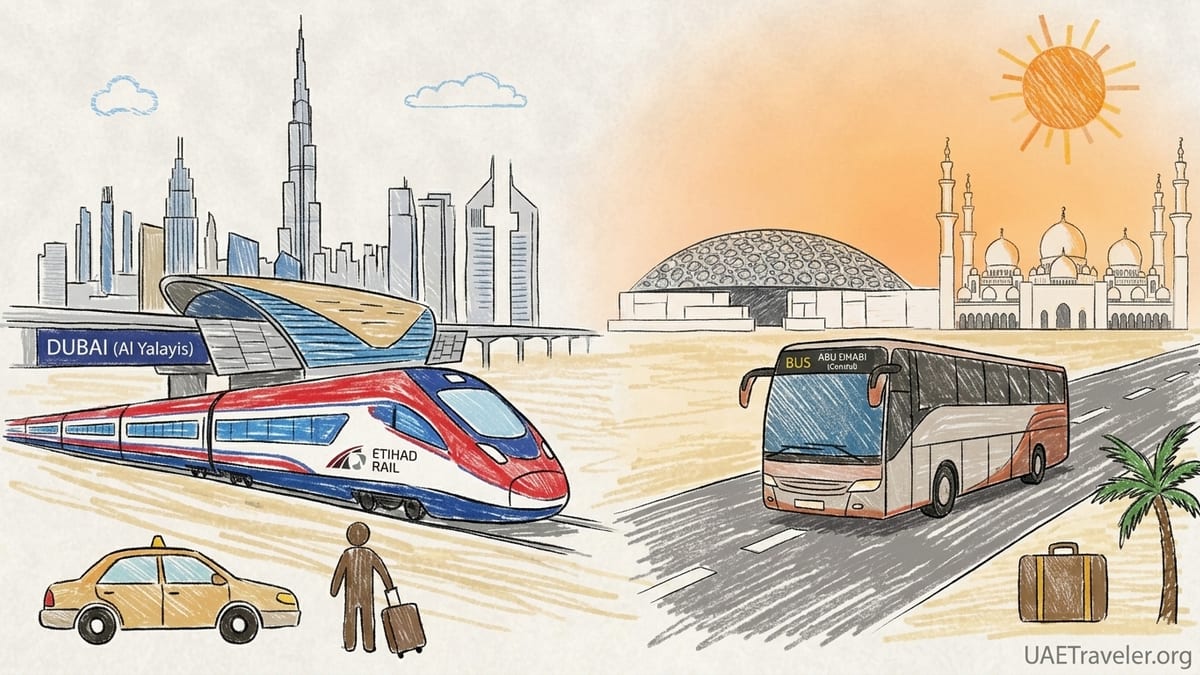
How the Dubai–Abu Dhabi transport landscape looks in 2026–2027
The opening of Etihad Rail’s Dubai passenger station in the Al Yalayis area has added a genuinely new way to move between the two emirates. The train now links south Dubai with Mohammed Bin Zayed City in Abu Dhabi in roughly 57 to 64 minutes, with Comfort Class fares from about AED 39 and Premium Class from about AED 109 at launch. This station-to-station time is significantly faster than the bus and usually a little quicker than a taxi in peak traffic, but it is only part of the story.
For many visitors, the Dubai–Abu Dhabi journey is either a classic day trip to the Sheikh Zayed Grand Mosque and Louvre Abu Dhabi, a transfer between hotels in the two cities, or an airport connection between Dubai International or Al Maktoum Airport and Abu Dhabi’s Zayed International Airport or Yas Island hotels. In all of these cases, the time and cost to reach the train or bus station can easily double the overall journey, especially if you are staying in Downtown Dubai, Dubai Marina, on Yas Island or in central Abu Dhabi.
The traditional workhorses of this route remain the E100 intercity bus from Al Ghubaiba Bus Station to Abu Dhabi Central Bus Station and the E101 bus from Ibn Battuta Bus Station to Abu Dhabi. These services, operated by Dubai’s Roads and Transport Authority, run frequently, cost around AED 25 one way when paid by Nol card, and deliver you right into the downtown Abu Dhabi bus terminal. For cost-conscious travelers who do not mind sitting for around one hour and forty-five minutes on the E11 highway, they continue to be hard to beat.
Layered on top of these are metered taxis, Uber and Careem rides and a wide range of private transfer companies that quote fixed rates for hotel-to-hotel travel. Taxis cost more but pick you up at your hotel door, while scheduled airline coaches, particularly those operated for passengers of major carriers, remain a niche but very comfortable option. The challenge in 2026 and 2027 is no longer finding a way to get between the cities, but deciding which combination of time, comfort and money works for your specific itinerary.
Etihad Rail: what the new train actually offers
Etihad Rail’s Dubai–Abu Dhabi passenger service began operating on 30 September 2026 between Al Yalayis Station in the Jumeirah Golf Estates area of south Dubai and Mohammed Bin Zayed City Station on the Abu Dhabi side. At launch, Comfort Class tickets started from AED 39 one way, with Premium Class from AED 109, according to the operator’s booking channels and local media reporting. Trains are modern, air-conditioned and offer onboard Wi-Fi and power sockets, with assigned seating in both classes.
The scheduled journey time generally falls between 57 and 64 minutes, depending on the specific departure. That compares very favourably with the E100 and E101 buses, which typically require around one hour and forty-five minutes for the highway run between city bus stations, and with taxis that can take anywhere from one hour and fifteen minutes to two hours at busy times. Where the train loses some of its advantage is distance from tourist areas. Al Yalayis is some way south of Downtown Dubai and even from Dubai Marina, while Mohammed Bin Zayed City sits inland from Abu Dhabi’s central Corniche and the main hotel strip.
In practical terms, travelers will almost always add a feeder journey at both ends of the train trip. From Downtown Dubai, a taxi to Al Yalayis can take 25 to 35 minutes outside rush hour and cost somewhere in the region of AED 60 to AED 90, depending on the exact pickup point and traffic. From Dubai Marina or Jumeirah Lakes Towers, the ride is shorter, but a metered cab can still cost AED 40 to AED 70. On the Abu Dhabi side, getting from Mohammed Bin Zayed City station to Corniche hotels or the city’s cultural district on Saadiyat Island can add another 25 to 40 minutes and roughly AED 50 to AED 80 in taxi fares.
Etihad Rail sells tickets through its website, mobile app and vending machines at stations. Seats are reserved, which means you know in advance that you will have a place on a particular train. The luggage policy at launch allows at least one medium suitcase and a smaller cabin bag per passenger in Comfort Class, with more generous space in Premium, but check the booking terms for any updates before you travel. Onboard luggage racks and overhead shelves are designed for typical airline-style wheeled cases rather than very large sports gear, so families with strollers and multiple big bags should allow extra time to board and store everything.
E100 and E101 intercity buses: cheap and central, but slower
The E100 and E101 intercity buses remain the backbone of budget travel between Dubai and Abu Dhabi. The E100 runs from Al Ghubaiba Bus Station in historic Bur Dubai to Abu Dhabi Central Bus Station, while the E101 connects Ibn Battuta Bus Station in south Dubai with the same Abu Dhabi terminal. Both routes use comfortable, air-conditioned coaches with high-back seats and overhead luggage racks, and they run frequently throughout the day.
Recent schedules and traveler reports suggest that daytime frequencies are typically every 20 to 30 minutes at peak times, dropping slightly in the middle of the day and late evening. The one-way fare is around AED 25, paid exclusively with a Nol smart card rather than cash. The journey normally takes between one hour and forty-five minutes and two hours, depending on traffic on the E11 highway and how many intermediate stops the service makes. Because both routes terminate at Abu Dhabi Central Bus Station, right by Al Wahda Mall, they are especially convenient if you are staying in central Abu Dhabi or changing to a local bus.
Departure and arrival points matter. Al Ghubaiba Bus Station is in the old part of Dubai, handy if you are staying around Dubai Creek, Bur Dubai or Deira. It is connected to the Dubai Metro Green Line and many local buses, so you can often reach it by public transport from Downtown Dubai in 20 to 30 minutes. Ibn Battuta Bus Station sits next to Ibn Battuta Mall and the Ibn Battuta Metro Station on the Red Line, which makes the E101 the obvious choice for travelers coming from Dubai Marina, Jumeirah Lakes Towers, JBR or even the Palm Jumeirah via tram and metro.
In terms of comfort, the buses are basic compared with the train but perfectly acceptable for most travelers. Air conditioning can be strong, seat pitch is reasonable and luggage space overhead and at your feet will cope with a medium suitcase or backpack. Very large suitcases or multiple bags can be awkward, especially at busy times. There is no seat reservation, so on popular departures you may find a queue forming 15 to 20 minutes before departure to secure a seat. For solo travelers and couples on a budget, though, E100 and E101 are often the most economical way to cover the distance.
Taxis, Uber, Careem and private transfers: door-to-door convenience
Dubai and Abu Dhabi both have extensive fleets of metered taxis, and ride-hailing services such as Uber and Careem typically use the same vehicles, operating under the regulations of the local transport authorities. While exact tariffs can change, a realistic one-way fare for a standard taxi between a central Dubai hotel and a central Abu Dhabi hotel in late 2026 is usually in the range of AED 280 to AED 380. The meter includes a flag-fall at pickup, a per-kilometre rate, plus any applicable tolls or surcharges. Travel time is normally around one hour and twenty minutes outside rush hour, but can stretch to close to two hours when traffic is heavy.
Ride-hailing fares often track metered taxi prices, especially when demand-based surge pricing applies, although at off-peak times you may find slightly cheaper quotes within the same general range. For solo travelers, that can be a high price for a single journey, but for couples and small groups, the cost per person compares more favourably with Premium train tickets once you include station transfers. A family of four with two large suitcases and two cabin bags might pay around AED 320 for a direct taxi, which works out at AED 80 per person, in exchange for a single door-to-door movement with no need to change vehicles or drag luggage through bus stations.
Private transfer companies advertise fixed-point rates for Dubai–Abu Dhabi trips, often using recent-model SUVs or people carriers. For example, a pre-booked private transfer in a basic sedan or small SUV for two to three passengers and luggage is often quoted in the AED 350 to AED 450 range one way, depending on the exact pickup and drop-off locations and the operator. Larger vehicles such as 7-seater vans for families or groups can rise to AED 450 to AED 600, but split between five or six people, the per-person cost can still be competitive compared with Premium-class train tickets plus taxis at either end.
Where taxis and private transfers win convincingly is simple convenience. You are picked up at your hotel, apartment or airport terminal and dropped directly at your destination, with no need to factor in separate feeder journeys, waiting times at bus stops or train stations, or walks through car parks. For early-morning flights, late-night arrivals, travelers with mobility challenges or families wrangling young children and multiple bags, that simplicity often justifies the higher overall fare. The trade-off is the unpredictability of highway traffic and the environmental and comfort benefits that fixed-schedule rail can offer.
Airline coaches and special shuttle services
Alongside public buses and taxis, airline-operated coaches and branded shuttle services continue to play a small but useful role on the Dubai–Abu Dhabi corridor. Some major airlines operating into Dubai and Abu Dhabi provide complimentary or paid coach transfers between their hub airport and the other emirate’s main city for ticketed passengers. These services typically run several times per day, use modern intercity coaches with generous luggage capacity and are timed to connect with specific flights.
For example, a passenger flying into Dubai International on a ticket that includes an airline coach segment to Abu Dhabi can often ride directly from an arrivals-side coach bay to a dedicated terminal in Abu Dhabi city, without needing to handle local bus tickets or negotiate taxi fares. In the other direction, coaches from Abu Dhabi can drop passengers right outside the departures area at Dubai International. Exact timetables and eligibility rules vary by airline and sometimes by ticket class or booking channel, so travelers must always confirm the latest details directly when booking flights.
Separate from airline coaches, hotel groups, tour operators and theme parks occasionally run shuttle buses linking popular areas like Dubai Marina or Downtown Dubai with Yas Island, Saadiyat Island or central Abu Dhabi. These can be complimentary for in-house guests or bundled into ticket prices for attractions such as major theme parks. Capacity is limited and schedules are usually built around morning departures and evening returns, rather than flexible all-day travel. If your hotel or attraction offers such a shuttle and the timing fits, it can be a very cost-effective and comfortable way to cross between the cities.
None of these shuttles, however, are a complete substitute for the flexibility of Etihad Rail, the public bus network or private taxis. They are best seen as helpful add-ons tied to specific airlines or hotel stays rather than as a guaranteed option for independent travelers. Always have a backup plan, especially if you are making a tight connection to an international flight or an onward tour.
Door-to-door reality: Downtown, Marina, Yas Island and central Abu Dhabi
The biggest mistake many visitors now make is to compare only the station-to-station times and headline fares for the train and bus, without factoring in the local journeys at each end. A simple example illustrates the difference. Consider a couple staying at a hotel near Dubai Mall in Downtown Dubai and heading to a hotel near Corniche Beach in Abu Dhabi. If they choose Etihad Rail, they must first taxi from Downtown to Al Yalayis Station, which might take 30 minutes and cost about AED 70. After an average one-hour train ride, they then need a taxi from Mohammed Bin Zayed City station to Corniche, adding perhaps another 30 to 35 minutes and AED 70. Their door-to-door trip time is close to two hours, with a total cost somewhere around AED 39 plus AED 109 for Premium or two times AED 39 for Comfort if both travel in the lower class, plus roughly AED 140 in taxis.
By contrast, the same couple could take a Dubai Metro ride from Burj Khalifa / Dubai Mall station to Al Ghubaiba, walk into the bus station and board the E100 to Abu Dhabi Central Bus Station. From there, a short taxi ride or even a local bus could deliver them to their Corniche hotel. Including metro, bus and taxi, their journey might take two hours and fifteen minutes to two and a half hours door to door, with total public-transport fares in the AED 40 to AED 60 range per person. They will spend longer in transit, but save a substantial amount of money compared with using the train with taxi feeders or a door-to-door private transfer.
Travelers based in Dubai Marina or JBR see a different picture. From Marina, a quick tram and metro ride, or a short taxi ride of 10 to 15 minutes, brings them to Ibn Battuta for the E101 bus, making the bus particularly attractive. Getting from Marina to Al Yalayis for Etihad Rail requires a taxi in almost all cases, adding both cost and complexity. In Abu Dhabi, guests staying on Yas Island face a similar decision. Mohammed Bin Zayed City station is closer to Yas than central Abu Dhabi, but still not adjacent. A taxi from the station to Yas’s big hotels and theme parks may take around 20 to 25 minutes, whereas the public buses from Abu Dhabi Central Bus Station involve at least one change.
Central Abu Dhabi hotels benefit from proximity to the main bus terminal, which is why E100 and E101 remain so popular. If you are staying near Al Wahda Mall, Hamdan Street or the Corniche, the walk or short taxi from Abu Dhabi Central Bus Station is straightforward. Using Etihad Rail instead can be faster and more comfortable but will almost always involve a taxi ride of 25 to 30 minutes from Mohammed Bin Zayed City station back into the city, eating into the time savings and adding to total cost.
Realistic costs for solo travelers, couples and families
When comparing the options, it helps to look at realistic totals rather than just promotion headlines. Take a solo traveler staying in Dubai Marina and heading to a mid-range hotel near Abu Dhabi’s Corniche. On the train, they might pay about AED 39 for a Comfort ticket plus AED 50 for a taxi from Marina to Al Yalayis and another AED 60 from Mohammed Bin Zayed City station to Corniche, giving a total of around AED 149 one way. If they opt for Premium at AED 109, that total rises closer to AED 219. The same person using E101 would perhaps pay AED 8 to AED 10 for metro or tram to Ibn Battuta and AED 25 for the bus, then AED 20 to AED 30 for a short taxi in Abu Dhabi, for a total around AED 55 to AED 65, at the cost of roughly 30 to 40 extra minutes.
For a couple in Downtown Dubai heading to Yas Island for a theme park day, things narrow. Two Comfort train tickets might come to around AED 78, plus a taxi from Downtown to Al Yalayis and another to Yas Island. If each of those taxi legs averages AED 70, the couple are looking at roughly AED 218 in total. A single metered taxi all the way from Downtown Dubai to a Yas Island hotel often falls somewhere between AED 320 and AED 360 one way, so the direct taxi is more expensive overall but not by a huge margin. If they place a high value on being picked up and dropped off at hotel doors with no changes, many will justify the extra.
For a family of four with two large suitcases, the calculus again changes. Buying four Comfort train tickets between Dubai and Abu Dhabi could easily run to about AED 156 one way, plus at least two taxi legs totaling around AED 140. The family might therefore spend approximately AED 296 to travel by train when door-to-door costs are included. A larger taxi or private transfer that can accommodate four passengers and luggage might be quoted around AED 360 for the whole group, only slightly higher than the combined train plus taxi expenditure. In such a scenario, many families choose the simplicity of a single vehicle, especially if traveling with small children or after a long flight.
At the ultra-budget end, the public bus still wins. A solo traveler carrying a backpack and staying near a metro station can realistically get from a Dubai hostel in Deira to a budget hotel near Al Wahda Mall in Abu Dhabi for around AED 30 to AED 40, combining metro and the E100 bus. The same journey using Etihad Rail with taxis at both ends will very likely cost four to five times as much. Over a long stay with several intercity trips, those savings add up, which is why many residents and long-stay visitors still rely heavily on the intercity bus network.
Practical recommendations: day trips, airport transfers and hotel moves
For classic Abu Dhabi day trips from Dubai, the right choice depends on your priorities. If you are based in Dubai Marina, JBR, JLT or the Palm and want to keep costs low, the E101 from Ibn Battuta is still the most straightforward option. A typical day might see you leave your hotel around 8 am, ride the tram or metro to Ibn Battuta, catch a mid-morning bus to Abu Dhabi Central Bus Station, then take a local taxi to Sheikh Zayed Grand Mosque or Louvre Abu Dhabi. On the return, you simply reverse the process. Your total transport cost for the day may sit around AED 100 to AED 150 per person, depending on how many taxis you use.
Travelers prioritising comfort and speed, particularly those staying within a short taxi ride of Al Yalayis, should seriously consider Etihad Rail for day trips. Booking an early morning Comfort Class train out of Dubai and an early evening return allows you to enjoy a full day in Abu Dhabi with a calm, Wi-Fi equipped base on the train. Just remember to add at least 30 minutes at each end for taxi rides between the station and your hotel or main sights. For tightly timed itineraries, such as pre-booked museum tickets or sunset tours, the reliability of fixed rail schedules can be a major advantage over unpredictable highway traffic.
For airport transfers, decisions are shaped by flight times and luggage. If you land at Dubai International late at night and need to reach a morning meeting in Abu Dhabi the next day, a direct taxi or pre-booked private transfer to your Abu Dhabi hotel is usually worth the extra cost, simply to avoid multiple changes when tired. If you are landing earlier in the day and have time to spare, combining the metro to Al Ghubaiba with the E100 bus can be a very affordable way to reach central Abu Dhabi. From Abu Dhabi’s Zayed International Airport to Dubai, some travelers make use of intercity buses via the city bus station, but door-to-door taxis or private transfers are more convenient if you are carrying checked luggage.
When changing hotels between the two cities mid-trip, a simple rule of thumb is to look at your group size. Solo travelers and couples can often save meaningful amounts by using train plus taxi, or bus plus metro, provided they are comfortable navigating stations with luggage. A family of four or more, or a group with several large suitcases, will almost always find that a door-to-door taxi or van transfer costs only slightly more than a combination of train tickets and local taxis. In that case, the extra dirhams buy you a far easier moving day, with your luggage loaded once and unloaded once at the new hotel.
FAQ
Q1. Is Etihad Rail now the fastest way to travel between Dubai and Abu Dhabi?
The Etihad Rail passenger service between Al Yalayis in Dubai and Mohammed Bin Zayed City in Abu Dhabi takes roughly 57 to 64 minutes station to station, which is generally faster than the E100 and E101 buses and often a little quicker than a taxi in heavy traffic. However, once you add taxi or metro rides to and from the stations, total door-to-door times can be closer to those of a direct taxi, especially if you are staying far from the rail stations.
Q2. How much does the Etihad Rail ticket cost compared with the bus?
At launch in late 2026, Etihad Rail fares between Dubai and Abu Dhabi started from about AED 39 in Comfort Class and AED 109 in Premium Class. By comparison, the E100 and E101 intercity buses charge around AED 25 one way, paid with a Nol card. When you add the cost of getting to and from train stations, the total cost of a train journey will usually be higher than the bus, but many travelers find the extra comfort and speed worthwhile.
Q3. Where exactly do the E100 and E101 buses depart and arrive?
The E100 bus runs from Al Ghubaiba Bus Station in Bur Dubai to Abu Dhabi Central Bus Station near Al Wahda Mall. The E101 bus departs from Ibn Battuta Bus Station next to Ibn Battuta Mall and its metro station in south Dubai and also terminates at Abu Dhabi Central Bus Station. Both routes are useful for reaching central Abu Dhabi, but which one you choose in Dubai depends largely on whether you are closer to historic Bur Dubai or to the Marina and Jebel Ali corridor.
Q4. Do I need to book Etihad Rail or bus tickets in advance?
For Etihad Rail, you are encouraged to book tickets in advance through the official website, mobile app or station machines, because seats are reserved for specific departures and popular trains can sell out. For the E100 and E101 buses, you do not book in advance. You simply tap your Nol card when boarding. That said, on busy weekends and holidays, it is wise to arrive at the bus station 15 to 20 minutes early to ensure a seat on your preferred departure.
Q5. What are the luggage rules on the train and buses?
On Etihad Rail, current policies allow at least one medium suitcase and one small cabin bag per passenger, with dedicated luggage racks and overhead shelves. Very bulky items should be checked against the latest conditions before travel. On the E100 and E101 buses, there are overhead racks suitable for smaller bags and space around your legs for a medium suitcase or backpack. Oversized luggage can be awkward on peak services, so if you are moving between hotels with several large cases, a taxi or private transfer can be more comfortable.
Q6. How long should I allow for getting from my hotel to the station?
If you are staying in Downtown Dubai, allow around 25 to 35 minutes by taxi to reach Al Yalayis for Etihad Rail, plus a few minutes to find your platform and board. From Dubai Marina or JLT, a taxi to Al Yalayis can take 15 to 25 minutes. In Abu Dhabi, a taxi from many central hotels to Mohammed Bin Zayed City station usually takes about 25 to 35 minutes. For buses, plan 20 to 30 minutes by metro or taxi to reach Al Ghubaiba or Ibn Battuta in Dubai, and 5 to 15 minutes by taxi from Abu Dhabi Central Bus Station to most central hotels.
Q7. Is it cheaper for families to take the train or a taxi?
Once you add together multiple train tickets and taxi rides at both ends, a family of four can easily spend close to what a door-to-door taxi or private van costs. For example, four Comfort train tickets plus two moderate taxi fares can bring the total close to the AED 350 to AED 400 range that many operators quote for a private transfer between the cities. In practice, families with young children and several suitcases often prefer the simplicity of a single vehicle, even if it is slightly more expensive than the combined train option.
Q8. Which option is best for a day trip from Dubai to Abu Dhabi’s main sights?
Budget-conscious travelers usually favour the E100 or E101 intercity buses, combined with local taxis to reach attractions like Sheikh Zayed Grand Mosque or Louvre Abu Dhabi. Those prioritising comfort and speed, and staying within a reasonable taxi ride of Al Yalayis, may prefer Etihad Rail. Travelers who want maximum flexibility and minimal planning often book a private tour or direct taxi that includes multiple sightseeing stops before being dropped back at their Dubai hotel in the evening.
Q9. Can I travel between Dubai and Abu Dhabi late at night?
Both intercity buses and taxis run into the evening, but frequencies drop and travel times can lengthen slightly. Etihad Rail’s current timetable focuses on daytime and early evening services rather than very late-night departures. If you expect to arrive in either city after midnight, a metered taxi or pre-booked private transfer is usually the most reliable option, especially if you are carrying luggage or staying far from bus and train stations.
Q10. How should I choose between all these options in 2026–2027?
Start by identifying where you are staying in each city, how many people are in your group and how much luggage you have. If you value comfort and predictable timing and are happy to pay more, Etihad Rail combined with short taxi rides can be very appealing. If you are watching your budget, the E100 and E101 buses offer the lowest practical costs. If you are a family or group changing hotels or connecting to airports, a door-to-door taxi or private transfer can be cost-effective and far less stressful. The best choice is the one that fits your specific route, schedule and comfort level rather than any single headline fare or journey time.