


On paper, Dubai and Abu Dhabi promise effortless Arabian Gulf beach bliss. The reality, once you start paying for day passes, sunbeds, hotel shuttles and soft drinks, is far more complicated. I spent several long, hot days shuttling between Dubai’s JBR and Kite Beach and Abu Dhabi’s Corniche and Saadiyat’s Kai Beach, tracking every dirham and every compromise. What emerged was a wide gap between the images that sell UAE beach holidays and what an ordinary family actually experiences on the sand.
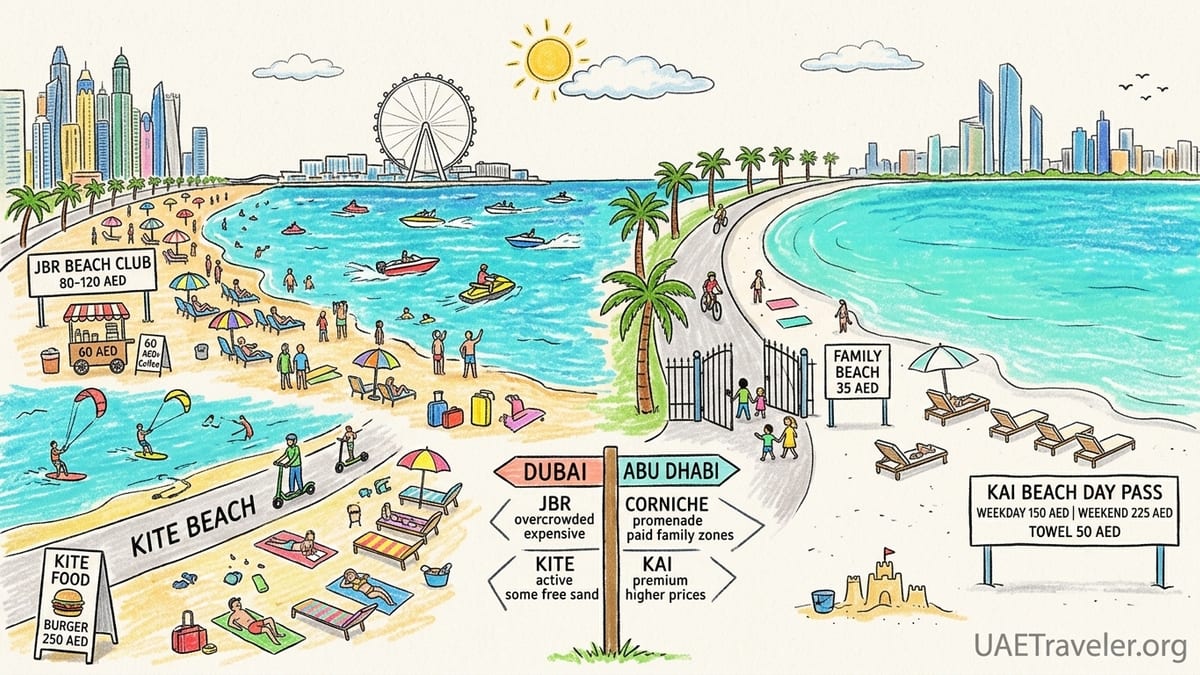
Marketing the Dream vs Walking the Sand
Tourism boards and hotel brands promote Dubai and Abu Dhabi with the same elements: turquoise water, empty loungers, clean lines of cabanas and just enough palm trees to frame the skyline. In Dubai the images usually focus on Jumeirah Beach Residence, known as JBR, with its skyscraper backdrop and Ain Dubai observation wheel offshore. Abu Dhabi’s brochures lean on Saadiyat Island’s powdery white sand or a serene curve of Corniche Beach in soft sunset light. In every image the sea looks calm, the beach uncrowded and the logistics invisible.
On the ground, those invisible details dominate the day. At JBR I had to deal with congested access roads and competition for parking, then the question of whether to tolerate the public sand or rent loungers from one of the beach clubs that now control most of the comfortable space. At Corniche Beach in Abu Dhabi I first had to choose between the free stretch at Al Sahil Gate 4 or the gated family sections where a small fee covers basic facilities and sunbeds, a split that never shows up in glossy photography.
The biggest gap is cost. Visitor guides and older blog posts still talk about “modest” entry fees to Corniche or “budget friendly” Saadiyat public beach. Several of those articles quote Kai Beach’s prices from when weekday entry hovered around 75 to 85 dirhams. More recent information shows adult weekday day passes around 150 dirhams and weekend passes around 225 dirhams, with family packages and cabanas costing far more and towels charged separately. The numbers have climbed faster than many travel sites update their content, which means casual research can leave travelers underestimating their daily spend by hundreds of dirhams.
All of this matters because the marketing does not sell a beach in isolation. It sells a mood: easy, spontaneous and relaxed. Once you start spending more than the cost of a decent hotel room in day passes and loungers for a single family beach day, the mood shifts into something closer to luxury shopping. The question becomes not whether the water is blue enough but whether the premium actually buys noticeably better comfort than a free public beach.
Dubai Reality Check: JBR’s Crowds and Hidden Extras
JBR is one of Dubai’s signature beach strips, heavily promoted as a place where you can walk straight from hotel towers to soft sand. That is technically true if you are staying in one of the waterfront hotels. If you are not, the first challenge is simply arriving. Driving into JBR involves slow traffic along densely built streets, and while there are multi level car parks, recent changes to ticketless systems and enforcement have caught out enough drivers that local forums are full of warnings about fines. Even when you find a space, you are paying city parking rates before you have even seen the sea.
On the sand, JBR’s public section is free to access, but the atmosphere is very far from the quiet scenes in advertising. On a Friday afternoon in peak season the beach was busy from the waterline back to the cafes. Families spread out mats under the sun, tour groups posed in front of branded installations and jet skis and speedboats churned the water into a noisy backdrop. Swimming felt safe within the roped area, but there was constant engine noise and a faint smell of fuel. If you want a sunbed and umbrella, you rent them from one of the beach clubs lining the promenade. Prices vary, but recent quotes for a basic lounger and umbrella set for one person often fall in the 80 to 120 dirham range, and on busier days some venues push higher packages that add drinks or pool access.
Food and refreshments at JBR are another escalation point. Branded coffee chains and casual restaurants charge familiar big city prices. Two iced coffees and bottled water easily push past 60 dirhams. Lunch for a family of four at a mid range restaurant on The Beach strip can reach 300 to 400 dirhams without alcohol. Although there are public toilets and basic changing facilities, they are limited relative to the number of visitors. Many families end up relying on restaurant restrooms, which creates another subtle pressure to keep buying something.
For a notional family of two adults and two children arriving by car on a busy winter weekend, a JBR beach day can look like this: 40 to 50 dirhams in parking, about 300 dirhams for four loungers and umbrellas, 350 dirhams on simple cafe meals, snacks and drinks, plus occasional ice creams or a paid activity such as an inflatable water park session or rolling water ball experience that can run around 100 dirhams per hour for a child. Without trying to splurge, you are already near or above 800 dirhams for what the marketing frames as a casual day at the beach.
Kite Beach: “Free” Access with Metered Comfort
Kite Beach, a little further along the coast, is often presented as Dubai’s more relaxed, local friendly alternative to JBR. In some ways that reputation holds. Access is a little simpler by car, and sections of free parking exist, though they fill early on winter weekends and evenings. The promenade here is lined with food trucks and casual outlets rather than glass fronted malls, and the vibe is noticeably more active, with joggers on the track and kitesurfers offshore when the wind is up.
The beach itself remains free. You can absolutely bring your own towel, sit on the sand and swim between the lifeguard flags without paying for anything except sunscreen and water. This is the closest Dubai comes to the vision of a low cost beach day, and for solo travelers or couples willing to forego shade and loungers, it can be economical. The trade off arrives as soon as you ask for comfort. Sunbed rentals at Kite Beach are offered by private operators along the sand. Recent local recommendations mention rates around 70 to 100 dirhams per lounger, often with an umbrella shared between two. For a family that quickly multiplies into another 250 to 400 dirhams just to get off the sand.
Food at Kite Beach is marginally cheaper than at JBR but still firmly in international city territory. Burgers, loaded fries and drinks for four at one of the better known food trucks can easily hit 200 to 250 dirhams, while coffee and smoothies add more. Water sports are another significant cost driver. Rental prices for stand up paddleboards or kayaks tend to start around 80 to 100 dirhams per hour, kitesurfing lessons cost several hundred dirhams and the ubiquitous banana boat and donut rides add another layer of noise and motion to the swimming area.
The physical environment at Kite Beach is also less tranquil than the images suggest. The sand is clean and the water generally clear, but there is almost no natural shade. In the hotter months this makes midday visits very uncomfortable unless you pay for a lounger with umbrella or bring your own canopy, which some visitors do with folding gazebos and beach tents. The path behind the beach is in constant use by e scooters and bicycles, and loud music spills from some food outlets. For a family aiming for a quiet day with small children, the combination of heat, limited shade and ambient noise can be draining.
Abu Dhabi’s Corniche: Free Promenade, Metered Beach Comfort
Abu Dhabi’s Corniche stretches for several kilometres along the city’s waterfront and features heavily in local tourism promotions. The photos usually show a curved strip of pale sand, calm blue water and perhaps a cyclist on the path. This part of the city does deliver more shade and greenery than Dubai’s beach strips, and the promenade itself really is free to enjoy at any hour, with benches under trees and good views across the water.
When it comes to actually swimming, however, the same pattern of graduated access appears. Corniche Beach is divided into sections, with one gate offering free entry and others operating as family or quiet zones with modest per person fees that include use of loungers and umbrellas. Current local reports describe prices around the mid 30 dirham range per adult for these paid sections, which is cheaper than Saadiyat or Dubai’s beach clubs but still a step above the zero cost impression some guides give when they simply label Corniche Beach as “public.” For a couple or family that plans to spend several hours and cares about shade and a chair, those basic fees become almost inevitable.
On my visit, the free Al Sahil section was relatively quiet on a weekday morning, with a mix of solo swimmers, groups of young men and a few families. The sand was clean but packed in places, and there was no guaranteed shade unless you hugged the edge of the promenade wall. Swimming areas were clearly roped off and lifeguards present, but there was occasional litter along the waterline, likely from the sheer volume of use. The paid family section, by contrast, had orderly rows of loungers, more umbrellas and a more balanced mix of visitors, including many parents with small children.
A Corniche beach day for a family that opts for the paid section can still add up more than expected for visitors primed by language like “token fee” or “small charge.” Transport might involve a taxi ride of 20 to 40 dirhams each way if you are not staying within walking distance. Four paid entries with loungers could come to roughly 140 to 160 dirhams, snacks and drinks at the small kiosks or nearby cafes perhaps another 150 dirhams, and optional extras such as e scooter rentals along the promenade or inflatable play rentals on the sand adding still more. It is very possible to keep total costs under 300 dirhams if you plan carefully, but the day is not free in the way guidebook photography implies.
Kai Beach, Saadiyat: When Public Turns Premium
Saadiyat Island’s shoreline is the star of many Abu Dhabi campaigns. The water here is a more vivid turquoise, the sand noticeably softer and whiter, and the low rise profile of the island avoids the canyon effect of tall towers. For years, Saadiyat Public Beach was a byword for an affordable taste of this environment. That era is over. The same stretch has been redeveloped and rebranded as Kai Beach, now run as a paid day pass venue with fixed prices and a more controlled experience.
Official and operator information as of late 2026 indicates that weekday adult day passes cost around 150 dirhams, with a portion, roughly 50 dirhams, redeemable on food and drink. Children between 6 and 12 tend to be charged around half that amount, and there are packages for families and cabanas that climb toward or beyond the 400 to 500 dirham mark on busy weekends. Towels are not automatically included and can cost around 50 dirhams each to rent. These figures significantly exceed older tourism directory listings that still quote entry in the 70 to 85 dirham range, a discrepancy that has caused surprise and frustration among visitors who arrived expecting a modest fee.
The experience once inside is undeniably more curated than at a free public beach. Loungers with stylish umbrellas are spaced with comfortable gaps, walkways keep most of the sand free of clutter and the cafe and food truck area serves competent meals and drinks. Showers, changing rooms and toilets are in good condition, and lifeguards monitor a clear swimming zone where the sea feels cleaner and calmer than in more urban locations. The trade off is crowd density and policy complexity. Weekends and public holidays can become busy enough that families report a long walk from the car park and competition for front row loungers, while Friday women’s days and child age restrictions on some offers can confuse first time visitors.
For a family staying at a Saadiyat city hotel that does not include beach access, the full cost of a Kai Beach day can be startling. Two adult weekday day passes at 150 dirhams each, two child passes at around 75 dirhams, and four towel rentals at 50 dirhams already create a base charge close to 650 dirhams before anyone has eaten or drunk anything. Even with some credit redeemable on food, a modest lunch and a couple of rounds of soft drinks can easily bring the total into the 800 to 900 dirham range, especially once transport and occasional ice creams are counted. On a weekend, the same outing pushes higher again.
Sea View Hotels and the Illusion of Easy Beach Access
One of the most consistent frustrations across both cities is the marketing of “sea view” or “beachfront” hotels that do not translate into simple, included beach access. Many properties on Dubai Marina and JBR have excellent views of the water, but only a subset provide direct beach frontage with private sand for guests. Others rely on shuttles to public or partner beaches, or they sell separate beach club access as an add on. It is common to see booking pages show wide angle shots of a beach that is technically reachable but not adjacent, often without clearly explaining that loungers and umbrellas at that beach carry their own fees.
Abu Dhabi has similar cases. Hotels along the Corniche advertise sea views and easy access to the promenade, yet guests still have to cross busy roads and then choose between free and paid sections of the public beach like anyone else. Some Saadiyat hotels genuinely front the sea and include beach access, but even there, the tone of marketing for nearby paid venues such as Kai Beach can blur the line between what is included and what is separate. Several travelers report realizing only on arrival that staying on Saadiyat Island does not automatically grant admission to every beach facility on the island.
The sense of disappointment grows when you have already paid extra for an upgraded sea view room. You stand at the window looking at the water, only to discover that to get onto a lounger at the beach in the photo you must either pay a resort day pass, obey restricted opening hours or share fully public facilities with day visitors from across the city. In some hotels, even transport to the advertised beach involves waiting for an hourly shuttle or paying separately for a taxi, neither of which appear in the hero image used to sell the stay.
If there is one rule that emerges from these experiences, it is this: treat beach access as a separate product from sea views. Before booking, ask directly whether your room category includes use of a specific beach, whether loungers and towels are free for guests, and how you actually reach the sand. If the answers are vague, budget as if you will need to buy a separate day pass or walk to a public beach and arrange shade yourself.
What a Full Family Beach Day Really Costs
To understand just how far reality can drift from expectation, it helps to look at approximate full day budgets for a family of four: two adults and two children under 12, staying in the city and heading out for a dedicated beach day. These figures are not exact, but they reflect the price bands currently quoted by operators and recent visitor reports.
In Dubai, a JBR or Kite Beach day with paid loungers might look like this. Transport could involve 20 to 50 dirhams in RTA parking fees or 50 to 80 dirhams in taxi fares return, depending on starting point. Four loungers and two umbrellas at a mid range rental rate of 80 to 100 dirhams per lounger bring the shade bill close to 320 to 400 dirhams. Lunch and snacks in cafes, even at the cheaper end, seldom come in under 300 dirhams for four, and more often reach 350 to 450 dirhams once drinks and a second round of coffees or ice creams are included. Add one hour of paddleboard or kayak rental for one adult and one older child at around 80 to 100 dirhams each and you are near or above 800 to 950 dirhams before any unforeseen extras.
In Abu Dhabi, a Kai Beach day can surpass even that. A return taxi from the main island to Saadiyat might cost in the 60 to 80 dirham range, or more for hotel car transfers. Day passes for two adults and two children at the rates quoted above quickly reach the mid 400 to low 500 dirham bracket before towels. Towel rental at roughly 50 dirhams each can add another 200 dirhams if you do not bring your own. Food and drink on site, even if you spend carefully and use redeemable credit, can ring up another 250 to 350 dirhams. Taken together, a Saadiyat family beach day can slide into the 900 to 1,100 dirham range, comparable to or exceeding the nightly room rate in some good mid range hotels.
By contrast, a day on Dubai’s Kite Beach or Abu Dhabi’s Corniche using only the truly public sections and bringing your own shade, towels and snacks can keep the spend remarkably low. Two short taxi rides might cost 60 to 80 dirhams total, supermarket picnic supplies perhaps another 60 to 100 dirhams and optional small treats from kiosks 50 to 80 dirhams. If you resist paid loungers and water sports, your total outlay might stay under 250 dirhams. The question is not whether this is possible but whether the comfort and conditions at the free beach feel worth the time in the heat.
Where I Would Not Spend the Money Again
After trying both paid and free options in the two cities, some experiences stood out as poor value relative to their marketing. Top of the list is paying for loungers at JBR on a busy weekend. The environment simply does not support the tranquil image used to sell premium waterfront days. The sand is crowded, the noise from watercraft and passing helicopters is constant, and the line of towers traps heat and reflects sound back onto the beach. Sitting on a rented lounger in the fourth or fifth row from the water, surrounded by speakers, selfie sticks and inflatable toys, never felt like a premium product worth several hundred dirhams for a family.
A second regret is paying full day pass prices for Kai Beach on a hot, hazy weekend afternoon. The sea was as beautiful as promised, but the combination of high entry cost, additional towel fees, crowded car park and limited natural shade meant that the experience felt squeezed. The family packages and credit toward food did not offset the sense of being constantly upsold on extras like cabanas. It is easy to imagine a very different experience on a quiet weekday morning in shoulder season, but on the day I visited the value equation tilted unfavourably.
In both cities, choosing hotels purely for “sea views” without guaranteed included beach access also feels like a mistake I would avoid. The extra nightly cost for a higher floor waterfront room rarely translated into a smoother, cheaper day on the sand. When a hotel’s marketing used beach photography that turned out on closer inspection to be a public beach several blocks or a shuttle ride away, the stay felt misrepresented.
None of these are universally bad places. They are simply cases where the price paid, under the specific conditions encountered, did not align with the promise of effortless relaxation. The gap between the marketing and the practicalities made the disappointment sharper.
Where Paid Access Was Worthwhile, and How to Avoid Overpaying
There were, however, situations where paying for beach access or facilities felt justified. A midweek, late afternoon visit to the family section of Abu Dhabi’s Corniche stands out. The modest per person charge brought order, adequate shade, reasonable crowd levels and clean changing facilities without the heavy upselling atmosphere of a full beach club. Families with young children seemed at ease, lifeguards were attentive and the city skyline softened in the late sun. If I had to choose one place to recommend for an affordable, structured beach experience, that would be it.
In Dubai, the most satisfying days were the simplest. Arriving early at Kite Beach on a weekday, before the heat built and the promenade filled, allowed several calm hours of swimming and sand play using only towels and a small beach tent brought from home. Buying water and snacks from a supermarket beforehand, then topping up with one light meal from a food truck, kept costs under control. Here the free access genuinely underpinned the experience rather than being overshadowed by add ons.
Across both cities, the same practical strategies repeatedly made the difference between feeling exploited and feeling in control. Firstly, cross checking beach prices directly with operators or recent local reports, rather than relying on tourism directories or older blogs, avoided rude shocks at entry gates. Secondly, bringing your own towels and, where allowed, compact shade structures reduced dependence on expensive on site rentals. Thirdly, timing visits for weekdays, early mornings or late afternoons outside the fiercest heat and weekend peak removed much of the crowding that makes even expensive beaches feel stressful.
Finally, choosing accommodation on the basis of confirmed, included beach access rather than marketing language about “sea views” proved essential. A simple hotel with a clear policy that guests may use its private beach, complete with towels and loungers, often delivered more real value than a flashier tower that required daily negotiations with external beach clubs.
The Takeaway
Dubai and Abu Dhabi still offer some of the most visually striking urban beaches in the world. Their water is warm for much of the year, the sand is maintained, and the skyline backdrops are instantly recognisable. What the advertising rarely acknowledges is the web of charges, restrictions and compromises that sit between a visitor and those tranquil scenes. Entry fees rise faster than directory listings, loungers and towels quietly double the bill, and a supposedly beachfront hotel can leave you queueing for a shuttle to a paywalled strip of sand.
That does not mean the UAE coast should be avoided. It means travelers need to approach glossy beach marketing with a critical eye and a clear budget. Ask hard questions before booking, verify current prices from primary sources, and be honest about what matters most to you: is it the perfect Instagram skyline shot, or a genuinely relaxed day by the water with your family that does not leave you wincing at the final bill. In many cases, a humble public beach with a picnic and a simple umbrella will serve that second goal better than any cabana and day pass ever could.
FAQ
Q1. Are Dubai and Abu Dhabi beaches actually free to use?
Some stretches of sand in both cities are genuinely free, such as parts of Kite Beach and the Al Sahil gate at Abu Dhabi’s Corniche. However, most of the comfort items that people associate with a beach holiday, such as loungers, umbrellas, towels and convenient changing facilities, are controlled by private operators and come with separate fees.
Q2. How much should a family budget for a paid beach day in Dubai?
For two adults and two children using paid loungers at JBR or Kite Beach, with cafe meals and one simple water activity, a realistic budget is often in the 800 to 1,000 dirham range. This includes transport, sunbeds, food, drinks and a modest amount of entertainment.
Q3. Is Kai Beach on Saadiyat still an affordable public beach?
No. The former Saadiyat Public Beach is now Kai Beach, a paid venue with adult day passes typically around the mid three figure mark in dirhams, additional charges for towels and higher weekend prices. It offers a high quality setting but no longer fits the image of a cheap public beach.
Q4. Do sea view hotel rooms in Dubai include private beach access?
Not always. Many hotels that advertise sea views or proximity to JBR and the Marina do not have their own private beach and instead rely on public sand or paid partnerships with beach clubs. Guests may still have to pay for loungers and umbrellas or travel by shuttle to a different location.
Q5. Which Abu Dhabi beach offers the best value for families?
The paid family sections of Corniche Beach often strike the best balance between cost and comfort. Entry fees are moderate compared with Saadiyat, loungers and umbrellas are included and facilities are adequate for a full day with children.
Q6. When are Dubai and Abu Dhabi beaches least crowded?
Weekday mornings outside local school holidays are generally the quietest. Arriving soon after opening, especially between November and March when temperatures are milder, usually provides several calmer hours before crowds and midday heat build.
Q7. Can I bring my own food and shade to UAE public beaches?
At free public sections like Kite Beach and parts of the Corniche, visitors commonly bring their own snacks, water and simple shade such as umbrellas or small tents, provided they respect local rules and do not block walkways. At paid venues and hotel beaches, outside food and personal shade structures may be restricted or discouraged.
Q8. Are there child age restrictions at UAE beach clubs?
Yes, some beach clubs and premium day pass venues have minimum age rules or women only days, particularly on Saadiyat Island. Boys above a certain age may not be allowed on women only days, and some offers are limited to adults. It is important to check age policies before booking.
Q9. How can I avoid overpaying for beach access in the UAE?
Verify current prices directly with beach operators or recent local sources, ask your hotel exactly what beach access is included, bring your own towels and water where permitted, and consider visiting free beaches with a picnic on at least some days instead of buying day passes every time.
Q10. Is paying for a beach club ever worth it in Dubai or Abu Dhabi?
For travelers who value quieter surroundings, guaranteed shade, clean facilities and attentive safety, paying for a well managed beach club or organised section like Corniche’s family area can be worthwhile, especially on weekdays. The key is to choose venues whose actual atmosphere matches their price, rather than relying only on marketing photographs.