


On my first trip to the UAE I thought I had been clever. I booked a cheap hotel in old Dubai, reasoning that I would “just take taxis” to the sights. By day three, as I sat in Sheikh Zayed Road traffic watching the meter creep toward another 60 dirhams, I realised my mistake. My nightly rate was low, but my actual daily spend was higher than friends staying in smarter areas walking distance from the Metro. That one decision on location changed how much I saw, how long I sat in cars, how often I escaped the heat and, ultimately, how I felt about Dubai and Abu Dhabi.
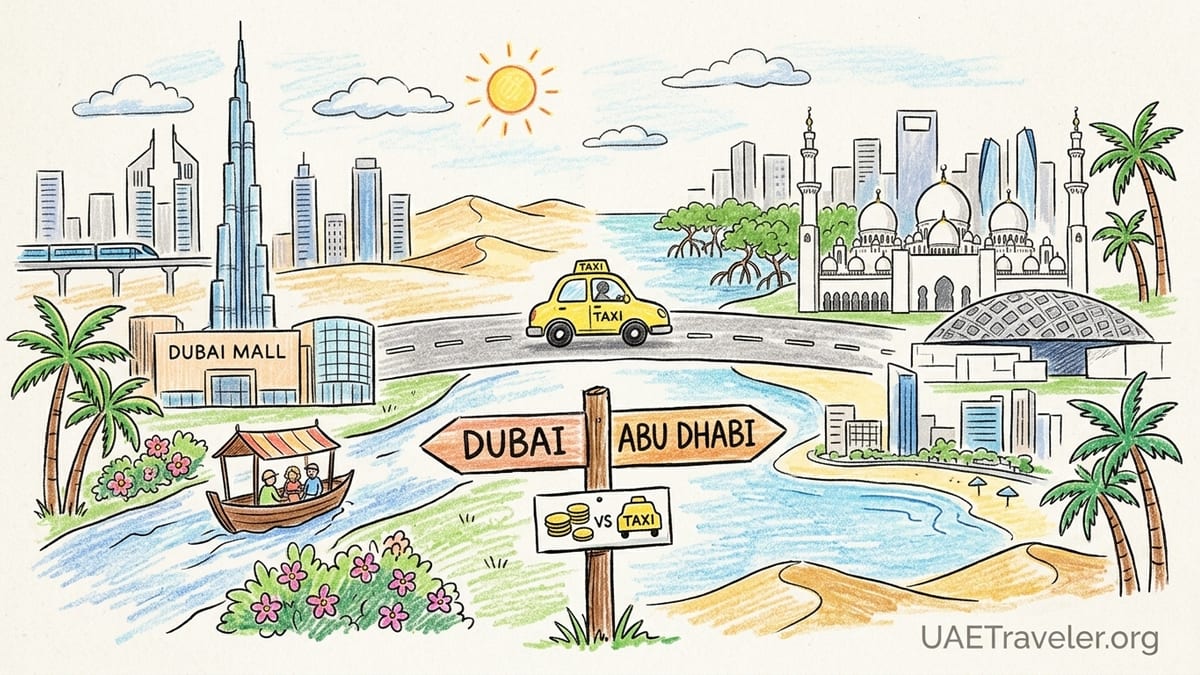
How Hotel Location Reshapes a First UAE Trip
Dubai and Abu Dhabi are built for cars, long highways and air conditioning. Distances that look short on a map can easily turn into 30 minutes in traffic and a surprising taxi fare. For a first-time visitor that matters more than it would in many European or Asian cities where you can simply walk everywhere. In the UAE, where you stay often decides what you will realistically see.
On my first Dubai visit I based myself in Deira, near the older creekside souqs. My hotel was roughly AED 220 per night, room only, compared with around AED 450 for the midrange hotels my friends had booked in Business Bay and Dubai Marina. I felt smug until I added the taxi receipts. A return cab from Deira to Downtown Dubai for the Burj Khalifa and Dubai Mall cost around AED 80 to 100 depending on traffic and time of day, and I was doing some version of that trip almost twice a day. By the end of a four-night stay I had spent more than AED 400 on taxis alone, roughly the price difference between my “bargain” and a more central hotel with Metro access.
Abu Dhabi taught me a similar lesson. I once stayed at a resort on Yas Island to be close to Ferrari World, Warner Bros. World and Yas Waterworld, and then underestimated the distance to the city’s other sights. The Yas Island cluster is brilliant for families and theme-park fans, but the 25 to 35 minute taxi rides into the Corniche and Qasr Al Watan quickly added up. It was perfect for that specific trip, but it would have been the wrong base for a culture-heavy first visit focusing on the Louvre Abu Dhabi, the Grand Mosque and the city itself.
Those two experiences now shape how I look at UAE hotel areas. Below is how I weigh Downtown Dubai, Business Bay, Dubai Marina, JBR, Deira, Bur Dubai and Al Barsha against Abu Dhabi’s Corniche, Yas Island, Saadiyat Island and central districts for a first-time trip, with concrete examples of prices, access and the hidden costs that can turn a cheap stay into an expensive one.
Downtown Dubai and Business Bay: The Burj-Centric Stay
Downtown Dubai is the obvious postcard choice for a first trip. You are next to the Burj Khalifa, Dubai Mall and the evening fountain shows. The area is modern, walkable in short bursts and reasonably well connected by the Red Line of the Metro at Burj Khalifa/Dubai Mall station, although many hotels still require a 10 to 15 minute walk or short internal shuttle. Around the Dubai Mall, car traffic can be heavy at peak evening hours, but you are at least stuck in traffic close to your hotel rather than commuting across town.
In October 2026, standard rooms in midrange international chains in Downtown, such as the Manzil or Vida branded properties and similar four-star hotels near the mall, were showing from roughly AED 550 to 850 per night on flexible rates including taxes, often without breakfast. Five-star options such as Address Downtown, Palace Downtown or Armani Hotel easily reach AED 1,200 to 2,000 per night or more. Most require at least a partial prepayment or a one-night deposit on flexible bookings and may hold a refundable security deposit of AED 500 to 1,000 per stay on arrival for incidentals. Breakfast supplements often add AED 100 to 150 per person per night if not included in the rate.
Immediately south of Downtown, Business Bay offers a practical alternative. It is a dense cluster of hotels and apartments along an extended creek, with slightly lower nightly rates while still just a 5 to 10 minute taxi ride from Dubai Mall in normal traffic. Midrange hotels here, such as DoubleTree Business Bay, Radisson Blu Canal View or similar four-star chains, are commonly priced between about AED 350 and 650 per night in the cooler season, with frequent promotions including breakfast. Officially, Business Bay has its own Metro station on the Red Line, but many hotels in the community sit a short taxi ride away from it, so you still want to check walking distance before booking.
For a first-time sightseeing-heavy trip, Downtown and Business Bay reduce taxi distances and make it easy to return to your room for an air-conditioned break in the middle of the day. The downside is value. You pay a significant premium for views and proximity to the Burj even if you spend most of your time exploring elsewhere. If you are comfortable using the Metro and do not mind a 15 to 20 minute ride into Downtown, more affordable areas like Al Barsha or Bur Dubai can deliver similar convenience at a lower nightly cost.
Dubai Marina and JBR: Beachfront Buzz and Long Distances
Dubai Marina and Jumeirah Beach Residence, known simply as JBR, feel like a separate city at the western end of Dubai. This is the area of tall residential towers, yacht-lined canals and a busy beachfront promenade lined with restaurants and cafes. It is an excellent base if you want a beach atmosphere and lively evenings on a first trip. The Marina has its own Red Line Metro stations at DMCC and Sobha Realty, plus the Dubai Tram that loops around the Marina and JBR, so you are not cut off from public transport.
The trade-off is distance. It can take 25 to 35 minutes by Metro or taxi from Dubai Marina to Downtown Dubai in moderate traffic, and more at peak evening times. A one-way taxi fare often sits around AED 60 to 80 between these areas depending on where exactly you start and end and the time of day. Doing that return journey daily across a four-night stay can add AED 500 or more to your budget, the equivalent of raising your nightly rate by AED 120 without noticing it on the booking confirmation.
Hotel prices here span a wide range. In late 2026, standard rooms in large four-star Marina properties on or near the waterfront often show from roughly AED 450 to 800 per night on flexible rates, with well-known chains clustering around the Marina Walk and JBR beachfront. Luxury beach resorts along JBR, including well-known international brands with private beach clubs and large pool decks, frequently price from around AED 900 to 1,800 per night in the high season, with many rooms accommodating couples and small families on sofa beds. Resort-style properties may also take larger deposits at check-in, for example holding AED 500 or more per night on your card to cover extras, and they can charge for on-site parking or valet services if you have a rental car.
For first-timers, Dubai Marina and JBR make most sense when the beach and evening promenade are genuine priorities rather than nice-to-have extras. If your itinerary is dominated by Burj Khalifa, Old Dubai, day trips and desert safaris, paying a significant premium to be directly on the beach may not make sense. You can still visit public and paid beaches by taxi or Metro from a more central base while keeping nightly costs and daily taxi time lower.
Deira, Bur Dubai and Al Barsha: Budget Bases and Hidden Transport Costs
Deira and Bur Dubai form the older core of the city around Dubai Creek. They are where abras cross the water, gold and spice souqs still trade and streets feel more lived-in. For price-conscious travelers these areas are tempting. In 2026, many simple three-star hotels and serviced apartments in Deira and Bur Dubai were available from roughly AED 150 to 300 per night including taxes outside of peak event periods. These areas are threaded with Metro stations on both the Red and Green Lines, so you can reach Downtown, the Marina and even the airport for just a few dirhams if you are happy to navigate the system.
The trade-off here is time and comfort. When I based myself in Deira, I found that journeys to newer parts of the city often took 30 to 45 minutes each way including walking and waiting for trains, or 20 to 35 minutes by taxi. That is not disastrous for a budget trip, but if you only have three or four days and want to see a lot, you spend a noticeable portion of your holiday in transit. If you lean on taxis because of the heat, the cost advantage of the lower room rate erodes quickly. A typical day of round trips between Deira, Downtown, the Marina and back to your hotel can easily reach AED 120 to 200 in taxi fares, the kind of money that could have upgraded you into a better-located midrange hotel elsewhere.
Al Barsha, by contrast, sits inland behind the Palm Jumeirah and is anchored by Mall of the Emirates. It is not glamorous, but it is practical. Several hotels cluster within a short walk of Mall of the Emirates Metro station on the Red Line, and you can reach both Downtown and Dubai Marina in around 15 to 25 minutes by train without changing lines. According to recent trip-cost breakdowns, budget and lower midrange hotels here typically run between about AED 180 and 350 per night for simple but clean rooms, often including basic breakfast and free on-site parking for guests.
For a first-time visitor focused on sightseeing rather than pool days, Al Barsha and the better parts of Bur Dubai can hit the sweet spot: affordable nightly rates, Metro access, easy taxi rides and local restaurants that are much cheaper than hotel outlets in Downtown or the Marina. The key is to choose a property genuinely close to a station. A cheap hotel 20 minutes’ walk from the Metro in summer heat is not good value if you then resort to a taxi for every journey.
Abu Dhabi Corniche and Central Districts: Classic City-and-Sea Base
Abu Dhabi has a very different feel from Dubai. It is the federal capital, more spread out and slightly quieter. For a first stay, the Corniche and central city districts offer the best mix of seafront, walkable promenade and access to major sights. The Corniche itself is a long, landscaped waterfront with public beaches, cycling tracks and parks, while adjacent city blocks hold shops, cafes and residential towers. From here, short taxi rides of 10 to 20 minutes connect you to the Sheikh Zayed Grand Mosque, Qasr Al Watan and ferry points to nearby islands.
Hotels along the Corniche, including five-star names and older landmark properties, tend to be significantly better value than similar beachfront hotels in Dubai. In late 2026, it was still common to see large five-star Corniche properties pricing standard rooms from roughly AED 450 to 900 per night in the main season on flexible rates, sometimes including breakfast and access to private or semi-private beach sections. Midrange central-city hotels a few blocks inland could be even cheaper, adding a short walk or taxi ride to the promenade but cutting rates to around AED 250 to 450 per night.
In my own stays along the Corniche, I have appreciated being able to step out for a sunset walk or a quick swim without paying the premium that a comparable beachfront address in Dubai would demand. Taxi rides from here to the Louvre Abu Dhabi on Saadiyat Island, for example, are typically around 20 minutes in light traffic, while reaching Yas Island’s theme parks usually takes 25 to 30 minutes. If your trip is balanced between city sights, a taste of the beach and perhaps one theme park day, the Corniche or nearby central districts give you flexibility without locking you into one island’s attractions.
One practical point: some Abu Dhabi hotels charge for valet or underground parking, while others include it for free, and daily service charges can be higher than Dubai once municipality and tourism fees are added. It is worth checking whether your quoted nightly rate is inclusive of all taxes and mandatory fees and whether breakfast is included. Cancellation terms vary widely, with some Corniche properties allowing free cancellation or date changes up to one or two days before arrival on flexible rates, while advance-purchase offers can be significantly cheaper but fully non-refundable.
Yas Island and Saadiyat Island: Theme Parks vs Culture and Beach
Yas Island and Saadiyat Island are Abu Dhabi’s two flagship resort districts, but they suit different kinds of first-time trips. Yas Island is entertainment-led. It is home to Ferrari World, Warner Bros. World, Yas Waterworld, an F1 circuit with the distinctive W Abu Dhabi hotel built over the track, and a growing strip of restaurants and bars around Yas Bay. Families can easily spend two or three full days moving between parks without leaving the island, and many hotels run shuttle buses linking the main attractions.
Hotel prices on Yas Island in 2026 usually reflect that convenience. Midrange chain hotels near Yas Mall and the parks were often pricing standard rooms from roughly AED 400 to 700 per night outside major events, while resort-style and branded luxury properties with large pools tended to range from AED 700 to 1,400 per night. During the Abu Dhabi Grand Prix or major concerts those numbers can climb sharply. Some hotels on Yas require higher deposits during event periods and may impose stricter cancellation terms, including full prepayment and non-refundable bookings weeks in advance, so it is essential to read the rate conditions carefully.
Saadiyat Island, in contrast, is the quieter cultural and beach hub. Its long natural beach hosts a cluster of luxury resorts, and the island also holds the Louvre Abu Dhabi and newer museum projects in the cultural district. Compared with Yas, Saadiyat feels more relaxed, with an emphasis on wider stretches of sand and calmer water. In 2026, many five-star beachfront resorts here, including international brands, were showing starting rates from roughly AED 900 to 1,600 per night in the main season, with some packages including breakfast and partial board. The premium largely reflects the combination of high-end service, direct beach access and the prestige of the location.
For a first-time visitor whose main aim is to relax on the beach with occasional forays into the city and one or two museums, Saadiyat can be a strong choice, but it is overkill if you are primarily sightseeing. The Louvre Abu Dhabi is easily reached by taxi from the Corniche or downtown hotels, and public beaches in Abu Dhabi, including sections of the Corniche, provide swimmable water without Saadiyat-level room rates. Yas Island similarly makes most sense when at least two of its theme parks are central to your plans. Otherwise, paying daily taxi fares from there into town for the Grand Mosque and Qasr Al Watan will quickly narrow any savings you made on an attractive room rate.
How A “Cheap” Hotel Becomes Expensive
My Deira stay in Dubai is the clearest example in my own notebooks of how a budget hotel can become an expensive decision. Across four nights I averaged around AED 230 per night for a simple, clean room with basic breakfast. At the time, friends in Business Bay were paying roughly AED 420 per night at a four-star property including breakfast and closer access to the Metro. On paper, I was saving around AED 760 across the stay.
In practice, my daily pattern looked like this: morning taxi to Downtown for Burj Khalifa or Dubai Mall, another ride to a different neighbourhood for lunch or an afternoon attraction, then a final journey back to Deira at night. Each individual fare rarely felt painful, often somewhere between AED 25 and 60, but over four days the total taxi spend exceeded AED 450. When I added in extra time spent traveling and the days when I chose taxis over the Metro because of the heat, my net saving was closer to AED 300 and came at the cost of longer days and less flexibility.
The same logic can apply in reverse with beach resorts. Paying an extra AED 400 per night to be on the sand might look extravagant if you only swim for an hour a day. Yet if that location saves you two long taxi journeys daily and lets you build a slower, more enjoyable routine, the higher rate can be justifiable. The key is to match the premium you are paying to how often you will use what it buys. On a sightseeing-heavy first trip where you expect to spend most of your time visiting mosques, observation decks, museums and desert camps, a midrange city hotel near a Metro or central road junction often delivers better value than a resort where you are too busy to enjoy the pool.
Before I book now, I sketch a basic cost comparison. I take the nightly rate difference between two realistic hotel options, multiply it by the length of stay, and then ask how much taxi money and time each location is likely to save. If staying in Business Bay or Al Barsha instead of Deira cuts my average cab bill by AED 70 per day and saves 40 minutes of commuting, the slightly higher room rate usually wins, especially when I consider the comfort of being able to pop back to the room in the heat of the afternoon.
Choosing Areas by Traveler Type: A Practical Decision Table
Different types of travelers will naturally gravitate toward different UAE hotel areas on a first trip. This is how I now think about it after several visits, bearing in mind the trade-offs in proximity to attractions, Metro access, evening atmosphere and value.
For couples, a split stay often works well. Starting with two or three nights in Downtown Dubai or Business Bay gives easy access to Burj Khalifa, Dubai Mall, Dubai Frame and Old Dubai, plus the option of evening fountain shows and fine-dining restaurants. Adding another two nights in Dubai Marina or JBR brings the beach and waterfront promenades into the picture. In Abu Dhabi, couples who enjoy city walks and a mix of culture and relaxation often prefer the Corniche or Saadiyat Island, depending on budget, with one or two nights enough if Dubai is the main base.
Families with children usually benefit from fewer hotel changes. In Dubai, Al Barsha can be an excellent base, balancing space, Metro access and supermarkets with quick links to both Downtown and the Marina. For theme-park-heavy trips, especially when Abu Dhabi is in the plan, a few nights on Yas Island can simplify life because the main attractions are minutes away by shuttle or on foot and many hotels offer family rooms or interconnecting options. In that scenario, a more central Corniche hotel in Abu Dhabi is then useful if you want to explore city sights after the parks.
Solo travelers and budget visitors will find the best value in Deira, Bur Dubai and Al Barsha, provided they choose properties close to the Metro and read recent reviews carefully. These areas offer inexpensive South Asian and Middle Eastern restaurants, laundries and convenience stores that help keep daily spending low. The trade-off is that evenings are quieter and more functional than the resort districts. Luxury visitors, by contrast, can lean into Downtown and JBR in Dubai and Saadiyat or the higher-end Corniche properties in Abu Dhabi, using taxis or private transfers liberally without worrying as much about the marginal cost per ride.
However you travel, it helps to decide your top two priorities in advance. If your non-negotiables are “see the Burj Khalifa and Old Dubai” and “keep costs sensible,” then Downtown may be less important than a good-value hotel on the Red Line with an easy Metro ride into those areas. If your priorities are “spend time on the beach” and “visit one or two big attractions,” then a resort area makes more sense and you can treat city taxi rides as occasional extras rather than daily necessities.
The Takeaway
Looking back at my early UAE trips, my biggest mistakes were trying to save too much on nightly rates and underestimating both distance and heat. In Dubai I would now avoid staying far from the Red Line of the Metro on a first trip, unless I was on a short, focused beach break. Deira and Bur Dubai let me experience the historic creekside and save money, but for a short, high-energy first visit I would choose Al Barsha, Business Bay or Downtown depending on budget, simply to spend less time in cars and more time actually doing things.
In Abu Dhabi, I would not automatically book Yas Island or Saadiyat for a first visit unless I had a clear theme for the trip. For a two or three night introduction focused on the Grand Mosque, Qasr Al Watan, the Louvre Abu Dhabi and some seafront walks, a Corniche hotel or a central city property a short taxi ride from the promenade feels like the best compromise between cost, atmosphere and flexibility. If theme parks were central, I would spend one or two nights on Yas Island instead of commuting back and forth from Dubai or the Corniche every day.
My preferred strategy now for a first-timer would be five or six nights in Dubai and two nights in Abu Dhabi. Within that, I would split Dubai into three nights in a Burj-centric area such as Downtown or Business Bay and two or three nights in a more affordable but still well-connected area like Al Barsha or Dubai Marina, depending on how important the beach is. In Abu Dhabi I would choose either two nights on the Corniche or a combination of one night on Yas Island and one in the city, again guided by whether the parks are non-negotiable.
The two mistakes I consciously avoid in my planning are chasing the very cheapest hotel at the expense of location and paying resort premiums for facilities I will barely use. In the UAE, where distances are long and temperatures are high for much of the year, being close to what you want to see, and to a reliable Metro or taxi route, is not a luxury detail. It is the difference between a trip that feels smooth, spontaneous and varied, and one that feels like a series of long transfers between hotel and attraction. When in doubt, I now pay a little more for a better base and let the city’s taxis and trains support the trip instead of defining it.
FAQ
Q1. Is it better to stay in Dubai or Abu Dhabi on a first trip to the UAE?
For most first-time visitors, Dubai makes the better main base because it has a denser cluster of headline attractions, more varied neighbourhoods and the Metro, with Abu Dhabi added as a two-night side trip for the Grand Mosque, Louvre Abu Dhabi and Corniche.
Q2. How many nights should I spend in Dubai and Abu Dhabi on my first visit?
If you have one week, a practical split is five nights in Dubai and two in Abu Dhabi. That gives time for key sights, a desert trip and at least one relaxed day without feeling rushed.
Q3. Which Dubai area is best if I want to see Burj Khalifa and also keep costs under control?
Consider Business Bay or Al Barsha. Both offer lower nightly rates than Downtown but still keep Burj Khalifa within a short taxi or Metro ride, helping you balance convenience and budget.
Q4. Is it worth paying extra to stay on the beach in Dubai?
It depends on how often you will actually use it. For a sightseeing-heavy first trip, paying a large premium to be directly on JBR or the Palm can be wasted if most days are spent in the city or on tours.
Q5. Do I need to rent a car, or can I rely on taxis and the Metro?
Most first-time visitors manage well with taxis and the Dubai Metro, especially if they choose a hotel close to a station. In Abu Dhabi, where there is no metro, taxis and occasional rideshares usually suffice for short stays.
Q6. Are Deira and Bur Dubai safe and suitable for budget travelers?
Generally yes. These older districts are busy, well lit and used by locals and workers, with plenty of affordable hotels and restaurants. The main compromise is longer daily travel time to the newer attractions.
Q7. Is Yas Island in Abu Dhabi a good base if I am not visiting the theme parks?
If the theme parks are not on your list, Yas Island’s location can feel inconvenient, as you will rely on taxis into the city for most sights. In that case the Corniche or central districts are usually better bases.
Q8. How far in advance should I book hotels in Dubai and Abu Dhabi?
For high season from roughly November to March or for major events like the Abu Dhabi Grand Prix and New Year’s Eve in Dubai, it is sensible to book several months ahead to secure better rates and flexible terms.
Q9. Do hotels in the UAE usually include breakfast and free cancellation?
Not always. Many midrange and luxury properties price room-only rates lower and add breakfast as a paid supplement, and the cheapest offers can be non-refundable. Check exactly what is included before confirming.
Q10. What is the best area in Dubai for solo travelers on a budget?
Al Barsha and parts of Bur Dubai work well for solo travelers who want value and access to the Metro. They provide affordable hotels, malls and places to eat without feeling too isolated.