


I realized I had misread Dubai the moment I stepped out of the Burj Khalifa elevator onto the 148th floor. I had paid roughly 370 AED for the “At the Top SKY” experience, more than double the standard observation-deck ticket, lured by promises of a quieter lounge, more exclusive views and a premium, once-in-a-lifetime moment. In reality, my “VIP” time in the SKY lounge lasted less than half an hour before we were funneled down to the same crowded 124th and 125th floors as everyone else. The included snacks were sparse, the staff rushed us along, and the famous view through slightly dusty glass did not feel 200 AED better than what I would have seen on the cheaper ticket. It was my first wake-up call that in Dubai, premium branding can hide surprisingly thin value.
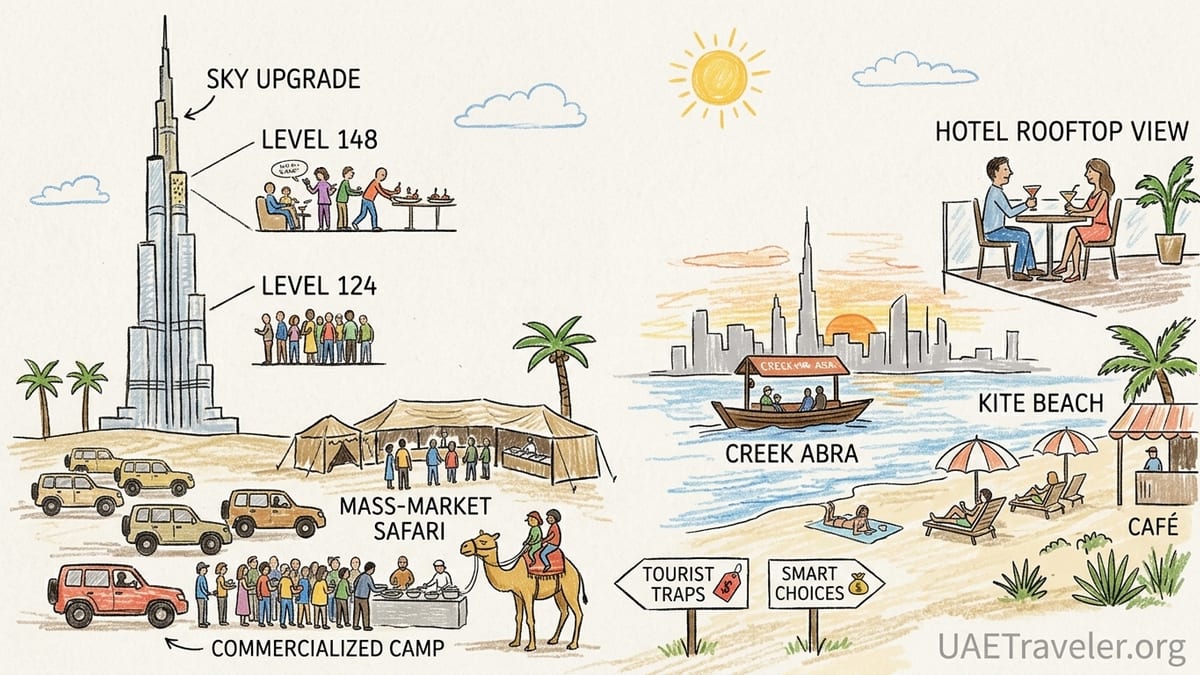
When “Sky” Upgrades Do Not Match Sky-High Prices
Observation decks are marketed as essential Dubai experiences, and the Burj Khalifa is at the center of that story. In 2026, standard “At the Top” tickets for levels 124 and 125, bought directly or through major resellers, often start around 179 AED for non-prime hours, while the “At the Top SKY” option that includes level 148 frequently jumps to around 370 AED or more for similar time slots. That is roughly double the price for access to a floor that, in many cases, you will experience for less than thirty minutes before being merged into the same lower crowd you were trying to avoid.
The marketing language promises an “exclusive lounge” and a “personalized tour,” along with canapés and soft drinks. In practice, recent visitors commonly describe a short stay in a compact lounge with limited seating, small trays of snacks that disappear quickly, and staff who gently but firmly move guests along to keep the groups flowing. Elevators for the SKY experience are sometimes shared with other tours, and the photo opportunities, though impressive, are constrained by reflective glass and window smudges rather than the open-air feel that some visitors expect when they read the word “sky.”
The critical mismatch is time versus cost. A standard 124/125 ticket can give you a flexible hour or more to wander, wait out clouds, and revisit viewpoints on both sides of the tower. By comparison, much of the SKY premium is spent standing in ticket lines, security queues and elevator transfers, all before and after that brief stint on level 148. There are reports of total visit times of ninety minutes to two hours, of which the 148th floor segment is often a small fraction. When you divide the extra 200 AED or so by the additional enjoyment you actually get, the value equation looks poor for many travelers, especially families paying the supplement across several tickets.
If you genuinely love skyscrapers, you may still decide the splurge is worthwhile just to say you did the highest paid observation deck in the world at 555 meters. But for most first-timers, a non-prime standard ticket at sunset or after dark delivers nearly identical photos and city context at far lower cost. Some mid-range hotels on Sheikh Zayed Road or in Business Bay even offer excellent skyline views from their own rooftop bars or pools for the price of a drink, which can feel more relaxed and less processed than racing through a timed, premium slot.
Desert Safaris: From Adventure to Assembly Line
The classic afternoon desert safari is another headline Dubai experience that can swing from memorable to miserable depending on operator and expectations. Brochure copy sells a package of dune bashing, camel rides, sandboarding, a sunset in the dunes, buffet dinner, live shows and hotel transfers for a single per-person price, often advertised as around 150 to 300 AED. The trap is that many of the cheapest deals compress all of that into a very tight schedule at overcrowded camps while adding aggressive upsells at every turn.
Recent traveler reports describe long pickup routes where shared 4x4s spend ninety minutes or more collecting guests from multiple hotels before ever reaching the desert. Dune bashing, a supposed highlight, can be as short as 10 to 15 minutes along a heavily trafficked section of sand almost within sight of the highway. After that, caravans of vehicles converge on the same roadside stop for “photo with the falcon” pitches and pre-dinner souvenir stalls. By the time you reach the main camp, any sense of remote desert adventure has been replaced by festival-style crowds all queuing for the same things.
At budget camps, the included camel ride is often a walk in a small circle lasting under two minutes, primarily designed as a photography backdrop. “VIP seating” upgrades, sometimes quoted on the spot at 50 to 100 AED per person, can simply mean sitting on chairs closer to the stage instead of cushions in the sand. Buffets can feel industrial, with lines forming well before the food is fully ready, and drinks beyond a basic water or soft drink priced at premium levels. Hookah, quad biking, henna and professional photography are also frequently sold as extras even when brochures imply that these activities are part of the main experience.
None of this means all desert safaris are bad. Higher-end operators who clearly publish group size caps and transparent inclusions often charge from 600 to 1,200 AED per person for smaller groups, longer drives into conservation areas and much quieter camps. The issue for first-time visitors is that many mid- and low-range options look identical on booking platforms, with similar sunset photos and vague wording like “many activities included.” Unless you read the fine print and reviews carefully, it is easy to assume you are paying for a wild desert adventure when you are actually buying a tightly scripted evening in a large, commercialized camp.
Staged Photos, Souvenir Pressure and the Cost of Saying No
One theme that runs through several Dubai attractions is an intense focus on photography as a revenue stream. At the Burj Khalifa, desert camps, Dubai Frame, Miracle Garden or various boat tours, you will often encounter staff photographers positioned at key backdrops. Having your photo taken is usually framed as part of the experience, but printed copies or digital packages at the end can range from 100 to 300 AED or more, especially if bundled with souvenir folders or USB drives.
The trap is rarely that you are forced to buy; it is that the social interaction and timing make it awkward to refuse clearly. At observation decks, photographers appear the moment you exit the elevator, taking group photos before you have even seen the view on your own. In desert camps, camel handlers may lead animals into photo poses and encourage shots on your own phone, only to ask for tips afterward. At boat tours along Dubai Marina or the Palm, staff sometimes move quickly from snapping photos to laying out printed copies on tables, inviting you to “choose your favorite” at end-of-cruise prices that can surprise those traveling with families.
Souvenir shops are also woven into exit routes from many attractions. While that is not unique to Dubai, some visitors report feeling funneled through multiple stalls with salespeople who follow them closely, making browsing less relaxed. In certain desert camps and indoor attractions, stalls selling headscarves, toy falcons or glow sticks for evening shows appear at several points, often targeting children just as parents are juggling food queues or show seating.
Travelers who are comfortable saying no and setting a photography budget will not find this ruinous, but those who expect a more low-pressure environment can leave feeling nickel-and-dimed. A practical workaround is to decide in advance where you genuinely want professional photos, then stick to your plan and decline everything else. In many locations, staff will still happily take a picture for you using your own phone if you ask politely, avoiding surprise charges while still capturing the moment.
Beach Clubs: Luxury Daybeds With Narrow Value Margins
Few images sell Dubai more strongly than the beach club: cushioned loungers, the Arabian Gulf and a skyline of glass behind you. Day passes have become a core part of the city’s lifestyle tourism, but their pricing can obscure how little time you actually spend enjoying what you pay for. Recent guides to Dubai beach clubs in 2026 show that mainstream venues often charge between 250 and 500 AED per person for a weekday or weekend day pass, with some ultra-premium locations going higher. In many cases, only part of this is redeemable as food and beverage credit.
For example, listings for popular party-style clubs along Jumeirah Beach or Palm Jumeirah show weekend day passes around 350 to 450 AED, sometimes with 200 to 300 AED redeemable on drinks and snacks. That can work out if you plan a full day from late morning until sunset, order lunch and drinks and make full use of the facilities. The trap for many first-time visitors is arriving in early afternoon after a morning of sightseeing, or leaving early due to heat or fatigue, effectively using just a few hours of a full-day pass. Once service charges and menu prices are factored in, the “credit included” can feel less generous than it appeared on the advert.
Several independent Dubai price trackers now highlight big gaps between venues. Some more relaxed clubs on stretches such as Jumeirah 1 or La Mer have weekday passes advertised in the 75 to 150 AED range, occasionally fully redeemable on food and drink. On the other end, resort-affiliated clubs connected to five-star hotels may charge 300 to 600 AED for a single lounger or cabana spot near the pool, with partial credit and separate pricing for shaded lounges or minimum spends for front-row beds. At certain party-forward spots, there are also age restrictions, higher weekend minimum spends and mandatory reservations that are not always obvious in headline price lists.
If you are staying in a hotel that already offers beach or pool access, the marginal benefit of a separate beach club day can be surprisingly low. Public beaches like JBR, Kite Beach or stretches of Palm West Beach provide free entry and inexpensive sunbed rental from independent operators, often in the 60 to 120 AED range for a chair and umbrella. Combined with a simple café lunch, these alternatives can deliver the same sand and sea, plus a view of the same skyline, at a fraction of the cost of high-profile clubs. The main difference you pay for at premium clubs is curated atmosphere and branding rather than fundamentally better water or views.
Attraction Pass Bundles and the Illusion of Big Savings
Multi-attraction passes for Dubai have become heavily marketed in recent years, promising up to “50 percent savings” on entry fees. Products like multi-day city passes or explorer-style passes list marquee attractions such as the Burj Khalifa, Dubai Aquarium, Dubai Marina cruises and theme parks in a single package. On paper, it can look irresistible if you plan to “see everything.” The disappointment often comes when you try to match the pass’s theoretical value with real-world time and logistics.
Analysis of some Dubai explorer passes shows that headline savings are calculated by assuming you will visit the highest-priced attractions in the shortest time window. That means stacking experiences like the Burj Khalifa, an evening Marina cruise, a desert safari and a premium theme park into two or three intense days. In practice, heat, transport time and simple fatigue reduce how many activities most travelers can realistically enjoy. You may find yourself rushing through exhibits, skipping included beaches or cutting short museum visits just to “get your money’s worth.”
There are other caveats. Certain passes include only non-prime time slots for marquee attractions, which might mean mid-morning Burj Khalifa visits or mid-afternoon boat tours when the light and temperatures are less pleasant. Some require advance reservations through a separate system, and popular time slots can book out days in advance. A few bundles exclude transportation, so you still pay for taxis or metro rides between distant sites, shaving off net savings. Others omit newer or niche museums that you might personally value more than the big-ticket items.
None of the main Dubai attraction passes are fraudulent, and for specific traveler profiles they can deliver real savings. Families intent on multiple theme parks, or visitors staying for a full week with a detailed plan, can come out ahead. The potential trap for first-timers is buying a large pass early in the planning stage before understanding distances between areas like Downtown, the Marina, Dubai Creek and the Palm. Once you see how spread out Dubai is, it may make more sense to pick a few anchor attractions and pay individually, then leave open space in your schedule for spontaneous discovery.
Heavily Promoted Dining That Prioritizes Spectacle Over Food
Dubai’s dining scene is broad and diverse, but the splashiest options pushed to tourists often revolve around views and theatrical experiences rather than culinary depth. Think set menus on yachts cruising the Marina, revolving restaurants in high-rise towers, Instagram-famous rooftop lounges with minimum spends, and beachfront venues with choreographed fire shows. Prices for such evenings frequently land between 350 and 700 AED per person once you add taxes, service charges and a couple of drinks.
The disappointment for many first-time visitors is that food quality at some of these venues feels solid but unremarkable compared with the pricing. Boat-dinner buffets may repeat similar international staples cooked in bulk, while high-rise restaurants rely heavily on the skyline to justify markups. Minimum spends at fashionable rooftops can be 200 to 400 AED just for the privilege of a sofa with a better view, forcing you to order extra cocktails or snacks even if you are not particularly hungry. Reservation platforms and hotel concierges, who may receive commissions, frequently steer short-stay tourists to these spots rather than to strong mid-range places with less marketing glamour.
This is not a criticism of all upscale dining in Dubai; the city hosts several excellent kitchens across Emirati, Levantine, South Asian and international cuisines where prices align more closely with the craft on the plate. The trap is equating a skyline or yacht photo-op with guaranteed culinary value. Travelers who focus on a small number of carefully researched meals in diverse neighborhoods like Deira, Karama, Jumeirah or the Marina often report more memorable food at half the price of heavily packaged “experience dinners.”
If you are tempted by a big-ticket dining event, ask practical questions first: Is the view truly unique, or could you enjoy a similar skyline from a free public promenade or a modestly priced café? Are you paying for live entertainment that you actually care about, or for a show that will pull focus from conversation? Does the menu look like something you would seek out at home at that price point? Investigating those details beforehand can save you from a situation where your strongest memory of the night is the bill.
Vague Inclusions, Pickup Systems and How Time Quietly Disappears
Across many of the packages mentioned above, vague language around inclusions is where disappointment quietly breeds. Phrases like “light snacks provided,” “VIP treatment,” “priority access,” or “many activities included” appear constantly in marketing copy, yet the reality can be minimal. A “light snack” before an observation-deck visit may mean a small pastry and juice rather than a substantial spread. “Priority access” might shorten only one of several queues, leaving you still waiting at security, elevators or transport shuttles. “Many activities” at a desert camp could boil down to a short camel loop, a quick sandboard demonstration and shared hookah in a crowded corner.
Pickup systems are another hidden cost, especially for shared tours. Operators commonly advertise hotel pickup for half-day and full-day excursions, but the route can involve multiple loops across sprawling neighborhoods. Guests at central hotels sometimes find themselves aboard vehicles that detour twenty or thirty minutes in the opposite direction to collect others, then repeat the process at the end of the night. When your afternoon tour advertises a six-hour duration, it is worth asking how much of that is actually spent at your main destination versus in traffic.
Most companies are not deliberately deceptive; they are operating within competitive price points and need to keep copy short on booking platforms. But from a traveler’s perspective, any time spent in transit, queues or uninteresting shops eats directly into the value you thought you were buying. On a short stay, even one or two overstructured excursions can leave you feeling that Dubai is more about logistics than experiences.
To counter that, build a habit of translating package descriptions into concrete questions. If a tour mentions a museum or heritage stop, is it a guided visit of meaningful length or a quick walk through a gift shop courtyard? If transportation is included, how many pickup stops are typical? If a package features shopping, is there a genuine market visit or primarily commission-based stops at gold, carpet or perfume showrooms? Providers who respond clearly and specifically are far more likely to deliver what you imagine.
Better-Value Alternatives and How I Would Do Dubai Next Time
Despite the tourist traps, Dubai can be deeply rewarding if you spend money where it actually multiplies your experience. After a first trip filled with both hits and misses, I would approach the city differently next time and prioritize value over hype. For skyline views, I would either book a standard Burj Khalifa ticket at a non-prime slot or skip paid decks altogether and choose a rooftop bar or public vantage point like the Dubai Canal or sections of Dubai Marina Walk, pairing the view with a simple drink or coffee rather than a premium ticket.
Instead of a mass-market desert safari, I would either invest in a clearly reviewed conservation-focused operator with small groups and transparent pricing or, if budget were tight, skip the safari completely and allocate that money to exploring the old creekside districts. A few hours on foot around Al Fahidi Historical Neighborhood, Dubai Creek abras and the souks in Deira can cost little more than basic transport and modest food, yet offer far more sense of place than a rushed evening in a crowded desert camp.
On the coast, I would use my hotel pool and beach access if included and supplement it with public beaches and mid-priced clubs that allow half-day use without punitive pricing. Rather than paying a 400 AED day pass at a party-forward club I would leave early anyway, I would choose a 75 to 150 AED option in a quieter area, or simply rent a lounger at Kite Beach or JBR and redirect the savings toward a special meal. For dining, I would limit myself to one or two big-ticket restaurant splurges after careful research, then explore local and regional cuisines in less-hyped neighborhoods for most other meals.
As for attraction passes, I would run the numbers with my actual schedule before buying anything. If my plan involved only three or four paid sights over four days, I would book each individually and keep my days flexible. Savings from passes only become real when your stamina, interests and logistics all align with their structure. The more you value unplanned time, the less attractive rigid bundles look.
The Takeaway
Dubai is a city that knows how to package experiences, sometimes more effectively than it delivers them. Premium observation decks, desert safaris, beach clubs, attraction bundles and experience dining can all justify their prices for the right traveler with clear expectations. The problem is that first-time visitors are often sold an emotional promise of exclusivity, adventure or luxury without enough attention to actual minutes on the ground, crowd levels, transportation time and hidden extras like photography and mandatory minimum spends.
If you begin every booking by asking, “How much of this fee buys me genuine, unrushed enjoyment, and how much buys me branding, logistics and line management?” you will already avoid many of the city’s soft traps. Clarify inclusions in writing, favor smaller groups where possible, and remember that some of Dubai’s most satisfying experiences cost little: an evening wandering the creekside, a simple shawarma with a view of the skyline, a late-night stroll along the sea when the heat finally eases.
My personal ranking after a first trip would be: skip expensive observation-deck upgrades and mass-market desert safaris, reconsider high-priced beach clubs and big attraction bundles unless they perfectly match your plans, and happily pay again for thoughtfully chosen food experiences and low-key time along the creek, coastline and in older neighborhoods. Dubai will happily sell you a prepackaged version of itself. The more you resist the urge to buy every upgrade, the more room you leave for the city’s quieter, and often better, side to emerge.
FAQ
Q1. Is the Burj Khalifa “At the Top SKY” ticket worth the extra cost?
For most visitors, no. The view is only marginally higher than the standard deck, time on level 148 can be short, and you still end up on the same crowded floors as cheaper ticket holders.
Q2. How can I choose a desert safari that is not a tourist trap?
Look for operators who clearly state group size limits, driving time in the dunes, exact location, and camp capacity, and who itemize what is included versus paid extras before you book.
Q3. Are Dubai beach clubs always bad value?
Not always, but many become poor value if you arrive late, leave early or already have hotel beach access. Compare day-pass prices, what is redeemable, and how many hours you will realistically stay.
Q4. Do attraction passes for Dubai really save money?
They can if you visit several high-priced attractions in a short period, but many travelers overestimate what they can fit in. Always map pass inclusions against a realistic day-by-day plan first.
Q5. How can I avoid surprise photography and souvenir charges?
Decide in advance where you want professional photos, politely decline others, and keep some small cash for tips when people help with shots on your own phone rather than buying printed packages.
Q6. Are Dubai’s heavily promoted dinner cruises and rooftop dinners worth it?
They suit travelers who prioritize views and spectacle over food quality and do not mind paying for atmosphere. Food-focused visitors often find better value in less-hyped neighborhood restaurants.
Q7. What questions should I ask before booking any Dubai tour or package?
Ask how long you spend at the main site, how many pickup stops there are, what group size to expect, which activities cost extra, and whether any “VIP” elements are shared with other groups.
Q8. Is it better to book Dubai activities in advance or on arrival?
Book high-demand attractions like the Burj Khalifa in advance for preferred times, but you can often wait until arrival to commit to desert safaris, beach clubs and passes once you gauge your energy and interests.
Q9. Are public beaches in Dubai a good alternative to beach clubs?
Yes. Public beaches such as JBR and Kite Beach offer free entry, paid sunbed rentals and access to cafés, giving you the same sea and skyline without high day-pass prices.
Q10. What are some genuinely good-value experiences in Dubai?
Riding abras across Dubai Creek, exploring Al Fahidi and Deira on foot, visiting free or low-cost seaside promenades, and eating in local cafés all offer strong sense of place for modest cost.