


Landing in the United Arab Emirates for the first time can feel overwhelming. Between Dubai’s futuristic skyline, old trading creek and endless malls, and Abu Dhabi’s mosques, museums and beaches, it is easy to overpack your days or rush between the two cities. This guide breaks the trip into two clear options, a focused 5 day itinerary and a richer 7 day version, built specifically for first time international visitors who want a realistic, enjoyable pace rather than a checklist of every minor attraction.
How Many Days You Really Need and Where to Base Yourself
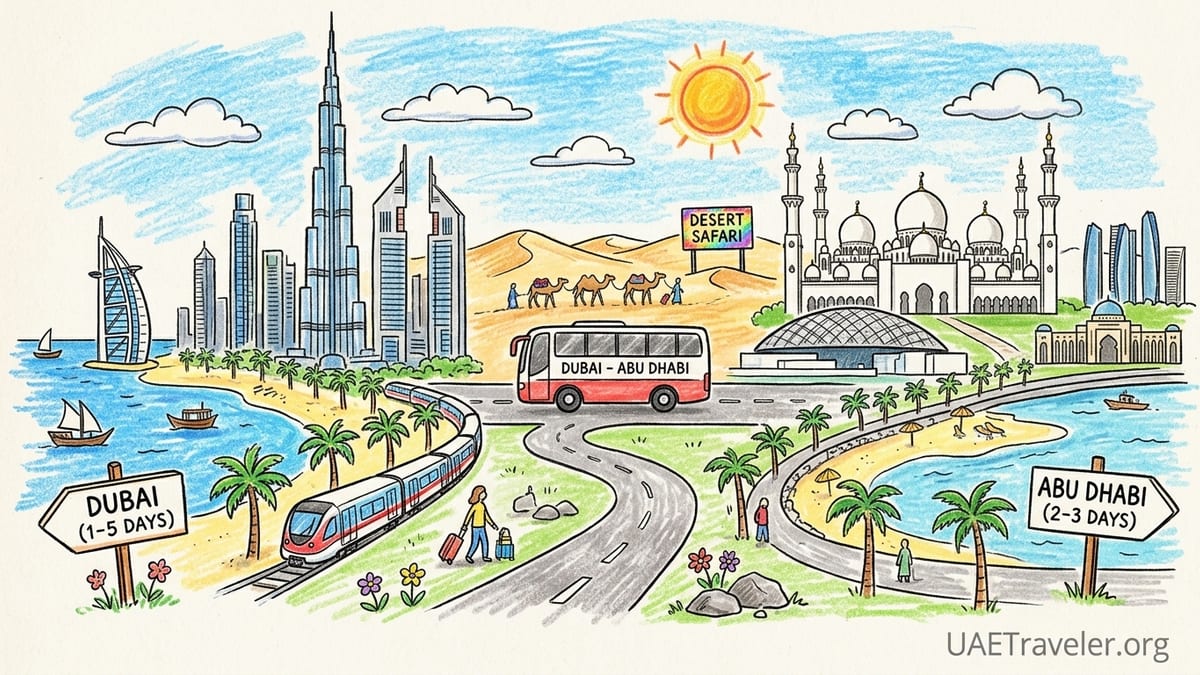
For a first visit that focuses on Dubai and Abu Dhabi, five full days is the practical minimum. This gives you time for Dubai’s core sights such as Downtown Dubai and Burj Khalifa, Dubai Creek and the Al Fahidi Historical Neighbourhood, plus a desert experience and a dedicated half day in Abu Dhabi to see Sheikh Zayed Grand Mosque. With seven days you can slow the pace and add genuinely worthwhile experiences including Louvre Abu Dhabi, Qasr Al Watan, Dubai Marina and a relaxed beach day or even a short side trip to Sharjah’s museums and heritage area.
Deciding where to sleep is just as important as deciding what to see. For trips of up to five nights, most first time visitors are better off staying entirely in Dubai, ideally along the Red Line of the metro in areas such as Downtown, Business Bay, Dubai Marina or near Mall of the Emirates. From there Abu Dhabi works well as a long day trip by shared tour, private transfer or intercity bus plus taxi. Once you reach six or seven nights, splitting your stay between the two cities starts to make sense, for example four or five nights in Dubai and two or three nights in Abu Dhabi on Saadiyat Island or near the Corniche.
Travel between the two cities is straightforward. The distance from central Dubai to central Abu Dhabi is around 140 kilometres and by car normally takes one and a half to two hours outside rush hour. Budget travellers can use the intercity buses that run from Dubai’s Ibn Battuta or Al Ghubaiba bus stations to Abu Dhabi’s main bus station. Many visitors, however, choose organised day tours that include coach transport from Dubai hotels to Sheikh Zayed Grand Mosque and Louvre Abu Dhabi, with guides handling mosque registration and dress checks.
In terms of budget, a pair of first time visitors can expect to spend in the region of 150 to 250 US dollars per day on activities, food and local transport when following the itineraries described here, before hotel costs. Accommodation pricing varies hugely by season and category, but as a broad guide two adults can often find central, well rated midrange hotels in Dubai from about 120 to 180 US dollars per night outside New Year and major events, while international chain beach resorts or high end suites may run several times that.
Key Practicalities: Heat, Fridays, Dress Codes and Booking Ahead
The UAE’s climate shapes how you plan your days. From roughly May to September daytime temperatures commonly exceed 40 degrees Celsius with high humidity, so it is sensible to schedule outdoor sightseeing such as Al Fahidi lanes, Dubai Creek abras, desert safaris and mosque courtyards early in the morning or after sunset. In the cooler months from about November to March, you can comfortably walk around heritage quarters and beaches for longer periods in the middle of the day. Regardless of season, carry water, a hat and sunscreen and factor in air conditioned breaks in malls and cafes.
Friday is the main congregational prayer day in the UAE, and this affects mosque visiting hours. At Sheikh Zayed Grand Mosque in Abu Dhabi, the main prayer hall is closed to visitors around the Friday midday prayer period and typically reopens later in the afternoon; visitors are asked to avoid the mosque interior during Friday prayer times so worshippers are not disturbed. If your schedule is flexible, plan your mosque visit for any day except Friday or aim for late afternoon to evening when the building is beautifully lit and tour groups have thinned.
Dress codes in Dubai and Abu Dhabi are generally relaxed in malls, hotels and most tourist attractions, where you will see everything from jeans and T shirts to summer dresses. Religious sites are different. At Sheikh Zayed Grand Mosque there is an explicit dress code as part of the visitor regulations. Women must cover their legs and arms fully, avoid tight or transparent clothing and cover their hair with a scarf or abaya style covering; men are expected to wear long trousers and sleeves that reach at least to the elbows. Clothing with offensive slogans or imagery is not allowed. Staff at the mosque can refuse entry or provide appropriate coverings if visitors are not dressed suitably, so it is easier to arrive already prepared.
Crowd levels and prices at headline sights make advance booking worthwhile. For Burj Khalifa’s At the Top observation decks on levels 124 and 125, it is strongly recommended to reserve preferred time slots in advance because sunset hours sell out first. Recent price checks in October 2026 for standard advance tickets showed adults paying in the rough range of 170 to 220 dirhams for non peak times, with higher prices for sunset or bundled experiences. Louvre Abu Dhabi adult entry tickets are generally around 60 to 80 dirhams depending on category, and Qasr Al Watan adult palace tickets are currently advertised at about 65 dirhams. Booking online through official channels or reputable ticket partners secures entry and sometimes modest discounts compared with walk up rates.
Five Day Dubai and Abu Dhabi Itinerary for First Timers
This five day plan is designed for visitors staying entirely in Dubai. It assumes arrival on Day 0 and five full days on the ground, but it can be adjusted if your flight lands early morning or departs late at night. Daily orders reflect realistic traffic conditions and opening hours and assume a base budget of about 200 to 250 US dollars per day for two adults excluding hotel costs, spread across activities, local transport and meals.
Day 1 focuses on Downtown Dubai. After breakfast, head to Dubai Mall mid morning by metro or taxi. Spend around two to three hours exploring the mall’s central attractions such as the indoor aquarium from the public viewing area, then have lunch at one of the many cafes facing the Dubai Fountain. In the mid afternoon, walk to the Burj Khalifa At the Top entrance inside Dubai Mall for your pre booked time slot. Allow around 90 minutes for security, elevator ascent to levels 124 and 125, and time on the viewing decks. A pair of standard off peak tickets will usually cost in the region of 340 to 440 dirhams in total. Stay in the area for sunset and the evening fountain show, dining in Souk Al Bahar or one of the waterfront restaurants before taking the metro or taxi back to your hotel.
On Day 2 you explore Dubai Creek and Al Fahidi Historical Neighbourhood. Start early in the morning before the heat builds, taking the metro or a taxi to Al Fahidi or Al Ghubaiba. Spend around two hours walking the narrow lanes of Al Fahidi, with its wind tower houses, small museums and cultural centres. Stop for coffee and a light Emirati breakfast at one of the courtyard cafes. From there, walk or ride a short taxi to the creek bank and cross the water in a traditional wooden abra, which costs only a few dirhams per person and takes a matter of minutes. Browse the spice and gold souqs on the Deira side for an hour or so, then retreat to an air conditioned cafe for lunch. In the evening you can either return to your hotel to rest or book an optional relaxed dhow dinner cruise on the creek if organised group dining appeals.
Day 3 is ideal for a desert experience. Avoid arranging this on your first day in case jet lag hits, and plan it for an afternoon and evening. Many reputable operators offer shared desert safaris that include hotel pickup around 3 pm, dune driving, sunset photo stops, camel rides and a barbecue dinner at a desert camp before returning around 9 or 10 pm. Prices in late 2026 for decent midrange group safaris tend to cluster around 250 to 350 dirhams per person including transport and food, with private and luxury versions higher. Spend the morning resting by your hotel pool or visiting a nearby mall. Lunch lightly so you can enjoy the barbecue, and dress in light, breathable clothing with a light jacket if travelling in winter months when desert evenings can be cool.
Day 4 is devoted to Abu Dhabi’s Sheikh Zayed Grand Mosque. From Dubai, the simplest approach for first timers is to book a full day coach tour that includes return transport and a guided visit to the mosque, sometimes paired with an exterior drive along the Corniche or a photo stop by the city skyline. Group tours from Dubai regularly depart in the morning, with pickup from central hotels around 8 am and arrival at the mosque mid to late morning after a drive of one and a half to two hours. Expect to spend around two hours on site including registration, security, walking through the colonnades and courtyards and time for photos. Midrange guided tours typically cost in the range of 250 to 450 dirhams per person including transport but not lunch. Dress according to the mosque’s rules and bring a shawl or scarf if needed. After the mosque, tours usually stop at a mall or promenade where you can buy lunch before the return to Dubai.
Use Day 5 to revisit favourite areas or add one or two lighter experiences. Morning is ideal for a relaxed beach visit at Jumeirah public beach or a beach club if weather allows, reachable by taxi from most central hotels in under thirty minutes. Allocate two to three hours for swimming, walking and coffee at a beachfront cafe. After a casual lunch near the beach or at Mall of the Emirates, spend the late afternoon strolling in the newer parts of Dubai Marina or Jumeirah Beach Residence pedestrian area and dine at one of the many restaurants overlooking the marina canal before heading back. Transport this day is mostly by short taxi rides, which for central routes within Dubai usually fall between 20 and 60 dirhams per journey depending on distance and traffic.
Seven Day Dubai and Abu Dhabi Itinerary With Cultural Highlights
If you have seven days, you can deepen the experience instead of simply stretching the same list. The first three days mirror the five day plan: Downtown Dubai and Burj Khalifa, Dubai Creek and Al Fahidi, and a dedicated desert evening. For a week long stay, consider three to four nights in Dubai followed by two to three nights in Abu Dhabi, checking out of your Dubai hotel on the morning you transfer between cities so you are not backtracking.
On the extended itinerary, Day 4 becomes your transfer and first Abu Dhabi culture day. Travel from Dubai to Abu Dhabi mid morning by intercity bus, private transfer or organised one way tour. After checking into a hotel on Saadiyat Island, near the Corniche or in the city centre, take a taxi to Louvre Abu Dhabi in the mid afternoon. Allow at least three hours for the museum’s permanent galleries, temporary exhibitions and time under the pierced metal dome overlooking the water. Two adult entry tickets will normally cost around 120 to 160 dirhams in total depending on current pricing and any concessions. There are on site cafes for coffee or an early dinner, or you can head back to Saadiyat Island’s beach restaurants afterward.
Day 5 combines Sheikh Zayed Grand Mosque and Qasr Al Watan. Begin with a taxi to the mosque early in the morning to avoid crowds and midday heat, spending about two hours there with time for a free guided tour if available on the day. After lunch in a nearby mall or food court along the way, continue by taxi to Qasr Al Watan in the afternoon. The presidential palace complex opens to visitors for several hours each day and showcases intricate mosaics, domes and a grand library. Adults currently pay around 65 dirhams each for palace entry tickets. Plan about two to three hours inside, including time on the terraces looking back toward the skyline. In the evening, return to your Abu Dhabi hotel and dine either in house or at restaurants along the Corniche.
Use Day 6 as your Abu Dhabi coastal and Saadiyat Island day. If you are staying on Saadiyat, spend the morning on the natural sandy beach. Day access to public stretches is generally inexpensive, and some resorts offer paid day passes to their pools and beach clubs that can range from approximately 150 to 300 dirhams per person with some credit for food and drinks. The island’s long, shallow shoreline is good for couples and families who want an unhurried day. In the late afternoon, take a short taxi ride to the Corniche promenade for a stroll and simple dinner in one of the cafes facing the water.
On Day 7, return to Dubai or explore Sharjah before departure. If your flight leaves late at night from Dubai, you can arrange a midday transfer back and spend your final afternoon in Dubai Marina or at a mall close to your airport route. Travellers interested in culture might instead schedule a half day in Sharjah from Dubai on either Day 2 or Day 7, reaching the emirate by taxi for a modest fare and spending a few hours in the Heart of Sharjah heritage area and Sharjah Museum of Islamic Civilization. Sharjah’s museum entry tickets tend to be reasonably priced and can be paid on arrival. Keep your final evening quiet, with an early dinner near your hotel and pre arranged airport transfer to avoid last minute stress.
Hotels, Transport and What You Will Spend
To give a concrete picture of costs, it helps to break spending into four categories: accommodation, transport between and within cities, attraction tickets and tours, and food and drink. All figures here are rough averages aimed at two adults sharing in late 2026; actual prices vary by season, exact hotel choice and currency movements, so check current rates when you book.
For hotels, budget travellers willing to stay in simple guesthouses or basic hotel apartments in older districts of Dubai such as Deira can sometimes find doubles in the region of 60 to 90 US dollars per night outside major holidays. Midrange visitors choosing modern chain hotels near the metro in areas like Business Bay or Dubai Marina should expect around 120 to 200 US dollars per night. Higher end stays, such as beachfront resorts on Jumeirah Beach, luxury brands in Downtown or five star properties on Saadiyat Island, often start around 300 US dollars per night and can climb considerably during peak dates. Over five nights, that gives a rough range from 300 to 1,000 US dollars for budget to midrange accommodation and far more for luxury; over seven nights the same categories might run from about 420 to 1,400 US dollars before taxes.
Transport within each city relies mainly on taxis and, in Dubai, the metro. Dubai taxis start with a modest base fare and increase with distance and time; many inner city journeys land between 5 and 15 US dollars, and even longer cross town rides rarely exceed roughly 30 US dollars under normal conditions. The metro is cheaper still, especially if you load a rechargeable travel card and travel in standard class. Intercity transport between Dubai and Abu Dhabi by public bus is usually significantly cheaper than private transfers, with tickets often under 10 US dollars per person each way, though you must then take taxis from the bus stations to your hotel or sights. Shared day tours that include round trip coach transfers are more expensive but remove the need to navigate bus stations and onward taxis.
Attraction and tour costs add up quickly, so choosing which organised activities are genuinely worth booking matters. For most first time visitors, it is sensible to spend on a timed Burj Khalifa observation deck ticket, a quality desert safari, and either a guided Abu Dhabi day tour from Dubai or separate tickets to Louvre Abu Dhabi and Qasr Al Watan if staying in the capital. Other attractions, such as mall observation decks, themed gardens and small museums, can be added depending on interest and budget. Food spending is highly flexible: two adults eating casual meals at mall food courts and simple local restaurants might spend 40 to 60 US dollars per day, while sit down dinners at hotel and waterfront restaurants with drinks can easily double or triple that.
Should You Split Nights Between Dubai and Abu Dhabi
For many first time travellers, the main dilemma is whether to sleep in both cities or use Dubai as a single base. The answer depends on how many days you have and how important Abu Dhabi’s cultural sights and beaches are to you. With five days total, staying entirely in Dubai keeps logistics simple. An organised day trip to Sheikh Zayed Grand Mosque, possibly combined with an exterior stop at Louvre Abu Dhabi, gives a good first impression without a hotel change, and you avoid losing half a day packing, checking out and checking in again.
With seven days, the equation changes. Spending two or three nights in Abu Dhabi allows you to visit the mosque, Louvre Abu Dhabi and Qasr Al Watan at quieter times and to enjoy Saadiyat’s calmer beaches and coastal walks in the early morning and evening. You also avoid returning to Dubai late at night after a long day tour. The trade off is the extra transfer and the need to coordinate your luggage and check in times. Some visitors resolve this by starting with a few nights in Dubai for the most intense sightseeing and finishing with a shorter, more relaxed stay in Abu Dhabi before flying out from there or returning to Dubai International Airport for their final flight.
In practice, a couple following the seven day split stay itinerary might spend roughly 800 to 1,200 US dollars on midrange hotels, 100 to 200 US dollars on local and intercity transport, 400 to 600 US dollars on key attractions and guided tours and 350 to 700 US dollars on food and drinks, giving an approximate total in the region of 1,650 to 2,700 US dollars for the week. A budget oriented pair staying in simpler hotels, focusing on free or low cost sights and using public buses as much as possible might compress that to around 1,000 to 1,500 US dollars, while high end travellers staying in luxury beachfront resorts and booking private tours can expect to spend significantly more.
Different Styles: Budget, Midrange and Higher End Experiences
The same core itinerary can feel completely different depending on where you choose to spend. Budget travellers might base themselves in Deira or Bur Dubai in uncomplicated hotels, use the metro for most journeys in Dubai, take the public bus to Abu Dhabi and book only a shared desert safari and the essential observation deck and museum tickets. They might eat breakfast at their hotel or a nearby bakery, have quick lunches in mall food courts or shawarma stands, and choose inexpensive cafeterias and small restaurants at night. Their paid attractions may come to around 300 to 500 US dollars over five days for two people, with most of their time spent walking older neighbourhoods, relaxing on public beaches and enjoying free fountain or light shows.
Midrange travellers typically look for comfort and efficiency without extravagance. They often stay in four star hotels near metro stations in Dubai and centrally in Abu Dhabi, take taxis for convenience when heat or time is an issue and are willing to pay for a well reviewed desert safari and a structured Abu Dhabi tour. They might allocate 500 to 900 US dollars over five days for key activities including Burj Khalifa, desert safari, mosque day tour and perhaps Louvre Abu Dhabi entry, with meals split between casual cafes and one or two special dinners at waterfront or rooftop restaurants.
Higher end visitors prioritise time and comfort. They may choose hotels directly attached to major malls, luxury beachfront resorts or suites with Burj Khalifa views, accept private car transfers between cities and book premium small group or private tours. A private desert experience in a conservation reserve, for example, or a chauffeured day exploring Abu Dhabi’s cultural triangle can cost several hundred dollars per person but delivers a quieter, less crowded experience. Dining might involve fine dining restaurants in Downtown Dubai or Saadiyat Island, afternoon tea in landmark hotels and room service breakfasts to start each day slowly.
Regardless of budget level, certain tour types are often worth the money. A quality desert safari with responsible dune driving, attentive safety standards and smaller group sizes usually delivers a better experience than the cheapest available options. Guided cultural tours at Sheikh Zayed Grand Mosque or Louvre Abu Dhabi, many of which are included in the entry ticket or offered at modest additional cost, can dramatically deepen understanding of the architecture and art on display. On the other hand, some heavily marketed but repetitive experiences, such as multiple different dinner cruises or combination ticket bundles that bundle minor attractions, can be skipped unless they genuinely match your interests.
The Takeaway
Planning a first time trip to Dubai and Abu Dhabi is about choosing depth over breadth. Five days gives you enough time for the essentials: Burj Khalifa and Downtown Dubai, Dubai Creek and Al Fahidi, a memorable evening in the desert and a meaningful visit to Sheikh Zayed Grand Mosque. Seven days allows you to turn that foundation into a richer journey, adding Louvre Abu Dhabi, Qasr Al Watan, Saadiyat Island beaches and unhurried evenings along Dubai Marina or the Corniche. You do not need to rush through all seven emirates to feel that you have “seen the UAE.”
Families with young children may prefer to slow each day slightly, spending longer in air conditioned malls and hotel pools and trimming the number of big sights. For example, a family might turn the five day plan into six or seven by spreading Downtown Dubai over two half days and choosing a gentler desert experience with more time at the camp and less intense dune driving. Couples might build in more late starts and sunset moments, such as timed Burj Khalifa tickets at dusk followed by a leisurely dinner, or an evening beach walk on Saadiyat instead of back to back museums.
Travellers who dislike rushed sightseeing can use the itineraries here as a menu rather than a checklist. In a five day visit they might choose only Downtown Dubai, one heritage day, the desert and Abu Dhabi’s mosque, skipping additional malls and minor attractions entirely. In seven days they could add just one or two major extras, such as Louvre Abu Dhabi and a beach day, and leave the rest of the time unscheduled for cafe sitting and neighbourhood wandering. The key is to respect the climate, the cultural norms around Friday prayers and dress at religious sites, and your own travel style.
With realistic daily distances, pre booked key tickets and a clear sense of costs, Dubai and Abu Dhabi become remarkably straightforward to navigate. Whether you spend your evenings under the dancing lights of the Dubai Fountain or the glowing domes of Sheikh Zayed Grand Mosque, a well paced five or seven days will leave you with strong first impressions and reasons to return rather than exhaustion and unfinished lists.
FAQ
Q1. Is it better to visit Abu Dhabi as a day trip from Dubai or stay overnight?
For trips of five days or less, a guided day trip from Dubai works well and avoids changing hotels. With seven days, staying two or three nights in Abu Dhabi lets you visit Sheikh Zayed Grand Mosque, Louvre Abu Dhabi and Qasr Al Watan at a calmer pace and enjoy Saadiyat’s beaches without long evening drives.
Q2. How far in advance should I book Burj Khalifa and desert safaris?
For popular periods such as December, New Year or major events, book Burj Khalifa sunset slots and well reviewed desert safaris at least two to three weeks in advance. At quieter times, booking several days ahead is often enough, but leaving it to the last minute can limit your choice of time slots and operators.
Q3. What should I wear to Sheikh Zayed Grand Mosque?
Women should wear loose, opaque clothing that covers arms and legs completely and bring a headscarf; men should wear long trousers and at least short sleeves, with shoulders fully covered. Avoid tight, transparent or slogan covered clothing, and be prepared for staff to check your outfit before entry.
Q4. Are Fridays a bad day to plan my mosque visit?
Fridays are the main congregational prayer day, and the mosque’s main prayer hall is closed to tourists around midday prayers. You can still visit at other times on Friday, but if your schedule is flexible it is simpler to choose another day so you have the widest visiting window and fewer timetable constraints.
Q5. How expensive are taxis and public transport in Dubai and Abu Dhabi?
Dubai’s metro is inexpensive and efficient along the main corridor of the city, while taxis in both cities are metered and reasonably priced by international standards, with many inner city journeys costing the equivalent of 5 to 15 US dollars. Intercity buses between Dubai and Abu Dhabi are cheaper than private transfers but take more planning for onward connections.
Q6. Can I visit Sharjah on a short trip focused on Dubai and Abu Dhabi?
Yes, but it is best treated as a half day cultural side trip rather than another full destination. From Dubai you can take a taxi to the Heart of Sharjah heritage area or the Museum of Islamic Civilization, spend a few hours exploring and then return in time for dinner back in Dubai.
Q7. How should I adjust my plans for summer heat?
From roughly May to September, schedule outdoor sights such as Al Fahidi, Dubai Creek, desert safaris and mosque courtyards for early morning or evening, and spend midday hours in air conditioned spaces like malls and museums. Drink plenty of water, wear light breathable clothing and take regular breaks to avoid overheating.
Q8. Are organised tours necessary, or can I do everything independently?
You can visit most sights independently using taxis and public transport, but organised tours are very helpful for the desert and for day trips that combine Dubai and Abu Dhabi. A good operator handles logistics, timing and entry rules, which saves you time and potential confusion, especially on your first visit.
Q9. What is a realistic daily budget for two adults excluding hotels?
For the itineraries in this article, a pair of visitors who mix paid attractions with free wandering and eat at midrange restaurants can expect to spend roughly 150 to 250 US dollars per day combined on activities, food and local transport, depending on how many guided tours and premium experiences they include.
Q10. Is tipping expected in Dubai and Abu Dhabi?
Tipping is not compulsory but is appreciated for good service. In cafes and casual restaurants, rounding up the bill or leaving about 10 percent is common practice, while hotel staff and tour guides often receive small cash tips in recognition of helpful service.