


Half an hour after landing at Dubai International Airport, I made my first and most expensive mistake of the trip: I followed the taxi signs without checking the fare table, waved away the official airport taxi queue because it looked long, and accepted an offer from a "limousine" dispatcher in the arrivals hall. Forty minutes later, I was in Dubai Marina, blinking at a printed receipt for 265 AED for a ride I had assumed would cost around 100 AED. That difference, multiplied across a week of small but relentless surprises, became the story of my first visit to the UAE: a holiday where the advertised prices and the money I actually spent drifted further apart with every taxi ride, hotel surcharge and attraction upgrade.
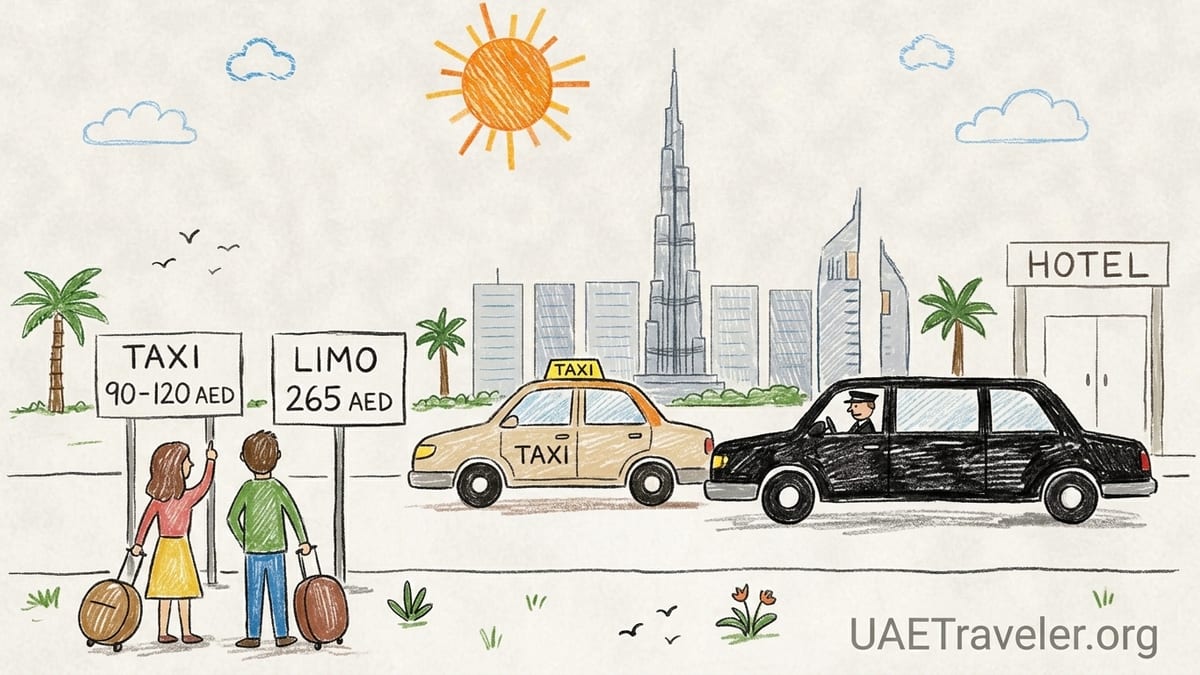
How One Airport Ride Exposed the Real Cost Gap
Before my trip I had read that a metered Dubai Taxi from Dubai International Airport to Dubai Marina typically runs in the region of 90 to 120 AED in normal traffic, depending on the exact drop-off point and tolls. The official taxi tariff published by Dubai’s Roads and Transport Authority shows a per‑kilometre rate just over 2 AED, a minimum fare around 12 to 13 AED, and extra charges when passing through Salik road-toll gates. The route from DXB to Dubai Marina usually crosses at least one toll gate, adding a small supplement but nothing dramatic compared with the base fare.
My 265 AED bill came from choosing an airport “limousine” service instead of the beige-roofed taxis lined up outside. The car was comfortable and spotless, but the price almost doubled what I had loosely budgeted. I had mentally pencilled in 50 AED per airport transfer because a friend told me that is what she paid several years ago when staying closer to Downtown, and I did not bother to check current fares. I started the trip 215 AED over budget before I had even checked into my hotel.
That set the pattern for the week. On paper, my seven-night stay for two adults looked like a reasonably priced city-and-desert break. Flights aside, I expected to spend around 4,000 AED on the ground based on headline hotel and attraction prices. By the time I added tourism fees, service charges, taxis, desert-safari extras, restaurant add-ons and mobile data, the actual figure was closer to 6,000 AED. The difference did not come from one catastrophic splurge, but from a series of small gaps between what was advertised and what I actually paid at the counter.
In this article I will walk through those gaps in detail, using real receipts and current regulations where I have them, to show how easily a first-timer can underestimate the true cost of a UAE holiday. My experience is specific to Dubai and Abu Dhabi in late 2026, but the principles apply across the country.
The Hotel Bill: Tourism Fees, Service Charges and Deposits
My main hotel in Dubai was advertised at 420 AED per night for a “member rate” room-only deal. I did my sums using that figure: seven nights at 420 AED gave me a neat 2,940 AED for accommodation, which felt fair for a modern four-star property with a pool and decent reviews. I knew there would be 5 percent VAT on top and some kind of tourism fee, but I glossed over the details, assuming the extra would be minor.
On checkout, the final room-related total was noticeably higher. Alongside the base room charges, my folio listed a 5 percent VAT line, a 7 percent municipality fee, a 4 percent service charge and Dubai’s Tourism Dirham fee, which is applied per room per night based on hotel category. Guidance on Tourism Dirham confirms that hotels in Dubai charge a flat amount per room per night, with a typical range of around 7 to 20 AED, depending on the star rating, and that the fee is collected for up to 30 consecutive nights. My hotel, classed in the upper mid-range, charged 15 AED per night, which added 105 AED across the week.
The bigger increases came from the percentage-based fees. When I added VAT, municipality fee and service charge, the “420 AED” room was actually closer to 470 AED per night, before the Tourism Dirham. Across seven nights, the accommodation section of my bill came to a little over 3,300 AED instead of the 2,940 AED I had used in my budget notes. None of this was illegal or hidden in the strict sense. The taxes and fees were clearly itemised in the confirmation, but because they were not fully baked into the big bold nightly price, I mentally dismissed them as marginal.
There was also a 500 AED refundable security deposit taken on my card at check-in to cover incidentals. I got it back a few days after checkout, but the pre-authorisation sat as a hold on my credit limit for the entire stay. For travellers with smaller credit lines or relying on debit cards, these deposits can temporarily make a holiday feel more expensive than it is, especially if more than one hotel stay is involved.
Breakfast, Beach Clubs and the Price of “Not Quite All Inclusive”
I booked my room on a room-only basis because the breakfast add-on felt steep at first glance. The hotel quoted 95 AED per person per day for the buffet if added at booking, or 120 AED if decided on the day. Over seven mornings for two people, that would have been more than 1,300 AED. I assumed we could eat more cheaply outside.
In practice, we rarely left the hotel hungry. On the first day, running late for a tour pickup, we took the buffet anyway and signed it to the room at the on-the-day rate. With VAT and service charge, breakfast for two came to just under 270 AED. On another day we grabbed coffee and pastries from a nearby international chain for around 70 AED, and on a third we tried a cafe in a neighbouring tower and spent 110 AED on a modest breakfast. Over the week we alternated between the hotel buffet, cafes and supermarket snacks. When I added up the receipts at home, our breakfasts had cost roughly 900 AED. We had saved money by skipping the full buffet every day, but not as much as my original calculation suggested.
The same pattern repeated with beach access. Because I chose a non-beachfront hotel in Dubai Marina to save on the nightly rate, I had assumed we would spend a day or two at public beaches, bringing towels and buying drinks as needed. Instead, we were tempted by a popular beach club that offered a weekday “day pass” with a sunbed and pool access. The website headline was 200 AED per person, with “fully redeemable on food and drink.” On arrival, the bill grew. There was a separate line for a towel rental, a 10 percent service charge on food and drinks, a municipality fee, and VAT. The minimum spend only covered menu prices before tax and service, so the final figure was closer to 550 AED for two people. It was a lovely day, but almost double what I had mentally allowed.
The lesson was that in Dubai, “not quite all inclusive” experiences, from hotel breakfasts to beach clubs, often come with stacked extras that nudge you towards package deals. Sometimes those packages genuinely add value; other times they simply make the unavoidable add-ons feel less painful because they are prepaid. The key is to cost both options using the full, tax-inclusive figures rather than the headline rates alone.
Transport: When a Cheap Hotel Becomes an Expensive Base
I decided to stay in Dubai Marina rather than Downtown or near a Metro interchange because the hotel there was around 120 AED cheaper per night than comparable properties closer to major attractions. Over seven nights, that looked like a saving of more than 800 AED, which seemed significant. I overlooked how that location would shape my daily transport costs.
Dubai’s public transport network is efficient by regional standards, and fares paid with a Nol card can be very reasonable. The catch is that staying just a bit too far from a Metro or tram station often nudges you into taxis, especially in the heat. My hotel was technically “walking distance” from the tram, but in reality it meant a ten to fifteen-minute walk along busy streets in high temperatures, so we defaulted to taxis more often than not.
Official Dubai Taxi fares use regulated meters. The Roads and Transport Authority specifies a base fare, a per‑kilometre rate of just over 2 AED and extra charges for Salik toll gates on certain routes. For example, a typical ride from Dubai Marina to Downtown Mall in light traffic, around 22 to 25 kilometres with one or two toll crossings, can easily come out between 60 and 80 AED. We needed that journey, or similar ones, on almost every sightseeing day. Add short hops of 15 to 30 AED around the Marina itself and airport transfers at either end, and our taxi total for the week landed near 900 AED.
Back home, I compared that figure with the extra cost of booking a centrally located hotel directly above a Metro station. Several Downtown properties I had considered were around 100 to 150 AED more per night than my Marina choice. Over seven nights, staying central would have cost roughly 700 to 1,000 AED more in accommodation, but likely saved at least half of the taxi spending. Once I accounted for the convenience and time saved, the “cheap” hotel did not look like such a bargain.
Driving yourself is an alternative, and rental rates can be competitive, but that introduces its own hidden costs. Dubai and Abu Dhabi both use automated toll systems on major roads. The RTA explains that Salik toll gates charge for each crossing, with rates that vary by time of day. While single crossings are modest, multiple daily trips accumulate quickly. Many car rental companies add administrative fees on top of the tolls when billing you after the fact. Hotel parking is not always free either, especially in city-centre properties and at some popular attractions.
Attractions, Upgrades and Desert-Safari Extras
At first glance, many UAE attractions appear straightforward. Burj Khalifa has published ticket categories. Desert safaris are advertised with all-inclusive packages. Louvre Abu Dhabi, theme parks on Yas Island and other major sights list their base entrance prices clearly on booking pages. The hidden costs emerge in the details and the upgrades.
Take a typical evening desert safari in Dubai. A series of tour operators track and publish live price ranges for shared and private safaris. Recent price guides show basic shared evening safaris starting around the high tens to low hundreds of dirhams per person, with hotel pickup, dune bashing, a short camel ride, camp entertainment and a buffet dinner included. Premium camps, smaller groups or private vehicles lift that into the 250 to 450 AED per person band. Those numbers match what I saw when shopping around before my trip.
The night we went, our shared evening safari for two cost 520 AED in total at the advertised rate. What the brochure did not emphasise was that quad biking and dune buggies at the camp were optional extras, not part of the base price. On site, short quad sessions were priced between roughly 150 and 250 AED per person, with longer rides and buggies significantly more, numbers that match independent price summaries for recent seasons. We decided to split a medium-length quad ride at 200 AED each. Once we added soft drinks outside the free buffet, souvenir photos and tips, our “520 AED” evening came out at around 1,100 AED.
Cancellation terms and rescheduling policies also caught me out. Some safari operators and attraction ticketing platforms offer lower “non-refundable” or “limited change” fares alongside more flexible options. I chose a marginally cheaper non-refundable city tour without properly reading the fine print. When I later tried to move it by one day to dodge unexpected rain, I discovered that changes counted as cancellations, and the only option was to pay again. That was another 250 AED lost that would not have appeared in my original budget spreadsheet.
Inside attractions, small upgrades accumulate. Paying to skip-the-line for an observation deck, choosing premium seating at fountain shows, or upgrading to “all access” at a waterpark can each add 50 to 150 AED per person. These options are not mandatory, but when you have already spent heavily to be there, it is psychologically easy to justify them. Planning for at least one or two such splurges in a week-long trip makes the overall holiday budget more realistic.
Restaurant Extras, Service Charges and Airport Prices
Dining in the UAE was where I most felt the gap between menu prices and final bills. Many mid-range and upscale restaurants in Dubai and Abu Dhabi add a service charge and municipality fee to the subtotal before VAT. The percentages vary by emirate and by establishment, but it is common in cities like Dubai to see an extra 7 percent municipality fee and a 10 percent service or hospitality charge, followed by 5 percent VAT on top. A main course listed at 85 AED and a soft drink at 18 AED, which might look like a simple 103 AED meal on the menu, can climb into the 120s once those layers are applied.
Over the week, my partner and I averaged around 350 to 450 AED per day on food and drink, including casual lunches, coffee stops and a couple of nicer dinners. That was roughly 30 percent more than I had allowed based on menu browsing before departure, where I had subconsciously read the printed prices as near-final. Tipping is discretionary on top of those built-in service lines. Some visitors choose to add a small extra tip for excellent service, others do not, but either way it is important to understand what is already included before scribbling another 10 percent on the receipt.
At the airports, the price jump is even more obvious. Quick meals and drinks in departure lounges, especially at Dubai International and Abu Dhabi’s newer terminals, were easily 30 to 50 percent higher than comparable items in the city. A modest fast-food breakfast for two before an early flight cost us just under 150 AED, which I had not factored into my “last day” budget at all. Airport taxis, premium coffee chains and last-minute gifts follow a similar pattern.
Mobile Data, Roaming, Parking and Tolls
Mobile data is another category where assumptions can be expensive. European and North American visitors often rely on roaming plans that include certain destinations but either exclude the UAE or charge high daily fees. I travel with a SIM card that offers a simple flat daily rate for roaming, so I lazily assumed it would be acceptable. When I checked the small print after arriving in Dubai, I realised the UAE was outside the bundle and roaming data would cost more than 15 AED per megabyte, a completely unrealistic option.
I ended up buying a tourist SIM package from a major UAE provider at the airport. Packages at the time started around 60 to 90 AED for small data allowances and climbed to 200 AED or more for higher data and local call bundles, which aligned with the brochures at the kiosk. I chose a mid-tier option around 125 AED, which worked out cheaper than even a couple of days of my home operator’s roaming. The cost itself was not outrageous, but it was an unplanned line item that pushed my communications budget well above zero.
For travellers renting cars, parking and tolls deserve more attention than they usually get. Official information from Dubai highlights an automated toll system on key roads, with charges per gate crossing that vary between off-peak and peak hours. In addition to that, on-street parking in busy districts is often paid, sometimes with hourly caps that make longer stops expensive. Shopping malls may validate a few hours, but exceeding that can trigger higher hourly rates. Some beachfront areas and popular sights in Abu Dhabi also charge for parking, particularly on weekends and holidays, and hotel valet parking can come with separate fees or compulsory tipping expectations.
In my case, I did not rent a car, but I watched other travellers at my hotel debating unexpected parking lines on their folios. Several had assumed that free parking came with the room, only to find nightly charges or valet fees added at checkout. When comparing hotel options, the presence or absence of complimentary parking and the location relative to toll gates can make more difference to the final cost of a stay than a 30 or 40 AED difference in the room-only headline rate.
Shopping and the Truth About the UAE Tourist VAT Refund
Like many visitors, I viewed the UAE’s 5 percent VAT as something I might “get back” on big purchases. The reality is more nuanced. The Federal Tax Authority operates a Tourist Tax Refund Scheme in partnership with a provider called Planet. The scheme allows eligible tourists to reclaim some of the VAT paid on goods bought from participating retailers, provided those goods are taken out of the country within a specific period and certain conditions are met.
Key points shaped my experience. Only purchases from shops linked to the digital refund system qualify, and there is a minimum spend threshold per invoice for the tax-free tag to be issued. Not every cafe or boutique participates, and services like hotel stays or restaurant meals are not eligible at all. At purchase, the shop assistant scanned my passport details into the Planet system and issued a digital tax-refund tag linked to my receipts.
At the airport on departure day, I used one of the self-service kiosks located near check-in to validate my purchases. Current Federal Tax Authority information explains that these kiosks and manned counters are available at major airports, seaports and some land borders, and that refunds can be paid in cash up to a cap or to a card account, with the card issuer’s exchange rate applying if the refund is processed in a foreign currency. The important detail is that tourists do not receive the full 5 percent VAT back. A processing fee is deducted for each refund, and if you choose cash there may be additional limits and charges.
On my own shopping, I had roughly 2,000 AED of eligible goods backed by the correct digital tags. Simple arithmetic would suggest 100 AED of VAT paid at 5 percent. After validation and fees, the net refund credited back to my card was closer to 75 AED. The difference reflected the operator’s service fees and rounding. It was still worth doing, but nowhere near the “5 percent off everything” mental discount I had casually assumed when pencilling in a shopping budget.
In October 2026, the FTA also announced enhancements to the tourist refund process built around a new digital platform and an official mobile app. Public statements describe an AI-supported system that lets tourists register by scanning their passport and bank card, track eligible purchases, and receive refunds more quickly, including to certain digital wallets or bank accounts without long queues at counters. The convenience is real, and the number of kiosks at airports, malls and some hotels has grown, but again it does not change the underlying arithmetic that only some VAT is reclaimable and only on qualifying goods.
My Real Budget vs What I Actually Spent
To keep this grounded, here is how my initial budget for seven nights in Dubai and Abu Dhabi compared with the real spend, excluding flights. I travelled as a couple, in late 2026, booking mid-range options but allowing for a few treats. All figures below are approximate and rounded, based on actual receipts where I have them.
For accommodation, I budgeted 2,940 AED based on a nightly headline rate of 420 AED. Once VAT, municipality fee, service charges and Tourism Dirham were added, the real accommodation bill was about 3,350 AED. That alone put us more than 400 AED over the line. I did not originally budget anything for deposits because I knew they were refundable, but the 500 AED hold on my card limited what else I could comfortably book in advance during the week.
For transport, I allowed 500 AED, based on a rough recollection of friends’ taxi spending and an assumption that we would use the Metro frequently. In reality, with the overpriced airport limousine, regular taxis across the city and a couple of trips to Abu Dhabi by intercity coach and taxi, the transport total landed closer to 1,100 AED. The difference came almost entirely from my decision to stay in a cheaper but less central hotel, and from not checking real taxi tariffs before arrival.
Attractions and tours were another area where my expectations diverged from reality. I had set aside 1,200 AED for two people, enough in my mind for a desert safari, an observation deck visit, Louvre Abu Dhabi and a couple of smaller sites. By the end of the week, including desert safari upgrades, a second unplanned observation deck visit, a non-refundable city tour I had to rebook, and a few smaller experiences, we had spent closer to 1,700 AED.
Food, drink and incidental spending accounted for the rest. I budgeted around 1,000 AED, assuming breakfast would be cheap outside the hotel and that we would mostly eat in food courts and casual spots. Our actual total on meals, coffee, bottled water, snacks and a couple of nicer dinners was a little over 1,800 AED. Mobile data, small souvenirs and airport spending added roughly another 250 AED, partly offset by about 75 AED of VAT refunds on eligible shopping.
Adding all of that together, my original on-the-ground budget for two people was 4,640 AED. The final total was around 6,200 AED, a difference of more than 30 percent. Very little of the overspend came from dramatic splurges. Instead it was the cumulative effect of service charges, tourism fees, taxis from a not-quite-ideal base, attraction extras, and the gap between menu prices and final restaurant bills.
The Takeaway: How I Would Budget My Next UAE Trip
If I were planning the same length of trip to the UAE again, with the benefit of hindsight, I would structure my budget differently from the start. First, I would treat the “headline” room rate as only about 80 to 85 percent of the true cost of accommodation once VAT, municipality fees, service charges and tourism levies are fully included. In practice that means taking any nightly price I see on a booking site, adding 15 to 20 percent to it in my spreadsheet, and comparing hotels on that basis instead of the pre-tax figure alone.
Second, I would give location even more weight than room price. Instead of fixating on saving 100 AED per night by staying slightly away from key areas, I would map out the transport implications. If a central hotel above a Metro station costs 700 AED more across a week but realistically saves 400 to 600 AED in taxis, I would take the central option for the convenience and time saved. When considering car rental, I would do the same with tolls and parking: sketch likely daily driving routes, look up where toll gates sit, and ask hotels directly whether parking is truly free.
Third, I would create explicit “extras” lines in my budget for breakfasts, beach clubs, attraction upgrades and desert-safari add-ons. For a seven-night trip, I would assume at least four hotel breakfasts, one beach club day, one major observation deck with a premium or timed ticket, and one safari with a paid upgrade like quad biking, costed using current prices rather than optimistic guesses. I would also build in a realistic daily food allowance that reflects service charges and VAT, not just menu prices, and include a modest but non-zero allowance for airport meals and last-day spending.
Finally, I would treat VAT refunds as a small bonus rather than a meaningful budget-reduction tool, and invest a few minutes before departure in understanding the latest refund procedures through official Federal Tax Authority channels or at the airport information desk. Between minimum spends, non-participating shops and operator fees, the scheme is helpful but does not transform the economics of a shopping-heavy trip.
FAQ
Q1. How much extra should I add on top of UAE hotel rates for taxes and fees?
For mid-range hotels in Dubai and Abu Dhabi, a rough rule is to add 15 to 20 percent to the advertised nightly room rate to cover VAT, municipality fees, service charges and tourism levies, then check the specific hotel’s confirmation for exact figures.
Q2. What is Dubai’s Tourism Dirham and how is it charged?
Dubai’s Tourism Dirham is a nightly fee applied per occupied room, with the amount based on the hotel’s official category. It appears as a separate line on your bill and is charged for up to 30 consecutive nights, so longer stays can add a noticeable total.
Q3. Are taxis in Dubai and Abu Dhabi metered and reliable?
Official city taxis are metered with regulated tariffs and are generally reliable. Costs rise when you use premium limousine services, sit in heavy traffic, cross multiple toll gates or rely on many short rides due to staying far from public transport.
Q4. Is it worth booking a hotel breakfast package?
If you expect to eat a full breakfast at the hotel most days, pre-booking can work out cheaper than paying the walk-in buffet price plus tax and service. If you are happy with coffee and a pastry outside, staying room-only can save money, but the difference is often smaller than it first appears.
Q5. How can I avoid surprise costs on a Dubai desert safari?
Before booking, ask the operator exactly what is included in the base price and what counts as an optional extra, such as quad biking, buggies, premium seating, photo packages and transfers from remote locations, and read the cancellation policy carefully.
Q6. Do restaurants in the UAE always include a service charge?
Many mid-range and upscale restaurants in Dubai and Abu Dhabi add a service charge and municipality fee before VAT, but not all do, so it is worth checking your bill before adding any discretionary tip to avoid double tipping.
Q7. How does the UAE tourist VAT refund system work in practice?
Eligible purchases at participating shops are tagged digitally at the point of sale, then validated at self-service kiosks or counters when you leave the country. After operator fees and possible currency conversion costs, you receive most, but not all, of the 5 percent VAT back on those goods.
Q8. Is it cheaper to stay outside the main sightseeing areas to save on hotel costs?
Cheaper hotels on the edge of popular districts or far from the Metro can generate higher taxi or fuel costs and longer travel times, so any nightly savings should be weighed against realistic daily transport expenses and the value of your time.
Q9. Should I buy a local SIM card or use my home roaming plan?
For many visitors it is cheaper to buy a local tourist SIM on arrival, especially if their home provider charges high daily roaming fees or excludes the UAE from inclusive zones, but it is important to compare current offers before deciding.
Q10. What is the single most common hidden cost first-time visitors overlook?
Many first-time visitors underestimate the combined impact of service charges, tourism fees and transport from less central hotels, which together can lift real spending 20 to 30 percent above the sum of headline prices they used in their initial budget.