


The first time I tasted Emirati food in Dubai, I was not sitting in a five-star hotel or a glittering mall restaurant. I was cross-legged on a patterned carpet in a restored wind-tower house in Al Fahidi, Old Dubai, the call to prayer echoing softly across the creek. A large metal tray landed in front of our small group, heavy with spiced rice, roasted chicken, bowls of lentil soup and tiny golden dumplings glistening with date syrup. The room smelled of cardamom, slow-cooked lamb and rosewater. Our Emirati host poured Arabic coffee from a long-spouted dallah into small handleless cups, passing dates around as he joked about everyone’s first hesitant sip. The flavors were familiar yet different: the warmth of cinnamon and turmeric in the rice, the nutty depth of ghee in the harees, the gentle bitterness of coffee softened by the sweetness of dates. By the time I stepped back into the sunlit alleyways, I realised I had barely scratched the surface of the UAE’s food story, and that most visitors never get this far beyond the hotel buffet.
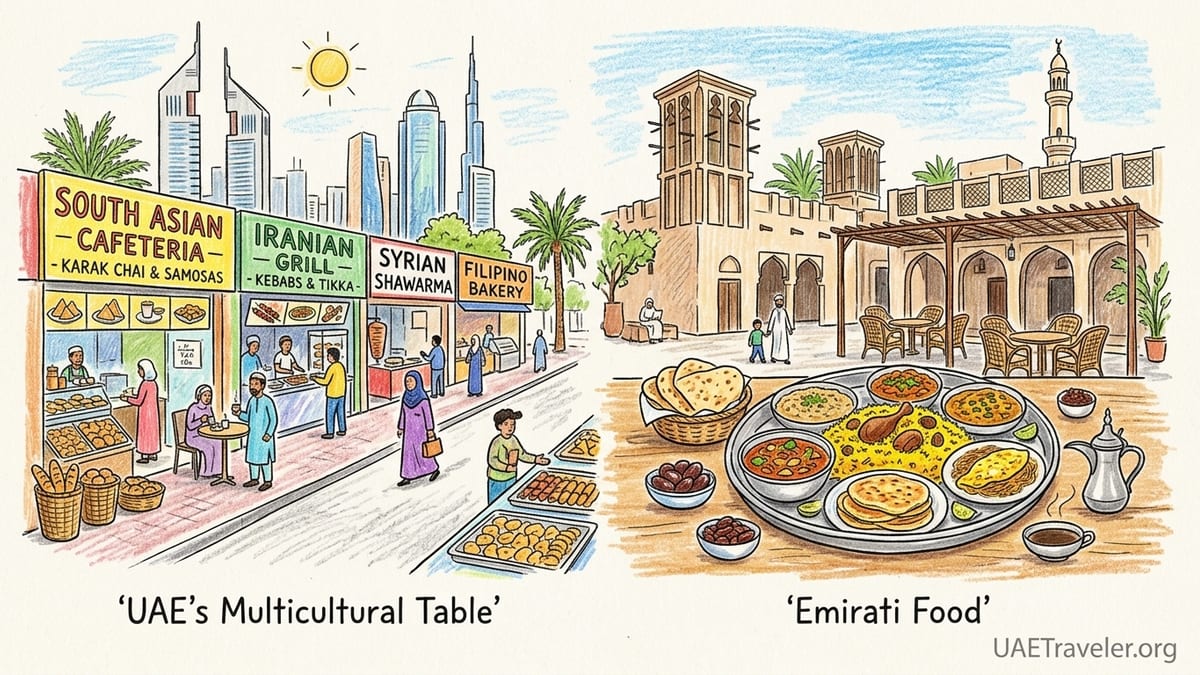
Emirati Food vs the UAE’s Multicultural Table
To understand what to eat in the UAE, it helps to separate two overlapping but distinct things: Emirati cuisine and the wider food scene shaped by decades of immigration. Walk through Deira or Bur Dubai and you are never more than a few steps from a South Asian cafeteria serving karak chai and samosas, an Iranian grill, a Syrian shawarma shop or a Filipino bakery. This everyday mix is part of life in Dubai, Abu Dhabi and Sharjah, but it is not the same as traditional Emirati food, which developed from Bedouin, coastal and oasis communities who cooked with what they had: rice, wheat, dates, fish, camel and goat, plus the spices that came through Indian Ocean trade.
Emirati dishes lean heavily on slow-cooked meats, rice, lentils, wheat and dates, with a spice profile that feels gentler and more perfumed than some Indian or Levantine food. You will taste cardamom, saffron, dried limes and cinnamon more than blistering chilli heat. Harees, for example, is made from cracked wheat slowly cooked with meat until it turns into a comforting, porridge-like dish. Machboos features rice simmered with meat or fish, onions, tomatoes and those distinctive dried limes that perfume the whole plate.
Because the UAE has grown so fast, many visitors’ first meal is an international hotel buffet rather than anything recognisably local. Sushi, roast beef and pasta are easy to find, while machboos might be tucked away in a corner tray labelled “Arabic rice.” You could spend a week eating well and still miss the flavours that Emiratis grew up with. That is why it is worth seeking out restaurants and cultural centres that deliberately foreground Emirati recipes, interiors and rituals, and pairing those experiences with time in the humble cafeterias that fuel the city every day.
What follows is a personal food guide anchored in meals I have actually sat down to, supplemented with current information from restaurants and cultural institutions across Dubai. The focus is on dishes a first-time visitor can realistically find, what they cost, where to eat them, and how to avoid the trap of thinking that the fanciest setting is automatically the most authentic.
My First Plates: Harees, Machboos and Luqaimat in Al Fahidi
My introduction to Emirati food came through a cultural meal at the Sheikh Mohammed Centre for Cultural Understanding in Al Fahidi, the restored heritage quarter beside Dubai Creek. The centre runs hosted breakfasts, brunches, lunches, dinners and tea-time “fuala” sessions where an Emirati presenter explains local customs over a shared meal. As of October 2026, cultural breakfasts and brunches are priced around 130 dirhams per person, with lunch from about 145 dirhams and dinner about 160 dirhams, including food and the guided session, and bookings are required in advance.
We began with Arabic coffee and dates, the classic welcome across the Gulf. The coffee was pale and fragrant, brewed with cardamom and poured in small quantities, which surprised some people used to dark espresso. The dates were soft and almost caramel-like, a deliberate contrast to the slightly bitter coffee. Then the big metal tray arrived, designed to be shared between four to six people. On it sat chicken machboos, a heap of yellow rice shot through with onions and flecks of tomato; a smooth bowl of harees that looked plain until the first spoonful revealed its depth; a lighter vegetable saloona that gave the vegetarians something more than a side salad; and a dish of luqaimat for dessert.
Machboos was the dish that stayed with me. The rice had soaked up stock made from chicken and spices, including dried black limes that gave it a gentle tang. The chicken itself was tender but not heavily sauced. It was a comforting dish rather than a showstopper, the kind of thing you can imagine being cooked in large pots for family gatherings. The portion at the cultural lunch could easily have served two people, which is typical when you order machboos at other restaurants in the city for around 60 to 80 dirhams, depending on whether you choose chicken, lamb or seafood.
Luqaimat came last, those addictive little dough dumplings that manage to be both crisp and fluffy. At the cultural meal they were drizzled with date syrup and sprinkled with sesame seeds. They are sweet but not cloying, and one bowl was enough for four of us to end the meal happy. Eating all of this while our host answered questions about Ramadan, clothing and family life reminded me that, in the UAE, food is often a starting point for wider conversations, not just a checklist of dishes.
Breakfast in Old Dubai: Balaleet, Chebab and Khameer
To move beyond that first cultural tray, I went back to Al Fahidi early one morning and tucked into breakfast at Arabian Tea House, one of the most atmospheric places to explore Emirati and regional dishes in a heritage setting. The original branch hides behind high walls painted turquoise and white, with a shaded courtyard of rattan chairs, bougainvillea and ceiling fans. Arrive by 9:00 in the morning on a weekday and you are likely to get a table without waiting; later in the morning and on weekends there can be a short queue.
On my first breakfast here, I ordered balaleet, chebab and Arabic tea. Balaleet is one of those dishes that sounds strange on paper and makes complete sense once you taste it: sweet vermicelli noodles scented with cardamom and saffron, topped with a thin omelette. At Arabian Tea House, a generous portion arrived in a deep plate, large enough to share between two if you are ordering other dishes. Balaleet here has typically been priced in the range of 30 to 40 dirhams, good value for the size and setting. The noodles were just sweet enough, with the spice perfume doing most of the work, while the omelette added a savoury layer that kept it from feeling like dessert.
Chebab, the Emirati answer to pancakes, came stacked and still warm, dotted with tiny holes and served with date syrup and soft cheese. Where Western pancakes are often fluffy and neutral, chebab brings a clear hit of cardamom and sometimes saffron. At Arabian Tea House and other Emirati-focused restaurants, a plate of chebab usually sits in the 25 to 35 dirham range and works well for sharing, especially if you pair it with khameer bread. Khameer is a slightly sweet, yeasted flatbread baked until golden, often split and filled with cheese or date paste. At breakfast tables around the UAE, it plays the same role as a croissant in Europe; at Al Fanar and similar restaurants you will see baskets of fresh khameer for under 15 dirhams.
For vegetarians, Emirati breakfast is a comfortable entry point. Balaleet, chebab and khameer can all be made without meat, and places such as Arabian Tea House clearly indicate vegetarian options on their menus. Dairy is common, so vegans will need to ask for modifications, for example chebab without cheese and replacing milk tea with black tea. Staff in Old Dubai’s heritage cafés are used to explaining dishes to visitors and can generally help you avoid ghee or yoghurt if you need to.
Al Fanar and Al Khayma: Heritage Restaurants Worth Planning Around
If you only book two Emirati restaurant meals in Dubai, make them Al Fanar and Al Khayma Heritage Restaurant. Both try to recreate the look and feel of old Dubai, yet each offers a slightly different experience. They are also among the most reliable places to find key Emirati dishes cooked with care, accompanied by English menus and staff who can walk you through the options.
Al Fanar has several branches in Dubai, Abu Dhabi and Al Ain. One of the most convenient for visitors is at Al Seef along Dubai Creek and another at Dubai Festival City. The interiors look almost like a museum, with recreated street scenes, fishing nets, old petrol pumps and sepia photographs. It can feel a bit theatrical, but the food is solidly rooted in Emirati recipes. On my latest visit, I ordered chicken machboos, a side of yogurt and cucumber, and a basket of local bread. Chicken machboos at Al Fanar currently sits around 65 dirhams, with lamb or seafood options rising into the 70 to 80 dirham bracket. Portions are generous; a single main plus a side is enough for a hungry adult.
Prices at Al Fanar are mid-range by Dubai standards. Starters such as salads and small plates hover roughly in the 30 to 40 dirham band. Breads like wagafi or a mixed bread basket are comfortably under 20 dirhams, while grills and biryanis range from about 65 to 80 dirhams depending on the protein. It is a place where you can order multiple dishes to share without sliding into fine-dining territory. You usually do not need a reservation at off-peak times. For dinner at popular branches on Thursday or Friday night, it is safer to book ahead or arrive early.
Al Khayma Heritage Restaurant, in the Al Fahidi area, delivers a slightly different mood. The dining area spreads across a traditional courtyard and indoor rooms, with lanterns, low seating and staff in local dress. At night, the atmosphere feels particularly special. Here, I tried lamb machboos and a mixed appetiser spread that included dango, a simple but delicious dish of slow-cooked chickpeas, along with salads and bread. Machboos portions were again large enough to share between two light eaters, with prices for mains in a similar band to Al Fanar, typically from the mid-60s to mid-80s dirhams depending on the dish. Al Khayma also partners with tour operators for set menus that package appetisers, a choice of machboos or grilled meats, dessert and water into a single price for groups; the exact figures vary but usually stay under what you would pay ordering the same items a la carte.
Between the two, Al Fanar feels slightly more polished and museum-like, while Al Khayma leans into its courtyard charm and proximity to the creek. Both are clearly designed with visitors in mind, but they are also popular with local families, especially on weekends. It would be unfair to dismiss either as inauthentic simply because they are comfortable and photogenic. The key is to balance these heritage experiences with time in simpler spots elsewhere in the city.
Beyond Heritage Dining: Neighborhood Cafeterias and the Multicultural Mix
After a few days in Dubai, you begin to see another side to the food scene. Small cafeterias with fluorescent lights and plastic chairs line the streets of Karama, Satwa and Deira, serving cheap and cheerful meals to the city’s working backbone. Many of these places offer a fusion of Indian, Pakistani and Gulf flavours rather than strictly Emirati dishes, but they are essential to understanding how people actually eat day to day.
Walk into almost any of these cafeterias and you will find karak chai on the menu, a strong, sweet milk tea originally from the Indian subcontinent but now a UAE staple. A paper cup rarely costs more than 2 to 5 dirhams, even in 2026, and it often comes with a side of biscuits or a samosa. Some spots also fry luqaimat to order, sold by the portion for under 15 dirhams. You will be surrounded by delivery riders grabbing takeaway bags, families sharing plates of shawarma and singles eating quickly before heading back to work. The atmosphere is worlds away from an air-conditioned mall restaurant, yet the welcome can be just as warm.
Not every cafeteria serves recognisable Emirati dishes like harees or machboos, though in areas with more Emirati residents you may see these on daily specials boards, particularly during Ramadan or on Fridays. Hawker-style eaters who want to chase those flavours should keep an eye out for places labelled as “local cuisine,” “Emirati” or “Khaleeji” in Arabic and English, and not be put off by humble surroundings. When you do find such a spot, you can expect a plate of chicken machboos for perhaps 30 to 45 dirhams, significantly less than at a heritage restaurant, and tea for small change.
It is tempting to assume that the cheaper, rougher-around-the-edges experience is always more “authentic,” but that is too simple. Many Emirati families enjoy dining at Al Fanar and Al Khayma because the food tastes like home but the setting is relaxed and comfortable. At the same time, the multicultural cafeterias that dominate daily life are an authentic reflection of the UAE today, where more than 80 percent of residents are expatriates. The key for a first-time visitor is to sample from both worlds: heritage restaurants to get a structured introduction to Emirati dishes, and neighborhood joints to feel the everyday pulse of the country.
Half a Day Eating Through Old Dubai
If you have limited time, a focused half-day in Old Dubai can give you a deep, satisfying introduction to local flavours without relying on hotel buffets. Start in the morning in Al Fahidi. Aim to arrive around 9:00, when the lanes are quiet and the light is soft. Have breakfast at Arabian Tea House or another courtyard café in the neighbourhood. Order balaleet or chebab with khameer, plus a pot of Arabic tea or karak. Expect to spend roughly 50 to 70 dirhams per person for a generous spread for two to share.
After breakfast, wander through the alleys of Al Fahidi, dropping into small museums and art spaces, then walk down to Dubai Creek. Take an abra, the traditional wooden boat, across to Deira for a couple of dirhams, and explore the spice souk and gold souk. This is an excellent moment to snack on dates from one of the shops and compare varieties, from sticky Khalas to firmer, nuttier types. Vendors often offer free tastes, and if you decide to buy half a kilo it will set you back somewhere in the 20 to 40 dirham range depending on the quality.
By midday, head back across the creek and walk to Al Seef or back into Al Fahidi for lunch at either Al Fanar or Al Khayma Heritage Restaurant. Reserve a table if you are travelling on a Friday or Saturday or during peak winter season from November to March. For lunch, plan on ordering one main per person plus a shared starter or dessert. A realistic budget is about 90 to 120 dirhams per person for a filling meal with soft drinks. Look out for machboos, saloona, grilled meats and at least one dessert like luqaimat or umm ali, a rich bread pudding with milk and nuts.
If you prefer a more guided experience, you could swap this self-guided lunch for a cultural meal at the Sheikh Mohammed Centre for Cultural Understanding. Their lunchtime sessions last about an hour and a half, weaving explanation and questions around a shared Emirati meal in a traditional house. You pay a fixed per-person price that covers all the dishes, water, tea and coffee. Beyond the food, what you gain is structured insight into topics visitors often tiptoe around, from why abayas and kanduras are worn to what daily life looks like during Ramadan. It is an easy way to combine lunch with cultural orientation, especially on your first day in the country.
Vegetarian, Dietary Needs and Ramadan Considerations
Travelers who do not eat meat sometimes worry that Emirati cuisine will be off-limits, given how central lamb, chicken and fish are to many dishes. In practice, it is quite feasible to enjoy a varied Emirati-inspired spread as a vegetarian, particularly at restaurants that are used to hosting international guests. Dishes like balaleet, chebab, khameer, hummus, moutabbal, fattoush and various lentil soups are all meat-free. Many places, including heritage restaurants, also offer vegetable saloona, a tomato and spice-based stew with seasonal vegetables, and dango, those slow-cooked chickpeas seasoned with cumin and onions.
Vegans need to navigate more carefully, because dairy and ghee are traditional ingredients. Arabic coffee and dates are naturally vegan, and some breads are made without milk or butter, but many desserts such as luqaimat and umm ali contain dairy. If that is a concern, ask staff to point out dishes made with oil instead of ghee or butter, and confirm whether bread dough includes milk or yoghurt. In larger venues like Al Fanar and Arabian Tea House, menus usually indicate allergens and servers are used to fielding questions about ingredients. In small cafeterias, you may need to rely on simpler grilled or fried vegetable dishes and plain rice.
The UAE caters well to gluten-free travellers in the international restaurant scene, but traditional Emirati food does lean on wheat, especially in dishes like harees and breads such as khameer and regag. Machboos and saloona served with plain rice are good options if you avoid gluten, as are grilled fish and meats with salads. It is important to flag your needs clearly when you order and not expect strict separation of utensils in very casual places.
Ramadan, which shifts dates each year, changes the rhythm of eating across the country. During the fasting hours from dawn to sunset, Muslims do not eat or drink, and many small cafeterias may close or operate reduced hours in the daytime. Large hotels and some restaurants remain open for non-fasting visitors, but daytime dining choices narrow, especially outside tourist zones. After sunset, the city comes alive with iftar, the meal to break the fast, often starting with dates, water and soup before moving on to heartier dishes like harees and machboos. Heritage restaurants such as Al Khayma frequently offer set iftar menus at fixed prices, and the Sheikh Mohammed Centre for Cultural Understanding replaces its standard dinner with an iftar experience that combines food with explanations of Ramadan practices. If you visit during this month, consider booking one of these hosted meals for a deeper look at how food, faith and community intersect.
When a Hosted Cultural Meal Is Worth It
Spending over a hundred dirhams on a set cultural meal can feel expensive if you measure it purely against the cost of food at a cafeteria. Yet what you are really paying for is structured access. At the Sheikh Mohammed Centre for Cultural Understanding, meals are led by Emirati hosts who are there not only to serve food but to take questions about social norms, religion, family life, public behaviour and anything else guests are curious or confused about. In a country where many first-time visitors are unsure what is polite or legal, this open Q and A format can be invaluable.
During my lunch there, people asked about everything from whether non-Muslims can enter mosques, to how arranged marriages work today, to what locals think about the rapid pace of development. Our host answered candidly, often using elements of the meal as prompts: explaining the coffee and dates ritual as a symbol of hospitality, or how a big shared tray reflects family structures where several generations once lived together. That kind of context is hard to pick up from signs in a museum or from a quick chat with a waiter.
Hosted meals also help you avoid the ordering anxiety that can come with unfamiliar dishes. Rather than trying to decode a long menu, you sit down and accept a curated spread that usually includes staples like harees, machboos, stews, salads, bread and dessert, with vegetarian elements woven in. Portions are generous. If you are travelling as a couple or small group, the per-person price often works out similar to ordering several dishes a la carte at a mid-range restaurant, but you walk away with a stronger grasp of what you have eaten and why it matters.
That said, a hosted cultural meal is not a replacement for exploring the grassroots food scene. Think of it as a foundation. Once you have tasted machboos and harees in this context and heard how Emiratis describe them, you will be better equipped to recognise good versions at restaurants and perhaps to spot them on buffet lines where they might otherwise blend into the crowd.
The Takeaway
By the end of my first extended stay in the UAE, certain flavours had become non-negotiable. If I could design my ideal meal from the dishes in this guide, it would start with Arabic coffee and plump dates, followed by balaleet and chebab at an Old Dubai courtyard table. Then I would move on to chicken or lamb machboos, preferably at a place like Al Fanar where the rice is deeply perfumed with dried limes and the portion big enough to share. Dessert would be a small plate of luqaimat, hot, crisp and drenched in date syrup, eaten slowly while watching abras ferry passengers across the creek.
There were disappointments too. A few hotel buffet versions of Emirati dishes felt like afterthoughts, with lukewarm rice and under-seasoned meat. One overly sweet balaleet at a non-specialist café tasted more like dessert noodles than a balanced breakfast. These experiences reinforced the value of seeking out restaurants and cultural venues that treat Emirati food as the main event, not a token addition to an international spread.
For a first-time visitor on a moderate budget, an affordable food plan might look like this: begin with one hosted cultural meal in Al Fahidi to ground yourself, spend a half-day doing the Old Dubai breakfast and lunch circuit described earlier, and then use neighborhood cafeterias and mall branches of Emirati restaurants to round out the week. Aim for one or two sit-down heritage dinners, a few casual lunches where a plate of machboos or biryani costs under 40 dirhams, and lots of small snacks: karak chai, dates from the souk, the occasional fresh fruit juice from a corner stand.
Most importantly, give yourself permission to move beyond the comfort of the hotel buffet. Emirati cuisine is not loud or flashy compared with some of its regional neighbours, but it is generous, aromatic and deeply tied to the story of the country. Sitting under a wind tower in Old Dubai with a plate of harees or a bowl of saloona in front of you will tell you more about the UAE than any skyscraper skyline ever could.
FAQ
Q1. What Emirati dishes should I prioritise on a short trip to the UAE?
Focus on machboos, harees, balaleet, chebab, khameer, luqaimat and Arabic coffee with dates. These give you a good cross-section of everyday staples, breakfast favourites and desserts without overwhelming you with choice.
Q2. How much should I budget for an authentic Emirati meal in Dubai?
In a heritage restaurant like Al Fanar or Al Khayma, expect to spend around 90 to 120 dirhams per person for a main, a shared starter or dessert and a soft drink. In simpler cafeterias, a plate of rice and meat plus tea can cost closer to 30 to 45 dirhams.
Q3. Do I need to book ahead for Emirati restaurants such as Al Fanar, Arabian Tea House or Al Khayma?
Reservations are strongly recommended for dinner on weekends and during the November to March high season, especially at popular branches in Old Dubai and along the creek. At quieter times on weekdays, you can often walk in for breakfast or lunch without a long wait.
Q4. Are cultural meals at the Sheikh Mohammed Centre for Cultural Understanding worth the price?
Yes if you value context as well as food. Prices from about 130 to 160 dirhams per person cover a full Emirati meal and an open Q and A with an Emirati host, giving insight into culture, religion and daily life you are unlikely to get in a regular restaurant.
Q5. Can vegetarians and vegans enjoy Emirati cuisine?
Vegetarians have plenty of options, including balaleet, chebab, khameer, salads, lentil soups, vegetable saloona and dango. Vegans need to be more selective because dairy and ghee are common, but Arabic coffee, dates, some breads and simple vegetable dishes can work if you confirm ingredients with staff.
Q6. What changes should I expect if I visit during Ramadan?
Daytime dining options outside hotels reduce, and some smaller eateries close or limit service until sunset. After dusk, iftar meals become the focus, with set menus featuring dishes like harees and machboos. Cultural centres and heritage restaurants often create special iftar experiences that combine food with explanations of Ramadan traditions.
Q7. Is Emirati food very spicy?
Emirati food is usually aromatic rather than hot. Expect flavours from cardamom, saffron, cinnamon and dried limes instead of strong chilli heat. If you are sensitive to spice, you can generally eat comfortably, especially if you mention your preference when ordering.
Q8. Where should I go for a first taste of Emirati breakfast dishes?
Head to Old Dubai. Courtyard cafés in Al Fahidi such as Arabian-style tea houses are ideal places to try balaleet, chebab and khameer in an atmospheric setting, with menus in English and staff used to explaining the dishes.
Q9. How do I recognise Emirati food among all the other cuisines in the UAE?
Look for menus that highlight dishes such as machboos, harees, saloona, balaleet, chebab and luqaimat, and for references to “Emirati” or “Khaleeji” cuisine. Restaurants like Al Fanar and Al Khayma explicitly present themselves as Emirati, while many cafeterias focus instead on Indian, Pakistani or Levantine food.
Q10. What is a sensible one-day Emirati food itinerary for first-time visitors?
Have breakfast in Al Fahidi with balaleet or chebab, wander the alleys and the creek, snack on dates in the spice souk, then return for lunch or dinner at a heritage restaurant such as Al Fanar or Al Khayma. If time and budget allow, swap lunch for a cultural meal at the Sheikh Mohammed Centre for Cultural Understanding to add a guided dimension to what you eat.