


I spent ten packed days between Dubai and Abu Dhabi, determined to see the United Arab Emirates the way most first-timers actually do: a mix of famous icons, older neighborhoods, a desert safari, and at least one lazy afternoon on the sand. I booked my own tickets, compared budget and premium options, and skipped a few “top 10” sights that did not appeal in person. What follows is my personal verdict on the experiences I genuinely had, what was worth the money, and what I would do differently next time.
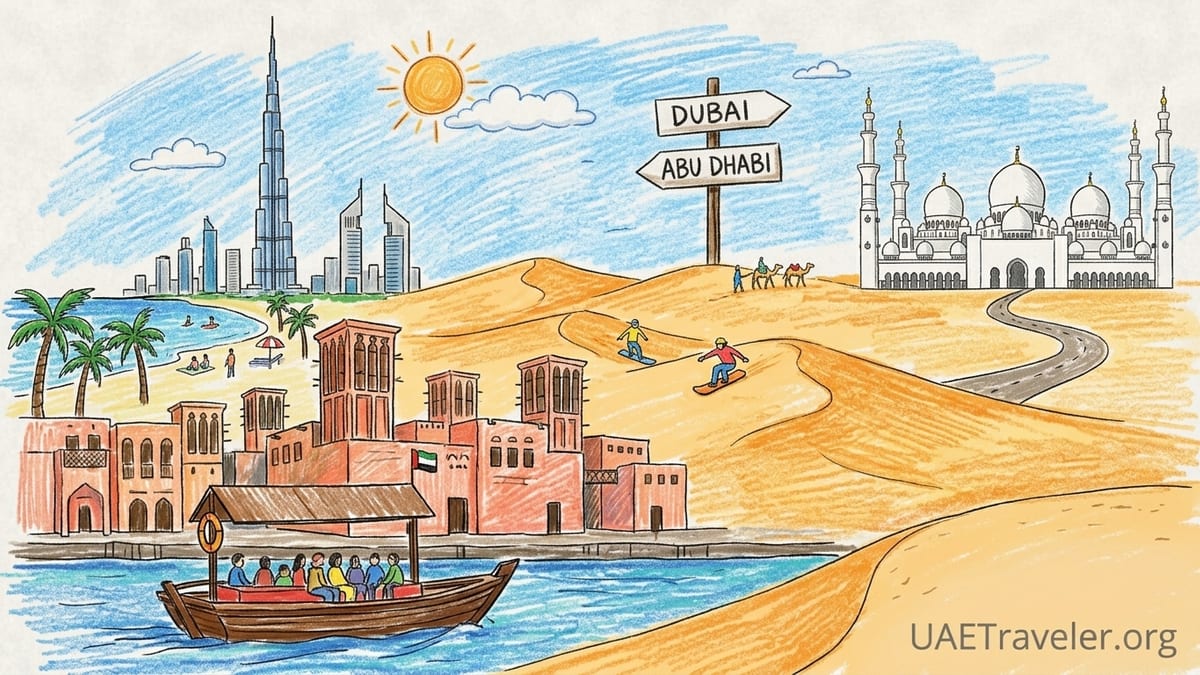
How I Planned This UAE First-Timer Itinerary
Before arriving in the UAE I had the same mental checklist as most first-time visitors: ride to the top of Burj Khalifa, do a desert safari, see Sheikh Zayed Grand Mosque, and squeeze in a beach day. What I did not want was a generic greatest-hits list. Instead, I blocked out two full days in Dubai, two in Abu Dhabi, plus a few flexible days to repeat what I liked most. I focused on a tight core of experiences and skipped several malls and theme parks that did not match my interests.
I pre-booked timed tickets only for Burj Khalifa, Louvre Abu Dhabi, and Qasr Al Watan, along with an evening desert safari. Everything else I left flexible. That balance turned out to be important. In the UAE, certain headline attractions do sell out or are much cheaper if booked in advance, while others are easy and inexpensive to enjoy on the day. Weather also matters more than I expected, especially from May to September when outdoor time can be brutally short.
What follows is not a ranking of “most famous” but a ranking of what truly impressed me once I was there. I will look at each experience through the same lens: my expectations, the actual visit, what I paid, crowds and atmosphere, and how it compares with cheaper or free alternatives. I will then give two separate rankings: most memorable experiences and best value for money.
For context, I visited in late winter, when daytime highs hovered around the mid-twenties Celsius and evenings were mild. That timing made outdoor places like Dubai Creek and Saadiyat’s beaches far more pleasant than they would be in peak summer, and it also affected what I think is realistic for families, couples, and visitors with limited mobility.
Burj Khalifa: Iconic View, Uneven Value
Before arriving, Burj Khalifa was the attraction I most expected to feel “obliged” to do. Everyone talks about it as a must, yet I had read many complaints about long queues and underwhelming views. On the official At The Top booking site, standard tickets for levels 124 and 125 were listed in the low hundreds of dirhams for popular sunset slots, with cheaper early morning and late evening options, while premium access to higher levels and lounge experiences cost several times more. I opted for a standard off-peak ticket in the late morning and booked online a week in advance to lock in a lower price and specific time.
Entry is through Dubai Mall, and even before you reach the lifts you pass through security and a corridor of displays about the tower’s construction. I spent roughly an hour and a half in total, including waiting, time on the observation floors, and browsing the inevitable gift shop. The lifts themselves were fast and smooth, and stepping out into the glass-walled observation deck still gave me a genuine sense of “I am really here.” The views stretch across Sheikh Zayed Road, the desert, and the Gulf. On a clear day it is vast and impressive, though the midday sun flattens the light and makes photography more difficult than I expected.
The main disappointment was how commercial the experience felt once the initial thrill faded. Crowds bunched up at the main viewing corners, and there were constant photo upsells and premium add-ons. For example, attendants steer you toward professional photos, souvenirs, and suggested “upgrades” to sky-level tickets or rooftop lounges that are not strictly necessary for enjoying the view. Compared to free or cheaper skyline options such as the outdoor terraces of nearby malls, the waterfront promenade around Burj Lake, or sunset drinks at mid-range hotel rooftops, the price for At The Top feels high if you are mainly after a distant cityscape.
Would I do it again? For a first visit, yes, especially for couples who want that classic bucket-list photo and for families with older children who will remember riding one of the fastest lifts in the world. For very budget-conscious travelers, or visitors with limited mobility who prefer to minimize queue time, I would consider skipping the observation deck and simply enjoying the fountain shows from ground level in the evening. Burj Khalifa is wheelchair accessible, but lines and crowd density make it more tiring than many people anticipate, so off-peak time slots and advance booking are highly recommended.
Dubai Creek and Al Fahidi: The Soul of Old Dubai
If Burj Khalifa was the iconic skyscraper experience, Dubai Creek and the Al Fahidi Historical Neighborhood were the places that made the city feel human. My expectations here were modest. I pictured a token “old town” lined with souvenir stalls. Instead I found a genuinely atmospheric waterfront and a maze of wind-tower houses that felt surprisingly calm right beside modern Dubai. I deliberately did not book a tour. The core areas are compact, well signposted, and easy to navigate using maps and the Creek abras.
An abra ride across Dubai Creek remains one of the best bargains in the city. The petrol heritage abras that shuttle between Bur Dubai and Deira charge a flat fare of a few dirhams per crossing according to the official marine timetable, paid in cash or by local transit card at the pier. The whole crossing takes about five minutes, and I rode back and forth several times at different times of day, spending roughly two hours in total along the waterfront. Sitting on the wooden bench, inches above the water, with traders and commuters packed in around you, feels wonderfully real compared with polished sightseeing cruises that cost ten or twenty times more.
On the Bur Dubai side, I walked into the Al Fahidi Historical Neighborhood, a low-rise district of restored coral-stone buildings and wind towers. Entry to the lanes themselves is free. I spent about three leisurely hours there, ducking into a small coffee museum, an art space, and a courtyard café. There were definitely tourist-oriented shops, but in the side alleys it was easy to imagine Dubai before the glass towers. Crowds were light in the morning and denser by late afternoon, especially when tour groups arrived, but never felt overwhelming.
Compared with paid alternatives along the Creek, such as long private abra charters or floating restaurants, the standard commuter abra and a self-guided stroll around Al Fahidi were far better value. For families, this part of the city offers an easy half-day with children who might be restless inside malls, and the short abras are exciting without being tiring. For visitors with limited mobility, the abra step can be a bit challenging at very low tide, but staff are used to assisting, and the main alleys of Al Fahidi include paved stretches that work reasonably well for wheelchairs and strollers.
Desert Safari: Shared Adventure vs Private Luxury
The desert safari was the experience I booked with the most skepticism. Before traveling I worried it would feel staged and rushed, a conveyor belt of dune bashing, camp show, and buffet. I also had to choose between a shared tour from a mid-range operator and more expensive private or luxury options that promise quieter dunes and smaller camps. After comparing several companies, I booked an afternoon and evening shared safari that included hotel pickup, 4x4 dune driving, sandboarding, camel rides, a barbecue dinner, and live entertainment.
The total time door to door was around seven hours, with about an hour spent in transit each way, an hour and a half of dune driving and photo stops, and the rest at the camp. The dunes themselves at sunset were genuinely beautiful, especially once the engines were turned off and the wind was the only sound. That thirty minutes watching the sky change color was the standout moment of the entire excursion. The disappointments came at the camp, where a central stage, buffet queues, and stalls selling upgrades created a theme-park atmosphere that will not appeal to travelers seeking solitude or cultural depth.
In value terms, a shared safari is hard to beat. For a few hundred dirhams per person, you get transport, food, and a full evening of activities. However, if your budget allows and you care most about peace and landscape, a private or more premium small-group desert experience is worth considering. Several operators run conservation-focused drives in protected desert reserves that avoid large camps and focus instead on wildlife sightings and quieter dunes. Those options can cost several times more per person but deliver a very different mood.
For families, the shared safari works well, provided children enjoy car rides and late nights. Couples might prefer a smaller group or private option to avoid the loud camp setting. Most standard safaris are not ideal for visitors with limited mobility, as dune bashing involves constant movement and getting in and out of the 4x4 can be demanding. Some companies, however, do offer gentler, more accessible desert experiences with minimal off-road driving, so it is worth emailing operators in advance and explaining any mobility needs.
Sheikh Zayed Grand Mosque: Spiritual Landmark With Practical Constraints
Sheikh Zayed Grand Mosque in Abu Dhabi was the site I had seen most often in photos: vast white domes, reflective pools, and intricate floral inlays. My expectation was of an overwhelmingly beautiful but heavily regulated visit. The official mosque site and regulations confirm that visitors must obtain an online access pass for visiting hours, pass security, and follow a dress code that covers arms and legs, with women also covering hair. Entry itself is free, but failing to meet clothing rules can mean renting or purchasing appropriate garments at the visitor center.
I booked an afternoon access pass, arrived by taxi, and spent about two and a half hours there, including time walking from the underground car park and visitor center through the long air-conditioned corridors to the main courtyard. The architecture is indeed extraordinary in person. The combination of brilliant white marble, gold-tipped columns, and calligraphy creates a sense of calm even with hundreds of people around. The main prayer hall, with its huge chandeliers and carpet, was the highlight. I joined one of the free guided tours, which added helpful context about the mosque’s design and symbolism.
Crowds are thickest around sunset and early evening, when the lighting is most dramatic. That is also when movement can become slow in the long indoor corridors and around the popular photo spots. Security and staff presence are heavy, and there are clear rules about photography and restricted areas. I saw several visitors turned back for dress code issues, which made me grateful I had double-checked the official guidance and brought modest clothing. Visitors with mobility challenges will find ramps, lifts, and smooth flooring throughout, but should budget extra time because of the size of the complex and the occasional slow-moving queues.
In terms of value for money, Sheikh Zayed Grand Mosque ranks extremely high since general admission is free apart from transport and any clothing rentals. Guided tours are complimentary, and it is perfectly feasible to visit without a commercial guide if you are comfortable reading signage and joining the mosque’s own tours. As a cultural and architectural experience that requires advance online registration but no ticket payment, it belongs at the top of a first-time itinerary.
Louvre Abu Dhabi and Qasr Al Watan: Culture on Saadiyat and the Presidential Palace
On Saadiyat Island and the nearby Presidential Palace complex I set aside an entire day to balance art and architecture. My expectation of Louvre Abu Dhabi was of a smaller, more manageable counterpart to its Paris namesake, and that proved accurate. According to the museum’s current visitor information, standard adult entry costs around 70 dirhams, with free admission for under-18s and several concession categories such as UAE residents above a certain age. I booked a timed ticket online mainly to skip the ticket desk queue, not because of strict capacity limits.
I spent just over four hours at Louvre Abu Dhabi, including time under the monumental perforated dome, in the permanent galleries, in a temporary exhibition, and on the waterfront terrace. Crowd levels varied by gallery but rarely felt oppressive, even on a busy afternoon. The building itself is as compelling as the collection, with filtered light falling through the dome and reflecting off shallow pools. My standout moment was stepping from darkened galleries filled with early religious art into a sunlit space facing the sea, modern sculptures silhouetted against the horizon.
From an access perspective, Louvre Abu Dhabi is straightforward. There are ramps, lifts, loanable wheelchairs, and benches throughout. Audio guides and app-based tours are available for a small extra fee, but I was content with the wall texts and a printed map. No private guide is necessary to enjoy the museum, though specialist tours can deepen the experience for art enthusiasts. Given the relatively modest ticket price, generous free categories, and the number of hours I comfortably spent there, the museum felt like one of the strongest value-for-money experiences of my trip.
Later that afternoon I visited Qasr Al Watan, the working Presidential Palace complex that opens a large section to the public. Official tourism information indicates that an adult ticket is in the mid-sixties of dirhams, with separate options if you plan to stay for the evening light show. I booked an entry slot for mid-afternoon to coincide with cooler temperatures and arrive before day-trip tour buses from Dubai. The palace interiors are jaw-dropping: colossal halls with patterned domes, inlaid floors, and exhibits on the UAE’s governance and heritage.
The main trade-off at Qasr Al Watan is time versus depth. You can walk through the primary halls in an hour if you move briskly, or linger for two to three hours if you stop to read displays and sit in the central hall. I spent about two hours before watching the early evening sky shift over the palace courtyard. Crowds spiked around the central dome and in the main gift shop but dispersed in the side galleries. Accessibility is good, with lifts and wide corridors, though the distances between ticketing, shuttle buses, and the palace entrance can be tiring for some visitors, so planning for rest breaks is wise.
Beach Day: Public Sands vs Private Clubs
No first visit to the UAE feels complete without time by the water, whether in Dubai or Abu Dhabi. Before traveling I imagined that all the best beaches would be hidden behind expensive resorts. In reality, both cities offer long stretches of excellent public sand alongside high-end beach clubs. I chose one main public beach day in Abu Dhabi, on Saadiyat Island, and a shorter afternoon at a mid-range beach club in Dubai to compare experiences and costs.
Public beaches such as Saadiyat public beach or sections of the Corniche typically charge either a modest entry fee or parking charges, with optional paid loungers and umbrellas. I spent about five relaxed hours on Saadiyat, walking along the shoreline, swimming, and reading in the shade of a rented umbrella. The sand was clean and soft, the water clear, and even on a pleasant winter Saturday there was still ample space. Lifeguards were on duty, and facilities like showers, toilets, and small cafés were available at sensible prices.
In Dubai, I sampled a day-access pass at a hotel-affiliated beach club attached to a large resort area. Entry alone was several hundred dirhams, with additional costs for food and drinks. The upside was a quieter stretch of sand, more landscaped surroundings, and resort-style pools with plentiful loungers. Service was attentive without feeling overbearing. Yet when I compared how much time I actually spent in the water and on the sand versus indoors or by the pool, it was difficult to justify the substantial price difference compared with my public beach experience.
For families, clean public beaches with lifeguards, playgrounds, and casual cafés are more than sufficient, and the saved money can go toward cultural sites or a second desert excursion. Couples seeking a special occasion setting might enjoy a splurge day at a beach club, particularly those that bundle spa access or a set food and beverage credit. Visitors with limited mobility should check in advance which beaches offer accessible pathways, beach wheelchairs, and accessible toilets. Several major public beaches have made visible improvements in this regard, whereas some smaller private clubs remain less well adapted.
Distinctive Cultural Activity: Coffee and Calligraphy in Al Fahidi
Beyond headline sights, I wanted at least one cultural activity that felt rooted in local traditions rather than created solely for tourists. In Al Fahidi I combined two such experiences in a single morning: an Emirati coffee tasting in a traditional house and a short introduction to Arabic calligraphy at a small art center. Both were inexpensive compared with larger attractions and felt intimate, with groups of fewer than ten people.
The coffee session, held in a courtyard setting, introduced the basics of roasting, spicing, and serving traditional Arabic coffee. The host explained the significance of the dallah pot and small cups, and we sampled lightly spiced brews alongside dates. The atmosphere was conversational; guests asked about everyday life in Dubai, local customs during Ramadan, and how hospitality works in Emirati homes. The session lasted around ninety minutes and cost less than a casual restaurant meal, making it excellent value for anyone curious about local culture.
The calligraphy introduction that followed was more hands-on. Over about two hours, a teacher demonstrated different scripts, showed how to cut and use a reed pen, and then guided us as we attempted our own names. While my results were far from museum-worthy, the tactile process of dipping ink and dragging the pen across textured paper made the lines of Arabic signage and mosque inscriptions more meaningful during the rest of my stay. The classroom was air-conditioned and step-free, so it was accessible for participants with mobility constraints, though holding the pen steadily could be challenging for some.
Compared with large-ticket attractions, these intimate cultural sessions stood out for emotional impact per dirham spent. They also worked very well for mixed-age groups. Children about eight and older in my sessions seemed engaged, and couples enjoyed the shared trying-and-failing aspect of calligraphy. For short trips, I would recommend picking at least one activity like this, whether it is coffee, calligraphy, pearl-diving history, or an architecture-focused walking tour.
Personal Rankings: Most Memorable vs Best Value
After ten days, my ranking of most memorable experiences looked very different from a simple list of tallest towers and most famous buildings. In terms of emotional impact and the images that stuck with me, my top three were: the desert at sunset on the shared safari, the first view of Sheikh Zayed Grand Mosque’s courtyard from the colonnade, and wandering Al Fahidi and Dubai Creek by abra at twilight. Louvre Abu Dhabi and Qasr Al Watan followed closely, each for their architecture and the way they layered history and modern identity. Burj Khalifa, despite its global fame, fell lower on this personal “wow” list because of the commercialized feel and crowded viewing platforms.
If I rank purely on value for money, the order changes. Sheikh Zayed Grand Mosque comes first because the experience is free aside from clothing and transport yet delivers world-class architecture and a meaningful cultural dimension. Dubai Creek abras and Al Fahidi come next, as they cost only a handful of dirhams and a modest café bill while offering deep insight into the city’s past. Public beach time, especially on Saadiyat, also ranks near the top, as a minimal entry or services fee buys you a full day of relaxation. Louvre Abu Dhabi then appears high on the value list due to its moderate ticket price and the number of quality hours it can absorb.
By contrast, Burj Khalifa’s observation deck and the Dubai beach club day fall much lower for value, though they have their place for specific travelers. The standard shared desert safari sits in the middle: not as cheap as Creek abras or public beaches but still a fair price given its logistics and length. A premium desert or private palace tour would slide further down the value chart unless you are specifically seeking exclusivity, quiet, or photography conditions that mainstream options cannot offer.
Suitability also differs by traveler type. Families with younger children will get the most from Dubai Creek, Al Fahidi, beaches, and selected parts of Louvre Abu Dhabi where interactive displays and children’s areas exist. Couples might favor a mix of mosque, Louvre, Qasr Al Watan, a quieter desert option, and one rooftop or Burj Khalifa visit for the skyline romance. Travelers with limited mobility will find the strongest combination in Sheikh Zayed Grand Mosque, Louvre Abu Dhabi, Qasr Al Watan, and accessible beach promenades, while treating desert safaris and crowded observation decks with more caution.
The Takeaway: What to Prioritize and How to Avoid Overpaying
If I had to design a very short UAE itinerary based on my own experience, with only three paid or time-intensive highlights, I would choose Sheikh Zayed Grand Mosque, Louvre Abu Dhabi, and an afternoon and evening around Dubai Creek and Al Fahidi with repeated abra crossings at sunset. Adding a desert safari would be my fourth choice if time and budget allowed. These experiences are where architecture, landscape, and culture come together most powerfully without feeling like a pure shopping or theme-park trip.
There are also experiences that only make sense for particular interests. Burj Khalifa’s At The Top observation deck is ideal for travelers who collect world-tallest skyscrapers or who value the bragging rights and photos. Premium or private desert safaris make sense for photography enthusiasts or those celebrating a special occasion who are willing to pay extra for quiet dunes and tailored itineraries. High-end beach clubs are best suited to visitors for whom poolside service, curated playlists, and a resort atmosphere are central to the holiday, rather than simply a nice bonus.
Across all these choices, the most important money-saving lesson was to be conservative about upgrades. Many attractions offer layered tickets that sound tempting but are not essential. For Burj Khalifa, standard off-peak tickets provide the core experience without paying extra for slightly higher floors or lounge packages. In the desert, a well-reviewed shared safari delivers the essential dunes and sunset without add-ons like quad biking or VIP seating areas that may not change your enjoyment. On the coast, public beaches with a rented umbrella and occasional café visits can match or exceed the relaxation you get from a far pricier beach club day.
Finally, think about timing and booking strategy. Reserve in advance for Burj Khalifa, desert safaris, Louvre Abu Dhabi, and Qasr Al Watan, especially in the cooler months and around holidays. Plan outdoor-heavy activities like desert trips, Creek walks, and beach days for early mornings or late afternoons when temperatures are more forgiving. Leave flexible slots in your schedule for places such as Al Fahidi or the Corniche that you can enjoy without tickets or guides. With that mix, your first trip to the UAE can feel both iconic and personal, and your budget will go toward the experiences that truly stay with you after you fly home.
FAQ
Q1. Do I need to book Burj Khalifa tickets in advance?
For popular times such as sunset and evenings it is wise to book At The Top tickets online at least several days ahead to secure your preferred slot and a better price. Early morning or late-night visits are usually easier to book last minute, but having a reservation still helps you avoid higher walk-up rates.
Q2. Can I explore Dubai Creek and Al Fahidi without a guide?
Yes. The abra routes across Dubai Creek are simple, and the core lanes of Al Fahidi are compact and well signposted. A self-guided visit with a basic map or smartphone app is enough for most travelers, though history enthusiasts may appreciate a locally run walking tour for deeper context.
Q3. Are desert safaris suitable for young children or older travelers?
Shared desert safaris are generally fine for school-age children and healthy older adults, but the dune bashing can be bumpy. Families with toddlers or travelers with back or mobility issues should look for operators who can tone down the off-road driving or offer gentler, more accessible desert experiences focused on scenery rather than thrills.
Q4. How strict is the dress code at Sheikh Zayed Grand Mosque?
The dress code is enforced. Men should wear long trousers and sleeves, and women need to cover arms, legs, and hair. If your clothing is not suitable, staff may direct you to rent or purchase appropriate garments at the visitor center, so it is best to arrive prepared to avoid extra cost and delay.
Q5. Is Louvre Abu Dhabi worth visiting if I am not an art expert?
Yes. Louvre Abu Dhabi is designed to be approachable, with clear storytelling through time and an emphasis on connections between cultures. Even casual visitors can enjoy the building, the play of light under the dome, and selected highlight works without feeling overwhelmed by the collection.
Q6. Do I need a guide for Qasr Al Watan?
No formal guide is necessary for Qasr Al Watan. The main halls and exhibits are easy to navigate with posted explanations, and you are free to move at your own pace. Hiring a guide can add historical context, but for most first-time visitors the self-guided experience is entirely sufficient.
Q7. Are public beaches in the UAE clean and safe?
Major public beaches in Dubai and Abu Dhabi are generally well maintained, with lifeguards on duty during the day, designated swimming areas, and clean sand. Facilities such as showers, toilets, and small cafés are common, making them a solid option for budget-conscious travelers and families.
Q8. How far in advance should I book a desert safari?
In the cooler high season it is sensible to book at least several days to a week in advance to get your preferred date and to compare operators. In very hot months there is often more same-week availability, but demand can spike during holidays, so advance reservations are still recommended.
Q9. Is the UAE manageable for visitors with limited mobility?
Key attractions like Burj Khalifa, Sheikh Zayed Grand Mosque, Louvre Abu Dhabi, Qasr Al Watan, and major malls and promenades have step-free access, lifts, and accessible restrooms. Challenges arise with long walking distances, crowding, and off-road activities such as desert safaris, so planning rest breaks and choosing accessible-focused tours is important.
Q10. Which three experiences should I prioritize on a very short trip?
Based on my visit, I would prioritize Sheikh Zayed Grand Mosque for architecture and culture, Louvre Abu Dhabi for art and design, and an afternoon and evening around Dubai Creek and Al Fahidi for a sense of the older city. If you have an extra evening and budget, consider adding a desert safari as a fourth highlight.