


Landing in the United Arab Emirates for the first time can feel overwhelming: multiple airports, unfamiliar transport systems, new payment methods and strict SIM registration rules. This guide is designed as a practical, step-by-step companion you can follow from the moment you leave the aircraft until you reach your hotel, focusing on Dubai and Abu Dhabi while also explaining Sharjah’s role in the wider metro area.
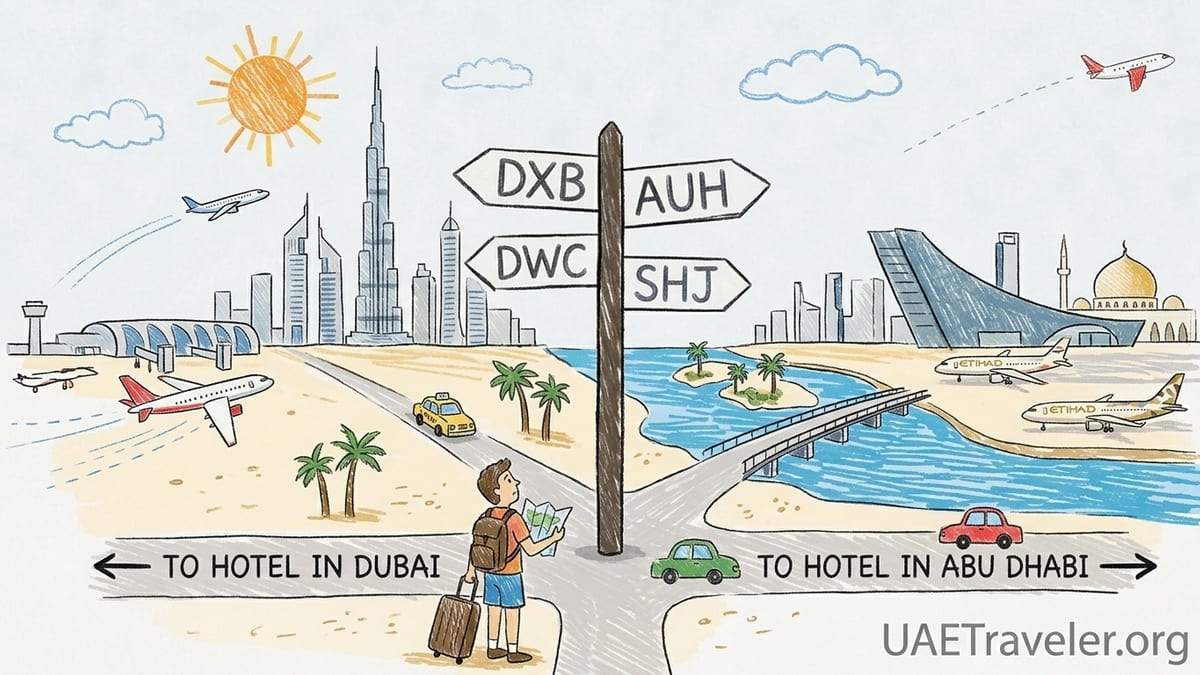
Choosing the Right Airport Before You Fly
For most first-time visitors, "Dubai" or "Abu Dhabi" on the ticket seems clear enough. In reality, greater Dubai and Abu Dhabi are served by several different airports: Dubai International Airport (DXB), Al Maktoum International Airport (DWC), Zayed International Airport in Abu Dhabi (AUH, rebranded from Abu Dhabi International) and Sharjah International Airport (SHJ). These airports can be 60 to 100 kilometres apart, and choosing the wrong one for your hotel location can add a costly extra transfer at the end of a long flight.
Dubai International Airport (DXB) is the main hub for Emirates and many other carriers. It sits relatively close to central Dubai: about 10 to 15 minutes by taxi to Deira and 15 to 25 minutes to Downtown Dubai in light traffic. DXB is directly connected to the Dubai Metro Red Line at Terminal 1 and Terminal 3, which makes it ideal if your hotel is in Deira, Bur Dubai, Downtown, Business Bay, the World Trade Centre corridor or Dubai Marina and Jumeirah Lakes Towers, all strung along the metro line.
Al Maktoum International Airport (DWC), also branded as Dubai World Central, is much farther south near Dubai South and the Expo City area. There is no metro station at the terminal. Reaching popular districts such as Downtown Dubai or Dubai Marina usually requires a taxi or ride-hailing journey of around 40 to 55 minutes in off-peak traffic and can be significantly longer at rush hour. A typical taxi fare from DWC to Dubai Marina will usually land somewhere in the 140 to 200 AED range depending on traffic and tolls, which can surprise travellers who assumed they were landing "in Dubai" in the same way as DXB.
Zayed International Airport (AUH) is the primary gateway to Abu Dhabi and the hub for Etihad Airways. It is roughly 30 to 35 kilometres from Downtown Abu Dhabi. In light traffic, a taxi typically takes 25 to 35 minutes to reach central areas such as the Corniche or Al Maryah Island. If you booked a flight to Abu Dhabi but your hotel is actually in Dubai, the distance between AUH and central Dubai is around 120 kilometres. A taxi between AUH and Downtown Dubai will often cost in the region of 350 to 450 AED one way, depending on the time of day and route taken, effectively erasing any small saving you might have made on the ticket price.
Sharjah International Airport (SHJ) sits in the neighbouring emirate of Sharjah but is often marketed as an alternative to Dubai, especially by low-cost carriers. It is close if your accommodation is in Sharjah itself, but reaching many Dubai districts from SHJ takes much longer than from DXB. Licensed Sharjah airport taxis apply an extra inter-emirate surcharge for trips heading to Dubai, on top of the metered fare, which can push a ride to Downtown Dubai or the Marina into a similar cost bracket as travelling from Abu Dhabi’s airport. That is why, for a typical tourist whose hotel is in Dubai, booking DXB instead of SHJ almost always reduces both travel time and cost.
What to Expect When You Land
Whichever of these airports you choose, the process after landing follows a similar pattern: immigration, baggage claim, customs, then a public arrivals area where you can find airport taxis, exchange counters, ATMs, telecom kiosks and often information desks. If you arrive at DXB Terminal 3 on an Emirates flight, for example, the walk from aircraft door to immigration can be long, but the signage is clear in English and Arabic and queues are usually managed into distinct lines for GCC nationals, UAE residents and visitors.
For many nationalities, the UAE issues a visa on arrival, while others must arrange a visa in advance or travel on a pre-arranged visa from an airline or sponsor. Check this long before departure, because if you are not eligible for visa on arrival and do not hold the correct visa, you will not be allowed to board your flight. At immigration you will have your passport scanned, possibly your photo and fingerprints taken, and your entry stamp or electronic record created.
After immigration, collect your checked luggage and follow the signs to customs and the exit. Once in the arrivals hall, you will usually see telecom desks for du or e& (the new brand name for Etisalat), banks and currency exchange counters, car rental desks and clear pointers to public transport and official taxis. At DXB and AUH in particular, it is straightforward to pick up a local SIM, withdraw cash and get into a regulated airport taxi within 20 to 30 minutes of stepping into the public area, provided immigration queues were not too long.
If you land late at night, note that public transport frequencies may be reduced, especially buses, and not all metro lines operate at the same frequency as during daytime peak. Airport taxis, however, run 24 hours a day at all four airports covered in this guide, and they remain the simplest option if you are tired, loaded with luggage or unfamiliar with the city.
Getting from the Airport to Your Hotel
Official airport taxis are the default mode for most new arrivals. At DXB, government-operated Dubai Taxi vehicles queue directly outside each terminal. Airport taxis use a taximeter with a slightly higher starting fare than city taxis; recent official information indicates a specific airport flagfall added to the basic starting meter. For a real-world example, an early-evening ride from DXB Terminal 3 to a Downtown Dubai hotel in moderate traffic often costs around 45 to 70 AED and takes 20 to 30 minutes. A trip to Dubai Marina in similar conditions might fall in the 80 to 120 AED range, taking 30 to 45 minutes.
From DWC, official taxis are again lined up at the terminal. Because of the longer distance to most hotel districts, meter readings are much higher. A journey to Business Bay in light traffic could easily reach 160 to 220 AED and take close to an hour, while late afternoon congestion on Sheikh Zayed Road can push both time and fare higher. If you are travelling as a couple or group with luggage, this can still be worth it for convenience, but it is important to factor into your budget.
At Zayed International Airport in Abu Dhabi, regulated silver taxis wait at each terminal with a controlled flagfall and per kilometre rate. A taxi to Abu Dhabi Corniche in light traffic might cost around 70 to 100 AED and take about 30 minutes. To popular districts such as Yas Island the ride is shorter and a bit cheaper. To Dubai, however, a direct taxi often runs well over 300 AED, reflecting both distance and tolls on the main highway.
Sharjah International Airport has its own licensed taxi fleet. Fares within Sharjah are moderate, but if you travel from SHJ to Dubai there is an additional inter-emirate fee on top of the normal meter. Realistically, you should expect around 150 to 250 AED to reach major Dubai hotel districts, depending on traffic and the exact drop-off point. The time can range from 45 minutes in light traffic to well over 90 minutes if you hit congestion at the Sharjah–Dubai border during evening rush hour.
Using Metro, Buses, Ride-Hailing and Prebooked Transfers
Dubai Metro is a major advantage of landing at DXB rather than DWC or SHJ. The Red Line stops at Airport Terminal 1 and Terminal 3, running along much of the length of the city. With a nol card (explained later), you can travel from DXB to Deira, BurJuman, the World Trade Centre, Dubai Mall / Burj Khalifa, Business Bay, Mall of the Emirates, Dubai Marina and JLT without changing lines. Travel time from DXB to Dubai Mall is around 25 to 30 minutes, to Dubai Marina area around 45 to 50 minutes in normal operating patterns.
Metro fares are zone-based and generally much cheaper than taxis. A single trip from DXB to Downtown or Dubai Marina typically costs under 10 AED in standard class with a Silver nol card. The trade-off is that you will need to walk or take a short taxi from the final station to your hotel, and the trains can be crowded at peak times, particularly during the evening rush and large events.
Dubai also operates an extensive bus network serving DXB and DWC, although routes can be slower and less intuitive for new visitors. Buses from DWC link to key metro stations in the city, but the travel time from airport to central areas can easily exceed 70 to 90 minutes. For a first-time traveller arriving with luggage after a long-haul flight, using the bus network immediately on arrival is generally better suited to those on a strict budget or with prior experience in the city.
Ride-hailing services operate widely in both Dubai and Abu Dhabi, working alongside official taxis. In Dubai, major international ride-hailing apps integrate with the local taxi operator, meaning many rides are still in licensed taxis but booked and paid via the app. In Abu Dhabi, similar arrangements exist and you can often choose between standard taxis and private-hire vehicles. Ride-hailing fares are typically close to metered taxi prices, though dynamic pricing can raise costs at very busy times. They are especially convenient if you prefer app-based payment and do not want to handle cash on arrival.
Prebooked transfers can be arranged through airlines, hotels or specialist companies. Emirates and Etihad both offer chauffeur services with certain premium-class tickets and paid transfer options for other passengers, which must be reserved in advance and confirm the price upfront. Many Dubai and Abu Dhabi hotels also sell fixed-price airport transfer packages, for example 180 to 250 AED each way from DXB to a Palm Jumeirah resort. These can be good value for families or late-night arrivals because you avoid taxi queues and have a driver waiting with a name board.
Understanding nol and Hafilat Cards
Dubai’s nol card and Abu Dhabi’s Hafilat system look similar but are completely separate. You cannot use nol on Abu Dhabi buses, and you cannot use Hafilat on Dubai Metro or buses. This is important if your trip covers both cities, as you may need one card for each.
The nol card is a contactless smart card for all major public transport services in Dubai, including the Metro, Tram, most public buses and many marine transport routes. Nol cards come in several types such as Red tickets (paper smart cards good for a limited number of trips), Silver cards and Gold cards. Silver cards are the most convenient for visitors staying more than a couple of days: you pay a small fee for the card itself and then top it up with credit for pay-as-you-go journeys or daily passes. Your fare is automatically calculated based on the zones you cross, and you simply tap in and tap out at station gates or at bus validators.
Abu Dhabi’s Hafilat card is a similar smart card product used on public buses in the emirate of Abu Dhabi. A standard Hafilat card has a low purchase price and is valid for several years, while a personalised version exists for residents and certain concessionary groups. You tap your card when boarding and sometimes when alighting, and the system automatically deducts the correct fare for the route travelled. Unlike nol, Hafilat is not currently linked into a wider metro or tram system in Abu Dhabi, although there are frequent express buses between key districts, including services between Zayed International Airport and downtown areas.
For a visitor whose trip is mostly in Dubai with a short day trip to Abu Dhabi by intercity bus or taxi, it usually makes sense to buy a nol card upon arrival in Dubai and only consider a Hafilat card if you plan to use Abu Dhabi’s bus network extensively. If you intend to base yourself in Abu Dhabi and only visit Dubai once or twice, you may do the opposite. In either case, treat the cards as city-specific, not as a nationwide transit pass.
Tourist SIMs and eSIMs from du and e&
Mobile connectivity in the UAE is generally excellent, and both major operators, du and e& (Etisalat), market products specifically aimed at visitors. These tourist SIMs and eSIMs typically bundle local data, local calls and sometimes international minutes, with validity periods ranging from 24 hours to around four weeks.
Du has long offered a tourist SIM product often branded as a Tourist SIM or Visitor SIM. In recent years, arriving visitors at DXB have frequently been offered a basic du prepaid SIM at no initial cost, which can then be topped up with paid bundles. Current du tourist offers include packs that combine several gigabytes of data with UAE voice minutes and messaging for durations such as 7, 14 or 28 days. Activation can usually be completed at a du counter in the arrivals hall by presenting your passport and entry stamp; you may receive a physical SIM card or, on compatible phones, be offered an eSIM profile.
E& markets a dedicated Visitor Line, which is a prepaid product designed specifically for short-term stays. You can choose from several Visitor packs that may emphasise data, voice and SMS in different combinations, with validity options such as 24 hours, 48 hours, 7 days, 14 days and 28 days. The Visitor Line can be activated at e& kiosks in airports, in many malls and through the operator’s own app for those with eSIM-capable phones. As with du, you must show your passport and valid UAE entry record; this is a legal requirement in the UAE for all SIM registrations.
For real-world planning, expect to see entry-level tourist packs from both operators priced in a range that is broadly similar to other Gulf countries for comparable data volumes. Larger bundles offering tens of gigabytes or even effectively unlimited local data over a fixed period are also common, aimed at business travellers, digital nomads and heavy social media users. Because offers change frequently, the most reliable approach is to compare the currently advertised du and e& visitor packs at the airport on arrival, deciding based on how much data you expect to use, how long you will stay and whether you need bundles of international minutes to call home.
If you prefer to organise everything before travel and your phone supports eSIM, you can buy an eSIM tourist plan from du or e& online shortly before departure and scan the activation code as soon as you land. However, identification rules still apply: you may have to complete a quick in-app verification with your passport and visa details. The advantage is that you can have mobile data working while you are still in the immigration queue, which is useful for contacting your hotel or ride-hailing driver.
Money, Payments, Tipping and Power Sockets
The UAE uses the dirham (AED). Exchange counters are present in all major arrivals halls, but rates there are usually less favourable than those at banks or exchange offices in the city. ATMs belonging to major local and international banks are widely available at DXB, DWC, AUH and SHJ, and withdrawing a modest amount of cash at an airport ATM can be a better-value option than changing large sums at the first exchange counter you see. Check your home bank’s foreign withdrawal fees before travel.
Card payments are widely accepted across hotels, restaurants, supermarkets and most attractions in Dubai and Abu Dhabi. Visa and Mastercard are nearly universal in mid-range and higher-end establishments. Contactless payments via physical cards and smartphones are common, which means that many visitors can use mobile wallets issued in their home country without issue, as long as their bank supports international transactions. However, small cafeterias, independent shops and taxis in more remote areas may prefer or require cash, so having some dirhams in small notes is useful from day one.
Mobile payment apps specific to the UAE exist, often linked to local banks and wallets, but as a short-term visitor you will probably rely on your home country cards rather than opening local accounts. Some government services and parking systems also support payment through these apps, but for tourists, using coins, parking meters or hotel concierge services is usually sufficient. When offered the choice between paying in your home currency or in dirhams on a card terminal, choosing to pay in AED and letting your bank apply the exchange rate is usually more transparent.
Tipping is appreciated but not as regimented as in some countries. Many restaurants in Dubai and Abu Dhabi add a service charge to the bill; if nothing is included, many locals and frequent visitors round up or leave around 10 percent for good service. For taxi rides, it is common to round up the meter to the nearest 5 or 10 dirhams rather than adding a fixed percentage. Hotel porters, valet staff and housekeeping staff may be tipped modest amounts in cash if you are satisfied with the service.
The UAE uses the British-style Type G three-pin plug, operating on 230V and 50Hz. Many hotel rooms have multi-standard sockets, but you should not rely on this. Pack at least one good-quality adapter if your devices use a different plug type, especially for laptops and cameras. Modern phones and tablets with USB chargers will generally work without issue, as long as your adapter fits the wall socket.
Essential Transport, Navigation and Attraction Apps
Having a few key apps on your phone can make your first hours in the UAE far smoother. For getting around Dubai, the Roads and Transport Authority promotes a journey planning app that integrates Metro, Tram, buses, marine transport and taxis into a single planner. You can enter your hotel name and see suggested routes combining different modes, approximate travel times and fare levels using nol.
In Abu Dhabi, official transport apps and mapping tools can show routes and timetables for Hafilat buses, including airport connections. For both cities, it is wise to pair these official tools with a mainstream map application that supports real-time traffic and walking directions, which will help you judge whether a taxi or metro makes more sense at a particular time of day.
Ride-hailing apps used in the UAE are extremely helpful for first-time visitors. They allow you to request a ride in English, pin your exact location even at a busy airport curbside and pay electronically without needing exact change. They are particularly useful if you are staying in a residential area where taxis do not constantly pass by, or if you are returning to your hotel from a restaurant late in the evening.
For attractions and activities, most large theme parks, observation decks and desert safari operators offer advance booking through their own apps or mainstream ticketing platforms. Downloading the apps for key attractions you plan to visit, such as a major observation deck or a large waterpark, often lets you book timed entry slots, show digital tickets and sometimes receive app-only discounts or queue updates. Even if you prefer flexibility, having these installed in advance can save time when you decide to make a last-minute booking once you are already in your hotel room.
Airline Stopover Programs: Dubai Connect and Etihad Stopovers
Emirates and Etihad both operate stopover accommodation programs that can include hotel stays for eligible passengers transiting through Dubai or Abu Dhabi. Understanding the rules is important so you do not assume that any long layover automatically includes a free hotel.
Emirates offers a service called Dubai Connect for certain itineraries that pass through Dubai International Airport. To qualify, your itinerary must be ticketed entirely on Emirates (or specific codeshares) and your connection time in Dubai must fall within a defined window, commonly more than six hours and less than a set upper limit. In addition, there must be no shorter feasible connection available in the same booking class. If a faster connection exists and you chose a longer layover for your own convenience, you may not qualify, even if your layover is long. Economy passengers often need to hold specific fare types to be eligible, and approval is confirmed in writing at booking rather than automatically applied at the airport.
Etihad has promoted an Abu Dhabi stopover program at Zayed International Airport, historically including options for discounted or free hotel nights if you booked a multi-day stop in Abu Dhabi on an Etihad itinerary. Over time, the precise details and generosity of this programme have changed. Some versions have offered up to two hotel nights at selected properties for free when booking a return ticket with a stopover of at least 24 hours and up to several days; others have focused on discounted hotel rates. In all cases, you typically must reserve the stopover hotel through Etihad in advance and receive confirmation before travel.
As of late 2026, travellers report that Etihad’s stopover offerings and any complimentary accommodation are subject to ongoing changes and occasional booking restrictions. It is therefore essential to verify the current terms directly with the airline before assuming that you will receive a free hotel. Both for Dubai Connect and for Abu Dhabi stopovers, you should think of the hotel benefit as a specific, pre-confirmed service on eligible tickets rather than a blanket right for anyone transiting for more than a few hours.
If you are planning a short city break as part of a long-haul journey, it can sometimes be better value to book an open-jaw or multi-city itinerary that deliberately includes a few nights in Dubai or Abu Dhabi at your own expense, using regular hotel deals, rather than relying solely on stopover schemes that might not match your dates or fare type.
First Two Hours After Landing: A Practical Checklist
Within the first two hours of landing, most first-time visitors can complete a core set of tasks that set them up for a smooth stay. After disembarking, clear immigration and collect your baggage. As you walk into the arrivals hall, take a moment to locate an ATM and withdraw a modest amount of dirhams, enough for a taxi and small purchases on the first day, bearing in mind any fees your bank charges.
Next, look for du and e& counters or kiosks in the arrivals area. Compare their currently advertised tourist SIM and eSIM plans by asking the staff to show you the data allowance and validity period in writing. Choose the operator whose pack best matches your stay length and data needs, then present your passport for registration. Ask the staff to insert and activate the SIM or eSIM and confirm that mobile data works before you leave the counter.
Once connected, download or open your chosen transport and navigation apps while you still have airport Wi-Fi as a backup. If you plan to use public transport in Dubai, look for the RTA ticket office or vending machines and purchase a nol card, loading enough credit for your first couple of days. If you are heading to Abu Dhabi and expect to use buses, consider where you will buy a Hafilat card and whether you need it immediately or can wait until you reach a central bus station.
Finally, decide on your transfer into the city. If you are tired or travelling with family, join the official taxi queue and show the driver your hotel name and address on your phone screen. If you are comfortable with public transport and arriving at DXB during metro operating hours, follow signs to the Metro and use your new nol card to tap in. Share your live location or estimated arrival time with your hotel if necessary. By the time two hours have passed since touchdown, you should ideally have local connectivity, some local currency, a transport card where relevant and a clear, confirmed way to reach your accommodation.
FAQ
Q1. Is it worth paying extra to land at Dubai International (DXB) instead of Sharjah (SHJ)?
For most travellers whose hotel is in Dubai, yes. DXB is closer to major districts and connected to the metro, so your total transfer time and taxi costs are usually much lower than from Sharjah.
Q2. Can I use a Dubai nol card on Abu Dhabi buses or at Zayed International Airport?
No. Nol works only on Dubai’s transport network, including Metro, Tram and most local buses. Abu Dhabi buses, including those serving Zayed International Airport, require a separate Hafilat card or appropriate ticket.
Q3. How much cash should I withdraw on arrival in the UAE?
Many visitors start with the equivalent of 100 to 200 USD in dirhams to cover taxis, tips and small purchases, relying on cards for hotels and larger expenses. Adjust according to your cash habits and bank fees.
Q4. Do Dubai airport taxis accept card payments?
Most official airport taxis in Dubai are equipped for card and contactless payments, but card readers are not absolutely guaranteed. If you must pay by card, mention this to the dispatcher or driver before starting the trip and carry some cash as a backup.
Q5. Should I buy a tourist SIM from du or e&?
Both offer competitive visitor packs. At the airport, compare current offers for the data volume and validity you need. If you expect to spend more time in a particular emirate, you might prefer the operator with stronger coverage there, but in the main cities the difference is usually small.
Q6. Is the Dubai Metro practical with luggage?
Yes for many travellers, especially from DXB to hotels near metro stations. Trains have dedicated luggage areas, and stations have elevators. However, during peak times trains can be crowded, and if you have very large or multiple bags, a taxi may be more comfortable.
Q7. Do all long layovers on Emirates qualify for a free Dubai Connect hotel?
No. Eligibility depends on your fare type, total connection time and whether a shorter connection was available. You must meet all conditions and usually need Dubai Connect added to your booking in advance.
Q8. Can I rely only on my home country credit card, or do I need local mobile wallets?
For most tourists, international Visa or Mastercard credit and debit cards are sufficient. Local wallets are convenient for residents but not essential for short visits, as hotels and major venues accept foreign cards widely.
Q9. What kind of adapter do I need for UAE power sockets?
The UAE uses the British-style Type G plug. Bring a good-quality adapter if your devices use a different plug type, and check that your chargers support 230V.
Q10. Is it safe to take taxis and ride-hailing at night from UAE airports?
Yes. Licensed airport taxis and authorised ride-hailing services operate 24 hours and are generally considered safe, with regulated fares and driver identification. As anywhere, confirm the vehicle details in your app and use official ranks inside the terminal area.