


Driving up the coast from Dubai to Umm Al Quwain for a morning of mangrove kayaking feels like slipping out of one United Arab Emirates and into another. The glass towers and eight‑lane highways give way to low villas, boatyards and a wide, pale lagoon where the loudest sound is usually a heron lifting off from the shallows. For visitors who know the UAE mainly through mega‑mall skylines and waterparks, a paddle through the tidal forests at Mangrove Beach is a reminder that much of this coast still belongs to fish, birds and the tide.
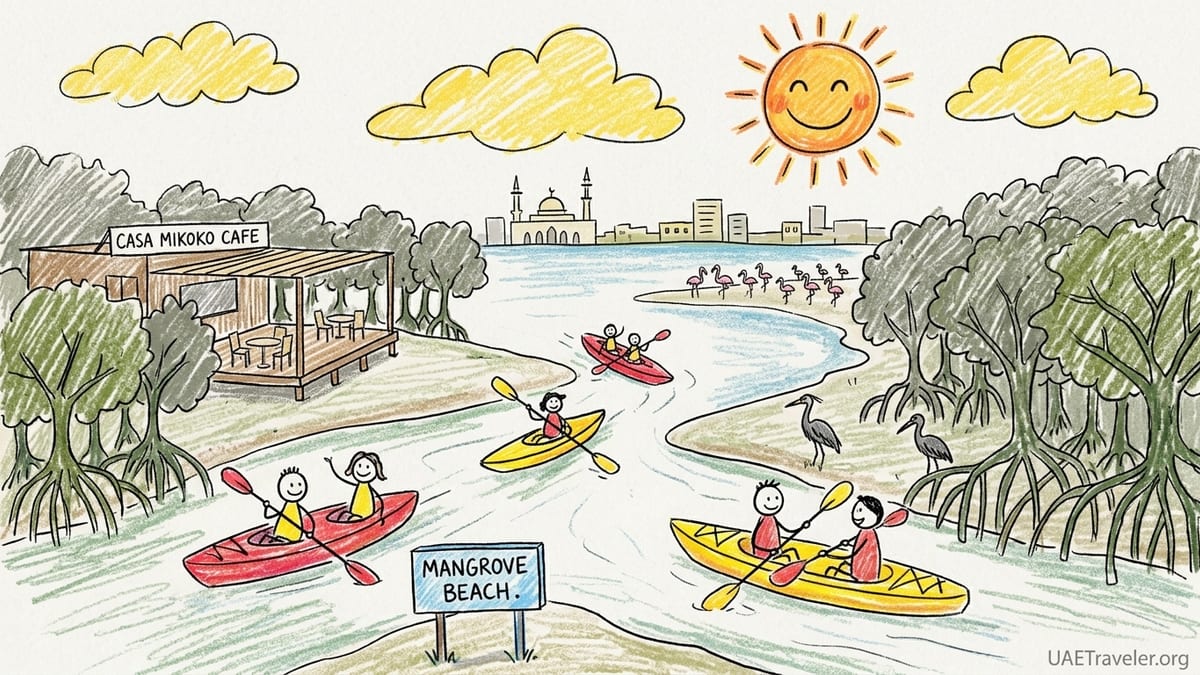
Getting There From Dubai, Sharjah and Ras Al Khaimah
I began the day in Dubai, leaving near Business Bay just after 6.30am to catch the high tide window at Mangrove Beach. It was a straightforward run: onto Sheikh Zayed Road, then north along E611 and across to Umm Al Quwain on the E11. In light early‑morning traffic, the drive took a little under an hour and fifteen minutes, including a stop for fuel near Sharjah. From central Sharjah itself you could expect about 45 minutes, and from Ras Al Khaimah city around 35 to 40 minutes following the coastal E11 south.
The turn‑off for Mangrove Beach is clearly signed once you pass through Umm Al Quwain town. A short paved section leads to a graded sand road that tracks along Khor Al Yeefrah, the tidal creek behind the beach. By 7.45am I was at the gate, where attendants collected the standard entry fee of 40 dirhams per car. They explained that the fee would be waived later if I spent at least 60 dirhams at Casa Mikoko, the on‑site café, which matched what regular visitors describe and what recent reporting on Mangrove Beach confirms.
Even at that early hour several local families were parked up with folding chairs and coolers, but the atmosphere felt relaxed and mostly quiet. Music from a couple of cars was low enough not to travel far across the water. Beyond the parked vehicles, the view opened onto a sheltered lagoon dotted with low mangrove islands and a long strip of pale sand curving towards distant Siniyah Island. It felt very different from the built‑up corniches of Dubai or Sharjah and immediately more like a small coastal town where life still moves at the pace of the tide.
For anyone driving from Dubai or Sharjah, the main planning consideration is timing your journey to the tour’s departure time, which in turn follows the tide. Operators at Umm Al Quwain confirm their exact start times the day before, often by WhatsApp, once they have checked the tide charts. Leaving the city early not only avoids traffic but makes it easier to line up with that crucial high‑water window.
Choosing a Tour and Booking the Kayak Experience
For this trip I booked a guided Kayak Mangrove Tour through Casa Mikoko, the café and watersports hub at Mangrove Beach. Their mangrove tours are widely referenced by independent UAE travel writers, who note that the standard outing runs about two hours and costs roughly 160 dirhams per adult and 100 dirhams per child, including kayak, paddle, life jacket and guide. Those figures matched what I was quoted when I contacted them directly two weeks before my visit.
The booking process was straightforward. I messaged the mobile number advertised for Mangrove Beach activities, received a reply within a few hours and was given a choice between an early‑morning and late‑afternoon slot on my preferred date. The operator highlighted that departure times moved with the tide and confirmed that for my weekend visit high tide in Khor Al Yeefrah fell just after 8.30am, so our group would launch around 8.15am to catch the rising water. Payment could be made in cash or card on the day; I chose cash and received a simple booking confirmation by WhatsApp.
Several other companies also run mangrove tours in Umm Al Quwain, including operators launching from beach clubs closer to town and day‑trip providers that package transport from Dubai with the kayaking experience. Their published prices as of 2026 sit broadly in the same range, around 150 to 200 dirhams per person for 90 minutes to two hours on the water. I opted for Casa Mikoko specifically because it launches directly from Mangrove Beach, which allowed me to see both the mangroves and the beachfront facilities in one visit.
When I checked in at the small watersports counter beside the café just after 8am, staff reconfirmed the price, collected my details and asked about swimming ability and prior kayaking experience. Although I have paddled in other parts of the Gulf, I noticed they gave equal attention to two first‑time paddlers ahead of me and to a family with young children joining the same tour. It felt like a genuine effort to match people to appropriate kayaks and to set expectations before we even reached the shoreline.
Facilities at Mangrove Beach and the Launch Point
Mangrove Beach itself is a simple set‑up compared with major private beach clubs elsewhere in the UAE, but it offers everything a paddler needs before and after a trip. Near the entry gate there is a large sandy parking area, rough but flat, with plenty of room even on a busy winter weekend. A cluster of small wooden kiosks and the Casa Mikoko café sit a short walk away, facing the lagoon.
The café has shaded outdoor seating on simple wooden decks overlooking the water, with a mix of picnic tables and cushioned low seating. During my visit it was serving breakfast dishes, coffee and cold drinks from around 7.30am. Prices were in line with a mid‑range café in Dubai, with a coffee and light breakfast together coming to just over 60 dirhams, enough to have the car entry fee waived. Showers and toilets for day visitors stand behind the café in a separate amenities block. The facilities were basic but clean: individual cubicles with running water, hooks and simple changing space. There are also open beach showers closer to the sand for rinsing off saltwater.
Near the waterline, a line of kayaks and stand‑up paddleboards rested on the sand under a shade structure. I could see a mix of single and double sit‑on‑top kayaks, all plastic hulls with scupper holes suited to shallow lagoon use rather than long‑distance touring. Paddles were stacked nearby and life jackets were hanging by size. Staff were actively checking buckles and tightening loose straps as people fitted their buoyancy aids, which gave a reassuring sense that equipment was not simply handed over and forgotten.
Our launch point was a gently sloping section of beach at the sheltered inner edge of the lagoon. Even at low tide the water here remains ankle to knee‑deep, but the guides explained that, deeper in the mangroves, channel access can shrink significantly as the tide falls. On the morning of my visit, the water was already on the rise by the time we carried the kayaks down to the shoreline, with a faint line of damp sand marking how much higher it would climb by mid‑morning.
Safety Briefing, Kayak Stability and Suitability for Beginners
Before anyone set foot in a kayak, our guide gathered the group in a semi‑circle on the sand. There were ten guests in total, including two children sharing a double kayak with their parents. That put us comfortably within the group sizes described in recent guides to Umm Al Quwain mangroves, which note that tours here often run with fewer than a dozen paddlers. The guide introduced himself, checked that everyone was wearing a properly sized life jacket and walked us through a concise but thorough safety briefing.
He covered three main points. First, the paddling route: we would follow the edge of the lagoon, enter a main mangrove channel, loop around several inner islets and then return along a slightly different path to avoid working directly against the wind. Second, communication and spacing: we were asked to stay behind his lead kayak, follow single‑file in narrower channels and stop paddling whenever he raised his paddle vertically, which would signal a pause. Third, environmental rules: no littering, no breaking or climbing on mangrove roots, no collecting shells or plants and no feeding birds or fish.
The kayaks themselves were wide, flat sit‑on‑top models with molded seats and backrests. When I rocked the kayak side to side in the shallows it felt noticeably more stable than the sleeker touring kayaks I have used elsewhere. The guide encouraged beginners to test this gentle rocking, explaining that while capsizes were always possible, the short, wide hulls were designed for novice paddlers. Double kayaks were assigned to couples and families, which both increased stability and allowed an adult to provide most of the power if a child tired.
Once on the water, the paddling effort proved modest. The lagoon was calm, with only a light wind rippling the surface, and the current inside the mangrove channels was gentle compared with open‑sea conditions. By the time we entered the first narrow channel, it was clear that even the two complete beginners in the group were managing their kayaks comfortably. They occasionally mis‑judged a turn and nudged branches, but the guide used those moments to quietly demonstrate how to back‑paddle and pivot without scraping roots. For fit first‑time paddlers, the route felt entirely achievable, more like an extended, low‑impact arm workout than a test of stamina.
Inside the Mangroves: Tidal Channels, Mudflats and Wildlife
As we left the more open water near the beach and slipped into the first mangrove channel, the temperature seemed to drop a degree or two. The canopy of Avicennia marina, the grey mangrove that dominates these forests, filtered the sun so the light on the water became speckled and green. A faint smell of salt and mud replaced the broader sea breeze. The guide pointed out the pencil‑thin aerial roots, or pneumatophores, rising from the mud on either side of the channel. These roots, he explained, allow the mangrove to breathe in waterlogged, low‑oxygen soils, and they are easily damaged by trampling.
On either side, the banks were a patchwork of exposed mudflats and flooded shallows. At the higher parts of the bank, small crabs darted between roots, their movement betraying them long before their bodies were clearly visible. In the slightly deeper pools, we could see schools of small fish flashing in the filtered light. The water here is fully saline, part of the same tidal system that feeds the open Gulf, so fish and invertebrates are adapted to saltwater, not freshwater. The guide noted that this mix of mudflats, saltwater creeks and sheltering roots provides nursery habitat for many fish species that later move into deeper offshore waters.
Birdlife appeared gradually rather than in dramatic bursts. Ten minutes into the channel we passed a western reef heron standing motionless at the edge of a pool, its dark grey body almost melting into the background until it flicked its head to spear a fish. A little further on, an egret lifted from a low branch ahead of us, bright white against the darker foliage. In the distance, scattered along a sandbar exposed by the falling tide in the outer lagoon, I could make out a thin cluster of flamingos. They were far enough away that only their posture and pale pink wash were clear to the naked eye, but through the guide’s small binoculars their bent bills and slow, sweeping feeding motion were unmistakable.
Closer to our kayaks, the most common sounds were the plop of a fish jumping and the soft rasp of paddle blades entering the water. Motorboat noise was almost entirely absent once we moved behind the first line of mangrove islands. The guide said that some fishing boats use channels further out in the lagoon but that our particular route was chosen to avoid them as much as possible. That absence of engine sound is one of the most striking differences between the Umm Al Quwain mangroves and the busier coastal strips of Dubai and Sharjah, where jetskis, party boats and beach club speakers often fill the background with a permanent hum.
Why the Tide Matters and What High Water Opens Up
During a pause in a wider pool, the guide used the setting to show us why timing these trips around high tide is so important. He pointed to the line of darker, still‑damp bark on the mangrove trunks, roughly at eye level from the kayak seat, and explained that this marked the approximate height of the previous high tide. At that point, he said, many of the small side channels we were looking at would have been fully navigable, allowing kayaks to slip between stands of roots and explore shallow backwaters. As the tide dropped, which we could actually watch happening over the course of our two‑hour trip, some of those channels narrowed into ankle‑deep trickles or even dry mud banks.
He noted that if we had launched a couple of hours later, closer to low tide, the route would have been very different. We might have found ourselves scraping over sandbars, stepping out to drag kayaks through sticky mud or simply unable to enter some of the shallower tributaries. Low water also concentrates both fish and birds in fewer channels and pools, which can sound like an advantage but in practice risks crowding wildlife. A well‑timed high tide spreads activity out more gently and lets kayakers move quietly over areas that would otherwise be off‑limits without churning up the bottom.
From a safety perspective, high tide also provides more margin for error. In deeper water, a misplaced paddle stroke or slow reaction to a gust of wind is less likely to result in a grounded kayak or scraped hull. For first‑time paddlers, especially families, this makes a real difference. It was easy to see how a beginner who enjoyed this calm high‑tide outing might leave confident and enthusiastic, whereas the same person stuck in mud at low water could walk away feeling frustrated and unlikely to try again.
By the time we began looping back toward the main lagoon, narrow shelves of mud had started to appear below some roots and the tips of more pneumatophores were poking above the surface. The guide quietly sped us up through one particularly shallow stretch, asking everyone to paddle a little harder for thirty seconds so we could clear a sill before it became uncomfortably shallow. It was a practical, real‑time demonstration of the tidal advice that many online guides give in more abstract terms.
Responsible Behavior in a Fragile Tidal Forest
One of the strongest themes of the tour, and one that the guide returned to several times, was how to behave responsibly in such a sensitive environment. He reminded the group that mangrove roots are living tissue, not just convenient handholds. Climbing onto them to pose for photographs, a habit that has become unfortunately common in some social media feeds from other mangrove sites, not only snaps individual roots but can stress entire sections of a tree by compacting the surrounding mud.
The same applied to shells and other natural objects. As we passed a small shell bank where the tide had dropped, the guide pointed out several attractive shells and fragments but asked us to leave them in place. In a system where nutrients are limited and much of the wildlife depends on recycled calcium from shells and skeletons, removing souvenirs in volume can slowly strip the mudflats of key building blocks. It also reduces the number of places that small crabs and other organisms can shelter.
Bird disturbance was another concern. When we skirted the sandbar where the flamingos were feeding, the guide deliberately kept the group at a respectful distance in deeper water and asked everyone to speak quietly. He explained that frequent flushing, where birds are repeatedly forced to take off and relocate, burns through their energy reserves and can be especially harmful during migration and winter when food needs are high. That is one reason why motorboat access is restricted or discouraged in some parts of Khor Al Beidah and Khor Umm Al Quwain, while low‑impact paddling routes are promoted instead.
Feeding wildlife, a temptation whenever fish congregate near kayaks or crabs scuttle close to the waterline, was clearly discouraged. The guide said that tossing bread or leftover snacks into the water can alter animal behavior, concentrating them unnaturally and encouraging dependence on human food. It also risks introducing ingredients that are not part of their natural diet. The unromantic but essential rule on our tour was simple: everything we brought in, including food packaging and water bottles, went back out with us in the kayaks.
Comparing Mangrove Paddling With UAE Beach Resorts
By the time we glided back into the more open water near Mangrove Beach, the day‑use area on shore had grown much busier. More cars lined the parking area, music from a few portable speakers carried faintly over the water, and children were splashing in the shallows. Kayaks and stand‑up paddleboards for hourly rental, typically 75 dirhams for a single and 100 dirhams for a double, were heading out in small groups without guides, staying mainly in front of the beach rather than venturing deep into the mangroves.
Even with this livelier atmosphere near the launch point, the contrast with larger, more commercial UAE beach resorts was striking. There were no thumping DJ sets, no jetskis pulling inflatables in tight circles and no rows of concrete towers looming immediately behind the sand. Facilities at Mangrove Beach are modest to mid‑range rather than luxurious, and the experience leans more toward nature than spectacle. That lower level of development is exactly what allows the mangrove channels a few hundred meters away to feel as peaceful as they do.
Other waterfront venues in Umm Al Quwain, such as beach clubs attached to hotels closer to town, follow a more classic resort model with higher access fees, permanent loungers and more structured entertainment. Some of those also offer kayak rentals and paddleboarding on the lagoon, and for travelers who want a full set of resort comforts they can make sense. For a dedicated mangrove immersion, however, starting directly from Mangrove Beach meant the quietest paddling and the shortest crossing distance to dense mangrove stands.
For me, the greatest pleasure of the outing was that ability to move from a simple beach café breakfast to a surprisingly wild, bird‑filled channel in less than fifteen minutes of paddling. It is not a wilderness in the strictest sense, but for anyone used to Dubai Marina or Jumeirah Beach Residence as their reference point for the Gulf coast, Umm Al Quwain’s mangroves genuinely feel like a different country.
Practical Gear, Clothing and Total Trip Costs
In terms of clothing and gear, the essentials here mirror recommendations from local operators and my own experience on the water. I wore lightweight quick‑dry shorts, a synthetic T‑shirt with long sleeves, a hat with a neck flap and open sandals that could handle getting wet. A high‑SPF, reef‑safe sunscreen went on about 30 minutes before launch and again after the tour, particularly on the tops of legs and feet which are very exposed when sitting in a kayak. Sunglasses with a strap were invaluable once the sun rose higher above the mangrove canopy.
Even though splashes on a calm day are minimal, I brought a small dry bag to protect my phone and a compact camera. The operator also supplied a limited number of communal dry barrels on shore for valuables, but keeping the essentials clipped to the kayak felt simpler. Casa Mikoko provided the kayaks, paddles and life jackets, all in good condition and clearly sized for different body types. I did not see any helmets, which aligned with the flat, low‑risk nature of the route, though people with medical conditions or non‑swimmers should raise any concerns during booking.
Changing facilities at Mangrove Beach were adequate for a couple of clothing changes. I arrived already in paddling clothes, used the beach shower to rinse off afterwards and then changed into dry clothes in one of the cubicles behind the café. Water pressure and drainage were both acceptable, though heavy weekend use can mean queues at peak times.
For a couple driving from Dubai and replicating my day, the rough cost breakdown in late 2026 would be as follows: around 160 dirhams per person for the guided kayak tour itself, 40 dirhams gate entry waived if at least 60 dirhams are spent at the café, perhaps 80 to 120 dirhams on breakfast or drinks for two at Casa Mikoko, and roughly 60 to 80 dirhams in fuel for the return drive depending on vehicle. That brings the total to somewhere around 520 to 600 dirhams for two people.
For a family of four, assuming two adults and two children on the same tour, with children priced at around 100 dirhams each, the kayaking portion would come to roughly 520 dirhams. Adding a similar café spend to offset the entry fee and slightly higher fuel costs, the full day could fall near the 700 to 800 dirham mark. These numbers can shift a little with seasonal price changes or special offers, but they reflect the ballpark figures quoted across multiple current sources and what I observed on site.
The Takeaway
Kayaking through the mangroves at Umm Al Quwain turned out to be less about adrenaline and more about attention. Compared with a day at a large UAE waterpark, where the goal is to squeeze in as many rides as possible, a mangrove paddle revolves around moving slowly enough to notice the angle of a heron’s neck, the way roots lace through the mud and the subtle pull of the tide beneath the kayak. It demands just enough physical effort to feel like an outing yet remains accessible to first‑time paddlers and families, provided they follow the guide’s instructions.
From an ecological perspective, the trip deepened my understanding of how much work these coastal forests quietly perform. The guide’s explanations, backed up by what is known about Khor Al Beidah and the wider Umm Al Quwain lagoon system, highlighted the mangroves’ role in stabilizing shorelines, filtering water and providing nursery habitat for fish and invertebrates. Seeing tiny fish shelter under roots that, at high tide, floated our kayaks above them made that abstract idea tangible. It also underscored why seemingly small actions, like trampling pneumatophores or removing shells, can have outsized impacts over time.
In terms of value, the experience felt fairly priced when stacked against other coastal activities in the UAE. A two‑hour guided nature experience at around 160 dirhams per adult sits comfortably below what many urban attractions charge for a similar duration, yet includes equipment, safety oversight and an environment that, for now, remains relatively uncrowded. For visitors who prioritize connection with nature over high‑density entertainment, it represents good value, especially when combined with a relaxed beach morning or an overnight camping stay at Mangrove Beach.
What surprised me most was not the paddling itself, which was gentle, but the small challenges that come with working around the tide and respecting a living landscape. Launching early meant a pre‑dawn alarm in Dubai. Steering carefully in tight channels called for more concentration than I had expected. Resisting the urge to edge closer to wildlife for a perfect photograph required a conscious decision to put the animals’ comfort ahead of social media. None of these were major obstacles, but they reminded me that responsible nature tourism always asks a little more of us than passive sightseeing.
Would I return for a longer guided trip? Yes, and next time I would aim for a winter weekday at first light, when both air temperatures and bird activity are at their best and human numbers are smallest. A three‑hour route deeper into the waterways of Khor Al Beidah, perhaps combined with shore time for guided birdwatching, would build on what I learned during this first outing. For now, though, the memory that stays with me is simple: the quiet dip of the paddle, a heron lifting off ahead of the bow and the sense that, for a couple of hours at least, the UAE’s quieter coast revealed one of its most rewarding secrets.
FAQ
Q1. Is mangrove kayaking at Mangrove Beach suitable for complete beginners?
Yes. The sit‑on‑top kayaks used at Mangrove Beach are wide and stable, the water is calm, and guides tailor the pace for first‑time paddlers, including families with children.
Q2. What is the best time of day and year to go kayaking in Umm Al Quwain?
Early mornings from October to April are ideal, when temperatures are cooler, birdlife is more active and operators can align tours with favorable high‑tide windows.
Q3. How much does a guided mangrove kayak tour cost?
As of late 2026, expect to pay around 160 dirhams per adult and 100 dirhams per child for a two‑hour guided tour, including kayak, paddle, life jacket and guide.
Q4. Can I paddle the mangroves on my own without a guide?
Hourly kayak rentals are available near the beach for about 75 dirhams for a single and 100 dirhams for a double, but access and routes may be more limited and you must still respect all local rules.
Q5. Do I need to know how to swim to join a mangrove kayak tour?
Basic water confidence helps, but non‑swimmers can usually join if they wear a properly fitted life jacket and inform the guide in advance so they can receive extra attention.
Q6. What wildlife can I realistically expect to see?
You are likely to encounter herons, egrets, small fish, crabs and other shorebirds. Flamingos are present seasonally and often viewed from a distance on sandbars in the outer lagoon.
Q7. What should I wear and bring for the trip?
Lightweight quick‑dry clothing, sandals that can get wet, a hat, reef‑safe sunscreen, sunglasses with a strap and a small dry bag for phone and valuables work well in these conditions.
Q8. Are there showers, toilets and changing facilities at Mangrove Beach?
Yes. Basic but clean toilets, enclosed changing cubicles and outdoor beach showers are available near Casa Mikoko, along with shaded café seating overlooking the lagoon.
Q9. How important is the tide for planning my kayak outing?
Very important. High tide opens shallow channels and makes paddling smoother, while low tide can leave routes too shallow or muddy to enter. Operators set departure times around the tide.
Q10. Is a mangrove kayak tour good value compared with UAE beach resorts and waterparks?
For the price of a mid‑range outing, you get two hours of guided nature time, use of all equipment and a quiet, wildlife‑rich setting that contrasts strongly with busier resort beaches.