


Before I formed an opinion on the UAE’s desert experiences, I forced myself to do both sides properly: a full, shared-evening Dubai desert safari with hotel pickup and a complete overnight adventure deep in Abu Dhabi’s Empty Quarter near Liwa Oasis. Only after being bounced around in a 4x4 outside Dubai and then watching the Milky Way rise over Moreeb Dune did the real differences become clear. These are not interchangeable experiences. They suit very different kinds of travelers, budgets and expectations.
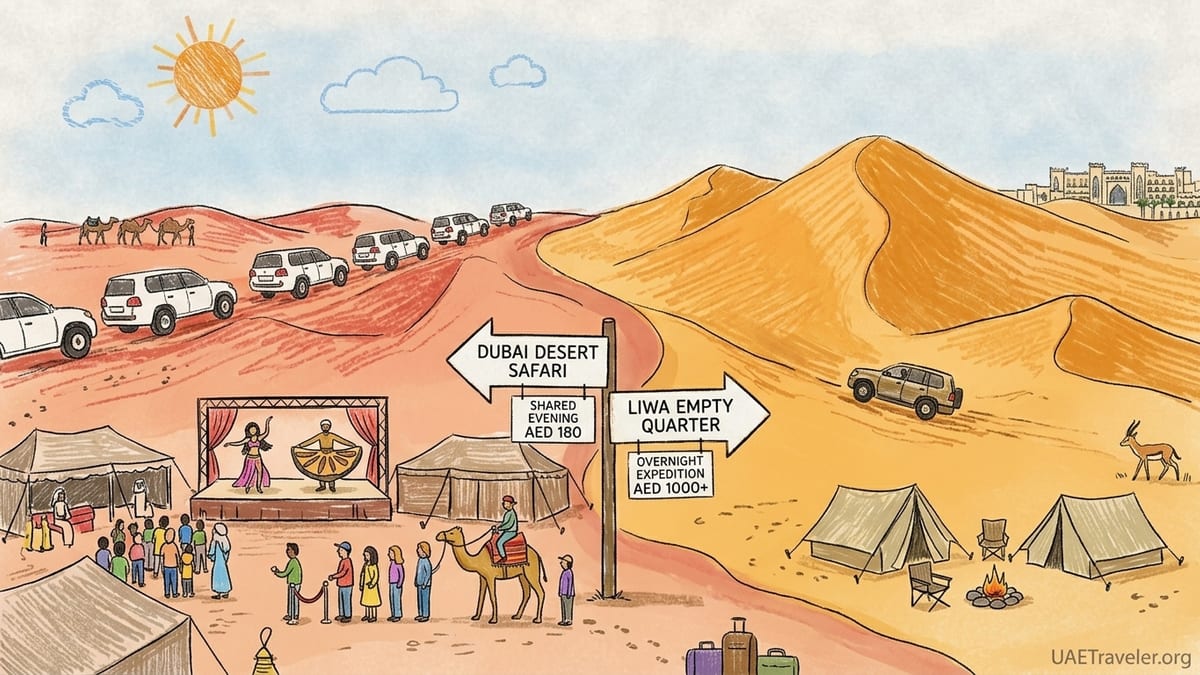
Setting Expectations: What Most Travelers Imagine vs What Actually Happens
Many visitors land in Dubai imagining golden dunes, a serene camel ride at sunset and a sky full of stars. They book the first “desert safari” their hotel concierge or ride-hailing driver recommends, often for somewhere between AED 130 and AED 250 per person for a shared evening safari with hotel pickup, dune bashing and a buffet dinner. In 2026 that is the realistic price range for a standard shared experience, and it usually delivers exactly that: a busy but fun evening in the sand, not solitude in the wilderness.
Liwa, on the other hand, lives more in the imagination than in the average tourist brochure. The Liwa Crescent and the nearby stretch of the Rub al Khali are three to four hours’ drive from Abu Dhabi city, at the very edge of the road network. Overnight guided camping or a stay in a resort such as Qasr Al Sarab Desert Resort by Anantara typically costs several times more than a Dubai evening safari once you factor in the longer transport, higher fuel use, limited infrastructure and specialist 4x4 guiding. Expect the bill for two adults to resemble a short luxury break, not a simple evening excursion.
Going into my Dubai safari, I expected something slightly commercial but still atmospheric. For Liwa, I expected uncomfortable driving, spartan facilities and transcendent desert scenery. What I found was the opposite in some areas and exactly on target in others. The contrast only became obvious when I looked at every stage of the experience side by side.
The key is to understand that a six-hour shared Dubai safari and a 24-hour Liwa escape are built for different purposes. One is designed to compress “desert” into a single affordable afternoon and evening for as many visitors as possible. The other is an intentionally remote experience that trades convenience and price for scale, silence and a sense of genuine wilderness.
My Dubai Desert Safari: Operator, Pickup, Dune Bashing and Camp Life
For Dubai, I booked a mainstream shared evening desert safari with a direct operator that runs its own fleet of Toyota Land Cruisers and Nissan Patrols rather than reselling other companies’ tours. The package was typical of the 2026 market: about AED 180 per adult in a shared 4x4, including hotel pickup anywhere in central Dubai, roughly 25 minutes of dune bashing in the Lahbab red dunes area, a sunset stop, a public desert camp with buffet dinner, soft drinks, short camel rides, henna, shisha corners and the usual belly dance, Tanoura and fire show lineup.
Pickup was from my hotel lobby in Business Bay around 2.45 pm. The driver had already collected two guests from Deira and one from Jumeirah, so we were a full car of six plus the driver. Roads were smooth, and about 50 minutes later we turned off the highway toward the Lahbab dunes where a loose convoy of 4x4s from different operators aired down their tires at a roadside meeting point. This is the first moment many travelers realize how industrialized the Dubai safari scene has become. Dozens of nearly identical white SUVs, each with a company logo, line up nose to tail waiting for their turn to head into the sand.
The dune bashing itself was genuinely fun. Our driver was licensed and clearly experienced, using the natural ridges and bowls of the dunes to create steep side slopes and short climbs. The ride lasted just over 20 minutes, which matches what many operators advertise in 2026 as the standard dune-drive duration on a shared safari. It is intense but controlled rather than extreme off-roading. Guests who felt queasy were encouraged to sit in the front or skip the most aggressive portions. Wildlife sightings were limited to a few distant camels near a fence line and a single lizard briefly glimpsed scurrying across the sand.
By sunset we were at a busy camp framed by low dunes. Here the experience shifted fully into entertainment mode. There were lines for the included short camel walk (essentially a five-minute loop), optional quad biking at an extra cost, henna stations, a sandboard on a small slope, tea and dates, shisha available for a modest surcharge at some tables and a central stage. Dinner was a large buffet with grilled meats, rice dishes, salads and basic desserts. The shows were energetic but clearly choreographed for mass tourism. From pickup to drop-off, the evening took about seven hours.
The Liwa Journey: Distance, Guides and the Empty Quarter’s Scale
Liwa required a very different level of commitment before I even saw a dune. I arranged an overnight Liwa safari starting and ending in Abu Dhabi city, using a specialist operator that focuses on the Western Region and the edge of the Empty Quarter. The quoted rate was just under AED 1,000 per adult for a small-group overnight trip including hotel pickup in Abu Dhabi, all transport in a fully equipped 4x4, camping gear, meals and dune driving around Liwa Oasis and the surrounding sands. Private tours or fully bespoke expeditions can cost considerably more, particularly if you request fewer guests per vehicle or additional activities.
Pickup from my Abu Dhabi hotel was at 1.30 pm, and it took nearly three hours on good tarmac roads before the landscape changed dramatically. After passing through the last service stations and date farms of the Liwa Crescent, the dunes grew taller and more complex, rising in long ridges and sweeping curves that made Dubai’s dune fields look modest by comparison. Our guide stopped to air down the tires and walk us through basic safety rules. He carried a compressor, sand ladders, tow ropes, a shovel and a satellite-based communication device, and drove a well-maintained Land Cruiser with low-range gearing and all-wheel drive engaged.
This is where Liwa’s reliance on competent off-road guiding becomes real. The Rub al Khali’s dunes can be extremely soft, tall and disorienting. Tracks shift with the wind and there are very few landmarks once you leave the main roads. Even as a passenger, it was obvious that route-finding here is a serious skill. We climbed and descended high slipfaces, skirted bowls that would trap an inexperienced driver and followed ridgelines that demanded precise throttle control. In contrast to Dubai’s carefully choreographed 20-minute dune runs, this felt like genuine travel across the desert, albeit still managed and relatively cautious.
After a circuit that included views over parts of the Liwa Crescent and, in the distance, the area known for Moreeb Dune, we reached our campsite at the base of a large dune away from any visible roads or other groups. There were no permanent structures, just a cluster of supported tents, a cooking setup, chemical toilets behind screens and a fire pit. We saw no other vehicles after leaving the blacktop, which immediately differentiated Liwa’s sense of isolation from the convoy traffic of Dubai’s safari zones.
Sleeping in the Sand: Serviced Camping vs Qasr Al Sarab–Style Luxury
For this trip I chose serviced camping rather than a resort stay to focus on the desert itself. The tents were already pitched, with foam mattresses, simple bedding and solar-powered lanterns. Dinner was grilled over charcoal and served family-style. There were camp chairs around the fire and a cooler with soft drinks and bottled water. Facilities were basic but thoughtfully handled. It was not a luxury camp, but it felt quiet, personal and far removed from the stage lights and amplified music of Dubai’s safari camps.
On a separate visit to the Liwa region I stayed at Qasr Al Sarab Desert Resort by Anantara, a well-known five-star desert property accessible by paved road but surrounded by high dunes on all sides. The resort functions almost like a self-contained oasis, with its own restaurants, spa, pool and a full activities program that can include guided desert walks, camel treks, fat biking, archery and falconry displays. The experience there is very different from camping: you have hot showers, fine dining, air conditioning and private terraces looking out over undulating sand.
Price is the clearest divider. While rates fluctuate, a night for two at a premium resort like Qasr Al Sarab typically moves into the thousands of dirhams once taxes, meals and some activities are included, putting it well above a simple serviced Liwa camp. In return you gain comfort, structured activities and the security of a property that maintains its own access roads, guides and emergency procedures. What you potentially lose is the rawness of waking up with sand on your boots and coffee brewing over a gas stove while the first light hits untouched dunes.
Comparing these Liwa options with Dubai’s shared safari camps underscores that accommodation shapes the entire impression of “the desert.” A shared Dubai camp gives you crowds and color. Serviced Liwa camping gives you simplicity and silence with modest comfort. A luxury resort in the Empty Quarter delivers high-end hospitality framed by genuine dune vistas but softens the sense of exposure. None is inherently better, but each matches a different traveler profile and budget.
Landscapes, Solitude, Dark Skies and Wildlife: How The Deserts Actually Felt
Visually, the Dubai safari dunes near Lahbab were attractive, with warm-toned sand and sculpted ridges that photograph well, especially at sunset. Yet the scale remained human. You could always see other vehicles, fences or distant electricity pylons on the horizon. The sense was of a recreational area used intensively for tourism rather than a true frontier. Nighttime darkness was partial; camp lights, music and vehicle headlights kept the sky from feeling fully remote, though a reasonable number of stars were visible between the stage shows.
In Liwa, the dunes felt almost geological in their ambition. Long, parallel ridges extended beyond view, and the slipfaces were significantly higher and steeper than anything I had seen on Dubai’s standard routes. From some vantage points, all I could see was sand: no power lines, no roads, no farmhouse lights. At our Liwa campsite, once the cooking lanterns were dimmed and the fire settled, the darkness felt thicker and more enveloping. The sky was busy with stars, but I will not promise perfect Milky Way views for every visitor since conditions depend heavily on moon phase, humidity and occasional haze. Even so, the quality of the night felt more like a true desert than a recreational site.
Wildlife encounters on both trips were modest but telling. On my Dubai safari, the only animals we saw were working camels and falconry birds brought specifically for photos. In Liwa, we did not stumble across herds of gazelles on command, but over several hours of driving and walking we noticed small tracks in the sand, a fox print near camp and a few beetles scuttling between ridges. Nearby conservation-focused properties sometimes see oryx or more birdlife, but these are not guaranteed sightings. Any operator promising abundant wildlife on a tight schedule should be treated with caution.
For photographers, the key distinction was control and time. In Dubai, there was a single sunset stop shared by multiple vehicles, with a few minutes allocated and people constantly walking into each other’s frames. In Liwa, we could linger on a crest waiting for subtle changes in light without anyone rushing us back for a show. The quality of images from Liwa, especially around first light and late evening, was on an entirely different level, not because Dubai’s dunes are unattractive but because the Liwa experience builds space around the photography.
Commercialization, Comfort and the True Cost of Each Experience
Every Dubai shared evening safari I have researched and the one I joined are built around volume. Operators must move large numbers of guests with limited vehicles, so itineraries are tight. Dune bashing is usually timed to about 20 to 30 minutes, camel rides are short, and dinner plus shows are compressed into roughly two hours before the convoy returns to the city. Camps are often shared or adjacent, leading to crowding at buffets, restrooms and staging areas. It can still be enjoyable, but it is explicitly commercial.
The benefit of that commercialization is cost control and comfort. For under AED 200 per adult in 2026, a guest receives hotel pickup, air-conditioned transport, supervised dune driving, a full buffet, soft drinks and entertainment. Vehicles carry basic safety equipment, drivers are required to hold desert-driving permits, and mobile coverage is generally available. For families with limited time, this trade-off is often acceptable, even if the atmosphere feels more theme park than wilderness.
Liwa flips the equation. The long journey, smaller group sizes, higher fuel consumption and need for highly experienced 4x4 guides all increase the price. Even a relatively simple serviced camping itinerary from Abu Dhabi can approach AED 900 to 1,200 per adult once all inclusions are factored in, and prices can climb higher for private tours or premium tents. Facilities are fewer and more basic. You may have portable toilets instead of built restrooms, limited charging points for electronics and no immediate access to shops. The comfort level depends heavily on the operator’s attention to details such as bedding quality, shade and food.
Unexpected expenses can catch unwary travelers on both sides. In Dubai, low advertised prices sometimes do not include quad biking, “VIP seating,” full table service or certain beverages, leading to a parade of upsells at camp. In Liwa, last-minute requests for private transport, additional safety gear or upgrades to more comfortable tents can add several hundred dirhams to the bill. In both cases, asking for a detailed list of inclusions before paying any deposit is essential if you want to avoid surprises.
Nighttime Magic: Where the Desert Felt Most Special After Dark
The single most memorable part of my Dubai safari night was not the stage shows but a brief period when the generator faltered and the main lights dimmed, leaving only lanterns and the soft glow of coals from the grill. For a minute or two, everyone lowered their phones and there was a hint of desert stillness under the stars. Then the music resumed, lights came back, and we were once again at a dinner show in the sand. It was enjoyable and sociable, but not transformative.
Liwa’s night felt like another world. After dinner, our small group climbed a nearby dune without headlamps, letting our eyes adjust. The sand underfoot was cool and slightly crusted after a breezy evening. There was no amplified sound, only the wind and the occasional clink from the campsite. We lay back at the crest, watching satellites track silently overhead and noticing how the horizon glowed faintly in the direction of distant towns while the zenith remained dark. Sitting there, it was easy to believe the stories of traders and explorers who once crossed these same sands.
In a resort setting such as Qasr Al Sarab, nighttime falls somewhere between these extremes. You can sip tea on a terrace looking out at silhouetted dunes, walk along softly lit pathways and perhaps join an organized stargazing session. The experience feels curated and safe but still connected to the desert atmosphere, particularly if you choose a room or villa with an unobstructed view. For many travelers, especially couples and families, this blend of comfort and desert mood hits the ideal middle ground.
None of these nights are guaranteed to be perfect. Clouds, haze, bright moonlight and even dust storms can dull the stars. Crowding can affect the mood in both Dubai camps and certain popular Liwa viewpoints. The key difference is that Liwa gives you the possibility of a long, quiet night where the desert itself is the main event, while Dubai’s shared safaris keep the focus on a structured evening of entertainment.
Safety and Why Independent Desert Driving Is A Bad Idea For Most Visitors
Both my Dubai and Liwa experiences reinforced one lesson: casual visitors should not attempt independent desert driving. Even in the relatively tame dune fields used by Dubai operators, vehicles can and do become stuck, overturned or stranded when driven by inexperienced hands. Professional guides use techniques that rely on muscle memory, mechanical sympathy and an understanding of how sand behaves under different temperatures and moisture levels. They carry compressors, recovery boards, tow straps and often drive in loose convoys so that one vehicle can assist another.
In Liwa and the wider Empty Quarter, the stakes are higher. The dunes are taller, the sand often softer and more variable, and the distances between paved roads and help points significantly greater. Navigation is not obvious, and GPS routes can be misleading when dunes drift or tracks vanish. A simple misjudgment of a slipface angle or an attempt to crest a dune at the wrong speed can leave a vehicle dangerously tilted or buried. Without another 4x4 to assist, recovery can be extremely difficult for amateurs, especially in high heat.
If you genuinely want the experience of driving in the dunes, the safest approach is to book a professional training session in a controlled environment or to take turns at the wheel under the supervision of an instructor in an operator’s vehicle. Under no circumstances should visitors in rental saloons or unmodified SUVs leave the tarmac on their own with only a basic roadside kit. The cost of proper guiding and recovery gear is far lower than the risk to your safety and the expense of rescuing a stranded vehicle.
Walking alone into the dunes at night is also inadvisable in both regions, particularly for those unfamiliar with desert orientation and temperature swings. In Dubai and Liwa alike, staying within earshot and sight of your guide or camp and letting someone know if you wander off to photograph or stargaze is a simple precaution that preserves the joy of the desert without unnecessary risk.
Which Would I Book Again: Evening Dubai Safari vs Full Overnight Liwa
When I line up the two experiences, a pattern emerges. The Dubai safari was social, efficient and good value. It delivered what it advertised: a half day with pickup, a fun 4x4 ride, classic camp activities and dinner with entertainment. It worked well as a first taste of the desert, especially for travelers on a tight schedule or budget. I would happily accompany friends or family who had never been before, particularly if I could steer them toward a reputable operator and a slightly less crowded camp.
Liwa, however, felt like the desert I had always imagined. The size of the dunes, the absence of crowds, the quality of the light and the long, unbroken stretches of quiet added up to an experience that lingered long after the trip ended. The cost, time commitment and basic comfort level of serviced camping are significant barriers, but for anyone who truly cares about landscapes, photography or a sense of remoteness, they are worth accepting. A luxury Liwa resort provides a more polished version of the same setting and is particularly appealing for those who want wilderness in view but not necessarily under canvas.
If I had to choose one to repeat for myself, the answer would be an overnight in Liwa with a competent specialist guide, ideally with at least two nights in the region to justify the drive. For visiting relatives on a short stopover or travelers unsure about desert travel, I would still recommend a well-reviewed Dubai evening safari as an accessible introduction. The key is to recognize that they are not competing products at all, but steps on a spectrum from entertainment in the sand to genuine desert immersion.
From a cost perspective, a single evening safari for two adults in Dubai might total around AED 400, including a few small add-ons at camp. A comparable overnight Liwa trip for two can easily start around AED 2,000 and climb quickly with private arrangements or resort stays. That price difference mirrors the contrast in time spent, distances traveled, infrastructure needed and the degree of solitude you are buying.
The Takeaway: Who Should Choose Which Desert Experience
After completing both a mainstream Dubai evening safari and an overnight Liwa Empty Quarter trip, my verdict is that neither is universally “better.” Each is a tool for a different kind of journey. Dubai’s desert safaris condense the idea of the desert into an entertaining, affordable half day that fits seamlessly into a city-focused itinerary. Liwa offers a slower, deeper encounter with one of the world’s great sand seas, at the price of more money, more time and fewer guarantees of comfort.
If you go into a shared Dubai safari expecting a quiet night under the stars, you may be disappointed by the crowds, the short activity windows and the overt commercialization. If you head to Liwa expecting a smooth, resort-like experience at standard excursion prices, you may be surprised by the long drive, the higher costs, the basic facilities of many camps and the reliance on your guide’s judgment. Match your expectations to the reality and both can be memorable for the right reasons.
My strongest practical recommendation is simple: choose one based on what you value most. If your priority is ticking “desert” off your list while keeping your base in Dubai, book a reputable evening safari, clarify the inclusions in writing and enjoy it for what it is. If your priority is space, silence and serious dunes, carve out at least one night for Liwa, travel with a proven specialist guide and prepare for conditions that feel closer to a small expedition than an add-on activity.
Either way, treat the desert with respect. Listen to your guides, avoid independent driving unless you have the training and equipment, and remember that beyond the buffets and campfires lies an environment that can be both fragile and unforgiving. That awareness, more than any particular itinerary, is what turns a trip into the dunes into a lasting travel memory.
FAQ
Q1. Is a Dubai desert safari suitable for young children and older travelers?
Yes, standard shared evening safaris in Dubai are generally suitable for families, but those with very young children, pregnant guests or older travelers with back or heart issues should ask to skip or soften the dune bashing segment. Many operators can arrange gentler driving or direct transfer to camp if requested in advance.
Q2. How long does it take to reach Liwa from Abu Dhabi and Dubai?
From central Abu Dhabi, the drive to Liwa Oasis usually takes around three hours each way on good roads. From Dubai, you should allow roughly five hours including a connection through Abu Dhabi or direct highways toward the Western Region, which is why most Liwa trips start and end in Abu Dhabi rather than Dubai.
Q3. How much should I budget for a Dubai evening desert safari in 2026?
In 2026, realistic prices for a shared evening desert safari with hotel pickup, dune bashing, buffet dinner and standard shows are often between AED 130 and AED 250 per adult, with private 4x4 options starting higher. Very low headline prices can indicate heavy upselling or overcrowded camps, so it is wise to read recent reviews before booking.
Q4. How expensive is an overnight Liwa trip compared with Dubai?
An overnight Liwa trip from Abu Dhabi with small-group transport, guided dune driving, basic serviced camping and meals can start around AED 900 to 1,200 per adult and rise for private tours. Luxury resort stays in the Liwa region are typically more expensive again once room rates, meals and activities are included, making Liwa a significantly higher investment than a single evening safari in Dubai.
Q5. Do I need special clothing or gear for either desert experience?
For both Dubai and Liwa, lightweight breathable clothing, a hat, sunglasses and closed shoes that can handle sand are sufficient. For Liwa, it is sensible to bring a light jacket for cooler nights, a headlamp, extra camera batteries and any personal medications, since you will be farther from city pharmacies and shops once you leave the main roads.
Q6. Will I definitely see lots of stars and wildlife in Liwa?
No, there are no guarantees. Liwa’s remoteness and low light pollution improve your chances of darker skies and subtle wildlife signs, but conditions depend on factors such as moon phase, humidity and seasonal movements of animals. Consider any clear night and small wildlife encounters a bonus rather than a promise.
Q7. Is it safe to go camping in Liwa as a first-time visitor?
Camping in Liwa can be safe and rewarding when arranged through an experienced operator that provides competent guides, proper vehicles, navigation equipment, water supplies and emergency procedures. Attempting independent camping without these elements is strongly discouraged for first-time visitors, as the Empty Quarter’s environment is much less forgiving than Dubai’s well-used safari zones.
Q8. Can I book a desert safari directly through my hotel?
Yes, most hotels in Dubai and Abu Dhabi work with partner operators to arrange desert safaris. This is convenient, but prices can be higher and you may have limited choice over the specific camp. If you care about a particular style of experience, such as smaller groups or conservation-focused tours, it can be worth identifying a reputable operator first and confirming whether your hotel can book with them.
Q9. Which experience is better for photography, Dubai or Liwa?
Dubai’s desert gives you easy access to photogenic dunes and classic sunset shots but often with many other visitors in frame and limited time at each stop. Liwa offers more dramatic dune formations, longer windows of good light and far fewer people, which together make it considerably better for serious landscape and night-sky photography if you are willing to invest the extra time and cost.
Q10. How should I choose between a serviced Liwa camp and a luxury resort?
If you prioritize immersion in the landscape and do not mind basic facilities, a serviced Liwa camp brings you closer to the feel of the Empty Quarter at a lower price than a five-star resort. If you prefer private bathrooms, air conditioning, full restaurant service and structured activities, a luxury resort in the Liwa region offers desert views with hotel-level comfort, at a significantly higher cost.