


I arrived in Abu Dhabi with a very specific goal: to visit Sheikh Zayed Grand Mosque properly, not as a rushed photo stop, but as a cultural experience. That meant entering through the official visitor route, registering online, joining an accredited cultural tour, and paying close attention to how dress, behavior and photography are managed in what is both a world-famous landmark and a living place of worship. What follows is a detailed account of that visit, combined with the latest official information, to help you plan your own respectful trip.
Getting to the Mosque from Abu Dhabi and Dubai
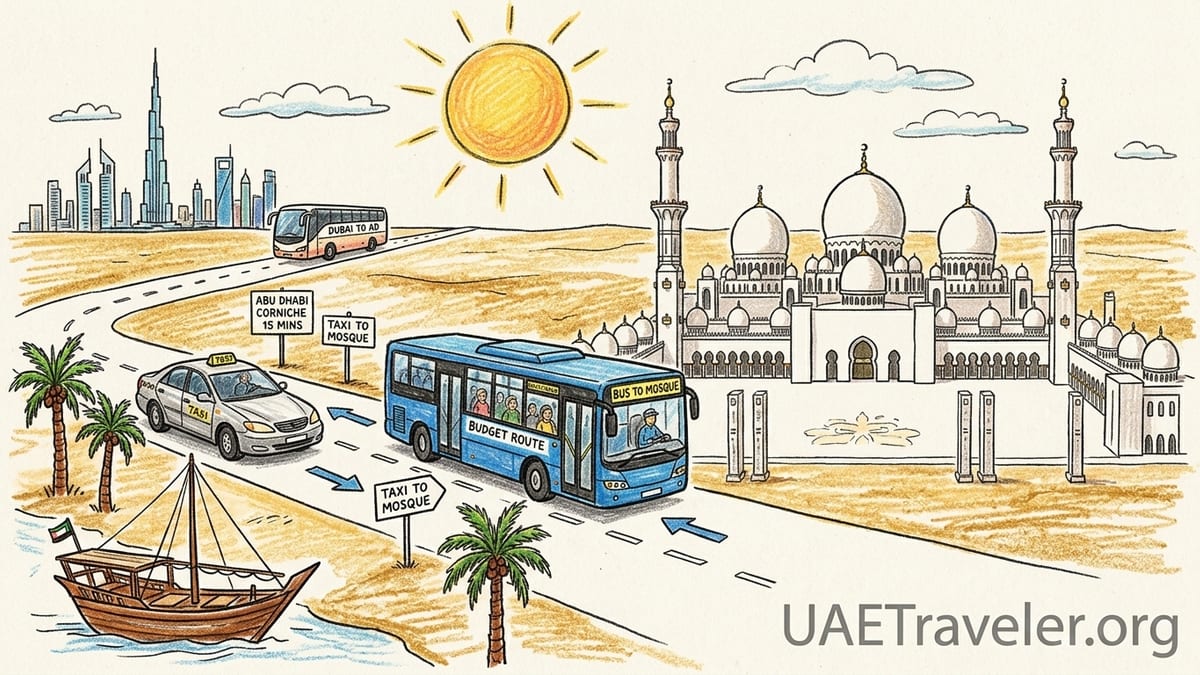
Coming from central Abu Dhabi, the mosque already dominates the skyline long before you arrive. On my most recent visit, I stayed near the Corniche and took a metered silver taxi directly to Sheikh Zayed Grand Mosque. Current fare guidance in 2026 puts the one-way cost from downtown Abu Dhabi to the mosque at roughly 25 to 40 AED depending on traffic and exact starting point, with a travel time of about 15 to 20 minutes. That aligned closely with my meter, which ticked up slowly as we left the dense blocks of the city and merged onto Sheikh Rashid Bin Saeed Street, the main highway that runs past the mosque.
Budget travelers who have more time than money can also reach the mosque by public bus. One of the core city routes connects the central bus stations with the mosque area, and the Abu Dhabi transport authority lists a low base fare and inexpensive day or week passes for the city network. I rode that route on an earlier trip; it took closer to 40 minutes from the city center, but the bus dropped me a short walk from the air-conditioned visitor arrival complex, which is crucial in the heat.
From Dubai, the logistics are more involved. Many visitors join day tours sold by big operators and local agencies that combine Sheikh Zayed Grand Mosque with stops at Louvre Abu Dhabi or photo stops along Abu Dhabi’s Corniche. In 2026, advertised prices for these Dubai-based group tours commonly range somewhere around 250 to 450 AED per person depending on group size and inclusions, with the mosque visit itself still free or very low cost. I have done the independent route as well: intercity bus from Dubai to Abu Dhabi, then a city taxi from the bus station to the mosque. That combination usually worked out cheaper overall than a packaged tour but required more time and planning.
Whichever starting point you choose, keep in mind that the mosque is within the city of Abu Dhabi, not in the desert. You will not be dropped at the mosque’s marble steps. All visitors are funneled through the same modern underground visitor center, which is where the experience, and the learning, really begin.
Visitor Center, Registration and Entry Route
Instead of approaching directly across the white marble courtyards, all tourists now enter via the official visitor complex known as the Dome of Peace. This is a glass dome structure set slightly apart from the mosque itself. Taxi drivers and tour buses drop passengers at the designated arrival area here, and there is an organized taxi rank for departures afterward. From the outside, it feels more like a high-end airport terminal than a religious site, but that design helps manage the huge crowds that the mosque attracts every day.
On my latest visit I used the mosque’s online registration, accessible through the Sheikh Zayed Grand Mosque Centre’s official platform. The system generated a QR code that I presented on arrival. There were separate signs for registered visitors and for those who still needed to register on site. Those who had pre-registered, like me, were guided into a faster-moving queue where staff scanned QR codes before security. The walk-in visitors used kiosks at the entrance to enter their details and receive their digital passes. From my perspective, registering in advance saved at least 20 to 30 minutes during a late-morning arrival.
After registration, everyone follows a similar process. You pass through airport-style security with bag scanning and metal detectors, staffed by both security personnel and visitor experience staff. Dress code is checked informally at this point, and more closely later at the final gate towards the mosque. Once through security, escalators take you down into an air-conditioned concourse of corridors and travelators that lead towards the mosque. This underground section contains toilets, a modest selection of cafes, souvenir and abaya shops, and information counters. Distances are longer than many expect; I easily walked several hundred meters from the entrance to the main courtyard access, and I was grateful for the moving walkways.
It is important to understand that what you see at this stage is a carefully planned visitor flow. Worshippers, particularly at prayer times, may use different entrances closer to the prayer halls. As a tourist, you are required to follow the signed routes and instructions, both for security reasons and to protect the sanctity of the mosque during worship.
Tourist Access vs Worship: Two Parallel Worlds
Sheikh Zayed Grand Mosque functions simultaneously as one of the largest mosques in the world and as a flagship cultural attraction. The distinction between visitor access and worship access becomes clear once you emerge from the underground concourse and step into the edge of the white marble courtyard. Tourist routes are marked and subtly roped, keeping you on designated walkways, while signs and staff indicate areas that are reserved for worshippers only.
During non-prayer visiting hours, tourists are allowed into major parts of the complex, including vantage points over the main courtyard, the outer colonnades and, with supervision, inside the main prayer hall. However, on Friday at midday, for example, the main hall is reserved for congregational prayers and closed to visitors for several hours. On my visit, I planned around this by choosing a weekday late afternoon, when both worship and cultural visits operate but are spatially separated.
Inside, worshippers entering for prayer often move with a different pace and purpose than tour groups. You will see men and women carrying prayer rugs or using the mosque’s carpets, stepping quietly into areas screened off from the tourist flow. Official information emphasizes that visitors of all backgrounds are welcome, yet that welcome is framed by the expectation that sightseeing does not interfere with prayer. That means no loud conversations, no entering marked worship-only areas, and no posing for glamour-style photographs where people are praying nearby.
This dual role is what makes the mosque so distinct. It is not a museum frozen in time. The marble is polished, the chandeliers sparkle, and new technologies, like multilingual multimedia guides, help explain the building. Yet five daily calls to prayer still structure its rhythm. Any visitor hoping to understand the place should recognize both aspects and be willing to adjust their visit around them.
Experiencing the Cultural Tour and Private Options
Although you can walk through much of the mosque independently, I strongly recommend joining one of the official free cultural tours offered by the Sheikh Zayed Grand Mosque Centre. I joined the English-language tour that started in the late afternoon. A cultural tour specialist gathered our group near a marked meeting point in one of the shaded arcades and handed out headsets so we could hear clearly without raising voices in sensitive areas.
The free public tours run several times daily according to the mosque’s current schedule, typically in the late morning, early afternoon and early evening. They last around 30 to 45 minutes and cover core spaces such as the main courtyard, one of the arcades and the main prayer hall, with stops where the guide explains details of the architecture, materials and religious practices. The tours are free of charge, but you still need to be registered as a visitor and should arrive at the meeting point at least 15 minutes in advance, particularly during high season or on weekends when crowds intensify.
For visitors seeking a more in-depth or personalized experience, the mosque also offers paid private tours. On my second visit I joined a small group that had booked a private “Unseen” style experience. Official information shows pricing for such private tours at several hundred dirhams per group for extended 90-minute sessions, with options that may include access to less visible areas and the use of club cars for older visitors or those with reduced mobility. These tours must be prebooked directly with the mosque and are often used by families, small VIP groups or specialist visitors interested in architecture or religious studies.
From a learning perspective, the difference between wandering alone and walking with an official guide is enormous. Our guide did not only recite facts; he framed the mosque in the context of the UAE’s modern history, explained how design choices were intended to express values like tolerance and hospitality, and gently corrected misunderstandings. When a member of our group asked if the mosque was “copied” from a European basilica, he pointed out the classical Islamic references instead and invited us to compare the proportions of the courtyard to historic mosques in the wider region.
Marble Courtyards, Domes, Columns and Chandeliers Up Close
Stepping out into the main courtyard during the cultural tour, I finally understood why photographs cannot quite capture Sheikh Zayed Grand Mosque’s scale. The courtyard’s white marble floor gleams so brightly in the sun that staff sometimes remind visitors to walk along the shaded edges. Inlaid into that marble are giant floral designs that appear almost painted from a distance, but up close you can see how each petal is formed from semi-precious stone pieces carefully fitted together. Our guide encouraged us to look down as much as up, pointing out how these patterns were inspired by plants native to the region and beyond.
Above, a forest of domes rises in every direction. The mosque has dozens of domes of varying sizes, but your eye is drawn to the largest central dome above the main prayer hall. The guide explained how the domes are not only decorative but also work structurally to distribute weight and symbolically to represent the heavens. At certain angles around the courtyard, you see reflections of the domes caught in the long rectangular pools that flank the colonnades. Visiting in late afternoon, I watched as the low sun turned the white marble a softer cream color, and the domes’ shadows stretched almost theatrically across the floor.
Inside the colonnades, double rows of columns line the walkways like a marble forest. Each column is wrapped in floral inlay near the base, and their capitals are finished with golden palm-like forms. During the tour, the guide pointed out how these design choices weave together local references, such as date palms, with a global palette of materials. In one section, he asked us to touch the cool marble gently with the backs of our hands to feel the difference between it and the warmer air, a subtle reminder of how materials respond to the desert climate.
In the main prayer hall, the atmosphere changes. Visitors instinctively lower their voices. The carpet underfoot is famously one of the largest hand-knotted carpets in the world, but what struck me more were the chandeliers. Massive, multi-tiered and dripping with Swarovski crystals, they hang like luminous gardens from the ceiling. The guide explained how their metal frameworks incorporate floral motifs and Quranic calligraphy, and how the lighting is carefully designed to be bright enough for reading but soft enough to maintain a contemplative atmosphere. Seen from directly underneath, the main chandelier looks almost like a jeweled mandala.
Dress Code in Practice: What I Wore and What I Saw
The dress code at Sheikh Zayed Grand Mosque is not symbolic fine print. It is actively enforced at multiple checkpoints. Official guidelines call for long, loose-fitting, ankle-length clothing for both men and women, with women required to cover their hair with a headscarf and avoid tight or transparent fabrics. Shoulders and knees must be fully covered for everyone, and clothing with offensive slogans or loud imagery is not allowed.
For this visit, I wore loose linen trousers and a long-sleeved, slightly oversized shirt that fell below the hips, along with closed shoes that were easy to remove. I carried a plain light scarf to cover my hair. At the first visual check near security, staff glanced at my outfit and let me pass. Later, near the final gateway to the courtyard, a female staff member asked me to adjust my scarf so that no hairline was showing and checked that my shirt did not ride up when I walked. I appreciated the respectful way this was handled; she simply demonstrated the preferred coverage on herself and waited while I mirrored it.
Not everyone in my group had it so smooth. One woman arrived in a calf-length dress with bare ankles and a loosely draped scarf that slipped off her head repeatedly. She was politely directed to a nearby shop in the visitor concourse where she could purchase an abaya, the long black outer garment, and a more secure headscarf. Prices for these in 2026 varied around a few dozen dirhams for simple styles. Another visitor in tight leggings under a long top was asked to ensure the top fully covered her hips and upper legs; when it did not, she also opted to buy a looser abaya.
Men, while not required to cover their heads, are also expected to dress modestly. On past visits I have seen men in shorts turned away or asked to change into longer trousers or traditional kandura-style garments available from the shops. Casual jeans and a plain T-shirt that covers the shoulders and upper arms are generally acceptable, provided they are not ripped or emblazoned with provocative images. Footwear matters less because you remove your shoes before entering prayer areas, but closed or sturdy sandals make the long walks and hot surfaces more comfortable.
There are no rental abayas provided free of charge by the mosque at the time of writing, so planning your outfit in advance will save both money and time. Think of the dress code not as a hurdle but as a gesture of respect to worshippers who use the mosque daily. Being appropriately dressed from the start also means you are less likely to be stopped repeatedly during security checks, which keeps the flow smoother for everyone.
Photography Rules and Respectful Behavior
Sheikh Zayed Grand Mosque is one of the most photographed buildings in the region, and it is easy to see why. Nearly every angle reveals symmetry, reflections and perfect white marble lines. Photography is allowed in most visitor areas, and many people arrive armed with professional cameras and smartphones. However, the mosque is not an unrestricted photo studio. There are clear rules, spoken and unspoken, about how and where you can photograph.
Official guidelines prohibit disrespectful poses, such as jumping, yoga positions, dips, or any behavior that turns the mosque into a prop for social media stunts. On one visit, I watched as security staff gently intervened when a couple attempted a dramatic dance pose in front of a prayer hall entrance. The staff member calmly asked them to review the visitor code of conduct and suggested they take more neutral images instead. Tripods and large professional equipment may require advance permission or may be restricted altogether in busy periods, partly for safety and partly to avoid blocking walkways.
Photography of people at prayer requires particular sensitivity. While our guide did not ban it outright, he asked that we avoid zooming in on individuals praying or on small children without their parents’ consent. When we passed a group of worshippers in a side hall, he paused the group and reminded us to keep our phones down until we were beyond that area. It was a helpful reminder that, although the architecture is spectacular, the primary purpose of the space is devotional.
One of the most memorable photographic moments for me came just after sunset, when the sky shifted from pale blue to deep indigo and the mosque’s facade lighting came on. The reflective pools along the colonnades became mirrors of blue and gold, and the domes seemed almost to float above their reflections. Many visitors clustered along the pool edges for photos, but security staff ensured that nobody leaned over or tried to climb barriers. I found I could still capture beautiful images simply by stepping back and framing the scene with a column or arch in the foreground.
Best Times to Visit, Crowds, Facilities and Accessibility
Choosing when to visit makes a significant difference to your experience. Official visiting hours currently run from mid-morning to evening, with shorter visitor windows on Friday around congregational prayers. I have visited in the late morning, mid-afternoon and early evening, and each offers a distinct atmosphere. Late morning tends to be bright and hot, with strong sun on the marble; crowds include tour groups from Dubai arriving after their highway drive. Mid-afternoon often feels quieter, especially outside peak tourist seasons, though the heat can be intense if you step out from the shaded walkways.
Early evening, around an hour before sunset, has become my preferred time. The light softens, making it easier to appreciate the inlaid floral designs without being dazzled. Cultural tours at this time are popular but manageable, and if you stay beyond sunset you can experience both the daytime and nighttime character of the mosque in a single visit. Nighttime lighting design is carefully calibrated so that the domes and minarets glow without feeling garish, and the air temperature becomes more comfortable for walking the length of the courtyards.
Crowd levels fluctuate throughout the year. During cooler months and major holidays, you should expect lines at registration, security and tour meeting points, particularly in the late afternoon and early evening. On one busy winter weekday, I waited roughly 20 minutes at entry despite having pre-registered. During a hot summer afternoon visit, by contrast, I moved almost directly through. If you have limited mobility or are traveling with young children, it is wise to avoid peak hours when corridors and walkways feel more congested.
Facilities are generally excellent. Toilets are available in multiple locations within the visitor concourse and near key transition points, kept clean and segregated by gender. There are also prayer rooms and ablution areas for worshippers. Accessibility is taken seriously: ramps, lifts and smooth floors accommodate wheelchairs and strollers, and longer routes often have golf cart-style club cars, especially in some of the paid extended tour experiences. Still, be prepared for substantial walking; my phone’s step counter easily exceeded several thousand steps by the time I exited. Water is available from kiosks and cafes, but I always carry a refillable bottle to manage the dry heat.
Costs: From Taxis to Tours
Entry to Sheikh Zayed Grand Mosque itself is, as of 2026, either free or very low cost depending on how your visit is categorized. Official information and recent visitor reports indicate that general tourist entry has historically been free, while there are now modest fees in some booking categories, especially for visitors booked through tour operators or certain age groups. Fees mentioned recently range around a small amount of local currency per visitor, with residents and older visitors sometimes paying less. These charges are subject to change, so it is best to check the official platform just before your trip, but they remain minor compared to transport and tour costs.
The public cultural tours provided by the mosque’s own staff are free of charge. You do not pay extra to join these once inside, which makes them exceptional value. Private tours and special experiences, on the other hand, have clearly defined prices. Recent official materials list extended private cultural tours of approximately 90 minutes at several hundred dirhams per group, with potential extras such as dedicated guides in specific languages or extended access. If you divide this cost among a family or small group, it can still be a worthwhile investment for a deeper, less crowded experience.
Transport tends to account for the largest share of your mosque visit budget. From central Abu Dhabi, a return taxi journey cost me around 60 to 80 AED on recent visits, depending on traffic and waiting time. Using the public bus reduced my costs to only a small fare each way, but increased travel time significantly. From Dubai, integrated tours that include hotel pick-up, return highway transport, mosque visit and sometimes additional Abu Dhabi stops are priced roughly in the mid hundreds of dirhams per person in 2026, with premium small-group or private tours costing more.
You should also budget for incidental spending. Buying appropriately modest clothing at the mosque’s shops can easily add 70 to 100 AED or more to your day if you arrive underdressed. Light snacks, coffee or cold drinks in the visitor concourse, plus small souvenirs like prayer beads or postcards, can also add up. Overall, my half-day visit from Abu Dhabi city, including taxi fares, coffee, a simple meal and a small souvenir, came to well under 300 AED, while a previous full-day excursion from Dubai on a structured tour, including multiple attractions, cost closer to the mid hundreds of dirhams.
The Takeaway
What surprised me most about Sheikh Zayed Grand Mosque was not its size, although standing in the main courtyard surrounded by domes and minarets certainly redefines your sense of scale. It was the care with which every detail, from the inlaid flowers underfoot to the careful lighting of the chandeliers, is woven into a broader story about faith, hospitality and cultural openness. During the cultural tour, our guide moved seamlessly from pointing out marble types to explaining how prayer times structure daily life, making the mosque feel less like an isolated monument and more like a living reflection of the country around it.
The guided interpretation elevated the visit far beyond architecture. Before joining the tour, I might have admired the colonnades as beautiful but anonymous. Afterwards, I understood how the floral motifs connect to specific verses, how the reflective pools were designed to cool the eye in a harsh climate, and how the interplay of stone and light is intended to evoke serenity rather than awe alone. That context also reframed the dress code and photography rules. Instead of seeing them as restrictions, I came to view them as a framework that allows millions of people to visit a sacred site without eroding its spiritual core.
For future visitors, I would suggest three key preparations. First, plan your logistics with intention: choose your time of day, pre-register online, and allow enough time for security, walking and, if you wish, both a cultural tour and some independent wandering. Second, plan your clothing at home. Bring long, loose garments and a headscarf if you are a woman, and avoid anything tight, transparent or slogan-heavy. You will feel more at ease and move more freely through checkpoints. Third, think about your purpose before you arrive. If you only want a quick photo from the highway, there are easier spots. If you are willing to slow down, listen and observe, the mosque will reward that attention generously.
Does Sheikh Zayed Grand Mosque deserve a dedicated visit rather than a rushed stop on a city tour? Based on several firsthand experiences, my answer is yes. A slow, attentive half-day here, ideally anchored by an official cultural tour, offers a far deeper understanding of Abu Dhabi and the United Arab Emirates than a checklist of quick photo stops ever could. Treat the mosque not just as a backdrop but as a host, and your visit will linger in memory long after the last call to prayer fades across the marble courtyards.
FAQ
Q1. Do I need to book my visit to Sheikh Zayed Grand Mosque in advance?
Advance online registration is strongly recommended because it generates a QR code that speeds up entry through the visitor center and helps you secure a spot near your preferred cultural tour time, especially during busy seasons.
Q2. Is there an entrance fee to visit the mosque?
The mosque itself is free or very low cost to enter for most visitors, though some booking categories and tour-operator visitors may see a small fee during registration. These amounts are modest compared with transport or paid private tours and are subject to change, so check the official platform just before your trip.
Q3. What should women wear, exactly?
Women should wear loose, ankle-length clothing that covers arms and legs completely, with fabrics that are not tight or transparent, and a headscarf that securely covers the hair and neckline. Outfits like a long, wide-leg trouser and a tunic-style top with a plain scarf work well and usually pass dress checks without issue.
Q4. What is acceptable clothing for men?
Men should wear long trousers and a shirt with sleeves that cover the shoulders and upper arms. Simple jeans or chinos with a plain T-shirt or shirt are usually fine, as long as there are no offensive logos, the fabric is not see-through and shorts are avoided.
Q5. Can I borrow or rent an abaya or headscarf at the mosque?
At present, there is no widely promoted free abaya rental, but there are shops in the visitor concourse that sell suitable abayas and scarves. If you arrive underdressed, staff will direct you to these outlets, but planning an appropriate outfit in advance is the more economical option.
Q6. Are photography and videography allowed inside?
Photography is allowed in most visitor areas, including courtyards and many interior spaces, but you must avoid disrespectful poses, commercial-style shoots without permission, and intrusive images of people at prayer. Large tripods or professional equipment may be restricted or require prior approval.
Q7. How long should I plan for a visit?
If you want to join a free cultural tour and also explore on your own, plan at least two to three hours at the mosque itself, not counting travel time. Visitors coming from Dubai on day trips often spend a half-day including transport, while those already in Abu Dhabi can easily dedicate a flexible morning or evening.
Q8. Is the mosque accessible for wheelchair users and people with limited mobility?
Yes, the visitor center and main visitor routes are equipped with ramps, lifts and smooth flooring, and staff can assist with directions. Some extended or private tours use club cars to reduce walking distances, but there will still be some movement between key sites, so communicate your needs in advance when possible.
Q9. Can non-Muslims enter the prayer halls?
Non-Muslim visitors may enter certain areas of the main prayer hall during designated visiting times as part of the general visitor route or an official cultural tour, provided they follow dress and behavior rules. During Friday prayers or special religious occasions, access to these areas may be restricted to worshippers only.
Q10. Is it better to visit independently or with a Dubai or Abu Dhabi city tour?
Visiting independently from Abu Dhabi gives you the most flexibility in timing and allows you to linger after the cultural tour, while organized tours from Dubai are convenient for combining the mosque with other attractions in one day. If you are mainly interested in the mosque itself, dedicating a standalone visit with ample time is often the most rewarding choice.