


On a recent October weekend in 2026, I left Dubai’s glass-and-steel skyline behind and drove into the Hajar Mountains for what has become one of the emirate’s signature nature breaks: kayaking on Hatta Dam and spending the night at Hatta Resorts. I wanted to see how this mountain-and-water escape actually feels in real life, from the drive and the logistics at the dam to the reality of paddling, the weather, and sleeping in the shadow of the jagged hills once the day-trippers disappear.
Leaving Dubai for the Mountains
I started from central Dubai just after 8 a.m., taking the E44 toward Hatta. Official tourism maps put the distance at roughly 130 kilometers from Dubai to Hatta Dam, with a drive time of about 90 minutes in clear traffic. The first hour is familiar Dubai driving, with multilane highways through flat desert. The transformation begins only after the last petrol stations and malls thin out, when the road narrows, low ridges appear on the horizon and the Hajar Mountains start to rise in jagged grey folds.
Road conditions in October 2026 were good all the way. The E44 is paved, signposted and suitable for a normal saloon car, with speed cameras and a few stretches where trucks slow things down. I passed the last major petrol stations about 30 to 40 minutes before Hatta and topped up the tank there on the way in. For anyone planning a day trip, this is a sensible place to refuel, both for peace of mind and to avoid hunting for fuel on the way back in the dark.
There is no entry gate or ticket required to access Hatta Dam itself. You follow the brown tourist signs for Hatta Dam, then climb a short access road that winds up to a concrete parking area overlooking the water. On my visit, cars were queuing lightly by mid-morning, but I still found a spot in the main lot without circling for more than a few minutes. The parking area is unshaded, a detail that matters if you plan to leave snacks or electronics in the car under the sun.
From the lot, a short slope leads down to the edge of the reservoir where the Hatta Kayak operation is based. The first impression is of bright plastic boats lined along the water, the concrete dam wall to one side and mountains closing in on the other. There are no manicured lawns or beach clubs here, just a functional launch area pressed into the base of the hills.
Tickets, Kayaks and Safety Briefing
Hatta Kayak is the only operator allowed to rent boats on the reservoir, which means you cannot bring your own kayak or paddleboard. You simply walk up to the ticket counter by the water. There is no need to book standard kayaks in advance on regular days; tickets are sold on a first-come, first-served basis and the staff move people through at a steady pace as boats come back in.
In October 2026, pricing boards at the counter listed single kayaks and single water bikes at around 60 dirhams, with double kayaks and double water bikes priced at roughly 120 dirhams, and larger three-seater water bikes higher again. These rates match figures quoted by several up-to-date local guides that reference Hatta Kayak’s own information from late 2026. The fee is not per hour for casual visitors; instead, you pay once for a block of "unlimited" time on the water, with the understanding that normal visitors paddle for about 60 to 90 minutes before returning.
Once I had paid for a double kayak, I was given paper wristbands and directed to the life jacket area. Every paddler is required to wear a buoyancy aid, and staff actively check that it is fastened. There was no long classroom-style safety talk, but the attendants did give a concise briefing while we stood by the shoreline: stay away from the dam wall, avoid ramming other boats, keep small children seated in the middle, and return if the staff call everyone in because of strong winds. It felt more like a beach rental than a guided expedition, but there was at least a basic structure in place.
The kayaks themselves are sit-on-top plastic models, wide and stable rather than fast. Our double had simple molded seats with backrests, foot wells of different lengths and a drain hole under each seat. Paddles were the typical aluminum-and-plastic combination, light enough for beginners but not performance gear. For most visitors, that is exactly what you want: forgiving boats that are hard to capsize and easy to clamber back onto from the water.
Paddling Between the Hajar Mountains
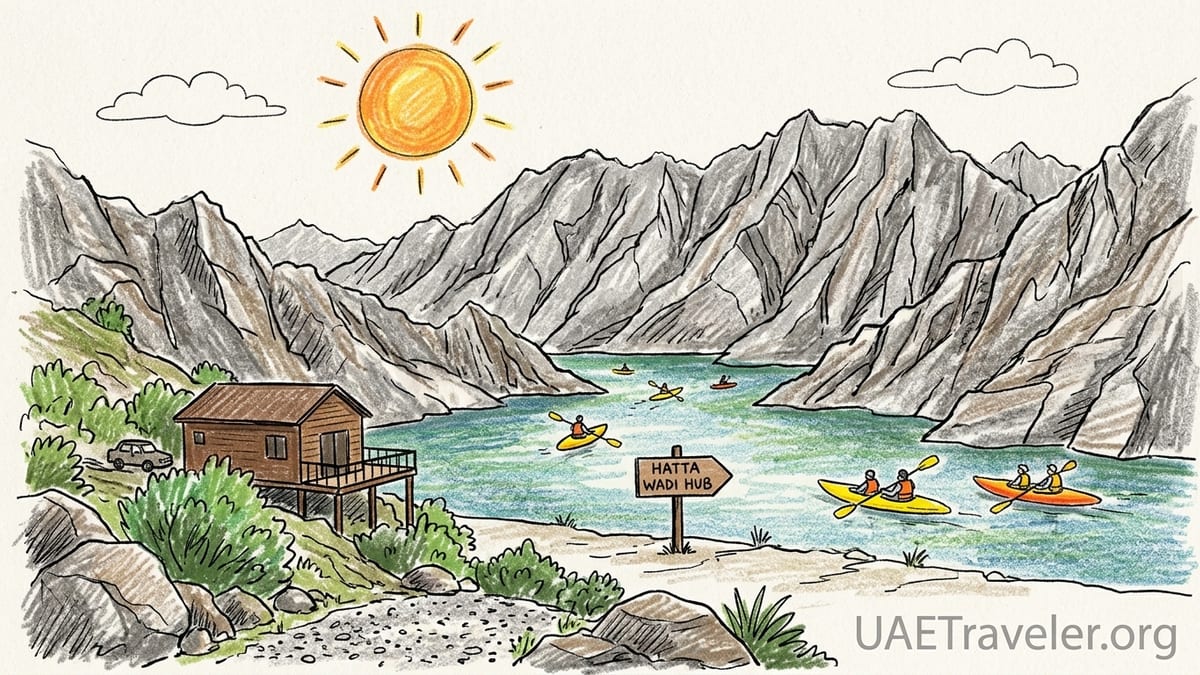
Launching is simple: you slide the kayak into the shallows, climb on and push off from the concrete edge. Within a few strokes, the parking lot recedes and you are surrounded by greenish-blue water and grey rock. Hatta Dam is essentially a flooded valley in the foothills of the Hajar range, and you feel that shape immediately. The reservoir forms a long narrow basin that splits into several rocky inlets flanked by steep, crumbly slopes.
On my visit, around late morning, the water was a deep jade color under hazy sunshine. It was not the flawless mirror you see in some marketing shots. A light breeze ruffled the surface, and the surrounding slopes created patches of swirling reflections where the wind funneled through the gaps. Visibility ranged from soft, almost milky outlines of the distant ridges to clearer views when clouds thinned. The ruggedness of the mountains is real: they are sharply folded, layered in tones of dark brown, charcoal and rust, with bare rock outcrops and loose scree that looks as if it could tumble at any moment.
Traffic on the water was moderate. There were families in bright yellow and orange double kayaks, couples pedaling water bikes and the occasional larger donut-shaped boat with a small group, all moving at leisurely speeds. Staff patrol the reservoir in motorized safety craft, but they keep a low profile unless someone drifts too close to the dam wall or stands up and starts rocking a kayak for photos. There is no engine noise from jetskis or speedboats, which helps keep the soundscape quieter than many coastal spots near Dubai.
In physical terms, paddling a double kayak here is manageable for anyone with basic fitness. We paddled steadily for just over an hour, exploring one of the longer arms of the reservoir and stopping several times to rest and take photos. Sharing a double worked particularly well as a couple: when one of us wanted to frame a shot or simply sit back and stare at the cliffs, the other could keep the boat drifting in the right direction with a few gentle strokes. Families with younger children often placed a child between two adults, turning it into a stable three-person setup as long as the combined weight stayed within the posted limit.
Weather, Conditions and Photography in 2026
October is the month when Hatta begins to feel significantly cooler than Dubai, but visitors should not expect alpine freshness in the middle of the day. On my paddling day, mid-morning air temperatures at the dam sat in the low 30s Celsius, with a slight drop compared with the city but still very much short-sleeve weather. The water itself felt cooler than Dubai’s sea, pleasant to dip a hand into but not cold enough to cause a shock if you got wet.
Wind is the factor that most alters the experience. Early in the morning, the reservoir was almost flat, with small ripples and easy paddling in any direction. By late morning, a crosswind developed down the main basin, and you had to work a little harder to keep the kayak pointing where you wanted it. Staff were monitoring conditions, and at one stage they whistled to recall a few boats that had drifted toward a narrow channel where gusts were funnelling strongly. If you are visiting with younger children or anyone nervous on the water, it is worth arriving on the earlier side of the day to take advantage of calmer conditions.
In terms of visibility, the air in October 2026 had a light haze, likely a mix of dust and humidity. This softened the outlines of the more distant peaks and gave the reservoir a slightly desaturated, almost pastel look by late afternoon. You will not always get the crystalline, postcard-perfect mountain reflections shown in some promotional images, but the softer visibility can create its own atmospheric mood, particularly when the sun dips behind the highest ridge and throws the inlets into shadow.
For photography, the most rewarding angles came from paddling into the side coves where the water narrows and the cliffs loom directly overhead. From a low, water-level perspective, the patterns in the rock strata become much more pronounced, and you can frame kayaks and water bikes against steep inclines that look far wilder than anything in downtown Dubai. A waterproof pouch for your phone is a sensible investment, as there is no place to stash gear that will stay completely dry if you take a splash.
Beyond the Water: A Real Stop at Hatta Wadi Hub
After returning the kayak and taking a short break at the dam, I drove the short distance to Hatta Wadi Hub, the official adventure center that sits in a shallow valley framed by more mountain ridges. The drive from the dam took under ten minutes. The hub has grown noticeably in recent seasons into a compact complex of food trucks, shaded seating areas, and activity desks offering everything from archery and axe throwing to downhill carts and ziplines when operating.
On this visit, I opted for mountain biking on one of the graded cross-country trails that loop out into the surrounding hills. Bike rental prices at the hub in late 2026 started in the region of 80 to 100 dirhams per hour for basic hardtail mountain bikes, with helmets included. Trails are color-graded for difficulty, and I chose an easier green route that wound over small rises, across gravelly flats and along the edges of dry wadis. The surface alternated between hard-packed dirt and loose pebble sections, and while the gradients were not extreme, you do feel both the heat and the fact that you are no longer at sea level.
The combination of kayaking followed by a ride out of the valley provided a good contrast. On the water the mountains had felt enclosing and intimate; out on the bike trail they unfolded in longer horizons, with views across multiple ridgelines and glimpses of the DEWA hydro project high above. For travelers who only have energy for one additional activity beyond kayaking, a short guided ride or hike from the Wadi Hub is an accessible way to see a little more of Hatta’s terrain without committing to a full-day trek.
Facilities at the hub included clean public bathrooms, prayer rooms and a small cluster of casual food options, mainly burgers, sandwiches and karak tea served from trucks and kiosks. Seating was predominantly outdoors under shade sails. By late afternoon, families and groups of friends were settling in to watch the sunset turn the peaks a dull rose color, with children playing on the open grassy areas while others queued for the ropes courses.
Staying the Night: Damani Lodges vs Domes and Caravans
For the overnight part of the trip, I checked into Damani Lodges at Hatta Resorts for my first night before visiting the newer dome-style accommodation the next day for comparison. Hatta Resorts operates several official glamping-style options in the same general area: the cabin-like Damani Lodges built into the hillside, domes with small plunge pools, and caravans and vintage campers parked on terraces with mountain views, all described on Hatta’s official tourism pages in 2026.
Damani Lodges are compact wooden-clad units stepped up along the slope, each reached by a short walkway and small terrace. Inside my lodge, the setup resembled a modern, efficient hotel room: a comfortable double bed with crisp linens, a sofa that could convert into a child bed, air conditioning, a wall-mounted television, tea and coffee making facilities and a small fridge. The bathroom was fully enclosed with a proper shower, plenty of hot water and standard amenities. Sleeping comfort was good, with the mattress leaning toward the firm side and blackout curtains that kept early morning light out.
Outside, each lodge had a small private terrace area with a basic seating arrangement and a nearby fire pit shared between a cluster of units. Fire pits were not roaring on their own; guests could request wood bundles from reception and light them in the evening, subject to wind conditions and park rules. Nighttime temperatures in Hatta in October 2026 dipped into the low 20s Celsius, which meant that sitting outside by a modest fire in light layers felt comfortable rather than chilly.
The domes, which I toured but did not sleep in, offered a different aesthetic: semi-transparent geometric tents with clearer sky views and small plunge pools on the deck. Interiors skewed slightly more romantic and design-forward, though bathroom and bedding standards were in the same broad range as the lodges. Caravans and vintage campers, parked lower down near Hatta Caravan Park, had built-in barbecues and fire pits, creating more of a classic camping feel, though the space inside is narrower and the beds less generous than in the fixed lodges.
Night Atmosphere, Food and Connectivity
One of the biggest questions about Hatta is whether it really feels quiet once the day visitors head back to Dubai. On this trip, the difference between late afternoon and after 9 p.m. was dramatic. In the evening, just before sunset, there were still cars passing the nearby road, groups walking between lodges, and a low buzz from families grilling and chatting. By late evening, ambient noise dropped significantly. The most consistent sounds were the hum of the lodge air conditioning units and the occasional murmur from neighboring terraces. The mountains themselves do not go completely silent, as wind in the ridges can whistle faintly, but the contrast with downtown Dubai is real and profound.
Dining options are more limited than in the city but adequate for a one or two-night stay. On my visit, Hatta Resorts directed lodge guests to an on-site casual restaurant offering a mix of Middle Eastern grills, burgers and simple salads, with prices a bit above a typical city mall food court. There were also food trucks at Hatta Wadi Hub operating into the evening on busier nights. Portions were generous rather than gourmet, the focus clearly on feeding active guests who had been hiking or biking all afternoon.
Wi-Fi coverage inside my Damani Lodge was stable enough for email, messaging and light browsing, though speeds and reliability dipped at peak times when many guests were presumably streaming. Mobile data reception on a standard UAE network was steady across the resort and at the dam, which meant sharing photos and checking maps was never an issue. For travelers hoping to fully unplug, you will need self-discipline; the digital world is still very much within reach.
If there was a disappointment, it was that light pollution from the resort buildings and nearby road reduced the intensity of the night sky compared with more remote mountain camps in the region. You can clearly see constellations and a generous scatter of stars, but this is not a pitch-black desert camp with a Milky Way arch overhead. For many visitors, though, the trade-off of comfort, private bathrooms and easy access from Dubai justifies the gentler, more suburban level of darkness.
One-Day Kayak Dash vs Two-Night Mountain Break
Hatta Dam can be visited as a straightforward day trip from Dubai, and plenty of residents do exactly that. A realistic one-day itinerary looks like this: depart Dubai around 7 or 8 a.m., arrive at the dam before the main crowds, kayak for 60 to 90 minutes, spend some time taking photos around the viewpoint, perhaps call in at Hatta Wadi Hub for lunch or a short walk, then drive back to the city before or just after dark. Fuel for the round trip in a typical compact car might cost the equivalent of a casual restaurant meal in Dubai, depending on your starting point and vehicle.
Financially, the core expenses for a simple day out could be kept to a kayak rental in the 60 to 120 dirham range, a meal or two at casual outlets and fuel. Time-wise, you are looking at three hours of driving for perhaps two or three hours on site if you are on a tight schedule, which is just about worthwhile if your main aim is to see the reservoir and get a feel for the mountains. It suits residents who want a change of scenery without booking accommodation.
A two-night stay creates a very different rhythm. Accommodation prices in October 2026 varied significantly by day of week and unit type, with standard Damani Lodges often quoted from the low four figures in dirhams per night for two adults on busy weekends, and some of the dome and caravan options trading in a similar bracket. This means that lodging quickly becomes the largest part of your budget, towering over fuel and activity costs. Food across two nights, including breakfasts and dinners, will add another layer, whether you eat at the resort restaurants, cook simple barbecue meals outside your unit or mix both approaches.
On the other hand, spreading your time over two nights allows you to kayak once, hike or bike on a separate morning, and simply enjoy being in the mountains without rushing. You can choose the calmest part of the day for paddling, relax in your lodge during the midday heat, and return to the dam or trails in the softer light of morning or late afternoon. For visitors flying into Dubai who want at least one landscape experience that is not desert or city-centric, budgeting for a full mountain break rather than a rushed day trip makes emotional sense, even if it costs more.
The Takeaway
What surprised me most about Hatta was how quickly the mood shifted from city to mountains once I turned off the main highway. In a country associated with skyscrapers, enormous malls and desert safaris, gliding quietly between rocky walls on a simple plastic kayak felt refreshingly low-tech and grounded. The dam is not a pristine alpine lake, but the interplay of muted water colors, irregular rock faces and scattered kayaks created an atmosphere that no Dubai marina or beach club can replicate.
Was the kayaking itself worth the drive from Dubai? For me, yes. The combination of accessible pricing at the dam, unlimited-time rentals for casual paddlers and the novelty of being surrounded by real mountains within 90 minutes of the city made it a strong value proposition. The physical effort level was moderate rather than punishing, and sharing a double kayak worked especially well as a couple who wanted to balance paddling with photography.
Accommodation was where expectations needed the most calibration. Damani Lodges and the other Hatta Resorts options delivered on comfort, with good beds, private bathrooms, air conditioning and atmospheric terraces. However, the relatively high nightly rates compared with mid-range Dubai city hotels, coupled with limited dining variety and some light pollution, may leave price-sensitive travelers feeling that they paid a premium primarily for location. If you imagine deep wilderness or total digital disconnection, you may be disappointed.
If I return, it will be for a combination of reasons: paddling again in cooler months when visibility is clearer, exploring more of the hiking and cycling network that threads into the hills, and enjoying the slower evening pace around the fire pits. If you only have a single free day in Dubai and want a taste of mountains and water, a focused day trip to Hatta Dam for kayaking is absolutely justified. If you have the budget and time for two nights, the overnight mountain atmosphere adds a quieter, more reflective layer that stays with you long after you merge back into Dubai’s morning traffic.
FAQ
Q1. How long does it take to drive from Dubai to Hatta Dam?
Driving from central Dubai to Hatta Dam usually takes about 90 minutes in light traffic, covering roughly 130 kilometers along the E44 highway.
Q2. Do I need to book Hatta Dam kayaking in advance?
For standard single and double kayaks, advance booking is generally not required; tickets are sold on a first-come, first-served basis at the dam.
Q3. How much does kayaking at Hatta Dam cost in 2026?
Recent on-site price boards and local guides indicate around 60 dirhams for a single kayak or water bike and about 120 dirhams for a double, with unlimited paddling time for casual visitors.
Q4. Can I bring my own kayak or paddleboard to Hatta Dam?
No, private kayaks and paddleboards are not allowed on the reservoir; all boats must be rented from the official Hatta Kayak operator at the dam.
Q5. Is Hatta Dam kayaking suitable for beginners and children?
Yes, the sit-on-top kayaks are wide and stable, and life jackets are mandatory; families with children who can sit still and follow basic instructions generally do well.
Q6. What is the best time of day to kayak at Hatta?
Mornings usually offer calmer water, gentler wind and slightly cooler temperatures, which makes them more comfortable for beginners and families.
Q7. What should I wear and bring for kayaking at Hatta Dam?
Light quick-drying clothes, sandals or water shoes, sunscreen, a hat, sunglasses with a strap and a waterproof pouch for your phone are all practical choices.
Q8. How does staying overnight at Hatta Resorts compare to a day trip?
A day trip keeps costs lower and focuses on kayaking, while an overnight stay adds higher accommodation and food costs but gives you time for hiking, cycling and quieter evenings.
Q9. Is there food available near Hatta Dam and Hatta Resorts?
Yes, you will find casual restaurants and food trucks at Hatta Wadi Hub and within Hatta Resorts, mainly serving grills, burgers, snacks and hot drinks.
Q10. Is Hatta worth visiting if I am only in Dubai for a few days?
If you want at least one experience in real mountains with a reservoir setting rather than malls or desert dunes, Hatta Dam kayaking is a rewarding use of a single free day.