


Visiting the United Arab Emirates for the first time in 2026 means dealing with clear but sometimes confusing rules on visas, passports, medicines and documents. This guide brings together the latest official guidance available as of October 26, 2026, to help you check your status, prepare the right paperwork and avoid problems at Dubai, Abu Dhabi or Sharjah airports.
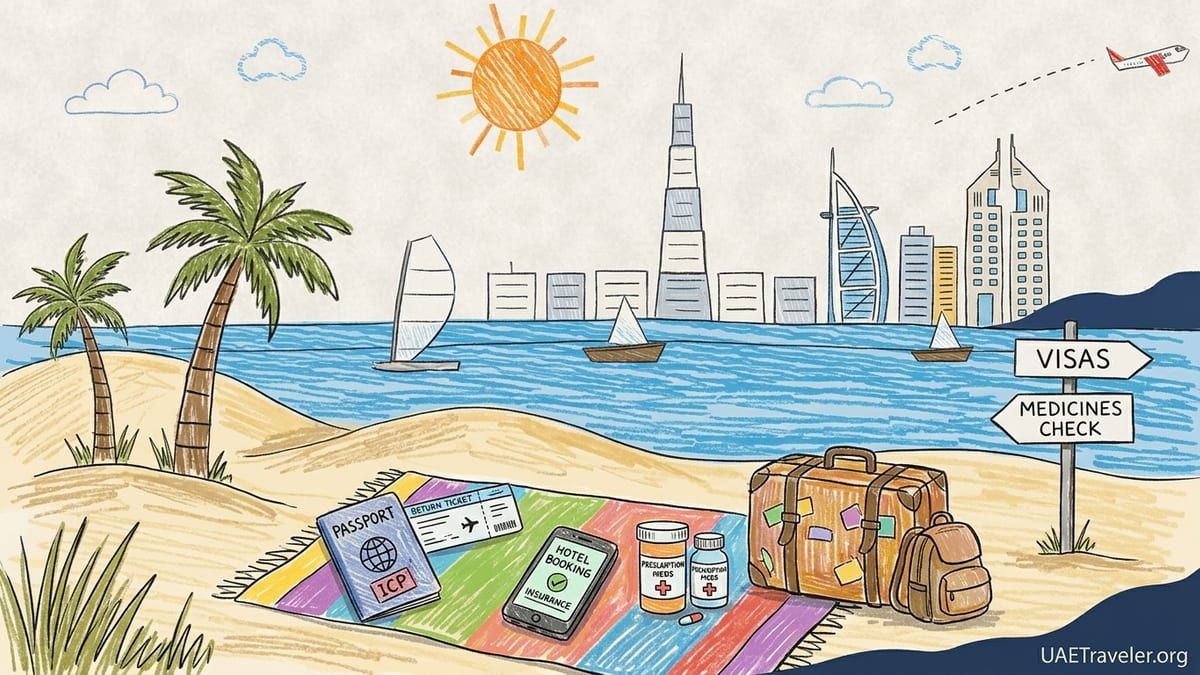
Your Essential Predeparture Checklist
Before you book flights to Dubai, Abu Dhabi or Sharjah, you should confirm seven essentials. First, check that your passport will be valid for at least six months on the date you enter the UAE, which is a standard requirement referenced by the Federal Authority for Identity, Citizenship, Customs and Port Security (ICP) and by official visa partners such as VFS Global for Indian applicants. Several embassies also note that temporary or emergency passports may be refused, so if you hold one, verify its acceptability directly with a UAE mission.
Second, verify visa rules based on your nationality. As of late 2026, many British, American and European Union citizens receive a free visa or entry stamp on arrival for short tourist visits, while Indian citizens usually need either a prearranged tourist visa or a visa on arrival linked to holding certain foreign visas or residence permits. The UAE visa policy is regularly updated, so always recheck close to travel using the UAE Ministry of Foreign Affairs (MOFA) nationality checker or your nearest UAE embassy’s guidance.
Third, understand how long you are allowed to stay. For example, U.S. citizens are currently issued a free entry stamp that permits up to 90 days in any 180 day period for tourism, as confirmed in the October 2026 U.S. State Department country information for the UAE. Other visitors often receive 30 day or 60 day stays, and some nationalities have 90 day visa free arrangements under bilateral agreements. Overstaying can lead to daily fines and complications with future visas.
Fourth, be ready to show a return or onward ticket, proof of accommodation such as a hotel booking or rental confirmation, and enough funds for your stay, especially if you arrive on a low cost airline or during busy travel periods. Fifth, purchase travel medical insurance that would cover emergency healthcare in the UAE, as foreign governments including the UK highlight that you may be refused non emergency treatment or face high bills without it. Sixth, check your prescription medicines against the UAE’s controlled and narcotic drug lists and gather supporting documents. Finally, organise printed or easily accessible digital copies of all key documents, including passports, visas, insurance, bookings and medical reports.
Visa Types Explained: Visa Free, Visa on Arrival, Prearranged and Transit
For first time visitors, the terminology around UAE entry can be confusing. In practice, most short term travellers fall into one of four categories: visa free entry, visa on arrival, prearranged tourist visa or transit visa. Visa free entry usually means your passport is stamped at immigration with no prior application or visa fee. Many European Union nationals, for example, enter Dubai or Abu Dhabi with just a passport and return ticket and receive a free 90 day or 30 day stamp depending on their country’s agreement with the UAE, as reflected in the UAE visa policy published by official platforms.
Visa on arrival for the UAE is commonly discussed in two ways. First, several nationalities, including citizens of the United Kingdom and the United States, effectively receive a visa on arrival in the form of a free entry stamp that authorises a specific period, often up to 90 days within 180 days. The U.S. State Department notes that American tourists are issued these non renewable visas upon arrival and do not apply in advance. Second, certain other nationalities, notably Indian passport holders, may be able to purchase a visa on arrival if they also hold a valid visa or residence permit for the United States, the United Kingdom, or a Schengen state. The precise eligibility list and conditions can change and should be checked through MOFA or ICP channels shortly before departure.
Prearranged tourist visas are required when your nationality is not eligible for visa free entry or standard visa on arrival. For example, most Indian tourists without qualifying foreign visas must apply for a 30 day or 60 day tourist visa before travel. These are commonly arranged online through UAE government e visa portals, UAE based airlines such as Emirates or Etihad, or licensed travel agencies that submit applications to ICP or the General Directorate of Residency and Foreigners Affairs (GDRFA). Official ICP information shows that typical visit visas allow 30 to 90 days of stay, and the UAE has introduced multi year multiple entry visas for frequent visitors, although conditions and fees differ from standard tourist visas.
Transit visas cater to passengers connecting through UAE airports. In recent years, some airlines, including Emirates and Etihad, have shifted away from directly selling 48 hour or 96 hour transit visas and instead direct passengers to apply through government channels or visa partners. If your layover in Dubai, Abu Dhabi or Sharjah is longer than a few hours and you wish to leave the airport, you will need to confirm whether you qualify to enter visa free, can obtain a visa on arrival, or must arrange a transit or short visit visa in advance. Always check with your airline and the UAE authorities, especially because rules for transiting without leaving the airport can differ from rules for entering the country.
Nationality Examples: British, American, EU and Indian Travelers
For British citizens, current UK government travel advice confirms that most UK passport holders do not need to apply for a visa in advance for tourist visits to the UAE. Instead, they receive a free visit stamp on arrival that allows a stay of up to 30 days or 40 days depending on the specific arrangement in place, with some travellers reporting 40 day stamps in 2026, though this can vary and is subject to change. The key point for British travellers is to arrive with at least six months of passport validity and proof of onward travel. Holders of British Overseas or other non standard British passports should check their exact category, since visa rules may differ from those for full British citizens.
For U.S. citizens, the October 2026 U.S. State Department country information clearly states that UAE authorities issue non renewable visas on arrival that permit stays of up to 90 days within any 180 day period. There is usually no fee and no need to apply ahead of time for tourist or short business visits. However, Americans travelling on official or diplomatic passports are required to obtain visas in advance. U.S. residents who are not citizens must follow the rules for their own nationality and cannot rely on a U.S. green card alone to gain visa free access.
European Union nationals generally enjoy visa free entry or visa on arrival to the UAE, with permitted stay varying by country. For instance, citizens of many Schengen area states can receive up to 90 days of stay in any 180 day period, reflecting reciprocal arrangements between the UAE and those states. However, not all EU passports are treated identically, and some have 30 day limits. Therefore, a French or German tourist planning a two week stay in Dubai can usually enter without a prior visa, while a traveller from a smaller EU member should still consult the UAE MOFA visa portal for the precise rules that apply to their passport.
Indian passport holders often face very different procedures. The UAE’s visa policy and guidance confirmed via official and airline linked channels indicate that most Indian tourists require either a prearranged 30 day or 60 day visit visa or, in specific situations, a visa on arrival that is linked to holding a valid U.S. visa, U.S. green card, or certain Schengen or UK visas. For example, an Indian citizen living in Germany with a multiple entry Schengen residence permit may be able to obtain a visa on arrival in Dubai, while a first time visitor from India without foreign residence will likely arrange a tourist visa through VFS Global or a UAE based sponsor. Because details such as minimum validity of the supporting visa and acceptable categories are updated periodically, Indian travellers should use official UAE visa portals or VFS Global’s UAE section rather than relying on outdated agency blogs.
Passports, Validity Rules and Applications Channels
The six month passport validity rule is one of the most consistent UAE entry requirements. The ICP and MOFA systems, as well as visa application forms published for Indian applicants, specify that your passport should be valid for at least six months from your date of arrival in the UAE. Airlines will generally enforce this rule at check in. Some embassies, such as the UAE mission in Stockholm, additionally warn that certain temporary or emergency passports are not accepted, meaning a Swedish traveller with a provisional document might be denied boarding even if the printed expiry date appears sufficient.
When you need a prearranged visa, you typically have several channels. The first is to apply through an official UAE e visa platform, which is linked from government websites such as the Ministry of Economy and Tourism’s entry requirements page and ICP portals. The second is to use your airline’s visa facility. Emirates, Etihad and flydubai all work with visa processing partners that allow travellers to submit passport scans, photos and supporting documents online once flights are booked. The third is to apply via a licensed UAE based travel agency or hotel that can act as a sponsor, especially common for Indian passport holders reserving package holidays to Dubai.
Processing times and fees change regularly and differ by nationality and visa type, so they are not listed in detail here. As of 2026, many standard tourist visas are processed within a few working days, but during major events or public holidays, applications may take longer. Always allow extra time and monitor your application through the official tracking system or your provider’s portal. Remember that an issued entry permit usually has a validity window to enter the UAE, often around 60 days, which will be printed on the permit; entering outside that window is not allowed.
Overstaying a visa or allowed stay period can lead to daily overstay fines, immigration records, and possible difficulties with future visas. While exact fine amounts are periodically revised, the principle is that each additional day in the UAE after your permission expires adds a financial penalty that must be paid at immigration before departure or during a status regularisation process. In serious or repeated cases, an overstay may result in entry bans. If you realise you need more time in the UAE, you should explore extension options through ICP Smart Services or GDRFA portals before your existing permission ends, or exit and re enter if that is permitted for your nationality and visa type.
Arrival at Dubai, Abu Dhabi and Sharjah Airports
When you land in Dubai International Airport, Abu Dhabi International Airport or Sharjah International Airport, expect a broadly similar arrival process but with some differences in layout and procedures. In Dubai, passengers typically disembark directly into the terminal, follow signs to Immigration, and join queues that are divided for GCC nationals, UAE residents and visitors. Airline staff may hand out landing slips on the plane, but many travellers now have their entry recorded electronically against their passport without filling a separate card. At the desk, an officer will scan your passport, verify your visa or eligibility, and may ask basic questions about your stay such as where you are staying and how long you plan to visit.
Abu Dhabi and Sharjah follow the same general model. At Abu Dhabi’s new terminal, you will pass through e gates or staffed counters depending on eligibility, then collect baggage, pass customs and enter the arrivals hall. Sharjah International, popular with regional low cost carriers, can feel busier at peak times, and queues may be longer. At all three airports, immigration officers have discretion to request evidence of onward travel, hotel bookings or invitations, particularly if your itinerary appears open ended or your visa type is unusual. Having confirmations ready on your phone or printed can speed things up.
After immigration comes customs. Dubai’s customs guidelines for travellers classify incoming goods as permitted, restricted or prohibited and explain when you must make a declaration. You will normally walk through a green channel if you have nothing to declare or a red channel if you are carrying significant amounts of cash, high value items, commercial quantities of goods or controlled items such as professional camera equipment or medical devices. Medicines, including prescription drugs and medical equipment, appear among items that may require permits or documentation. UAE customs also has strict prohibitions on narcotics, some weapons, certain types of publications, and products containing ingredients considered offensive or illegal, such as items with explicit content.
Immigration and customs checks for children can be strict. If a child is travelling with only one parent or with relatives, some airlines and UAE authorities may ask for documentation showing parental consent, especially in cases of different surnames or complex custody situations. While there is no single published global rule for the UAE on this point, carrying a notarised letter of consent from the non travelling parent, along with copies of passports and birth certificates, can help avoid delays at the border.
Medicines, Controlled Drugs and Differing Advice
Carrying prescription medication is one of the most sensitive aspects of travelling to the UAE. The UAE government’s health portals and the Emirates Drug Establishment (EDE) set out detailed rules on importing medicines for personal use. They distinguish between ordinary prescription or over the counter medicines and controlled substances such as narcotics, psychotropics and certain strong painkillers and stimulants. An official travellers’ guideline notes that ordinary prescription medicines for personal use may be brought in for up to three months’ consumption when accompanied by a valid medical prescription or report, while controlled medicines, including those listed as narcotic or psychotropic, may require prior approval from the Ministry of Health or EDE and are also limited in quantity.
Recent updates on the EDE portal describe an online “Issue of Permit to Import Medicines for Personal Use” service that allows travellers to apply in advance for approval to carry controlled medication. The portal clarifies that this service is optional in the sense that, if a traveller cannot submit the application, they may still bring controlled medicine when it is accompanied by an appropriate prescription or report and the quantity does not exceed a three month supply. However, because border officials have wide discretion and penalties for drug offences can be severe, several foreign governments, including the UK and Australia, advise their citizens to obtain prior approval whenever their medicines appear on the UAE controlled or semi controlled lists.
Differing advice can be confusing. For instance, the UK government travel health page for the UAE states that some UK prescribed and over the counter medicines are considered controlled in the UAE and that travellers must get approval in advance from the UAE Ministry of Health. The U.S. State Department similarly emphasises strict anti drug laws and advises travellers to carry prescriptions and to ensure their medicines are legal. In practice, many travellers with common medications such as blood pressure tablets, thyroid hormones, basic antibiotics or inhalers report no issues when bringing them in original packaging with prescriptions. Problems tend to arise with medications containing codeine, strong benzodiazepines, certain ADHD medications and some psychiatric drugs, which may appear on controlled lists.
Because the official annex listing controlled and semi controlled medicines is lengthy and subject to change, this article does not reproduce specific brand names. Instead, the safest approach in 2026 is to check your ingredients against the latest annex on a UAE government site or through EDE, then apply for a permit if you find any match under narcotic, psychotropic, controlled or semi controlled classifications. If you take a medicine that is widely controlled globally, such as morphine based painkillers or high dose stimulants, do not rely solely on general travel blogs. Contact a UAE embassy or EDE customer service and carry a detailed medical report summarising diagnosis, dosage, treatment plan and the prescribing doctor’s details. Keep medicines in original labelled containers and avoid carrying more than three months’ supply through UAE borders.
Customs Declarations, Prohibited Imports and Common Questions at the Border
UAE customs rules focus heavily on narcotics, weapons, counterfeit goods and items considered offensive to public morals or religion. Dubai’s customs guidelines instruct travellers to declare cash and negotiable instruments above a specified threshold, commercial goods, and items that require permits from other authorities, such as radio equipment, drones in some categories and professional filming gear. Food for personal use is generally allowed within limits, but bringing in large quantities or commercial packs can trigger inspection. Importing pork products or products containing certain animal ingredients may be restricted.
At immigration, officers may ask a short series of questions. Typical queries include the purpose of your visit (tourism, business, family visit), length of stay, accommodation address, return flight date and whether you have sufficient funds. For example, a first time tourist from India arriving on a newly issued 30 day tourist visa might be asked to show a hotel booking for at least the first few nights in Dubai and a confirmed return ticket to Mumbai within the visa period. A European backpacker on a one way ticket planning to exit by bus to Oman might need to explain this plan and show evidence such as a booked onward flight from Muscat.
Travellers should be aware that some items that are legal or common at home can cause serious problems in the UAE. Official and foreign government sources highlight that even trace amounts of illegal drugs detected in blood, urine or belongings can lead to arrest. Products containing cannabis derivatives, including some CBD oils or edibles that are legal in North America or Europe, can be treated as narcotics. Similarly, the U.S. government notes that poppy seeds, which sometimes appear on baked goods, are treated as controlled substances. Avoid bringing any product whose legality is uncertain, especially around drugs, pornography, and content deemed insulting to religion or culture.
For families, bringing children’s medicines, baby formula and special dietary products is usually acceptable in normal personal quantities, but large shipments may be considered commercial. If your child needs controlled medication, such as certain epilepsy drugs, you should follow the same permit and documentation process as for adults and carry paediatric medical reports. At the border, be prepared for extra questions if a minor is travelling with only one parent or with non parents; carrying consent letters and supporting documents can speed up resolution.
Planning Timeline: 30 Days, 7 Days and 24 Hours Before Departure
About 30 days before departure, start with a passport and visa audit. Check that your passport has at least six months of validity beyond your planned entry date into the UAE. If you need a new passport, apply immediately, as some countries can take several weeks to issue replacements. Next, use the UAE Ministry of Foreign Affairs visa checker or your nearest UAE embassy’s website to confirm whether you need a visa and which category applies. If you are an Indian passport holder without qualifying foreign visas, for instance, you may decide to apply for a 30 day tourist visa through VFS Global in partnership with an airline like Emirates, submitting your passport copy, photo and basic financial or employment documents as specified.
At this 30 day mark, travellers with long term prescription medicines should compare their medications against UAE controlled lists and, if needed, begin an application for an import permit through the Emirates Drug Establishment portal. Obtaining detailed medical reports and translations can take time, especially if your healthcare provider is busy or abroad. This is also when you should research and purchase travel medical insurance that covers the UAE, ensuring emergency care and medical evacuation are included. Some multi trip policies already include the UAE as a covered destination, but you should confirm the terms and coverage limits, ideally in the range commonly required for Schengen trips or higher.
Seven days before departure, you should have your visa issued or your visa free or visa on arrival eligibility confirmed. Print or download your entry permit if applicable and double check the validity window printed on the document. Confirm hotel bookings, tours and internal transfers, such as an airport pickup in Dubai or Abu Dhabi. Recheck baggage allowances for your airline, especially if you plan to bring sports equipment or bulky items. For medicines, pack them in original packaging, split essential doses between carry on and checked baggage if appropriate, and keep prescriptions and approvals together in a folder. Review customs guidelines and remove any doubtful items like CBD products, poppy seed snacks or large quantities of herbal supplements.
Within 24 hours of departure, keep your core documents easily accessible. This typically includes your passport, visas or entry permits, return or onward flight confirmation, hotel confirmations, travel insurance certificate, and a small folder of medical documents if you take regular medication. Take screenshots of important confirmations on your phone in case roaming or airport Wi Fi is unavailable. If you are travelling with children, keep copies of birth certificates and consent letters where relevant. Finally, check the latest travel advisories from your home government and any airline specific requirements, such as health declarations or online check in steps, as these can occasionally change close to travel.
Special Topics: Schengen Residence Permits, Insurance and Digital Documents
Many travellers wonder whether holding a residence permit for a Schengen state, the UK or the United States changes UAE entry rules. For some nationalities, particularly Indian citizens, a valid multi entry Schengen visa or residence card can open the possibility of a UAE visa on arrival. The UAE visa policy indicates that nationals of certain countries with normal passports and visas or residence permits issued by Schengen states, the UK, the US and a few others may obtain visas on arrival under specified conditions. However, this does not apply universally and criteria such as minimum validity and prior use of the supporting visa can apply. Therefore, an Indian engineer living in the Netherlands with a residence permit card should still verify eligibility on the UAE MOFA portal before relying on visa on arrival.
Travel insurance for the UAE is not universally mandated by UAE immigration for all tourists, but it is strongly recommended and sometimes functionally required. For example, when applying for Schengen visas from the UAE, residents are required to show insurance with at least €30,000 of medical cover, and many travellers sensibly maintain similar coverage when visiting the UAE itself. Some tour operators and airlines selling UAE holiday packages may make insurance a condition of booking. Foreign governments, including the UK and Australia, warn that you may be unable to access private medical care or may face large bills without insurance. Given the high standard and corresponding cost of UAE healthcare, especially in Dubai and Abu Dhabi, comprehensive insurance is a practical necessity even if immigration does not check it on arrival.
A related question is whether documents must be printed or whether digital versions on a phone are enough. Dubai and Abu Dhabi airports are highly digital, and in many real world cases, travellers present hotel bookings, return tickets and even e visas on their smartphones without issue. Airlines and immigration desks can usually scan QR codes or read PDF files from screens. However, technology failures happen, so carrying printed copies of critical documents such as visas, entry permits, and medical approvals can provide a margin of safety. Some travellers also find it easier to hand over a paper folder at immigration rather than scroll through apps during a busy arrival.
Schengen residence permits or visas do not replace UAE visas for European citizens whose nationality already benefits from visa free entry. A French resident in Germany, for instance, enters the UAE based on French nationality, not the German residence card. Conversely, a non EU national resident in Italy must check rules for their own passport, with the Schengen permit sometimes acting only as a supporting document for visa on arrival or as proof of stable residence when applying for a prearranged visa. In all cases, you should think of foreign residence cards as helpful documents, not automatic tickets to the UAE.
FAQ
Q1. As of October 26, 2026, what passport validity do I need to enter the UAE?
Most visitors are expected to have at least six months of passport validity from the date of entry, a standard referenced in ICP and official visa application guidance. Some airlines enforce this strictly at check in, so renew your passport early if you are close to that limit.
Q2. I am a British or American tourist. Do I need to apply for a UAE visa in advance?
Current UK and U.S. government advice indicates that the majority of British and U.S. citizens receive a free entry stamp or visa on arrival for short tourist visits and do not need to apply in advance. However, holders of diplomatic, official or certain non standard passports may face different rules, so check your specific case with a UAE embassy.
Q3. I hold an EU passport. How long can I stay in the UAE without a visa?
Many EU nationals can visit visa free or receive a visa on arrival, often for up to 90 days within a 180 day period, though some nationalities have shorter 30 day allowances. Because agreements vary by country and can change, you should confirm your exact entitlement on the UAE Ministry of Foreign Affairs visa information system before travel.
Q4. I am an Indian passport holder. Is a Schengen visa enough for a UAE visa on arrival?
For some Indian citizens, a valid multi entry Schengen visa or residence permit can qualify them for a UAE visa on arrival, but this is subject to specific conditions such as visa category, validity and sometimes prior use. The rules are updated periodically, so treat Schengen status as a possible facilitator, not a guarantee, and verify eligibility on official UAE platforms.
Q5. Do I need travel medical insurance to enter the UAE?
In many cases, UAE border officials do not actively check travel insurance for short tourist stays, but foreign governments emphasize that medical treatment in the UAE can be expensive and that you may be refused non emergency care without proof of ability to pay. As a result, comprehensive insurance is strongly recommended and may be required by airlines or tour operators.
Q6. Are digital copies of my visa and bookings enough, or should I print them?
Digital documents on your smartphone are commonly accepted at UAE airports, and many travellers enter using only electronic confirmations. Nevertheless, it is wise to carry printed copies of critical items such as entry permits, hotel bookings and medical approvals, especially if you rely on controlled medicines or anticipate detailed questioning at immigration.
Q7. How strict is the UAE about prescription medicines in 2026?
The UAE maintains strict drug laws and classifies some common foreign medicines as controlled substances. Ordinary prescription drugs in original packaging with a doctor’s prescription are usually unproblematic, but narcotic, psychotropic and certain strong painkiller or stimulant medications may require prior approval and are limited to small personal quantities. Penalties for undeclared illegal drugs remain severe.
Q8. What happens if I overstay my allowed period in the UAE?
Overstaying generally leads to daily fines that accumulate until you regularise your status or leave, and in more serious or repeated cases it can result in immigration records or entry bans. Fine amounts and procedures are adjusted from time to time, so you should either extend your visa in advance via ICP or GDRFA channels or depart before your permission expires.
Q9. Are there special rules for children entering the UAE?
Children need their own passports in most cases, and if they travel with only one parent or with non parents, border officials or airlines may ask for evidence of parental consent. Carrying copies of birth certificates, consent letters from non travelling parents and relevant custody documents can help avoid delays at check in or immigration.
Q10. Is this information still current if I travel after 2026?
This guide reflects official guidance and foreign government advice available on October 26, 2026. Because visa lists, stay limits and controlled medicine rules can change, you should always recheck with UAE government portals, your embassy and your airline shortly before booking and again in the week before you travel.