


I realised how far from home I really was in Dubai the first time a security guard stepped squarely between my camera and the view. I had been framing a shot of the glittering skyline from a shopping mall balcony, the sort of harmless urban photography that no one would notice in London or New York. In the UAE, it was different. The guard was polite but firm: no photos of the mall interior, no photos that might capture staff or families without consent, and absolutely no images pointed anywhere near a government-looking building in the distance. A few hours later, I watched another tourist asked to delete beach photos after a woman complained she might be in the background. That was the moment I understood that in the UAE, everyday behaviour, photography and privacy expectations operate under a much stricter legal and cultural lens than many visitors expect.
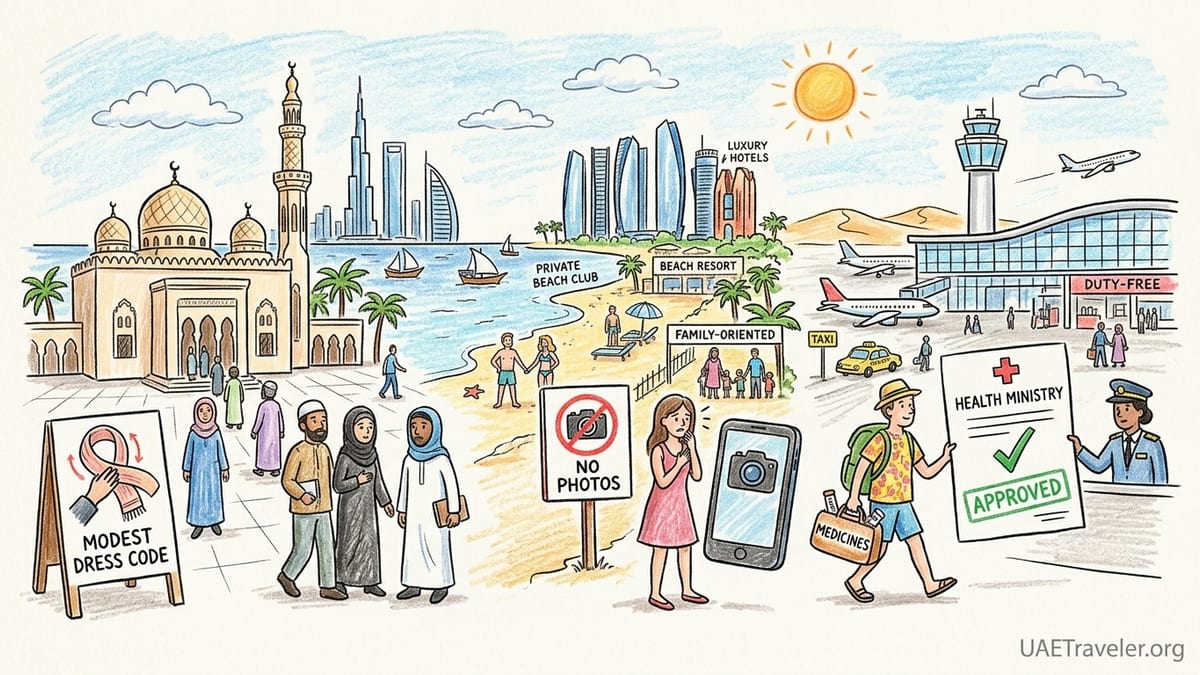
A Different Rulebook Behind the Glamour
On my first trip I arrived with the lazy assumption that “it’s like any big, modern city, just hotter.” That was a mistake. The UAE is welcoming, efficient and highly developed, but it is also a federation of seven emirates with a legal system that mixes federal laws, local emirate regulations and deeply rooted cultural norms. Behaviour that would be brushed off elsewhere can have legal consequences here, especially when it involves alcohol, public behaviour, photography or social media. What unsettled me most was not the existence of rules, but how easy it would have been to break them without realising.
In Dubai and Abu Dhabi in particular, the hotels, shiny malls and beach clubs create an illusion of global sameness. You can sip a cocktail in a rooftop bar, wander air-conditioned luxury malls and ride ride-hailing apps just as you would in Los Angeles or Singapore. Yet outside those controlled spaces, a different standard applies. Federal law still prohibits drinking or being under the influence of alcohol in public places anywhere in the UAE, and privacy protections around images of people and certain sites are far more robust than many visitors are used to. Stepping from my hotel bar to the taxi queue with a buzz from a couple of drinks, I was technically crossing a legal line I had not even known existed.
Understanding the difference between national law, local policies and unwritten etiquette is the key to staying safe and avoiding serious trouble. It is not about being paranoid. It is about recognising that you are in a country where order, privacy and public decorum are priorities, and where the law sometimes assumes you should have known better, even as a tourist.
Alcohol, Public Intoxication and Emirate-by-Emirate Differences
The first area where visitors get caught out is alcohol. The UAE has liberalised in recent years, but the core rule remains: drinking or being under the influence of alcohol in a public place is an offence under federal law. Official travel advisories from several governments still repeat this point clearly and note that arrests have occurred following arguments in the street, taxi disputes and road accidents where alcohol was involved. You may see people who appear to be bending the rules, especially in nightlife districts, but that does not change the legal position.
Inside licensed venues the picture is different. In Dubai and Abu Dhabi, hotel bars, restaurants, some beach clubs and certain standalone venues are licensed to serve alcohol, typically to those aged 21 and over. In Dubai, large chains like MMI and African + Eastern operate bottle shops where residents and, in practice, many tourists can buy alcohol for private consumption. Local rules continue to evolve, and some emirates no longer require residents to hold a paper liquor licence, but that flexibility does not extend to drinking on the street, on public beaches outside licensed zones, or in cars and taxis. Being obviously drunk when you leave a bar and step into a mall corridor or taxi ranks you as “in public” in the eyes of the law.
The critical exception is Sharjah. Sharjah is a dry emirate under local law. Travel advisories and official UAE sources are consistent on this point: the sale and public consumption of alcohol are prohibited in Sharjah, and foreign missions warn that the emirate bans alcohol by law. In practice, airline duty-free limits still allow small quantities of alcohol to be brought into the country under customs rules, but if your entry point is Sharjah and you transfer directly into that emirate, you are putting yourself in a complex legal space if you are found with it. On my last visit I flew into Dubai, collected a modest duty-free allowance and made sure I did not transit via Sharjah with any visible bottles in my luggage, just to avoid any ambiguity.
What surprised me most was how minor situations can escalate once alcohol is involved. Foreign consular reports mention cases where a simple fender-bender or an argument with a taxi driver turned serious because one party had been drinking. The threshold for “under the influence” is low. I now treat licensed venues in Dubai and Abu Dhabi as bubbles. I drink moderately, I do not drive at all, and I move quietly between those bubbles and my hotel room, avoiding any public confrontation that could invite police attention.
Photography, Privacy and What You Cannot Point Your Camera At
Photography is where my own assumptions failed hardest. On paper, the law targets specific harms: it is illegal to take photos of people without their consent in a way that violates privacy and to photograph government and military facilities or certain critical infrastructure. The UAE’s official portals and multiple foreign travel advisories warn that taking pictures of accident scenes, courts, embassies, police, military sites and some strategic buildings can be treated as a security offence. Even if no sign is posted, security staff may interpret “sensitive facility” more broadly than you expect.
In practice, the line can feel blurry. In Dubai’s older Deira districts, I had no problem taking wide street scenes with a phone. On the Palm Jumeirah, security guards largely ignored tourists filming themselves on the boardwalk. The friction came in private, controlled spaces that still feel public to a visitor. In one central Dubai mall, a friend was told to stop using a mirrorless camera in the atrium, even though dozens of people were filming on phones. Another time, a hotel staff member asked a content creator to delete a clip where housekeeping staff were clearly visible in the background. Privacy laws give locals strong protections if they feel they have been filmed or photographed without permission and then posted online.
On beaches, the cultural expectation is also stricter than the visual reality might suggest. Bikinis and typical Western swimwear are normal at designated hotel and public beaches in Dubai and Abu Dhabi, and there is no law requiring women to cover their hair in those spaces. The issue is where your camera is pointing. Female visitors, especially Emirati and Gulf women, may be extremely uncomfortable being in the background of strangers’ photos in swimwear, and complaints can lead to police involvement. I now avoid shooting any close-up of beach crowds, even with a phone, and never post images of recognisable strangers from UAE beaches on social media.
As a working rule, I treat big malls, hotel lobbies, metro platforms and family areas as places where photography is at the venue’s discretion, not my “right.” If a security guard tells you “no photos,” it is easier and wiser to apologise and comply than to argue the point. If I want to shoot more serious images with a larger camera, I now ask my hotel or the mall’s guest services desk whether they require a permit before I start.
Public Behaviour, Gestures, Dress and Social Media
Despite its reputation for glitz, the UAE retains conservative expectations around public behaviour. Public displays of affection that would barely register in Paris or Toronto can draw unwelcome attention in Dubai or Abu Dhabi. Travel advisories and Dubai’s own code-of-conduct documents warn that kissing or intimate touching in public might be treated as indecent. I have seen couples gently asked to separate in mall queues and once witnessed a heated exchange outside a club where security staff reminded a pair that their behaviour was “against local culture.” Simply holding hands is rarely an issue for married couples, but anything more explicit is a bad idea in public areas.
Offensive language and gestures are risks that many visitors underestimate. Swearing loudly at a driver, making a rude hand signal in traffic, or insulting someone online while you are physically in the UAE can be treated as criminal acts. Some travellers have faced charges after disputes that turned into shouting matches. The safest approach is to lower the emotional volume. If a situation starts to escalate, I now walk away, especially if I have had a drink. A complaint from a local resident carries particular weight, and the police are likely to side with whoever appears calm and respectful.
Dress codes fall into three categories: national law, local policies and etiquette. There is no federal law that forces all women to cover their hair or wear an abaya. At public beaches and hotel pools in Dubai and Abu Dhabi, ordinary one-piece swimsuits and bikinis are widely accepted for foreign visitors. Where the line tightens is in mosques, traditional souks and many shopping malls. Official UAE guidance talks about dressing “modestly,” especially in family areas, advising that shoulders and knees be covered. Some malls post signs requesting no strapless tops, very short shorts or transparent clothing. In Sharjah, written decency rules go further and expect both men and women to dress more conservatively than in neighbouring Dubai.
Social media deserves special caution. Defamation and “insult” are criminal matters in the UAE, not civil disputes. Posting a rant about a hotel, sharing an image of an identifiable person without their consent, or criticising local institutions in crude terms can attract legal scrutiny if someone complains. Consular advice often includes real cases where tourists were detained or questioned over social media posts made while in the country. I still review my phone gallery carefully before posting from the UAE, and I do not share any image that includes strangers’ faces or car plates. I also avoid airing grievances publicly; if something goes wrong, I take it up privately with the business or my travel insurer.
Mosques, Religious Spaces and Venue Rules vs National Law
My most powerful experience in the UAE was walking through Sheikh Zayed Grand Mosque in Abu Dhabi just before sunset, watching the stone cool from white to gold as the call to prayer echoed across the courtyards. It is also where I saw the sharpest contrast between venue rules, national law and cultural etiquette. The mosque has a very specific dress code that goes beyond federal law: women must cover their hair, arms and legs fully; men must wear long trousers and cover their shoulders. On arrival, staff perform visual checks and sometimes ask visitors to adjust scarves or borrow abayas from the facility.
These rules are not arbitrary. For locals, mosques are sacred spaces, and the tourism infrastructure around them is built on the assumption that visitors will respect that. Photography is allowed in clearly marked areas, but certain spots are off limits, and staff will intervene if people pose in ways that feel disrespectful, such as dramatic fashion-model shots or yoga poses in prayer halls. When I visited, a guard quietly stopped a group trying to record a loud TikTok dance inside a colonnade. They were not arrested; they were simply told, firmly, to stop. That was venue enforcement backed by a wider cultural expectation, not a specific criminal statute.
Similar dynamics play out at smaller mosques and religious sites across the country. Many do not admit non-Muslims to the prayer hall, and those that do may have signs explaining behaviour and dress. There is no law criminalising a foreign woman for not covering her hair in the street, but failing to follow a mosque’s published dress code can lead to being refused entry, or in extreme cases, complaints about disrespect. My rule now is simple: wherever religion is visibly central, I err on the side of maximum modesty and minimal photography, and I always ask staff if I am unsure.
This distinction between national law and venue rules repeats elsewhere. Beach clubs may allow swimwear that would be frowned upon a few hundred metres down the coast in a family park. A hotel may insist that non-guests cannot use its private beach even if there is no public law forbidding you from walking along the sand. The patterns are not always intuitive, so I treat signs, staff instructions and published house rules as binding conditions of entry, not mere suggestions.
Medicines, Prescriptions and Confusing Official Messages
If there is one subject that generates confusion and anxiety among visitors, it is medication. The UAE has strict federal laws on narcotics and psychotropic substances, and the Ministry of Health and Prevention maintains detailed schedules of controlled drugs. At the same time, its current official guidance explains that travellers may bring personal medicines, including certain controlled medications, in quantities up to a three-month supply when accompanied by a prescription or medical report. The ministry even notes that the online pre-approval process for travellers is optional for visitors who are not residents, provided they carry proper documentation and stay within the three-month limit.
Where it becomes tricky is that foreign travel advisories are often more conservative in tone. Some government sites still suggest that visitors “must” obtain prior approval for any controlled medicine and warn of possible confiscation or legal trouble without it. Others recommend carrying medications in original packaging with a prescription that clearly states your full name, dosage and the generic name of the drug. None of this contradicts UAE law, but it can paint a more alarming picture than the UAE’s own portal, which emphasises that ordinary, non-controlled prescriptions are usually fine to bring without advance permission, subject to inspection at the border.
On my last trip, I carried a stimulant medication that appears on many countries’ controlled lists. To reconcile the differing messages, I did three things. First, I checked the UAE’s most recent controlled medicines list published by the health ministry to confirm the exact status of the active ingredient. Second, I applied for the optional electronic approval permit several weeks before travel, attaching a scan of my doctor’s letter and prescription. Third, I carried the medicine in original labelled packaging in my hand luggage, along with printouts of both the approval and my prescription. At Dubai airport, no one asked to see any of it. But if they had, I would have had a clear, documented trail.
The bigger risk is not honest travellers with a month of prescribed tablets, but those who arrive with large quantities of strong painkillers, sedatives or ADHD medications without any paperwork, or who carry substances that are illegal back home and assume they are equally tolerated abroad. The UAE’s drug laws still allow significant penalties for unauthorised possession of narcotics and psychotropics, although recent legal reforms have given judges more flexibility for first-time offenders. Do not rely on that mercy. Before you fly, cross-check your medications against both your own government’s travel advice and the UAE health ministry’s lists. If anything is even arguably controlled and you cannot obtain clear confirmation, talk to your doctor about alternatives for the duration of your trip.
Scams, Taxis, Unofficial Rides and Insurance
In daily life, I feel safer on the streets of Dubai or Abu Dhabi than in many Western cities. Violent street crime is relatively rare, and the visible police and private security presence is strong. That does not mean the UAE is free of petty scams or risky situations. The problems tend to be quieter and more transactional: overcharging, unofficial rides, contract traps and the occasional small-time con dressed up as hospitality.
At airports, you will see clearly marked official taxi ranks with metered cabs. These are generally safe and regulated, and I use them without hesitation, especially late at night. The risk lies in individuals inside the terminal who approach you with “taxi, taxi” offers and lead you to unmarked vehicles. These rides can be significantly more expensive, may lack proper insurance and leave you with little recourse in case of dispute or accident. Ride-hailing services are widely used in major cities, but the rules around who can operate can change, and it is wise to stick to licensed apps recommended by your hotel or a trusted local contact.
Scams in tourist districts often take the form of “free” tours that end in high-pressure sales rooms, bogus VIP desert safaris sold on the street, or confusing pricing around shisha and drinks in backstreet cafes. I once saw a group of backpackers stunned by a bill several times what they expected after accepting a “special package” that was never clearly priced. In these environments, written menus and upfront quotes are your friend. For excursions, I now book desert safaris, dhow cruises and similar activities through well-known operators or via my hotel concierge, who can at least vouch for a certain level of insurance and safety compliance.
Travel insurance in the UAE is not a luxury. It is a practical necessity. Private healthcare is excellent but expensive, and public hospitals may still bill foreign visitors. Some travel advisories explicitly remind travellers that they must cover the cost of medical evacuation themselves if uninsured. In a country where a simple clinic visit can cost far more than you expect and where liability rules in traffic accidents may not favour the foreigner, a robust policy that covers medical care, repatriation, legal assistance and personal liability is worth every cent. I also carry digital and printed copies of my policy and the insurer’s emergency contact numbers, as connectivity can be patchy on desert excursions.
Security Climate: Advisories vs How It Feels on the Ground
The final piece many first-time visitors misunderstand is regional security. On the street in Dubai, Abu Dhabi or Sharjah, life feels orderly and calm. Families stroll malls late into the night, joggers circle waterfront promenades, and tourists photograph skyscrapers and fountains. It can be tempting to treat the UAE as a perfectly safe bubble, isolated from the tensions that affect the wider region. Official travel advisories tell a more nuanced story.
Several Western governments currently advise travellers to exercise a high degree of caution in the UAE due to the risk of terrorism and regional spillover, and some explicitly warn against non-essential travel to specific military bases or sensitive zones. These advisories reference past incidents in the Gulf where missiles and drones were used against targets in or near the UAE and note that the country’s prominence and alliances could make it a target in future. They also remind travellers that even sophisticated security services cannot eliminate risk entirely in a high-profile, high-traffic destination that hosts major events, large expatriate communities and critical energy infrastructure.
How does that translate into everyday decisions? For me, it means adopting the same mindset I would in any major global city under a similar advisory. I stay alert in crowded iconic sites and transport hubs, pay attention to local news and follow any security instructions from authorities or venue staff. I avoid demonstrations or large political gatherings, even peaceful ones, as they can attract scrutiny. At the same time, I let my direct experience carry weight: walking alone at night along the Marina promenade, I have felt substantially safer than in many Western capitals, with far less street harassment and a palpable sense that someone is always watching, in good ways and bad.
The key is to respect both realities at once. The UAE’s internal policing and surveillance make day-to-day crime risk relatively low for tourists, but those same systems also mean that when something goes wrong, it can involve multiple agencies quickly and formally. You are travelling in a country that takes security seriously, on terms it sets. Acknowledging that duality is more honest than dismissing warnings or treating the place as a danger zone.
The Takeaway: How I Now Travel Confidently in the UAE
Looking back, what I most wish I had known before my first visit is that the UAE is not inherently “dangerous” for tourists, but it is unforgiving of those who ignore its rules. The line between a smooth, memorable trip and a consular nightmare is often as small as a raised voice after a night of drinking, an impulsive social media post, or an overconfident assumption about medication or photography. The country offers extraordinary experiences from dawn desert light to white marble mosques and futuristic skylines, but enjoying them fully requires conscious adaptation.
Before each trip now, I check three kinds of sources. First, my own government’s travel advisory for the UAE, paying attention to updates on security, local laws and areas to avoid. Second, the UAE government’s official portals on visiting, social responsibility and medicines, so I know the local legal position in its most current form. Third, I look at my airline and hotel’s latest guidance on check in, as they often highlight practical changes around visas, customs allowances or health requirements. When those sources differ in tone or detail, I assume the strictest version will be applied to me in a dispute and plan accordingly.
On the ground, my personal rules are simple. I treat alcohol as something to consume only in licensed venues and never combine with driving or confrontation. I keep my photography wide, respectful and modest, seeking consent where people are identifiable and backing off the moment someone objects. I dress in a way that would be considered conservative casual in a European city whenever I am outside beach or pool areas, and I upgrade to full modest wear around mosques and older districts. I carry prescriptions and, where relevant, optional approvals for any sensitive medication. I only use licensed transport and reputable tour operators, and I keep my travel insurance details on my phone’s home screen.
Most importantly, I remind myself that as a guest, I am moving through a society where the balance between personal freedom and public order is calibrated differently. Choosing not to test those boundaries is not surrender. It is a strategy for reclaiming the best parts of the UAE experience without sleepwalking into avoidable risks. With informed caution and a willingness to adapt, first-time visitors can explore Dubai’s marinas, Abu Dhabi’s museums, Sharjah’s souks and the mountains and deserts beyond with genuine confidence and respect.
FAQ
Q1. Do women have to cover their hair everywhere in the UAE?
Women are not legally required to cover their hair in public spaces such as malls, streets or most tourist sites. Head coverings are typically required only in specific religious venues like mosques, where dress codes ask women to cover hair, arms and legs as a sign of respect.
Q2. Is it illegal to wear a bikini on the beach in Dubai or Abu Dhabi?
Ordinary beachwear, including bikinis and one-piece swimsuits, is widely accepted at designated public and hotel beaches in Dubai and Abu Dhabi. The key is to limit swimwear to beach and pool areas and wear more modest clothing when walking through streets, malls or hotel lobbies.
Q3. Can tourists drink alcohol legally in the UAE?
Yes, non-Muslim tourists can drink alcohol in licensed venues such as hotel bars, restaurants and some beach clubs, usually from age 21. It remains illegal to drink or be drunk in public places outside those venues, and the emirate of Sharjah bans alcohol under its own laws.
Q4. How strict is the UAE about photographing people and buildings?
The UAE is stricter than many countries on privacy and sensitive locations. Taking and sharing identifiable photos of people without consent, or photographing government, military and some critical infrastructure sites, can lead to complaints or legal trouble. In malls and private venues, staff may restrict photography even when phones are allowed.
Q5. Do I need special permission to bring my prescription medicines?
For most non-controlled prescriptions, bringing up to a three-month supply in original packaging with a doctor’s prescription is generally acceptable. For medicines that are narcotic, psychotropic or otherwise controlled, the UAE health ministry allows visitors to carry limited quantities with a prescription and says online approval is optional, but many foreign governments still advise obtaining that approval in advance.
Q6. How safe is the UAE compared with other destinations?
Daily personal safety in cities like Dubai and Abu Dhabi feels high, with low visible street crime and strong security presence. However, official travel advisories highlight an underlying risk of terrorism and regional tensions, so travellers are advised to stay informed, avoid sensitive areas and follow local security guidance.
Q7. What should I know about public behaviour and gestures?
Public displays of affection beyond modest hand-holding can be viewed as indecent, and swearing or making rude gestures, especially in traffic or disputes, can be treated as criminal acts. Staying calm, avoiding confrontation and keeping interactions polite is the safest approach, particularly if alcohol is involved.
Q8. Are there common scams or problems tourists face in the UAE?
Violent crime is rare, but tourists may encounter overpriced unofficial taxis, high-pressure sales linked to “free” tours, and unclear bills in some cafes or shisha venues. Using official taxis or licensed ride-hailing apps, booking tours through reputable operators and asking for prices in writing greatly reduces these risks.
Q9. Is travel insurance really necessary for a trip to the UAE?
Travel insurance is strongly recommended. Healthcare for foreigners can be expensive, and some governments warn that medical evacuation and treatment costs must be covered by the traveller. A good policy should include medical cover, evacuation, personal liability and legal assistance.
Q10. Where can I find the most reliable current rules before I travel?
The most useful sources are your own government’s latest travel advisory for the UAE, the UAE government’s official portals on visiting, laws and medicines, and up-to-date guidance from your airline or hotel. Checking all three shortly before departure helps you catch any recent legal or security changes.