


I still remember standing on a curb in Deira at 2 p.m., sweat dripping into my eyes, watching yet another taxi with a "On Call" sign speed past. I had just checked out of a budget hotel near the old souks and, in my infinite wisdom, booked a timed ticket for the View at The Palm at 3 p.m. I had assumed Dubai was a compact, easily walkable city where a quick cab and a short stroll would connect Old Dubai to Palm Jumeirah. Instead, I spent almost an hour in a taxi crawling down Sheikh Zayed Road, paid more for that ride than the saving I made by choosing the cheaper hotel, and arrived flustered, dehydrated and too late to enjoy the views properly. That one decision summed up my first UAE trip: good intentions undermined by poor logistics.
Believing Dubai Was Walkable Like A European City
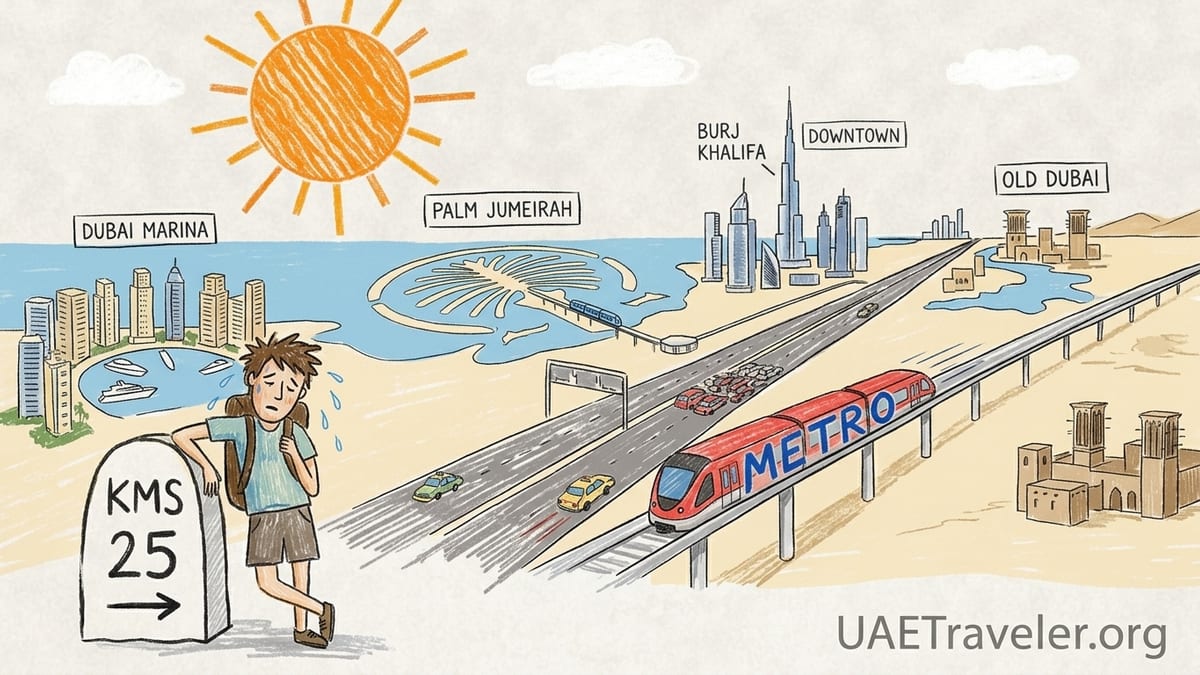
My biggest conceptual mistake was treating Dubai like Paris or Barcelona, where a thoughtfully chosen central hotel and a good pair of shoes let you walk between many sights. On the map, Old Dubai, Downtown, Palm Jumeirah and Dubai Marina looked like different neighborhoods of one city. In reality, they are separate corridors stretched along more than 40 kilometers of coastline, stitched together by highways and a metro built for speed, not for leisurely strolling between districts.
Even within individual areas, the distances are larger than they look. Google Maps showed 900 meters from Dubai Mall to a restaurant I liked in Business Bay. In February that might be a pleasant riverside walk. In October afternoons, with temperatures often above 35°C and radiant heat reflecting off glass and concrete, that "short" walk felt punishing. I learned quickly that a shaded pedestrian environment is the exception, not the rule.
The corrected decision would be to stop thinking of Dubai as a city to crisscross on foot. Instead, I now pick one or two adjacent zones per day, accept that I will mostly move by metro, tram or taxi within and between them, and treat walks over 500 to 700 meters as potentially strenuous in warm months. Mentally reframing Dubai as a string of hubs reduces the temptation to connect too many dots in one go.
Cost-wise, this approach also makes sense. A single Nol card metro trip across two zones costs around 6 to 8.5 dirhams, while a cross-city taxi journey of 25 to 30 kilometers can easily run above 60 dirhams before tolls and waiting time are added. By planning days that are geographically compact, I now keep most rides short and avoid stacking long, expensive hops on the same day.
Misreading The Geography: Old Dubai, Downtown, Palm & Marina
On my first visit, I thought Old Dubai, Downtown Dubai, Palm Jumeirah and Dubai Marina were essentially neighboring districts. The metro map looked like a straight line and the roads seemed flawless in photos, so I assumed traveling between them would be quick. Only once I was in a car did I fully grasp the real scale. From the historic area around Dubai Creek in Deira and Bur Dubai down to Dubai Marina is roughly 25 to 30 kilometers along Sheikh Zayed Road, depending on your exact start and end points. Continuing on to Abu Dhabi adds another 130 to 140 kilometers. Excellent road surfaces do not shrink those distances.
In real time, this meant that what I thought would be a 15-minute cross-town jump became a 35 to 45-minute taxi ride in daytime traffic. A journey from near the Gold Souk in Deira to Palm Jumeirah in mid-afternoon took me a little under 50 minutes door to door, including short slowdowns around Business Bay and Dubai Marina. A similar taxi later in the week from Dubai Marina back up to the Al Fahidi Historic District took just over 40 minutes with lighter traffic but several traffic lights near the creek. These are not outliers. Guides that describe Dubai to Abu Dhabi as a 90-minute drive at normal speeds highlight how stretched the urban corridor really is.
Today, I plan with this geography front and center. I give Old Dubai and the creek area essentially their own day. Downtown and Dubai Mall get another, sometimes linked with an evening fountain show and dinner. Palm Jumeirah combines logically with Dubai Marina because they sit at the same end of the city and are connected by tram and monorail. I now warn friends that expecting to bounce between the creek, Downtown, Palm and Marina in one day will convert your holiday into an unpaid city-wide taxi survey.
The financial lesson was equally sharp. With Dubai Taxi’s metered fares in the range of roughly 2 to 2.5 dirhams per kilometer plus a minimum flag fall around 12 dirhams, my supposedly “clever” decision to save 200 dirhams per night by staying far from where I was spending my evenings evaporated in long daily cab rides. A Deira to Marina round trip of about 50 to 60 kilometers can easily reach 110 to 140 dirhams in a day once base fares and any tolls are counted. Over four nights, that exceeded the saving on my cheaper room and cost me time I could have spent on the beach.
Booking Distant Attractions Back-To-Back On The Same Day
The single worst day of my trip was not caused by a bad hotel or rude staff. It was my own schedule. I booked an early-morning slot at Al Fahidi and the Dubai Museum, a 3 p.m. visit to the View at The Palm, and an evening dinner reservation in Dubai Marina. On paper it seemed neat: old city, modern skyline, then waterfront dinner. In reality, heat, traffic and distance shredded the plan.
After a leisurely morning in the shaded alleys of Al Fahidi and a quick abra across the creek, I returned to my hotel in Deira around midday. That left what I thought was “plenty of time” before the 3 p.m. slot in Palm Jumeirah. Instead, at just after 2 p.m. I was still looking for a taxi. Midday demand had spiked, back streets were congested, and drivers were understandably avoiding small side lanes without clear pick-up space. When I finally got one, we hit slow patches near Downtown. The roughly 30-kilometer ride took over 45 minutes and cost enough that the price difference between timed slots for the Palm observation deck felt irrelevant.
The better version of that day splits those experiences. Now I would spend a full day around the creek and Al Fahidi, including the souks on both banks, taking breaks for indoor air-conditioned cafes. I would allocate another afternoon and evening to Palm Jumeirah and Dubai Marina together, perhaps starting with a relaxed late-morning beach visit at JBR or a hotel club, then using the tram and monorail to reach a late-afternoon viewing deck slot. Dinner would then be a short stroll away rather than another taxi dash.
In practical terms, this is where non-refundable tickets become dangerous. Many major attractions in Dubai, from frame and sky decks to desert tours, use timed entries or fixed pick-ups. On my second trip, I deliberately paid slightly more for flexible or on-the-day tickets whenever available, especially for anything that required crossing from one district of the city to another. That extra 20 to 40 dirhams felt like an insurance policy against my own tendency to overprogram.
Underestimating Traffic Because The Roads Look Perfect
Coming from cities with potholes and crumbling asphalt, I equated Dubai’s wide, immaculate highways with effortless movement. Sheikh Zayed Road looks like a fast-moving artery in photos and promotional videos, and during quiet periods it can indeed deliver quick journeys. The mistake was assuming that smooth tarmac cancels out rush hours, merging bottlenecks and the simple reality of distance.
Traffic variations on my first trip were significant. An early evening taxi from Business Bay to Dubai Marina crawled past several malls and interchanges and took about 55 minutes. The same route late at night, when I returned, took just over 20 minutes. Similarly, a mid-morning ride from a hotel near BurJuman to Dubai Mall was around 15 minutes, but when I tried to replicate that timing before a late-afternoon booking, it nearly doubled. None of this is unusual in a big city, but I had not built slack time into my plans because I was seduced by images of free-flowing roads.
My corrected decision is to treat any cross-city journey as potentially 50 percent longer than the navigation app suggests, especially at typical check-out times in the late morning and during early evening dining hours. If an attraction is non-refundable and timed, I now target arriving 45 to 60 minutes early, using any extra time for coffee inside the air-conditioned mall or observation deck lobby instead of fretting in the back of a taxi.
I also mix transport modes more intelligently. The Dubai Metro can bypass surface congestion along much of Sheikh Zayed Road. For instance, I now travel from Bur Dubai or Deira to Dubai Marina by metro during busy times. Even with one or two interchanges, the predictable journey time and low per-trip fare are worth the trade-off in comfort compared with a door-to-door taxi. I then use short taxis only for the last mile, such as from the Marina metro or tram station to a specific hotel or beach club.
Ignoring The Heat When Scheduling Outdoor Time
Another naïve assumption was that as long as I visited outside July and August, the weather would be "hot but manageable" throughout the day. Dubai’s summer temperatures regularly exceed 40°C, and even shoulder months can have midday highs above 35°C, with high humidity making the air feel hotter. In July 2024, for example, average daytime temperatures around 37°C were recorded, with peaks that felt dramatically higher when humidity spiked. I understood these numbers intellectually but scheduled my days as if shade and sea breeze would soften the blow.
I booked a morning desert safari that started with a pickup just after 9 a.m., assuming it counted as an early start. By the time we were out among the dunes near 11 a.m., the sun was already punishing. A camel ride that should have felt atmospheric instead became something to endure. On another day, I tried to walk a long stretch of The Walk at JBR around noon in late September. Despite the occasional sea breeze, surfaces were radiating heat and I was darting between pockets of shade. I retreated indoors long before I had explored the area properly.
The corrected approach is to anchor all outdoor-heavy activities in the early morning or after sunset, especially from May to October. For desert trips, I now favor late-afternoon safaris that reach the dunes as the sun begins to drop, or sunrise experiences that start very early. For waterfront promenades like Dubai Marina Walk or the Palm Boardwalk, I plan pre-breakfast or post-dinner walks, using midday hours for museums, malls and indoor observation decks.
This principle also influences hotel choice. On my second visit, I deliberately chose a hotel with direct shaded access to the beach in JBR and a pool that stayed in partial shade during the hottest hours. Paying a bit more per night saved money I would otherwise have spent on extra daytime taxis shuttling between an inland hotel and various air-conditioned refuges.
Choosing A Cheaper Hotel Too Far From The Metro
My most expensive “saving” in Dubai was booking a budget hotel in Deira that looked central on the map but sat almost a kilometer from the nearest metro station. The nightly rate was roughly 150 dirhams lower than a similar property closer to a Red Line stop. I congratulated myself on four nights of frugality before discovering how quickly distance from the metro turns into taxi dependency.
Because the walk to the station involved crossing wide, sun-exposed roads and several junctions with limited shade, I used taxis for nearly every outing. Short hops to the metro or nearby sights often hit the minimum fare, around 12 dirhams, regardless of the actual distance. A simple round trip to Dubai Mall that could have been two metro rides for perhaps 20 dirhams total became a pair of taxi rides easily exceeding 60 to 80 dirhams once base fare, per-kilometer charges and occasional tolls were counted. Over four days of multiple outings, I burned through the room saving and sacrificed the flexibility to pop back to my room by train.
When I ran the numbers later, the trade-off became obvious. Paying an extra 150 dirhams per night for a hotel within a five-minute shaded walk of a Red or Green Line station would have cost around 600 dirhams over four nights. My added taxi spending, multiplied across sightseeing trips, dinner outings and airport transfers, came close to that figure while delivering a less convenient experience. The more structured your itinerary, the more valuable that quick, predictable metro access becomes.
On subsequent trips, my rule is simple. If I am relying primarily on public transport and taxis, I prioritize proximity to a metro station over almost every other amenity in mid-range hotels. In practical terms, that means looking at the map carefully. "Near the metro" in marketing language can mean 100 meters or 900 meters. I now measure that distance and consider the walking route, crossings and shade. A genuinely short walk under the sun is a crucial perk in the UAE.
Mistiming Desert Trips And Abu Dhabi Day Excursions
My romantic vision of the desert ran into clock reality. On my first visit, I booked an Abu Dhabi day trip that included the Sheikh Zayed Grand Mosque and a quick drive along the Corniche. The tour departed Dubai after 9 a.m. and promised a return by early evening. The outline was accurate, but what the brochure did not emphasize was how much of that "day" would be spent on the road along E11, the main highway linking Dubai and the capital.
The door-to-door drive from central Dubai to the Grand Mosque area is around 120 to 140 kilometers, usually taking 80 to 100 minutes in each direction depending on starting point and traffic. Factor in hotel pickups around the city, a mid-journey stop, and city driving within Abu Dhabi itself, and you can easily have four or more hours in a vehicle on a single day. I enjoyed the mosque visit immensely but felt rushed at every stop, tweeting between photos and dress code checks. Back in Dubai, there was neither time nor energy left for a meaningful evening activity.
If I could redo that, I would give the Abu Dhabi excursion an entire day mentally and physically. That means accepting that on a standard group tour, you will see the Grand Mosque and a couple of city highlights, then return and rest. On my next visit I chose a small-group tour that left earlier and was explicit about drive times. I packed snacks, water and realistic expectations. Alternatively, I would now consider spending one night in Abu Dhabi instead of forcing everything into a single day. The room cost for a mid-range hotel can easily be justified against the value of a quiet evening stroll on the Corniche without watching the clock.
The same logic applies to desert safaris. My initial 9 a.m. pickup left me in the hottest part of the day with too little time to linger at sunset. I now treat desert trips as half-day commitments that deserve either an early dawn or an afternoon start. This means planning no fixed back-to-back bookings either side. On a recent return, I booked a 3 p.m. pickup, reached the dunes when the light was softening, and was back in Dubai after dinner in the desert. That day had one focus and felt rich rather than packed.
Overprogramming: Trying To Do “All Of Dubai” In Three Days
The final, overarching mistake was assuming I could "do" Dubai and a taste of Abu Dhabi in three full days. My list included Old Dubai, Dubai Mall and Burj Khalifa, Dubai Fountain, the Frame, Palm Jumeirah, JBR, Dubai Marina, a desert safari and an Abu Dhabi mosque visit. On a spreadsheet, with one or two items per day, it looked plausible. On the ground, when each line item had to be translated into breakfast, transport, queues, security checks, walking time and heat management, the plan turned into a chase.
One telling example was the day I squeezed Dubai Frame between a morning in Downtown and an evening dhow cruise on the creek. The Frame is only a few kilometers from Dubai Mall, but getting there involved leaving one massive complex, finding a taxi, dealing with mid-afternoon traffic and then repeating the process to make the cruise boarding time. Instead of marveling at the views, I spent the visit checking my watch and calculating how quickly I could get back to the creek.
My philosophy has since shifted to an explicit one-attraction-per-half-day rule, especially for big-ticket or timed experiences. A morning might be built entirely around Dubai Mall and the Burj Khalifa observation deck, with lunch on site and an unhurried stroll through the mall’s aquarium or art installations. The afternoon might be nothing more than relaxing at the hotel pool followed by an evening fountain show. That may sound sparse on paper, but the lived experience is richer. Absent that breathing space, even the most impressive skyline becomes a background to your schedule rather than an object of attention.
Crucially, I now accept that deleting an attraction can create a better holiday. On my second trip, I consciously cut the Frame from my tight three-day plan and kept it as a "next time" idea. In return, I gained a slow sunset walk along Dubai Marina and a spontaneous dinner in a small Lebanese restaurant I found without rushing. When I think back, I remember that evening more vividly than any checklist of landmarks.
The Takeaway
Looking back, my first UAE trip did not suffer from a lack of information. It suffered from my refusal to believe what the map, the climate charts and other travelers were already telling me. I underestimated heat, misread distances, trusted perfect roads to deliver perfect traffic, and treated metro stations as optional instead of essential. Each mistake on its own would have been manageable. Combined, they turned what should have been relaxed desert sundowners and creekside evenings into a sequence of clock-watching taxi rides.
If I were planning a first-timer itinerary today, I would start with a different philosophy. Old Dubai and the creek would get their own slow day, with air-conditioned pauses in museums and cafes. Downtown and Burj Khalifa would take another full day, allowing for flexible timing around possible queues and security. Palm Jumeirah and Dubai Marina would share a third day, with planned use of tram, monorail and short taxis instead of backtracking across the city. A desert safari would stand alone as a half-day anchor, either sunrise or late afternoon, with nothing fixed immediately before or after. An Abu Dhabi visit, if included, would be treated as a full day with early departure and no expectations beyond the mosque and perhaps one other stop.
Within that framework, the practical rules are simple. Pay a little more for a hotel within a short shaded walk of a metro station in the part of town where you will spend most evenings. Assume every cross-city journey could take 50 percent longer than ideal conditions, and treat midday outdoor walks longer than a few hundred meters as serious exertion for much of the year. Use flexible tickets where possible for attractions that require long transfers. Most importantly, be willing to strike a line through one or two "must-see" sights so that the remaining experiences have time to breathe.
Dubai and the wider UAE reward this kind of restraint. When you stop trying to compress the whole skyline, desert and neighboring emirate into a long weekend, the city shifts from exhausting obstacle course to hospitable base. The souks smell richer, the malls feel less like transit corridors, and the desert light has time to work its slow magic. The logistics will never be invisible, but if you plan with geography, heat and transport in mind, they will quietly support your trip instead of defining it.
FAQ
Q1. Is Dubai really too spread out for walking between major sights?
Dubai’s main districts are separated by many kilometers along the coast, so walking between areas like Old Dubai, Downtown, Palm Jumeirah and Dubai Marina is impractical for most visitors. Short local walks are fine, but expect to rely on metro, tram and taxis for most longer movements.
Q2. How much time should I allow to travel from Old Dubai to Dubai Marina?
In light to moderate traffic, a taxi between the creek area and Dubai Marina can take around 30 to 40 minutes, but at busy times it can stretch beyond 45 minutes. The metro follows a similar corridor and offers more predictable timing, though with transfers and walking at each end.
Q3. Is an Abu Dhabi day trip from Dubai worth it for first-time visitors?
An Abu Dhabi day trip can be worthwhile, especially to see Sheikh Zayed Grand Mosque, but it involves around three to four hours of driving in total. For a short Dubai stay of three days or less, many travelers are happier saving Abu Dhabi for a future trip or giving it at least one overnight stay.
Q4. What is a realistic number of major attractions per day in Dubai?
A practical rule is one big attraction per half-day. For example, you might pair Dubai Mall and Burj Khalifa in the morning with a relaxed evening at Dubai Fountain, or spend a full afternoon and evening between Palm Jumeirah and Dubai Marina without adding distant, timed visits elsewhere.
Q5. How close should my hotel be to a Dubai Metro station?
For a first visit without a rental car, staying within a five to seven-minute shaded walk of a Red or Green Line station makes a big difference. This reduces taxi costs, shortens return trips for rest breaks and adds flexibility when traffic slows on the main roads.
Q6. When is the best time of day for desert safaris or outdoor activities?
In the warmer months, early morning and late afternoon or evening are the most comfortable times. Midday heat can be intense from late spring through autumn, so sunrise or sunset desert trips and evening waterfront walks are usually more enjoyable.
Q7. Are Dubai’s perfect roads a guarantee of fast journeys?
The roads are generally in excellent condition, but that does not remove rush hour congestion, merging bottlenecks or the simple reality of long distances. Journey times can increase significantly at peak periods, so it is wise to add generous buffer time to any plan involving cross-city travel.
Q8. How expensive are taxis compared with the metro in Dubai?
Dubai taxis charge a base fare plus a per-kilometer rate, so longer trips add up quickly. The metro uses zone-based fares that are usually far cheaper for long journeys. Many visitors find a combination of metro for main corridors and taxis for short last stretches to be the best value.
Q9. Can I comfortably walk around areas like JBR and Dubai Marina?
These waterfront districts are some of the most walkable in Dubai, with promenades and plenty of cafes. However, in hotter months midday sun can still be challenging, so early morning and evening are more comfortable times for longer strolls.
Q10. How should I adjust my expectations for a three-day first trip to Dubai?
For three days, focus on two or three core areas, such as Old Dubai, Downtown and either Palm Jumeirah or Dubai Marina, plus one desert trip. Accept that you will not see everything, and design each day around a few well-chosen experiences instead of a long checklist.