


Planning a first-time trip to the United Arab Emirates is exciting, but working out what it will actually cost can be confusing. Hotel rates jump between high season and summer, attractions like the Burj Khalifa and desert safaris range from modest to eye-watering, and there are local fees that rarely appear in headline prices. This guide uses current 2026 price ranges to build realistic 5 and 7 day budgets for Dubai and Abu Dhabi, with separate estimates for budget, comfortable midrange and luxury travelers, shown in both AED and approximate USD.
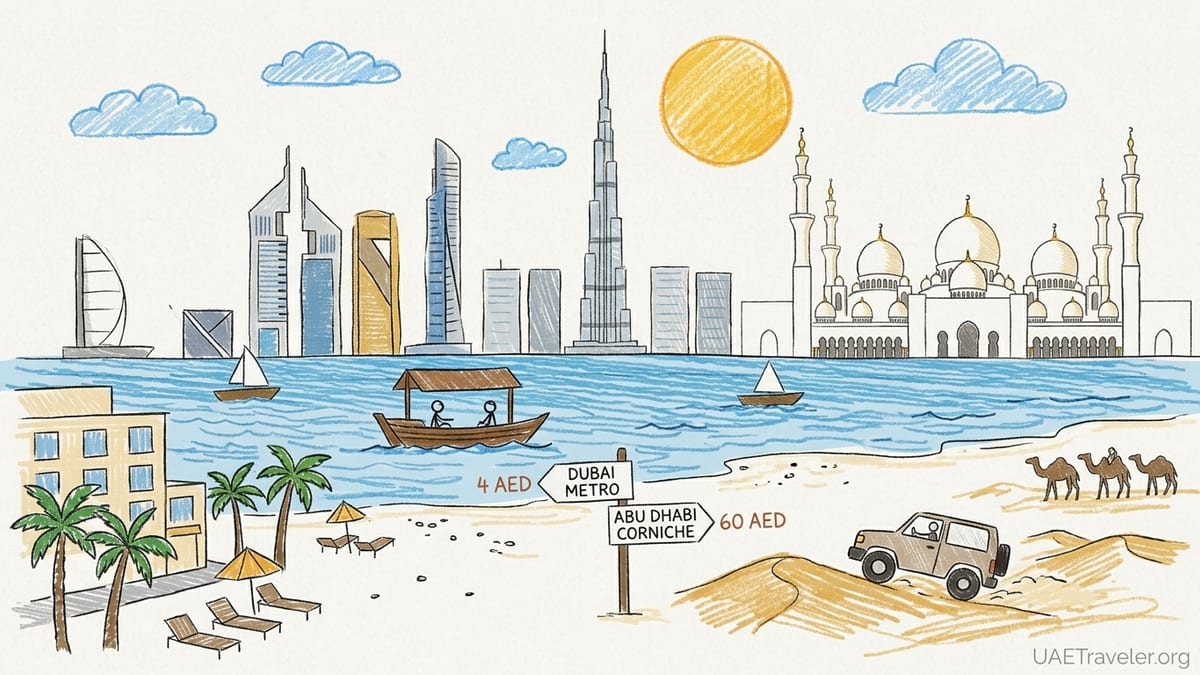
Understanding Seasons, Cities and Price Levels in the UAE
Most first-time visitors focus on Dubai and Abu Dhabi, which also set the tone for prices across the UAE. Dubai hotels currently show a wide spread, with market analysis in October 2026 indicating a median asking rate of about 300 to 520 AED per night for standard double rooms in popular areas, depending on month and category, before taxes and fees. In cooler high season from roughly November to March, typical central midrange rooms in areas such as Downtown Dubai, Dubai Marina and on Sheikh Zayed Road often list around 550 to 800 AED per night, while summer months from June to September can drop those same properties to roughly 350 to 550 AED with aggressive promotions.
Cheaper but still well-reviewed three-star hotels and serviced apartments in districts like Al Barsha, Deira and parts of Bur Dubai often price in the 220 to 400 AED range in shoulder and summer periods, rising closer to 350 to 500 AED in peak dates such as New Year or major events. These areas are not beachfront, but many sit within walking distance of the Dubai Metro or frequent buses, which keeps transport costs down. Abu Dhabi shows a similar pattern but with slightly lower averages, particularly for business-oriented properties on the main island away from the Corniche or Yas Island.
At the top end, luxury beachfront and landmark properties in Dubai, including major international brands on Palm Jumeirah, Jumeirah Beach Residence and high-end Downtown towers, frequently command 1,200 to 2,500 AED per night in high season for entry-level rooms, excluding breakfast and taxes. Signature suites and club-level rooms can run significantly higher. For this guide’s example budgets, approximate exchange rates of 1 USD equal to about 3.67 AED are used, so 367 AED is roughly 100 USD. Actual card conversion rates and bank fees will shift final numbers slightly.
Because hotel prices vary so strongly by date and location, the budgets below focus on realistic mid-2026 price bands that travelers can currently find with some advance booking rather than one-off flash deals or the very cheapest options far from transit. All figures are rounded for clarity and are meant as working planning numbers rather than exact guarantees.
Local Taxes, Tourism Fees and Hidden Hotel Costs
When you book accommodation in Dubai or Abu Dhabi, the nightly rate rarely tells the whole story. Across the UAE, a 5 percent value-added tax is applied to most hotel services, restaurant bills and many attraction tickets. Hotels also commonly add a municipal room fee or service charge, which together can reach around 20 percent or more on top of the base rate in major city properties. In practice, a room advertised at 500 AED per night may cost closer to 600 AED once these charges and tourism fees are included.
Dubai adds a specific levy called the Tourism Dirham, charged per room per night according to the hotel’s classification. Current 2026 guidance indicates that basic hotel apartments and budget hotels pay around 7 AED per room per night, while midrange properties are closer to 10 to 15 AED and five-star hotels up to 20 AED per night. This fee is normally collected at check-in or check-out and will appear as a separate line on your bill. For a seven-night stay in a higher-end hotel, that can add up to roughly 140 AED, or about 38 USD, which is easy to overlook when budgeting.
Refundable deposits are another frequent surprise. Many Dubai and Abu Dhabi hotels pre-authorize a security deposit on your credit card per stay or per night to cover incidentals such as room service or minibar use. A common pattern in city hotels is a hold of 200 to 500 AED per stay, but luxury resorts can block 500 to 1,000 AED per night. The money is usually released after checkout if you have no extra charges, but it temporarily reduces your available credit, so it is wise to travel with a spare card if possible.
Serviced apartments and holiday homes often charge separate cleaning fees, late check-out fees or local community charges. While these are not always high on a per-night basis, they can make a short 3 to 5 night stay more expensive than the nightly rate suggests. Reading the “taxes and fees” and “additional charges” sections carefully before confirming a booking will help align your real costs with the budgets set out in this guide.
Transport, Daily Food and Core Attraction Costs
Within Dubai and Abu Dhabi, everyday costs are less extreme than many first-time visitors expect, provided you use public transport and eat some meals away from hotel restaurants. In Dubai, the Metro and tram system uses a zone-based fare structure monitored by the Nol card. Current official guidance shows typical fares with a standard ticket of about 4 AED for very short trips under 3 kilometers, around 6 AED for two-zone journeys and about 8.5 AED for three or more zones, with discounts for daily or weekly passes. A single airport-to-city trip on the Metro usually falls in the 6 to 8.5 AED band, which makes it far cheaper than taxis.
Taxis, however, remain affordable by international standards and are heavily used by visitors. A typical starting fare from the airport is around 25 AED, with per-kilometer rates adding up to roughly 60 to 80 AED for a central city ride in normal traffic. Cross-city journeys, for example from Dubai Marina to Dubai Creek, can run 60 to 100 AED depending on distance and congestion. In Abu Dhabi, taxi starting fares are slightly lower, though longer distances between sights can equalize total spend. For this guide, an active day of sightseeing using mostly metro and a few taxi hops is costed at about 40 to 60 AED per person, rising to 80 to 120 AED per day for travelers who rely mostly on taxis.
Food can be as inexpensive or lavish as you choose. Simple meals in South Asian cafeterias or small local eateries in areas like Karama, Deira and back streets in Abu Dhabi frequently cost around 15 to 30 AED for a generous plate of biryani, grilled chicken or shawarma with a soft drink. Midrange cafes and casual restaurants in malls, Marina Walk or Yas Mall often land in the 45 to 80 AED range per main dish, with a meal including a drink around 70 to 120 AED per person. Hotel buffets, brunches and licensed restaurants typically start around 150 AED per person before drinks and can climb much higher, so this guide treats those as occasional splurges rather than daily dining.
For attractions, a standard “At the Top” ticket to the Burj Khalifa observation decks on levels 124 and 125, bought in advance for off-peak times, has recent checked prices in the rough band of 179 to 244 AED per adult, with prime sunset times costing more. A classic shared evening desert safari, including dune bashing, a barbecue dinner and entertainment in a group camp, currently ranges from about 150 to 350 AED per person depending on pickup style and camp quality, while premium or small-group safaris in the Dubai Desert Conservation Reserve can reach 500 to 900 AED per adult. These big-ticket experiences, rather than daily transport or food, are what drive up total trip costs most sharply.
Three Budget Levels: What a UAE Trip Really Costs
To move beyond vague “average daily cost” figures, this guide uses three realistic spending profiles. All numbers are approximations based on current price ranges and rounded to the nearest 10 AED. For currency comparison, 370 AED is treated as roughly 100 USD. Actual exchange rates at the time of booking may shift totals slightly but not enough to change the overall picture.
The budget traveler profile assumes staying in simple but clean three-star hotels or basic hotel apartments in districts like Deira, Al Barsha or central Abu Dhabi, using mostly metro and occasional taxis, eating many meals in inexpensive cafeterias and food courts, and picking a small number of paid attractions. Daily per-person costs for a solo traveler in this category work out around 350 to 550 AED including accommodation, or roughly 95 to 150 USD, depending on season and city.
The comfortable midrange profile fits travelers who prioritize central locations close to the metro or the Corniche, stay in well-rated four-star hotels, mix local eateries with midrange restaurants and a few hotel meals, and include several major paid attractions plus a quality desert safari. For these visitors, realistic daily spend for a solo traveler including lodging typically lands around 700 to 1,000 AED in high season, or about 190 to 270 USD. Couples sharing rooms gain some economies of scale on accommodation, but food and attraction costs scale almost linearly with the number of travelers.
The luxury profile assumes high-end beachfront or landmark hotels, frequent use of taxis or private cars, meals in high-quality hotel restaurants and well-known fine-dining spots, and preference for premium versions of major experiences such as VIP lounge access at Burj Khalifa or private desert safaris. Here, solo travelers can easily spend 1,800 to 3,000 AED per day including lodging, or about 490 to 820 USD, while couples and families who share rooms but pay for multiple attraction tickets often fall in the 2,500 to 4,500 AED per day range altogether.
5 and 7 Day Cost Estimates for Solo, Couples and Families
Pulling these elements together, it becomes possible to map out realistic trip budgets across lengths of stay and traveler types. Consider a five-day budget trip to Dubai for a solo traveler in summer, staying in a decent three-star hotel in Deira for around 220 AED per night plus taxes and Tourism Dirham, which brings the nightly real cost to roughly 270 AED. Over four nights, that is about 1,080 AED for accommodation. Daily food and drink at cafeterias and supermarket snacks could be held to about 80 to 120 AED per day, say 500 AED total, with public transport and a few taxis adding another 200 AED across the trip.
Add in a discounted basic evening desert safari at around 180 AED, a standard Burj Khalifa ticket at about 200 AED and a few smaller paid attractions and museum entries totaling roughly 200 AED, and the complete five-day package approaches 2,100 to 2,300 AED, or about 570 to 630 USD. A couple on the same plan, sharing the room but each paying attraction and food costs, would see lodging rise only slightly to perhaps 1,080 to 1,200 AED total, while meals might double to 1,000 AED and attractions and transport to around 1,400 AED combined, bringing their five-day total to roughly 3,500 to 3,800 AED, about 950 to 1,040 USD.
At the comfortable midrange level in high season, a solo traveler might stay in a four-star hotel near the Dubai Mall or Dubai Marina at around 650 AED per night including taxes and Tourism Dirham, which totals roughly 2,600 AED for four nights. If they allocate about 200 AED per day for a mix of midrange and occasional hotel meals, that is another 1,000 AED. Transport using mostly metro with some taxis could run 250 AED across five days. For attractions, they might book a midrange evening desert safari at 280 AED, an off-peak Burj Khalifa ticket for about 200 AED, a day trip to Abu Dhabi or a guided old Dubai tour for around 350 to 500 AED, and additional minor entries and activities for 300 AED. The final five-day total lands close to 4,900 to 5,300 AED, roughly 1,330 to 1,440 USD.
Families see the largest spread. A family of four at budget level, booking a basic but decent hotel apartment in Al Barsha in summer at about 350 AED per night including taxes for a one-bedroom unit with sofa bed, might pay about 1,400 AED for four nights. Cooking simple breakfasts and some dinners, with cafeteria lunches and snacks, could keep food to around 1,200 to 1,600 AED across five days. Using metro and a handful of taxis might total 400 to 500 AED. If they choose one shared desert safari with discounted child pricing and pick only a couple of paid attractions with free entry for younger children, total activity costs could stay around 1,200 to 1,500 AED. Their full five-day budget would then roughly range from 4,200 to 5,000 AED, about 1,140 to 1,360 USD, illustrating how apartment-style stays and fewer paid extras help families control costs.
Sample 7 Day Spending Plan and What Drives Costs
To illustrate how these numbers feel day by day, imagine a seven-day, six-night comfortable midrange trip focused mainly on Dubai with a one-day Abu Dhabi visit for a couple traveling in high season. They book a reputable four-star hotel in Al Barsha, a short walk from the metro, at 580 AED per night including estimated taxes and Tourism Dirham. Over six nights, that is 3,480 AED in total for accommodation. This works out at about 1,740 AED per person, or roughly 475 USD each, for lodging alone.
On daily spending, the couple might plan around 280 AED per day for both of them on food if they combine hotel breakfasts with mall food courts, neighborhood cafes and a few slightly nicer dinners. Over seven days, this is about 1,960 AED for dining. Public transport and taxis, using metro most days with a few taxi segments to beaches and late-night rides, might reach around 70 AED per day for two, or roughly 490 AED in total.
The big-ticket items quickly add up. A midrange group desert safari for two at about 280 AED per person would cost 560 AED. Two standard Burj Khalifa “At the Top” tickets could come to around 400 AED together. A full-day small-group excursion to Abu Dhabi to see the Sheikh Zayed Grand Mosque, the Corniche and Louvre Abu Dhabi might cost around 350 to 450 AED per person including transport, which for two people adds about 800 AED. Additional admissions and small paid experiences, such as Dubai Museum or Al Shindagha Museum entries, abra rides, or modest-priced boat tours in Dubai Marina, could total another 400 to 500 AED across the week.
When all of these line items are added, the couple’s seven-day, six-night midrange trip budget looks like this in simple rounded form: accommodation 3,480 AED; food 1,960 AED; city transport 490 AED; attractions and tours roughly 2,260 AED. The total comes to around 8,200 to 8,400 AED, which at the working exchange rate equates to roughly 2,230 to 2,280 USD for two people. On a per-person basis, that is near 1,120 to 1,140 USD for a week. Adjusting any of the major components, such as choosing a cheaper hotel district or skipping the premium Abu Dhabi day tour, changes the final total far more than trimming small everyday purchases.
Splurges vs Free and Low-Cost Alternatives
Dubai and Abu Dhabi both offer expensive signature experiences that many first-time visitors feel pressured to include. In Dubai, beyond the Burj Khalifa observation decks and desert safaris, big-ticket items include theme park days at complexes such as the large parks on the city’s outskirts, premium yacht cruises from Dubai Marina, and high-end brunches in hotel ballrooms that can cost 400 to 700 AED per person once drinks are included. In Abu Dhabi, premium seating for major events on Yas Island, high-performance driving experiences and VIP museum tours can all sharply raise a trip budget.
Balancing these are an impressive number of inexpensive or free experiences. One of the best value moments in Dubai remains the short abra ride across Dubai Creek between Bur Dubai and Deira, where wooden boats shuttle passengers for just a few dirhams per crossing. Public beaches such as Jumeirah Beach, Kite Beach near Umm Suqeim, and stretches of the Corniche in Abu Dhabi have no entry fee, with costs limited to optional sunbed, umbrella or locker rentals and snacks. Exploring the historic Al Fahidi neighborhood, wandering around the spice and gold souks in Deira, or strolling through modern spaces like City Walk can fill several days at almost no direct cost.
Even with observation decks, there are lower-cost strategies. Instead of paying for the highest and most premium-level tickets at Burj Khalifa, visitors may opt for off-peak hours at the standard decks or choose to enjoy the free Dubai Fountain show and the view of the tower from the Dubai Mall promenade. In Abu Dhabi, the spectacular Sheikh Zayed Grand Mosque welcomes visitors without an entrance fee, with only modest transport and optional guided tour costs to consider. Louvre Abu Dhabi charges an admission fee, but browsing the waterfront around the museum and nearby promenade areas is free.
When planning, it helps to group “must-do” splurges and then fill remaining time with free and low-cost activities. For example, a first visit might prioritize one desert experience, one observation deck or skyline view, and one special meal, while relying on abra rides, heritage districts, markets and beaches to round out the remaining days. This approach keeps the heart of the UAE experience intact without letting a handful of high-priced experiences dominate the overall budget.
Where You Can Save Without Missing the UAE Experience
The largest controllable cost category for most visitors is accommodation. Shifting from a luxury beachfront hotel on Palm Jumeirah at 1,800 AED per night in high season to a central four-star in Al Barsha or Trade Centre at 600 to 750 AED can save over 1,000 AED per night, or roughly 270 USD, while still keeping you close to metro lines and major malls. Families who choose serviced apartments in slightly outer districts, with kitchenettes and laundry, can cut both lodging and food costs by cooking some meals and avoiding hotel laundry fees.
Food strategy matters too. Swapping one hotel buffet breakfast for a quick meal in a local bakery or cafeteria at 20 to 30 AED can save 50 to 100 AED per person per day. Over a seven-day trip for two people, that difference approaches 700 to 1,400 AED, equivalent to the cost of a quality desert safari or a pair of premium attraction tickets. Reserving splurge dining for one or two memorable evenings, while treating most lunches and simple dinners as opportunities to explore local and mall-based eateries, keeps the total food budget in the more manageable 100 to 160 AED per person per day range.
Transport savings are straightforward. Using the Dubai Metro from the airport instead of a taxi can cut a single arrival journey from perhaps 80 to 120 AED down to under 10 AED, provided your hotel is near a station and you are not carrying unmanageable luggage. During the stay, grouping sights by area and walking more in neighborhoods like Downtown, Dubai Marina, the Creek and key parts of Abu Dhabi reduces the need for multiple short taxi hops. For longer inter-city journeys, upcoming rail options and scheduled intercity buses may offer cheaper alternatives to private transfers for budget-conscious travelers.
Finally, being selective about souvenirs and shopping helps prevent budget drift. Malls in Dubai and Abu Dhabi feature many of the same international brands found at home, often at similar or higher prices. Travelers who focus on a small number of meaningful purchases, such as modest gold jewelry, textiles from souks, or locally produced dates and sweets, will likely remember the experiences and sights far more than an extra bag of impulse buys. Putting a simple shopping ceiling into your daily budget, for example 50 to 100 AED, can keep overall spending firmly within the ranges mapped out in this guide.
The Takeaway
A first-time trip to the UAE does not have to be an open-ended expense. By using realistic current prices, you can plan a five or seven day itinerary that aligns with your budget and still includes the highlights that make Dubai and Abu Dhabi memorable. For budget travelers, a solo five-day stay in summer can be built for roughly 2,100 to 2,300 AED, while couples and families benefit from sharing accommodation. Comfortable midrange visitors can expect totals in the 4,900 to 5,300 AED bracket for five days solo or around 8,200 AED for seven days as a couple, while luxury stays can climb far higher when premium hotels, fine dining and private tours are chosen.
The key levers are accommodation category and location, the number of high-priced attractions and tours you include, and whether you embrace local transport and eateries instead of hotel-centered options. Public beaches, abra rides, heritage districts and mosque visits offer deep impressions of the UAE at very low cost, balancing out signature experiences like desert safaris and observation decks. With a clear overview of what each part of your budget buys, it becomes easier to design a UAE trip that feels rich in experiences rather than stretched by unplanned costs.
FAQ
Q1. How much should I budget per day for a first trip to Dubai on a tight budget?
For a solo traveler staying in a basic but decent hotel in an outer central area, using metro and eating mainly at inexpensive cafeterias, a realistic 2026 figure is about 350 to 550 AED per day including accommodation, which is roughly 95 to 150 USD at current exchange rates.
Q2. What is a comfortable daily budget for Dubai or Abu Dhabi without going full luxury?
A comfortable midrange daily budget for a solo traveler, including a solid four-star hotel in a central area, mixed restaurant meals, some taxis and a few paid attractions, is around 700 to 1,000 AED, or about 190 to 270 USD, with couples spending more overall but less per person because they share a room.
Q3. How do hotel prices differ between high season and summer in the UAE?
In cooler high season from roughly November to March, central four-star hotels in Dubai often charge around 550 to 800 AED per night for standard rooms, while in the hot summer months of June to September comparable rooms can drop closer to 350 to 550 AED as demand softens and promotions appear.
Q4. What is the Dubai Tourism Dirham and how much will it add to my bill?
The Tourism Dirham is a nightly fee charged per hotel room in Dubai based on the property’s category, with current typical amounts from roughly 7 AED at budget and apartment-style places up to about 20 AED in five-star hotels, collected separately at check-in or checkout.
Q5. Are desert safaris and Burj Khalifa tickets really worth the cost?
For many first-time visitors they are, and current prices for shared evening desert safaris usually range from about 150 to 350 AED per person, while standard Burj Khalifa “At the Top” tickets for off-peak times sit around 179 to 244 AED per adult, making them significant but manageable one-off splurges in a well-planned budget.
Q6. How much does local transport typically cost in Dubai?
Using the metro and tram with a Nol card, most journeys fall between 4 and 8.5 AED, so an active sightseeing day might cost 15 to 25 AED in fares, while occasional taxis usually add 20 to 60 AED per ride depending on distance, giving many visitors a total of 40 to 120 AED per day for transport.
Q7. What should families with children expect to spend for a week in Dubai?
A family of four on a careful budget, staying in a modest hotel apartment and cooking some meals, can often keep a seven-day, six-night trip within roughly 6,000 to 8,000 AED, while midrange families who choose more central accommodation and several major attractions might see totals between 9,000 and 12,000 AED.
Q8. How much should I allow for food each day in the UAE?
Travelers who eat mainly in local cafeterias and mall food courts can often keep food to about 60 to 120 AED per person per day, while those mixing casual spots with a few nicer dinners should expect closer to 120 to 200 AED per day, excluding alcohol, which is expensive in licensed venues.
Q9. Are there free or very cheap things to do that still feel special?
Yes, including riding an abra across Dubai Creek for just a few dirhams, relaxing on public beaches like Jumeirah Beach or the Abu Dhabi Corniche, exploring the Al Fahidi heritage district, visiting souks and promenades, and touring Sheikh Zayed Grand Mosque in Abu Dhabi, which does not charge an entrance fee.
Q10. What expenses most strongly affect the final cost of a UAE holiday?
The biggest drivers are hotel category and location, the number and type of premium experiences such as desert safaris, observation decks and guided day tours you choose, and how often you dine in hotel restaurants or fine-dining venues instead of local eateries, while everyday costs like metro fares and simple meals stay relatively modest.