


Seeing all seven emirates of the United Arab Emirates in one holiday is absolutely possible, but only if you plan your driving, sightseeing time and budget carefully. The distances look short on the map, yet real-world traffic, tolls, parking and family needs can quickly turn a simple idea into a tiring blur of highways. This guide lays out three complete and genuinely different itineraries for 7, 10 and 14 days that connect Dubai, Abu Dhabi, Sharjah, Ajman, Umm Al Quwain, Ras Al Khaimah and Fujairah in a logical loop, with optional detours to Al Ain, Hatta, Khor Fakkan and Jebel Jais.
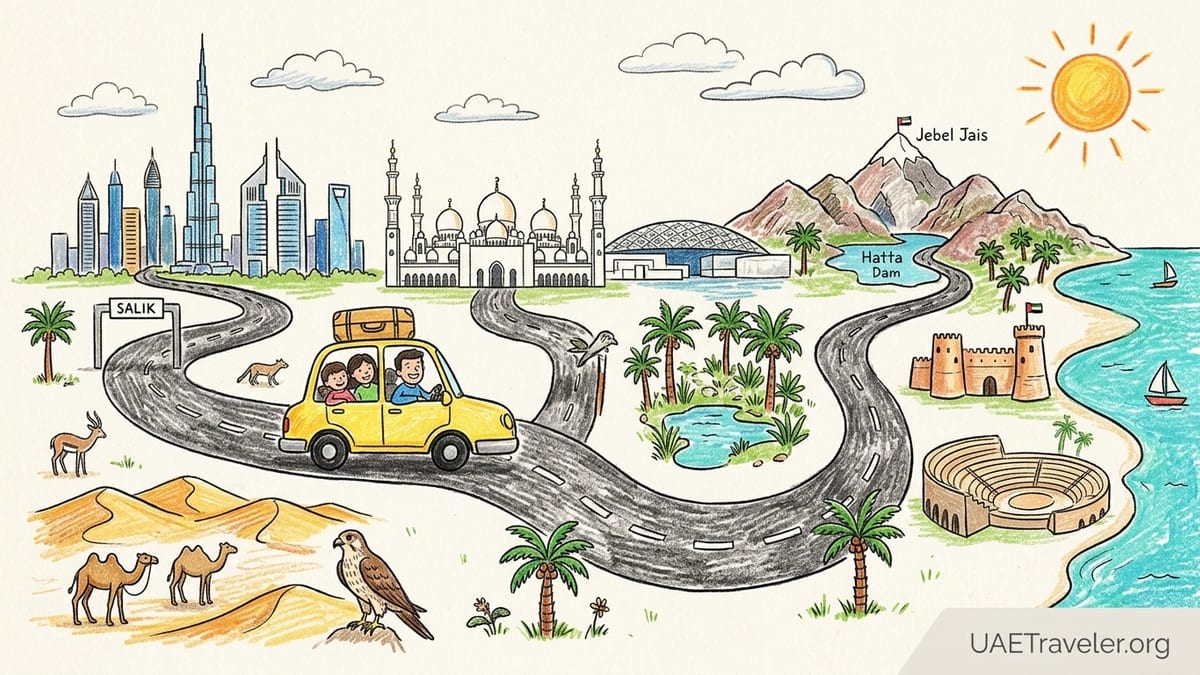
How Driving Around the Seven Emirates Really Works
On paper, the UAE is compact. In practice, its road system channels most long-distance traffic along a few big highways that cross multiple emirates. You might drive from Dubai to Ras Al Khaimah in 1 hour 15 minutes, but for much of that time you are physically passing through Sharjah and Umm Al Quwain without stopping. This does not really count as a visit unless you exit the highway, park, and spend some time in a town, beach or attraction.
Dubai and Abu Dhabi are linked by Sheikh Zayed Road and E11, a wide multi-lane highway that carries both commuters and tourists. Between them sit Sharjah and Ajman along the coast, and inland the desert city of Al Ain belongs to the Emirate of Abu Dhabi despite its closer feel to Oman’s mountains. North of Dubai, you reach Umm Al Quwain, Ras Al Khaimah and Fujairah, with Hatta as an exclave of Dubai in the Hajar Mountains and Khor Fakkan as an exclave of Sharjah on the east coast.
Dubai’s automatic toll system, Salik, and Abu Dhabi’s Darb toll on some city bridges, add small but noticeable costs. Since mid 2026, a Salik gate in Dubai typically costs around AED 6.30 in weekday peaks and about AED 4.20 off peak, with free hours during the night. The charge is automatic each time you pass under a toll gantry, and most rental companies simply add the total tolls to your final invoice rather than asking you to top up a tag yourself.
Fuel is relatively affordable compared with Europe but higher than it was a few years ago. In 2026, widely reported pump prices for Special 95 petrol often sit somewhere around AED 3.5 to 3.7 per litre. For planning, many visitors assume that 1,000 kilometres of driving in a medium sedan will cost in the region of AED 350 to 450 in fuel, depending on traffic and driving style, then add road tolls and parking on top.
Rental Car and Accommodation Strategy
For these itineraries a rental car is the most flexible option. Major agencies at Dubai International Airport and Abu Dhabi International Airport typically offer compact sedans from roughly AED 120 to 200 per day in high season, with midsize SUVs somewhere between AED 200 and 350 per day. Weekend or off season rates can be lower. If you plan to head up into the mountains to Jebel Jais in Ras Al Khaimah or the wadis near Hatta, a car with good ground clearance is helpful, although the main mountain roads are paved and passable in ordinary sedans in good weather.
Insurance options matter. Basic coverage is usually included and may come with a relatively high excess. Many couples accept this to keep costs down, while families more often pay extra for full coverage to avoid surprise fees after small scrapes in tight hotel car parks or city streets. Check in advance whether your rental contract includes unlimited kilometres and whether cross-emirate driving is allowed as standard, which is usually the case for UAE-wide travel.
Accommodation works best with a hub-and-spoke pattern rather than changing hotels every night. In Dubai and Abu Dhabi, prices vary widely. A midrange city hotel in Deira or Al Barsha might cost from AED 350 to 600 per night for a double room in high season, while beachfront resorts on Saadiyat Island or Jumeirah Beach can range from AED 900 to well above AED 2,000. In the northern emirates, Ras Al Khaimah and Fujairah have resort strips where sea-view rooms might run AED 600 to 1,200 per night, while simple city hotels can be lower.
Parking at hotels is often free outside the absolute city centres, but in Downtown Dubai, Dubai Marina and central Abu Dhabi you may pay for valet or use metered street parking. In most paid public zones, fees are around AED 4 to 6 per hour in busy daytime periods. To keep a realistic budget, many travellers mix city hotels with one or two splurge nights at a beach resort or desert camp rather than staying at luxury properties every night.
7-Day Seven Emirates Highlights Itinerary
This 7-day route is about ticking off the seven emirates efficiently while still allowing a couple of headline experiences in each. Driving times are estimates without heavy traffic. In winter school holidays, add at least 20 to 30 percent on Dubai and Sharjah city routes, especially at rush hours.
Day 1: Dubai highlights
Start: Dubai. Driving time: Local city driving 45 to 60 minutes spread through the day. Morning at Dubai Marina and JBR beach, afternoon at Downtown Dubai for views of Burj Khalifa and Dubai Mall fountains. Expect 5 to 6 hours of sightseeing. Lunch options range from casual cafes in JBR to midrange restaurants in the mall. For dinner, many visitors choose restaurants near the Dubai Fountain to see the evening shows. Hotel base: Dubai (city hotel or Marina). Estimated daily spend per couple: AED 900 to 1,600 including midrange meals, moderate shopping, taxis or parking and attraction tickets such as Burj Khalifa if booked.
Day 2: Sharjah and Ajman
Start: Dubai. Drive to Sharjah: around 30 minutes in light traffic, often 45 minutes or more at peak times. Visit the Sharjah Art Museum and the restored Heart of Sharjah heritage area, with 3 to 4 hours of slow walking, coffee stops and indoor museum time. Continue to Ajman, about 20 minutes along the coast, for a late afternoon stroll on Ajman Corniche and sunset on the beach. Meal areas include cafes around Sharjah’s Al Majaz Waterfront for lunch and simple seafood places on Ajman Corniche for dinner. Either return to Dubai in about 45 minutes or overnight at a beachfront hotel in Ajman. Daily spend per couple: AED 700 to 1,300 depending on hotel choice, with museum entries and parking still modest compared with Dubai.
Day 3: Umm Al Quwain and Ras Al Khaimah
Start: Ajman or Dubai. Drive Ajman to Umm Al Quwain in about 30 to 40 minutes. A short stop of 1.5 to 2 hours lets you see the quiet old harbour, mangrove views and sandy beaches. Continue to Ras Al Khaimah in roughly 45 minutes. Spend the afternoon at a resort beach or exploring the National Museum in an old fort. Total driving for the day is around 2 to 2.5 hours. Meal options include roadside cafeterias on E11 and resort restaurants in Ras Al Khaimah. Hotel base: beachfront or city hotel in Ras Al Khaimah. Expected spend per couple: AED 900 to 1,500 including a midrange hotel, simple lunch and sit-down dinner.
Day 4: Optional Jebel Jais and east to Fujairah
Start: Ras Al Khaimah. Drive up to Jebel Jais in about 45 to 60 minutes on a paved mountain road. Jebel Jais is in the Emirate of Ras Al Khaimah and is the UAE’s highest peak. Plan 3 to 4 hours for photo stops, short walks and a cafe break. Commercial activities like the Jais Flight zipline are sometimes suspended for maintenance or heat, particularly in summer. When running, tickets often cost several hundred dirhams per person, so check the current status and book in advance if it is a priority. In the afternoon, drive down and continue to Fujairah on the east coast in roughly 2 hours via coastal highways that pass through parts of Umm Al Quwain, Sharjah and Ras Al Khaimah again without long stops. Hotel base: Fujairah or nearby coastal resort. Daily spend per couple: AED 1,000 to 1,700 if you include a resort night and some mountain snacks.
Day 5: Fujairah and Khor Fakkan option
Start: Fujairah. Spend the morning visiting the historic Fujairah Fort and Al Bidya Mosque, one of the oldest in the country, with around 3 hours of sightseeing and photo stops. For an optional extra, drive about 45 minutes north to Khor Fakkan, which is actually an exclave of Sharjah on the east coast, for a beach walk and the new amphitheatre area. If you do this, allow 3 to 4 hours including driving and beach time. Meal areas include beachfront cafes in Khor Fakkan and simple restaurants in Fujairah city. Hotel base: Fujairah or return west towards Dubai in about 1 hour 45 minutes. Couples often spend around AED 800 to 1,400 depending on activities and meal choices.
Day 6: Abu Dhabi city highlights
Start: Dubai or Fujairah, but for a smoother day most travellers position themselves in Dubai the night before. Drive Dubai to Abu Dhabi in around 1 hour 30 minutes in light traffic along E11, noting that you stay within the Emirate of Dubai before crossing into the Emirate of Abu Dhabi; Sharjah and Ajman are north and do not sit on this direct route. In Abu Dhabi, visit Sheikh Zayed Grand Mosque (2 to 3 hours including security, walking and photography) and then head to Saadiyat Island for Louvre Abu Dhabi, where standard adult tickets for foreign visitors are generally in the AED 60 to 80 range, with reduced prices for some categories and children. Plan 3 hours there including galleries and a coffee break under the famous dome. Hotel base: Abu Dhabi city or Saadiyat Island. Daily spend per couple: AED 1,000 to 1,800, reflecting higher city hotel prices and two major attractions.
Day 7: Al Ain option and back to Dubai
Start: Abu Dhabi. For a fast end to your trip, you can simply drive back to Dubai in 1 hour 30 minutes and use the rest of the day for last shopping and a relaxed dinner. To add one more very different side of the emirate, extend to Al Ain, an oasis city that is officially part of the Emirate of Abu Dhabi. The drive from Abu Dhabi to Al Ain is around 1 hour 45 minutes, with 3 hours to see at least one oasis area, the National Museum and Al Jahili Fort, then a further 1 hour 45 minutes back to Dubai via Al Ain Road. This makes for a long but rewarding final day. Expect fuel and tolls to add up a little more, so couples might spend AED 900 to 1,600 depending on whether they include Al Ain and a farewell Dubai dinner.
10-Day Itinerary with Culture and Nature Layers
With 10 days you can slow the pace and add more cultural and nature experiences instead of racing from photo stop to photo stop. This version assumes you start and end in Dubai and stay at least two nights in Dubai, Abu Dhabi and Ras Al Khaimah or Fujairah.
Days 1 to 3: Deeper Dubai and Sharjah
Day 1 focuses on Dubai’s modern icons as before. Day 2 moves into Old Dubai for 3 to 4 hours around the Al Fahidi Historical Neighbourhood, Dubai Museum area and the abras that cross Dubai Creek, followed by an evening in Deira’s spice and gold souqs. These bring in local history, traditional architecture and everyday commerce, not just malls. Day 3 is devoted to Sharjah’s museums and cultural quarter, adding Sharjah’s excellent Museum of Islamic Civilization or the Rain Room installation for those interested in contemporary art. Each day involves 1 to 1.5 hours of total city driving, which can lengthen in rush hour. A couple might spend AED 900 to 1,500 per day, while a family of four in midrange hotels and restaurants can expect around AED 1,400 to 2,200 including attraction tickets and taxis or metro rides.
Days 4 and 5: Desert and Abu Dhabi culture
On Day 4, pick up the car if you have not already and drive 45 minutes to 1 hour outside Dubai to a desert conservation reserve or desert activity camp. Operators offer morning dune drives, camel rides and falcon demonstrations, typically costing in the region of AED 250 to 500 per person depending on inclusions. After a late lunch, continue about 1 hour 30 minutes to Abu Dhabi. Day 5 then gives you a full cultural day in the capital with Sheikh Zayed Grand Mosque in the morning and Louvre Abu Dhabi plus the newer cultural developments on Saadiyat Island in the afternoon. With hotel, meals, attractions and fuel, a couple might budget around AED 1,200 to 2,000 per day for these two days, with families slightly higher.
Days 6 and 7: Al Ain and Hajar Mountains
Day 6 takes you from Abu Dhabi to Al Ain, which is still in the Emirate of Abu Dhabi and well known for its palm-filled oases and historic forts. Driving time is about 1 hour 45 minutes. Spend 4 to 5 hours between Al Ain Oasis, Al Ain Palace Museum and the fort before overnighting in Al Ain at a midrange city hotel. On Day 7, drive from Al Ain towards the Hatta region, which is an inland mountain exclave belonging to the Emirate of Dubai near the Oman border. The journey is roughly 2.5 to 3 hours depending on route and traffic. Hatta offers mountain biking, dam viewpoints and short hikes, as well as kayak rentals on the reservoir. Plan 3 to 4 hours outside, avoiding the hottest midday hours in peak summer. Hotel base: simple Hatta hotel or eco-lodge, or continue another 1.5 to 2 hours to Fujairah on the east coast for your next base.
Days 8 to 10: East coast, Ras Al Khaimah and quieter emirates
From Hatta or Fujairah, use Day 8 to explore the Fujairah and Khor Fakkan coast properly, including snorkeling or boat trips where available. Fujairah is its own emirate, while Khor Fakkan belongs to Sharjah. Expect a relaxed day with 1 to 1.5 hours of driving and 4 to 5 hours of seaside time. Day 9 sees you driving about 2 hours north along the coast and through dips into other emirates towards Ras Al Khaimah. Settle into a resort, then on Day 10, drive up to Jebel Jais in the morning, allowing 45 to 60 minutes each way, and stop in old Ras Al Khaimah city or at a beach club in the afternoon. You will technically pass near or briefly cross Umm Al Quwain and parts of Sharjah again on coastal highways, but without stopping those do not count as new visits. Budget for AED 900 to 1,600 per day per couple in this section, depending on resort prices and optional paid activities.
14-Day Itinerary for Slower Travel and Variety
With two full weeks, you can create a loop that includes beaches, museums, mountain excursions and real downtime at the pool. This itinerary favours couples and families who prefer to check into a hotel for at least two nights at a time, unpack and enjoy both the city and its surroundings.
Days 1 to 4: Dubai as a base
Use Dubai as a four-night base to cover its urban highlights and nearby nature. Day 1 is modern Dubai, Day 2 focuses on Old Dubai and Deira, and Day 3 is reserved for a day trip to Sharjah and Ajman with dinner back in Dubai. Day 4 can be a beach and leisure day at JBR or Kite Beach with a short optional drive out to the desert at sunset. Total city driving each day may be just 45 minutes to 1.5 hours, interspersed with walking, metro rides and pool time. A family of four might budget AED 1,600 to 2,500 per day in this phase including a midrange hotel family room, attraction tickets, several taxi rides and three meals out.
Days 5 to 7: Abu Dhabi and Al Ain loop
On Day 5, drive from Dubai to Abu Dhabi in around 1 hour 30 minutes and check in for two nights. Divide sightseeing between Sheikh Zayed Grand Mosque, Louvre Abu Dhabi and a relaxed evening on the Corniche or at a Saadiyat beachfront café. Day 6 stays in the Emirate of Abu Dhabi but shifts the mood in Al Ain. Drive there in under 2 hours, spend the day around the oases and palm gardens, and return to Abu Dhabi by early evening. Day 7 can be an unhurried day with only one main sightseeing focus, for instance a mangrove kayaking tour in the city or simply hotel pool time and a short drive to Qasr Al Watan for a palace tour. Daily driving is 2 to 3.5 hours on the Al Ain day, and under 1.5 hours on the others.
Days 8 to 10: Hatta and Fujairah mountains and coast
Leave Abu Dhabi on Day 8 and cross the Emirate of Dubai to Hatta. While Hatta is part of Dubai, it feels much more like a mountain village. Depending on the exact route and traffic, the drive can take around 2.5 to 3 hours, passing through stretches of desert and low hills without stopping in other emirates. Overnight in Hatta to enjoy the cooler evening air and mountain views. Day 9 offers more Hatta time for short trails, dam views and activities such as mountain biking or kayaking. With younger children or in the hottest season, you may shorten the active portion to the early morning and late afternoon, resting in air conditioned spaces in the middle of the day.
On Day 10, drive from Hatta to Fujairah in around 1.5 to 2 hours, checking into a beach resort or coastal hotel for two nights. You have now officially added the Emirate of Fujairah to your list. The rest of the day can be spent on the beach or by the pool, with a short drive in the evening to Fujairah city for dinner near the fort or mosque area. Daily spending across Days 8 to 10 will depend heavily on hotel choice. Couples staying at simple hotels might manage AED 900 to 1,300 per day, while families at full-service resorts with kids’ clubs and buffets could sit in the AED 1,800 to 2,800 range.
Days 11 to 14: Northern emirates, Jebel Jais and return to Dubai
Day 11 takes you north along the east coast and then inland to Ras Al Khaimah, about 2 hours of driving from Fujairah. You may dip into Sharjah’s coastal enclaves and pass through parts of Umm Al Quwain on this route but will not count additional emirates unless you stop off the main road. Check into a Ras Al Khaimah hotel for three nights. That afternoon, keep things light with a walk on the beach or a visit to the old town souq.
Day 12 is for Jebel Jais, with 45 to 60 minutes of mountain driving in each direction. Take snacks, water and layers, as temperatures at the top can be noticeably cooler than on the coast, especially in the cooler months. If the zipline or other mountain attractions are open, you will need to have reserved ahead online and should allow at least half a day including queuing and safety briefings. Day 13 can then be a relaxed resort day or a short outing to see a mangrove area or a desert camp near Ras Al Khaimah. On Day 14, drive back to Dubai in about 1 hour 15 minutes and return your rental car, factoring in a buffer for Salik tolls and possible city traffic near the airport.
Route Map, Costs and Practicalities for Couples and Families
Mentally, all three itineraries form loops. The 7-day route is a tight clockwise circuit from Dubai to Sharjah and Ajman, up to Umm Al Quwain and Ras Al Khaimah, across to Fujairah and back via Dubai to Abu Dhabi, with optional extensions to Al Ain. The 10-day version adds extra loops inland to the desert, Al Ain and Hatta. The 14-day route stretches those loops with multiday stays in Dubai, Abu Dhabi, Hatta, Fujairah and Ras Al Khaimah so that driving rarely dominates the day.
If you are a couple sharing a medium rental car and staying mostly in midrange hotels, a realistic daily budget in 2026 across these itineraries might fall roughly between AED 900 and AED 1,800. This range includes accommodation, meals, fuel, tolls, parking and a few entrance tickets each day, provided you are not staying every night at high-end beachfront resorts or booking multiple premium activities. For a family of four, allow at least AED 1,400 to 2,800 per day depending on hotel category, how often you eat in restaurants rather than food courts, and which paid attractions you prioritise.
Driving costs are only one part of this. In the 7-day itinerary you might cover 900 to 1,100 kilometres, in the 10-day loop perhaps 1,300 to 1,600 kilometres including Al Ain and Hatta, and in the 14-day trip up to around 1,800 kilometres once mountain detours and city driving are included. With average petrol prices in the mid-three-dirham range per litre, this usually translates into a total fuel bill of several hundred dirhams for the entire trip, not thousands, as long as you are using a reasonably efficient car.
Salik and Darb tolls accumulate over the days if you cross Dubai’s toll gates or Abu Dhabi’s city bridges frequently. A visitor who commutes across Dubai’s central toll gates twice per day for a week might see AED 150 to 250 in tolls added to a rental car bill, whereas someone who plans routes on parallel roads and travels outside peak hours will pay much less. Rental companies usually add a small administrative fee on top of the toll total, so it is useful to ask how they calculate this at the counter.
Parking is another factor, especially if you like to drive into Downtown Dubai or near busy beaches. Many hotels and malls offer free or validated parking, but street parking and public car parks in prime areas can add AED 20 to 40 per day. Families often find it convenient to pay hotel valet fees instead of hunting for spaces with tired children, while couples on a tighter budget sometimes park a little farther away and walk.
The Takeaway
Attempting to see all seven emirates in only a few days is possible but rarely satisfying. The three itineraries described here each serve a different style of traveller. The 7-day version is a greatest-hits road trip, ideal for those who simply want to say they have been everywhere and are comfortable with many hotel changes and longish driving days. It hits headline icons such as Burj Khalifa, Sharjah’s museums, a Fujairah beach, Ras Al Khaimah’s mountain road and the big sights of Abu Dhabi, at the cost of some downtime.
The 10-day route adds the cultural depth and nature days that many travellers remember most clearly. The inclusion of Old Dubai, a proper Sharjah day, a desert experience, Al Ain’s oases and more time on the east coast and in Ras Al Khaimah creates a much broader understanding of the country beyond skyscrapers and malls. For many visitors this 10-day loop offers the best balance of time, budget and meaningful experiences while still ensuring that all seven emirates are visited in more than just a technical sense.
The 14-day itinerary is for travellers who prefer slower mornings, pool time and the freedom to adjust plans to the weather or mood. It gives couples and families alike space to linger in favourite places, from Saadiyat’s beaches to Hatta’s hills and Jebel Jais’s rock faces, without rushing from check-out to check-in. It also spreads fixed costs like rental and tolls over more days of genuine holiday enjoyment, rather than concentrating them into a frantic race.
If your goal is to balance time, budget and authentic experiences rather than simply ticking boxes, the 10-day itinerary stands out as the sweet spot. It lets you experience desert, coast, mountains, mosques, museums and traditional districts, with enough breathing room to enjoy evening walks and unplanned coffee stops. The 7-day schedule still works well for frequent travellers who know they will return, while the 14-day loop rewards those who want to make this their once-in-a-decade deep exploration of the Emirates.
FAQ
Q1. Do I really need a rental car to complete a seven emirates itinerary?
For a route that includes mountains, east coast towns and places like Hatta and Al Ain, a rental car is by far the most practical choice. Public transport between emirates mainly serves commuters, and organised tours rarely combine all seven emirates in a single coherent loop.
Q2. How much should I budget for fuel and tolls on a 10-day trip?
Most visitors driving a medium car on the 10-day loop might spend several hundred dirhams in fuel and perhaps another AED 150 to 300 in Salik and Darb tolls, depending on how often they cross busy city gates and bridges.
Q3. Is it safe to drive in the UAE for visitors not used to multi-lane highways?
Roads between emirates are generally high quality and well signposted in English and Arabic. Traffic can be fast, so it is important to stay in the right or middle lanes, avoid sudden lane changes and allow extra time for busy city periods.
Q4. Which emirate is Hatta part of, and do I cross into Oman?
Hatta is an inland exclave of the Emirate of Dubai in the Hajar Mountains. Main tourist routes to the dam and activity centres stay on the UAE side and do not require crossing into Oman, although you are close to the border.
Q5. Can I visit Jebel Jais all year round?
The mountain road to Jebel Jais in Ras Al Khaimah is usually open year round, but some paid attractions at the top may close for maintenance or in extreme heat. Always check current conditions and opening hours before driving up.
Q6. Which emirate does Al Ain belong to, and why is it so green?
Al Ain belongs to the Emirate of Abu Dhabi and is known as the Garden City because of its palm-filled oases fed by historic falaj irrigation channels. Its parks and tree-lined streets make it feel cooler and greener than many coastal cities.
Q7. Is it worth staying overnight in Sharjah or Ajman instead of commuting from Dubai?
For travellers interested in museums, heritage areas and quieter beaches, at least one night in Sharjah or Ajman can be rewarding. It cuts commuting time and lets you enjoy evening waterfront walks without worrying about driving back to Dubai.
Q8. How should families plan around heat and children’s energy levels?
Families often plan outdoor sights like mosques, forts and mountain viewpoints in the early morning and late afternoon, reserving air conditioned museums, malls and hotel pools for midday. Shorter driving legs and two-night stays also help keep children rested.
Q9. Do I need to reserve attractions such as Louvre Abu Dhabi or the Jebel Jais zipline in advance?
It is strongly recommended to buy timed tickets for popular attractions online where possible, especially in peak travel seasons. The Jebel Jais zipline and major museums often sell out specific time slots, and advance booking also helps you organise your driving day.
Q10. Which of the 7, 10 and 14-day itineraries is best value for money?
The 7-day trip compresses many highlights into a short time, but some days feel rushed. The 14-day loop offers the most relaxation but costs more in accommodation. For most travellers, the 10-day itinerary delivers the best balance between cost, driving time and the depth of experiences across all seven emirates.