


I thought I was being clever booking a cut-price UAE summer road trip. In one week I would drive across all seven emirates, tick off beaches and heritage sites, and still spend less than a long weekend in November. By day two, walking between air-conditioned lobbies felt like stepping from one sauna into another. My “bargain” started to look like an expensive way of not doing very much outdoors at all.
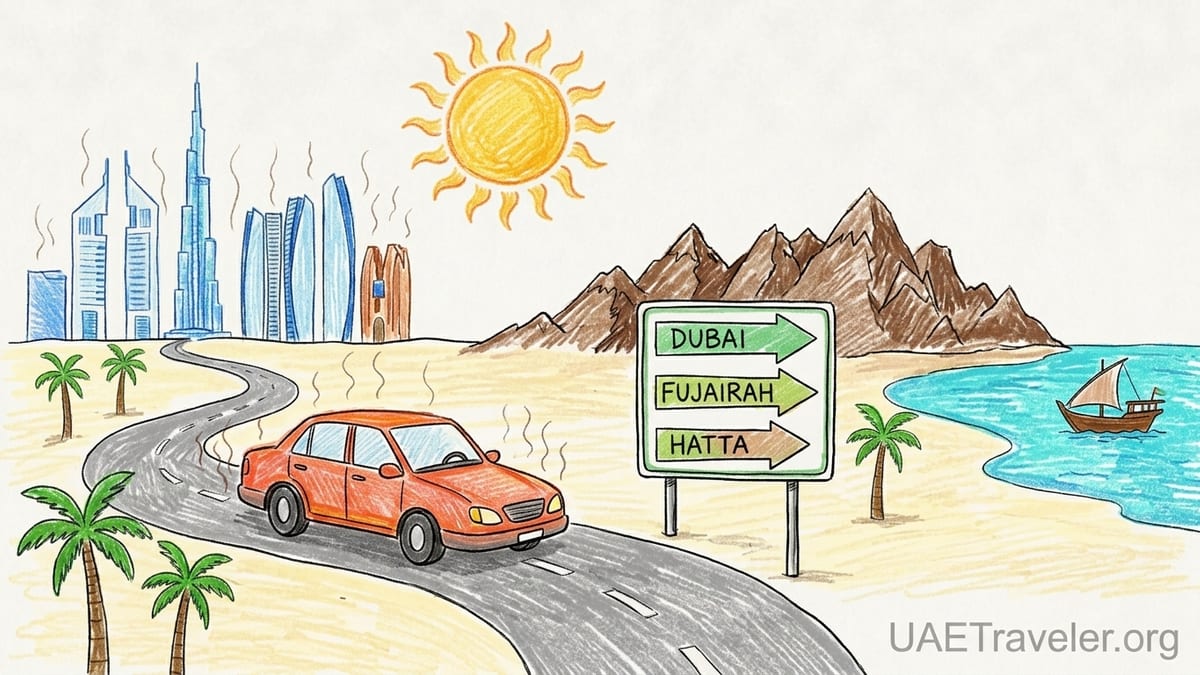
How UAE Summer Really Feels on a Multi‑Emirate Road Trip
On paper, summer numbers in the UAE can look survivable. In Dubai and Abu Dhabi, long-term climate data puts June to August daytime highs around 40 to 42 degrees Celsius and overnight lows close to 30 degrees. The Gulf water reaches the low 30s. Rain is almost nonexistent in these months and humidity readings in many summaries sit around the mid 50 to 60 percent range. All of that can trick you into thinking: hot, but manageable with breaks and hydration.
The lived reality on a road trip is very different, especially once humidity and reflected heat from asphalt and glass enter the picture. In coastal Dubai I stepped out of an underground car park at 11 am and my glasses fogged instantly. The building’s marble forecourt radiated heat like a stovetop. By the time I reached the next block I was sweating through my shirt, my phone warned of overheating when used for navigation, and the short walk I had planned between Al Seef and Al Fahidi Historical Neighbourhood turned into a dash from shade patch to shade patch.
In Abu Dhabi the heat felt even more trapped on Corniche side streets, hemmed in by towers. Average relative humidity near the coast is high year-round and peaks in the warmer months, with government statistics recording summer maximum humidity well above 70 percent in many years. The result is a heat index that regularly pushes conditions into what health authorities classify as dangerous for prolonged exertion, especially in the middle of the day.
Drive east and the pattern changes rather than improves. Fujairah and the Gulf of Oman coast run slightly cooler in pure temperature, with long-term averages in the mid to high 30s in June and high 30s in July and August, but humidity climbs again in midsummer and often reaches its annual maximum between June and August. The air in Fujairah city and Khor Fakkan felt thick even at 7 pm, like standing in a steam room with a hairdryer blowing in your face. On my trip, a planned late-afternoon walk along Al Aqah beach lasted twenty minutes before I retreated to the hotel pool bar.
Why the Cheapest Hotel Months Can Wreck an Otherwise Great Itinerary
The reason many travelers are tempted into a UAE summer road trip is simple: price. In Dubai Marina and Downtown, I have seen international chain hotels that sell winter rooms for 900 to 1,200 dirhams a night slide under 400 dirhams in late July. Beach resorts on Saadiyat Island in Abu Dhabi or Al Aqah in Fujairah routinely advertise 30 to 50 percent off their high-season rates once daytime highs climb above 38 degrees. Families see these numbers and imagine doubling their nights or upgrading from city hotel to beachfront resort.
The trade-off only becomes clear when you try to execute a sightseeing-heavy, multi-emirate plan. By my second day I had already shifted my schedule so aggressively that the “long days of exploring” I had imagined shrank into two short outdoor windows: roughly 7 am to 9:30 am, and then 6 pm to perhaps 8:30 pm. The entire middle of the day became a strict indoor block. Driving was possible, but any stop that involved walking more than a couple of shaded minutes felt punishing.
This has a direct effect on what you can realistically see across seven emirates. A November itinerary that might comfortably include the Dubai Creek museums in the morning, a desert detour via Sharjah in the afternoon, and sunset at Jebel Jais in Ras Al Khaimah would be impossible to replicate safely in August without cutting major elements. Instead of wandering Sharjah’s Heart of Sharjah heritage district, for example, I found myself darting into the Sharjah Art Museum and nearby indoor souqs simply to recover from the walk from the car.
Even roadside viewpoints and coastal promenades that look great on paper become low-value stops in summer. The long curve of the Corniche in Abu Dhabi, the pedestrian areas around Ajman’s seafront, or the open plazas of Ras Al Khaimah’s old town are designed for strolling. In June, my notes are full of versions of the same sentence: “Great view, no atmosphere, too hot to linger.” The money I saved on hotel rates was starting to feel like a penalty I had paid in lost experiences.
Heat, Humidity and How They Hit Each Emirate Differently
It is tempting to treat the UAE as a single climate block, but the seven emirates feel distinct on the road, especially in summer. Dubai and Abu Dhabi are hot coastal cities with long stretches of reclaimed waterfront, deep canyons of glass towers, and multi-lane highways that soak up sun all day. Their official climate normals show average highs around 23 to 25 degrees in January rising steadily to about 40 degrees in August, with humidity staying high along the coast. That combination produces some of the harshest heat index readings in the country for pedestrians.
Sharjah and Ajman sit in the same coastal belt, with very similar conditions but more low-rise neighborhoods and, in Sharjah’s case, larger historic districts. In theory those older streets should provide more shade. In reality, the humidity and still air between close-built walls can feel even more oppressive. Walking between the traditional coral-stone buildings of Sharjah’s restored merchant houses in July, I found shaded alleys where the air felt unmoving and stifling, far hotter than the automobile dashboards suggested.
Further north, Umm Al Quwain and Ras Al Khaimah introduce more variation. Both have coastal strips and inland areas that inch closer to the desert. Daytime temperatures in June to August remain in the high 30s to low 40s, but nights inland can feel marginally drier. Ras Al Khaimah also has the unique escape valve of Jebel Jais, where summit temperatures usually sit several degrees lower than sea level. In theory this makes it attractive as a summer road trip highlight. Recent seasons, however, have shown that mountain access and adventure attractions cannot be assumed as year-round fixtures, with road closures and safety inspections affecting opening schedules.
On the east coast, Fujairah and the smaller coastal exclaves of Sharjah around Khor Fakkan add humidity from the Gulf of Oman. Climate data from Fujairah Airport shows average relative humidity over 60 percent for much of the year, climbing higher in midsummer and combining with upper-30s daytime temperatures along the coast. That is the combination that turned my morning visit to Fujairah Fort into a short sprint. I had planned to explore the hilltop fort, the nearby heritage village and the old mosque on foot, but the exposed slopes between them offered no shade at all. Ten minutes of climbing later, I was back in the car, taking photographs through the windscreen.
Mountains, Deserts and Seasonal Operations: Hatta and Jebel Jais
Many UAE road trip plans lean on mountain and desert stops to break up coastal heat. The two headline names in the north are Hatta in the Hajar range and Jebel Jais in Ras Al Khaimah. Both offer a handful of adventure activities and cooler evenings, and both are heavily seasonal.
Hatta’s main adventure area is the Wadi Hub, run with a defined operating season. The current season, listed as Season 9, runs from late September to the end of May, with summer described as a break for the main resort operations even though a small subset of activities such as zipline and archery continue on reduced summer programming. In July I found Hatta quieter than winter, with temperatures still well into the mid 30s in the afternoon and many third-party operators for mountain biking and guided hikes either paused or running only at sunrise.
Jebel Jais has an even more complex pattern as of late 2025 and 2026. The mountain road and viewing areas have seen extended closures following heavy rainfall and safety reviews, with the emirate prioritising controlled access tied to specific bookings for zipline or restaurant slots when partial reopening is allowed. Official and local sources stress that prospective visitors must check the latest status of the road and attractions rather than assuming that the popular Jais Flight zipline, Sky Tour or new trails are available on any given summer date. On my own trip I had to scrub a planned sunset drive when I reached a police checkpoint a short way up the mountain and was turned back without a pre-booked ticket.
Even when open, both Hatta and Jebel Jais shift their schedules in the hottest months. Operators tend to start activities earlier in the morning and later in the afternoon and compress mid‑day slots, both for safety and guest comfort. That means a road trip that relies on a full‑day Hatta bike-and-hike or back-to-back zipline and hiking circuits at Jebel Jais fits far more naturally into the November to March window. In June or July, a lot of that adventure element either shrinks or disappears from the realistic plan.
Walking, Beaches, Driving and Dining: How Summer Changes Everyday Travel
The most tangible way to understand UAE summer is to look at how ordinary holiday moments change. Start with walking. In January, you can spend an entire morning on foot in Old Dubai, crossing Dubai Creek by abra, exploring Al Fahidi, and wandering through the spice and gold souqs at a comfortable 22 to 26 degrees. In August, that same loop becomes a test of endurance. Many tourists I met on my summer visit simply hailed taxis between points that are five minutes apart on the map, which quickly ate into the money they had saved on hotels.
Beaches tell a similar story. Winter mornings on Saadiyat Island or Kite Beach are one of the UAE’s genuine pleasures, with air around 24 degrees and sea temperatures in the low 20s. Picnic blankets, joggers and families fill the sand. In July, sand temperatures become uncomfortable by late morning, and the Gulf water in Dubai and Abu Dhabi climbs into the low 30s, warmer than typical body temperature. Floating off Palm Jumeirah one afternoon, I realised I felt more like I was standing in a giant bath than swimming in the sea. Lifeguards also shorten or shift their most active hours as the sun and UV index peak around midday.
Driving, which seems like it should be a refuge from the heat, presents its own challenges. In every emirate, I found myself planning parking based on shade rather than proximity. Unshaded asphalt car parks around mid-day can turn steering wheels and seatbelt buckles into genuine burn risks, and rental car dashboards frequently reported outside readings several degrees higher than the official shade temperatures. Long desert stretches between Abu Dhabi and Al Ain or between Dubai and Ras Al Khaimah felt draining, and I had to factor in more fuel and water stops than the distances alone would justify.
Food and nightlife also compress into narrower time slots. In November, it is natural to book an outdoor table at a creekside restaurant in Dubai around 7:30 pm, linger through dessert and then stroll the promenade. In high summer, waterfront terraces in Dubai Marina, Yas Bay or Al Qasba in Sharjah can remain sticky and still after dark. On my summer trip, several restaurants I had bookmarked for their outdoor seating closed terraces entirely until October and shifted entertainment indoors. I spent more evenings in malls and hotel bars than I had intended, discovering that shopping centres like Dubai Mall or Abu Dhabi’s Yas Mall start to feel like default summer “attractions” simply because they are among the few places where it is comfortable to walk for more than fifteen minutes.
Summer vs Winter: Crowds, Prices and Real Holiday Value
To decide whether a UAE summer road trip makes sense, it helps to compare costs and crowds against what you sacrifice in experience. In broad terms, hotel prices for comparable properties in Dubai and Abu Dhabi often run 30 to 50 percent higher in the peak cool months of December and January than in July and August. A midrange international hotel room that might sell for 350 dirhams per night in late August can easily climb to 600 or more over New Year. Beach resorts on Saadiyat, The Palm or Al Aqah in Fujairah show similar patterns between August and February.
Attractive as those savings are, they only tell half the story. From November through March, daily highs generally sit in the mid 20s to very low 30s across the emirates, evenings cool down, and the bulk of the year’s modest rainfall, such as it is, falls in scattered showers. Outdoor attractions open longer hours, desert safaris are more comfortable, and mountain trips to Hatta and, when accessible, Jebel Jais become full-day options rather than dawn-and-dusk dashes. In other words, you can use almost every daylight hour for sightseeing and still feel human at dinner.
Crowds in the cool season are real, especially around major events, school holidays and New Year in Dubai. You will wait longer at Burj Khalifa, find Saadiyat’s quieter public beach areas busier, and see more tour buses at desert conservation reserves. Yet I found that the density of people did not ruin experiences in the way that summer heat sometimes did. Sharing a popular viewpoint in January is still sharing a moment. Standing alone on the Corniche in June at 2 pm, when nobody else is out because the pavement radiates heat, felt more like a warning than a privilege.
Total holiday value therefore leans heavily toward the cool months for a multi-emirate road trip. The extra money you spend on rooms often buys you double or triple the usable outdoor hours per day, better access to seasonal mountain and desert activities, and far less fatigue. In summer, the airport-to-pool-and-mall model of travel can still be good value if that is your aim, but once you start adding long walking days across several emirates, that calculus reverses sharply.
If You Must Visit in Summer: Indoor and Resort‑First Strategies
There are still ways to make a UAE trip work in June, July or August, particularly if you focus your expectations and build the itinerary around air-conditioned comfort. In Dubai and Abu Dhabi, that means treating malls, indoor entertainment centres and resort facilities as the core of the trip rather than as rainy-day backups. On my summer road trip, some of the best hours were spent in museum and gallery spaces like Dubai’s Etihad Museum, Louvre Abu Dhabi, and Sharjah’s cluster of indoor art museums, all of which maintain reasonable temperatures and allow you to experience local culture without courting heat exhaustion.
Families can thread together indoor theme parks and aquariums into a cohesive week. Examples include IMG Worlds of Adventure and Dubai Parks’ indoor components near Jebel Ali, indoor ski slopes and snow parks attached to malls, and large aquariums inside major shopping centres. In Abu Dhabi, indoor segments of Yas Island’s big-name parks, such as the mostly enclosed Ferrari-branded park and waterparks with shaded or night openings, help fill the hot middle of the day. These ticketed attractions are not cheap, but they align better with summer’s reality than repeated attempts to sightsee on foot between noon and 4 pm.
For a resort‑heavy stay, summer discounts can be a genuine win. High-end beachfront and desert resorts that would be out of reach in January often release summer deals that include breakfast, resort credit and late checkout. If your goal is to enjoy room upgrades, long pool sessions in shaded areas, spa treatments and good restaurants, and you are content to limit outdoor movement to a few steps between facilities, you may find that July offers excellent value. The key is to avoid over-scheduling sightseeing in the middle of those days.
On a constrained summer road trip that still needs to cross emirates, I would now design the plan in short driving hops, with early‑morning outdoor stops and long indoor blocks. For instance, leave Dubai before sunrise, walk Sharjah’s old town between 7 and 9 am, then dive into indoor museums and lunch until 4 pm, before continuing to a resort in Ras Al Khaimah or Fujairah for the evening. That structure accepts the climate as it is, rather than fighting it hour by hour.
The Takeaway: When I Would Road Trip the Seven Emirates Again
Looking back at my own routes, the strongest lesson is that not all months are created equal for a UAE-wide road trip. While some residents joke that summer in Dubai runs from May to October, there is a clear sweet spot for visitors who want to connect several emirates in one journey without feeling constantly pushed indoors. For me, late November to early March is that window. January offers the gentlest daytime temperatures, often with highs around the mid 20s, but November combines warmth, beach‑friendly water temperatures and manageable humidity across the country.
I would personally avoid planning a full seven‑emirate driving circuit in June, July or August again. The savings on hotel rooms did not compensate for the shortened walking windows, abandoned mountain and desert days, and general fatigue. Public spaces and heritage areas felt like stage sets waiting for an audience that would only appear again in winter. Attractions that had looked like anchors of my itinerary when I booked, such as Hatta’s full adventure roster or a lazy afternoon at Jebel Jais, were either reduced or effectively unavailable.
There are, however, travelers for whom summer still makes sense. If you are primarily a resort guest, happy to move between pool, spa and air-conditioned restaurants with only brief forays outdoors, the discounted rates from June to September can turn aspirational properties into realistic options. Business travelers tied to conference dates, digital nomads looking for short, intensive apartment stays with fast internet, and repeat visitors who have already done the major outdoor sites will also find value in off‑season pricing.
For a first or second visit built around a grand tour across all seven emirates, my recommendation is simple and clear. Aim for late November, December, January or February, accept that room prices will be higher, and treat the cost difference as an investment in usable days rather than as a surcharge. The UAE is one of the few places where a calendar choice can change the entire character of a trip. After one “bargain” summer road trip, I would now pay a premium to experience those same roads, beaches, forts and mountain curves in the softer light and cooler air of winter.
FAQ
Q1. Is it ever a good idea to plan a full UAE road trip in July or August?
It can work only if you keep driving stages short, schedule almost all walking for early morning or evening, and accept that many outdoor and mountain activities will be curtailed or closed. For a first-time visitor wanting to see a lot of heritage districts and landscapes, July and August are usually a poor trade-off, even with cheaper hotel rates.
Q2. Which months offer the best balance of price and comfort for visiting all seven emirates?
Late November and early March often offer the best compromise, with daytime highs around the high 20s to low 30s, cooler evenings, and room prices that are lower than peak New Year but higher than in midsummer. January is the most comfortable for walking but can be among the most expensive weeks of the year in popular Dubai and Abu Dhabi districts.
Q3. How much cheaper are hotels in Dubai and Abu Dhabi in summer compared with winter?
Exact percentages vary by property and date, but it is common to see midrange and upscale hotels pricing 30 to 50 percent lower in June to August than in December and January. Some beach and desert resorts run special packages that make summer stays feel dramatically cheaper, which is why the season can still be attractive for resort‑focused travelers.
Q4. Are east coast emirates like Fujairah more comfortable than Dubai in summer?
Fujairah often runs slightly cooler in pure temperature than Dubai in midsummer, but its coastal humidity can be higher in June to August, so the overall “feels like” conditions are still oppressive during much of the day. The main benefit of the east coast in summer is scenery and a change of atmosphere, not a large drop in heat stress.
Q5. Can I count on Jebel Jais and Hatta adventure activities operating normally in summer?
No. Both destinations run on seasonal schedules and are affected by weather, maintenance and, in Jebel Jais’s case, safety-related road access decisions. Operators tend to shift to early morning and late afternoon slots in hot months and may suspend some activities altogether, so you should always check current seasons and opening hours before locking in a summer itinerary around them.
Q6. What is walking around Dubai Creek or Abu Dhabi Corniche like in August?
Midday conditions are usually extremely uncomfortable, with air temperatures near 40 degrees, high humidity and heat radiating from pavements and buildings. Short, shaded strolls are possible early and late in the day, but long unshaded walks between museums, souqs and viewpoints are best avoided around the middle of the day for safety and comfort.
Q7. Are UAE beaches enjoyable in high summer?
Beaches can still be used in the very early morning and at sunset, but by late morning the sand heats up and the Gulf water around Dubai and Abu Dhabi feels bath‑warm, often above 30 degrees. Sun exposure and UV levels are intense, and many locals simply stay away from open beaches during the hottest hours of summer days.
Q8. How should I structure my days if I have no choice but to visit in July?
Plan two outdoor windows, roughly from sunrise to mid‑morning and again from early evening to late evening, and reserve the middle of the day for indoor museums, malls, aquariums and resort facilities. Build in extra time for rest and hydration, and keep driving stages modest so that you are not tackling long desert stretches during the hottest hours.
Q9. Who benefits most from summer hotel discounts in the UAE?
Travelers who intend to spend most of their time inside resorts, spas, restaurants and indoor attractions gain the most. That includes couples seeking quiet poolside stays, business visitors extending work trips into short breaks, and repeat guests who already know the main outdoor sights and are happy to skip them in exchange for upgraded rooms and facilities.
Q10. If I want to drive across all seven emirates once, which month would you personally pick?
I would choose late November or January. Late November balances warm but comfortable daytime temperatures with good beach conditions, while January offers the softest light and coolest air for long walking days and mountain or desert excursions, even if hotel prices are higher than at other times of the year.