


When most travelers picture beaches in the United Arab Emirates, they think of Dubai’s skyline and manicured city coastline. Yet some of my most memorable swimming, snorkeling and sunset walks have been on quieter strips of sand in Fujairah, Ajman, Ras Al Khaimah and Umm Al Quwain. Over several recent trips, I set out specifically to compare these lesser known beach escapes, paying close attention to how the water feels, how easy it is to access facilities, and whether the experience justifies the cost of resort day passes and organized activities.
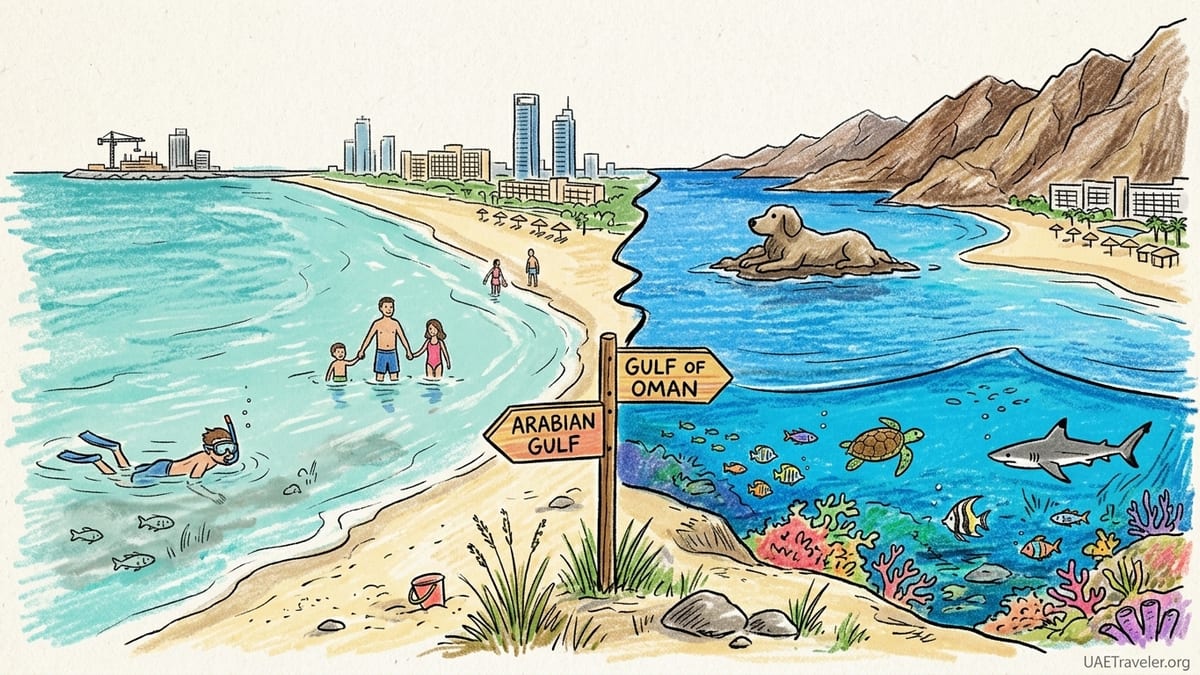
Arabian Gulf vs Gulf of Oman: Why the Water Feels Different
The first thing that struck me as I moved between the emirates is how dramatically the sea itself changes. West coast beaches in Ajman, Ras Al Khaimah and Umm Al Quwain sit on the Arabian Gulf, a semi-enclosed, relatively shallow body of water. The east coast around Fujairah and Al Aqah faces the open Gulf of Oman and, beyond that, the Indian Ocean. On the sand this translates into a real difference in color, clarity and underwater life.
On the Arabian Gulf side, the water is often a milky turquoise, especially close to busy ports or areas with ongoing construction such as Al Marjan Island in Ras Al Khaimah. On days with light winds I have had clear, calm swimming conditions, but after a blow or during periods of dredging the visibility drops quickly and the sea can look cloudy. You still get warm, swimmable water through much of the year, but it rarely approaches the glassy clarity I experienced in Fujairah.
In Fujairah on the Gulf of Oman, particularly around Al Aqah and Snoopy Island, the seabed is rockier and the coast drops off more quickly. This helps keep the water clearer and supports coral heads that draw small reef fish, turtles and occasional blacktip reef sharks. Standing waist deep near Snoopy Island and looking down, I could clearly see my toes and clusters of fish even on a busy weekend. That simply did not happen for me on the Arabian Gulf side, where visibility was often limited to a meter or two at most when I tested it with a mask.
This environmental contrast matters if you are choosing a beach break for snorkeling or underwater photography. Fujairah’s east coast spots are where I would send anyone whose priority is marine life. If you are more focused on resort pools, shallow paddling for young children or sunset promenades with city views, Ajman, Ras Al Khaimah and Umm Al Quwain still offer good options, but you need to manage expectations about what you will actually see underwater.
Fujairah’s Al Aqah and Snoopy Island: The UAE’s Snorkeling Sweet Spot
Driving over the Hajar Mountains to Fujairah and Al Aqah feels like leaving the city entirely. The skyline drops away, the road traces cliffs and small villages, and then you arrive at a string of low-rise resorts facing a broad crescent of sand and a rocky islet that really does look like a reclining cartoon dog when viewed from the beach. This is Snoopy Island, one of the best known shore-access snorkeling spots in the country, sitting roughly 100 meters off Al Aqah Beach with depths around 7 meters at its deepest points.
On my latest visit I split time between the free public section of the beach and a resort day pass. The public beach at Al Aqah is a simple strip of beige sand with a slightly coarse, shelly texture underfoot. There are no formal boardwalks, but you can park along the roadside or in informal sandy lots behind the shoreline, then walk a minute or two to the water. There were no fixed changing rooms on the public stretch when I visited, only basic public toilets at intervals, so I changed in my car. Shade is minimal, limited to small gazebos and what you bring yourself, and families tended to set up their own pop-up tents and tents with camping chairs.
The sea here is where Al Aqah shines. Even swimming out from the public section, the water felt cooler and more refreshing than the Gulf side, especially in late spring. Small rolling waves made entry easy, and once I was a few strokes from shore the bottom quickly shifted from sand to rocks and coral patches. Without swimming all the way to the island, I was already seeing small reef fish. On calm days, snorkelers simply fin from the public beach to Snoopy Island, a 5 to 10 minute swim for confident swimmers in clear conditions, keeping a safe distance from the reef itself to avoid damaging corals.
Resort day passes at Al Aqah add another layer of comfort. Hotels behind Snoopy Island and along the bay frequently sell pool and beach day access that, based on current checks, often falls in the range of roughly 150 to 250 dirhams per adult on weekdays, rising on peak weekends and holidays, with part of that redeemable on food and drinks. These passes buy you proper changing rooms, showers, loungers, fixed shade and access to hotel-organized snorkel trips that use kayaks or small boats to drop you near the best coral patches. For non-swimmers or families with children, I found this structured access made a big difference to how relaxed the day felt.
Khor Fakkan: Sharjah’s Mountain-Backed Bay
A short drive north from Al Aqah brings you to Khor Fakkan, a Sharjah exclave that curves around a natural bay framed by mountains. This is not as much of a snorkeling hotspot as Snoopy Island, but it is one of the most scenic urban-style beaches in the country. The sand is a narrower strip than at Al Aqah, backed by a landscaped corniche with lawns, play areas and a pedestrian promenade. The vibe reminded me of a small coastal city in southern Europe, only with dramatic brown cliffs rising behind the town.
When I visited Khor Fakkan in shoulder season, swimming conditions were gentle, with only a light shore break and a soft sandy bottom underfoot for the first few meters. As you wade out, the water deepens more quickly than on the Arabian Gulf side, and the color shifts from pale aqua to a deep blue-green. Water clarity was decent for swimming but not spectacular for snorkeling when I tested it by duck diving near the small public swimming area; I could see my hand clearly at arm’s length but not much beyond that. You do get a sense of depth and open ocean here that is quite different from the flatter horizon in Ajman or Ras Al Khaimah.
Facilities around Khor Fakkan beach felt more developed than Fujairah’s public stretches. I made use of municipal showers and changing cabins set back from the sand, and there were shaded picnic structures and dedicated play areas that families were using into the evening. Parking was straightforward, with marked spaces along the corniche road and additional lots behind the promenade. The trade-off is that this is a popular spot for local day trippers, especially on weekends and during school holidays, so by mid-afternoon the lawns and walking paths were busy and the soundscape included traffic, children, scooters and the occasional jet ski offshore.
For snorkeling, Khor Fakkan is best treated as a gentle introduction rather than a destination. Several local tour operators and dhow trips depart from nearby harbors to reach secluded coves along the Fujairah and Sharjah east coast where visibility and marine life are better. On my last trip, I joined a small boat that ran north towards Dibba, with a per-person price in the low hundreds of dirhams including gear and soft drinks. Compared to swimming straight off Khor Fakkan beach, the offshore coves offered much more varied underwater scenery while still being manageable for beginner snorkelers.
Ajman Corniche and Resort Beaches: Urban Sand With Surprises
Back on the Arabian Gulf, Ajman Corniche is one of the easiest beach escapes to reach from both Dubai and Sharjah. It is a long, free public beach with a paved promenade and a backdrop of mid-rise towers, cafes and shawarma shops rather than mountain cliffs. My first impression on arrival was the breadth of the sandy strip itself. The beach is wide, with a gentle slope into the sea and compact, light-colored sand that is comfortable for bare feet once the heat of the day has gone.
The swimming experience in Ajman depends heavily on timing. Early mornings and weekday afternoons in cooler months gave me calm, shallow water with small ripples and very gradual depth, ideal for wading or children playing at the edge under watchful eyes. Lifeguards were visible along certain sections, and the water temperature felt like a warm bath in late spring and autumn. Visibility, however, was limited. Even in relatively calm conditions with no obvious swell, I could not see my feet clearly once the water was above my knees when I tested it with a mask, and there is no reef structure or notable marine life to explore near the shore.
Facilities along Ajman Corniche have improved over the years, but they are not uniform. On my walks I found stretches with public toilets, simple showers and changing booths, interspersed with more basic sections where families relied on car-based changing and their own beach gear. Parking is free along much of the Corniche Road, although local reports and my own experience show that on busy winter weekends sections can be coned off or temporarily closed, funneling visitors into side streets and paid basements under the residential towers. The promenade itself is well used for running, cycling and evening strolls, with food trucks and cafes adding to the atmosphere after sunset.
For those who want more comfort, Ajman’s beachfront resorts offer controlled stretches of sand with loungers, towels and pool access behind. Day passes at mid-market properties here typically sit below Dubai prices, often somewhere in the low to mid hundreds of dirhams per adult depending on day of week and season, with some credit back on food and drinks. When I tested a mid-range resort day pass, the biggest upgrades compared to the public beach were clean, air-conditioned changing rooms, well maintained pools as an alternative to the sometimes murky sea, and a quieter, more curated crowd. It did not transform the underwater experience, but it did raise overall relaxation levels significantly.
Ras Al Khaimah’s Al Hamra and Al Marjan Island: Resort Enclaves in the Gulf
Further up the coast, Ras Al Khaimah has leaned heavily into resort-driven beach development, especially around Al Hamra and the man-made Al Marjan Island archipelago. Al Hamra’s older resorts sit on a natural sandy stretch facing the Arabian Gulf, while Al Marjan Island presents a more sculpted environment of wide, pale sand, planted palms and offshore breakwaters designed to keep the water calm for swimming.
Swimming off Al Hamra on my visit felt similar to Ajman but slightly quieter. The sand was soft and light, with a shallow gradient and small lapping waves. Many of the beachfront sections are controlled by resorts, so access from the public road is more limited and often requires you to either be a guest or buy a day pass. The sea itself was warm and inviting, though again somewhat cloudy when I checked visibility with a mask. Compared with Fujairah, I never saw more than a few small fish and I treated the water more as a pleasant place to cool off rather than a snorkeling venue.
Al Marjan Island is more intensely resort-focused, with hotels lining the outer edges of its coral-shaped arms. On the ground, the beaches look postcard-perfect at first glance. The sand feels evenly graded underfoot, loungers march in neat rows and many hotels offer floating play structures or inflatable water parks just offshore. The water is sheltered by the island’s layout and various breakwaters, so I consistently found very small waves and a comfortable, safe-feeling swimming area, especially suited to families with younger children who do not like chop or currents.
The downside is cost and, at times, crowding. Day passes at major Al Marjan resorts, based on current published offers and local roundups, often fall in a band of roughly 150 to 300 dirhams per adult on weekdays, rising on peak weekends and holidays, usually with a portion as food and beverage credit. I tested one such pass at a large family resort and found the pools packed by midday on a winter Friday, with loungers fully occupied and a soundtrack of poolside music, children’s activities and jet skis buzzing just beyond the swimming buoys. If you are looking for serenity, you need to come early, choose a weekday or pay for a more upmarket property with stricter capacity controls.
Umm Al Quwain: Sleepy Shores and Quiet Corners
Umm Al Quwain is the antithesis of Dubai’s hyper-curated waterfronts. Its coastline has long, low-key strips of sand, mangroves and a scattering of older resorts and weekend homes. Driving in, I noticed immediately how traffic dropped away and low-rise buildings replaced towers. The main public beach area is a broad, pale arc facing the Arabian Gulf, with enough width that even on a holiday weekend it never felt packed in the same way that Ajman Corniche can.
Walking the sand here is a pleasure, particularly in the hour before sunset when the heat softens and the sky turns peach over the water. The sand itself is fairly fine but with more occasional shells and small stones than the groomed resort beaches farther south. The sea was very gentle on my visits, with barely any waves and a long, shallow shelf that allowed me to walk out quite a distance before needing to swim. Visibility in the water was limited, but that mattered less because I was not aiming to snorkel here; it felt more like a wading and relaxation beach.
Facilities on Umm Al Quwain’s main public beach are more modest than in Ajman or Ras Al Khaimah. I found basic public toilets and a few shower points, plus shaded picnic shelters used by local families. There is plenty of informal parking directly behind the beach, often just on compacted sand, and access from car to sea rarely took more than a couple of minutes on foot. There are no big promenades or shopping streets just behind the sand, which keeps noise down but also means you need to bring your own snacks or drive a short distance back towards the main roads for meals.
For overnight stays or pool access, older beachfront hotels and small resorts in Umm Al Quwain sometimes offer day passes, generally priced below the major brands in Ras Al Khaimah or Ajman. When I checked, rates were often positioned to appeal to local residents looking for a simple beach day without the extra entertainment layers. That matches the wider feel of the emirate. If you want basic, quiet time by the sea, perhaps combined with a visit to mangroves or the water park inland, Umm Al Quwain has an appeal that is hard to quantify until you are standing on its open sands listening to nothing much at all.
Public Beaches vs Day Pass Resorts vs Organized Activities
Across these emirates, I tried four types of beach access: fully free public beaches, hotel-controlled beachfronts limited to guests, paid day passes that open up resort facilities for a day, and organized snorkeling or boat excursions. Each comes with its own set of trade-offs around cost, crowds, convenience and the quality of the actual water experience.
Free public beaches, such as Ajman Corniche, Fujairah’s non-resort stretches near Al Aqah and the main sands in Umm Al Quwain, are unbeatable for price. I paid only for parking in a few cases, and even that was often free or low cost. These spots gave me the most flexible, unstructured days, where I could walk, swim and leave when I liked. The price is paid instead in comfort. Shade is usually what you bring with you, changing rooms may be basic or absent, and there is no guarantee of lifeguards or water quality monitoring outside of better known municipal sites.
Hotel-controlled beachfronts without day passes are effectively off-limits unless you book a room, but many properties from Ajman to Ras Al Khaimah sell pool and beach day access to non-residents. When I compared several of these offers, a pattern emerged. In Ajman and some older Ras Al Khaimah resorts, weekday day passes often sat below Dubai’s typical rates while still providing loungers, towels, showers and resort pool access. On Al Marjan Island and premium Fujairah properties facing Snoopy Island, prices were higher although still generally less than top-tier Dubai hotels. For that outlay, you get comfort and convenience rather than fundamentally better sea water. In Fujairah there is genuine added value in organized snorkeling access to reefs, but elsewhere the advantage is primarily on land.
Organized snorkeling excursions are where I saw the most dramatic step up in underwater experience. In Fujairah and along the east coast, dhow cruises and small-boat trips head from spots such as Dibba or Khor Fakkan to coves with clearer water and richer marine life than the main town beaches. Prices I observed for half-day trips with gear hire typically ran into the few-hundred-dirham range per person, making them a considered spend but worthwhile if snorkeling is a priority. On the Arabian Gulf, snorkeling outings felt more like scenic boat rides with opportunistic swims rather than focused reef experiences.
In every emirate I also weighed incidental costs such as food and drink. Public beaches allowed me to bring my own snacks and water, keeping a tight lid on spending. Resorts with day passes required buying at least some items on site, sometimes at prices that added up quickly even when part of the pass fee was redeemable. My most expensive beach day overall was at a large family resort on Al Marjan Island once I added lunch, coffee and a few drinks to the pass price, even though I barely dipped into the sea itself because of the limited visibility.
Sea Conditions, Seasons and When the Beaches Disappoint
One thing that does not show in glossy photos is how sea conditions change by season and weather. Across multiple trips, I found that late autumn to early spring offered the most pleasant combination of air and water temperatures, particularly on the Arabian Gulf where summer sea temperatures can feel almost hot. Winter weekends, however, are when crowds surge, especially in Ajman and on Al Marjan Island, and that is when I saw the heaviest use of facilities, more litter on busy public sections by late afternoon and competition for loungers at resorts.
On the Gulf of Oman, conditions at Al Aqah and around Snoopy Island can be affected by occasional swells and currents linked to wider ocean weather. On one visit, a passing system offshore created a choppy surface and reduced visibility; lifeguards at the resort I was using limited how far people were encouraged to snorkel. It was still swimmable for confident adults, but the calm, aquarium-like water I had enjoyed on a previous trip was not there that day. If snorkeling is your main goal, it is worth building flexibility into your schedule and checking conditions upon arrival rather than committing to a single, non-refundable boat trip.
I also had to adjust expectations around cleanliness and atmosphere. In Ajman and Ras Al Khaimah’s more urban-adjacent beaches, litter occasionally appeared near picnic areas by evening, and not all visitors respected quiet zones or non-smoking areas. On one Ajman weekend, loud music from parked cars and group games dominated sections of the sand, making it less appealing for couples seeking a peaceful sunset. Conversely, in Umm Al Quwain and parts of Fujairah, the issue was not noise but a near-complete lack of shade or structured activities, which some travelers might find too barebones for a full day unless they are prepared.
There are also times when environmental issues temporarily affect enjoyment. Oil slicks, algae blooms or coastal construction can occasionally lead to short-notice warnings or closures along parts of the Arabian Gulf, particularly near industrial areas or shipping lanes. Before long drives, I now make a habit of checking local news and municipal updates to ensure that the specific beach I am targeting is open for swimming. If you arrive to find red flags flying and people out of the water, it is important to respect those signals and adjust plans rather than trying to swim regardless.
Who Should Go Where: Practical Recommendations
If your primary goal is clear-water swimming and snorkeling, Fujairah’s Al Aqah and the waters around Snoopy Island stand out. The combination of mountain backdrop, open Gulf of Oman exposure and accessible reef life gives this area an edge that no Arabian Gulf beach I visited could match. Paying for a resort day pass here or joining a small-group snorkel trip adds both comfort and safety. Confident swimmers who are comfortable in open water can also enjoy good snorkeling from the public beach on calm days at low or mid-tide, provided they give the reef itself a respectful buffer.
Families with young children who care more about shallow paddling, shade and playgrounds than coral fish might be happier in Ajman or on Ras Al Khaimah’s Al Marjan Island. The gentle gradient of the sand, presence of lifeguards on busy stretches and abundance of nearby food options create an easy day out, especially between November and March when the heat relents. Opting for a mid-range resort day pass in these areas gave me peace of mind through pool access and controlled numbers, even though the sea itself was less impressive than Fujairah.
Couples or solo travelers looking for a quieter atmosphere should consider Umm Al Quwain or choose weekdays in Khor Fakkan and Fujairah. Umm Al Quwain’s beaches are simple but spacious, with fewer crowds and less commercial noise than Al Marjan or central Ajman. For sunset walks and mountain-meets-sea scenery, Khor Fakkan and the Fujairah coast are hard to beat, especially if you book accommodation with balconies facing the water rather than relying entirely on crowded public strips.
For travelers wanting to keep costs low, the strategy that worked best for me was to mix free public beaches with occasional targeted day passes rather than defaulting to resorts every day. In practice, this meant using Ajman Corniche or Umm Al Quwain for relaxed, low-spend days where I brought my own food and shade, then splurging on a Fujairah resort pass for serious snorkeling or on a single Al Marjan Island property when I wanted the full pool-and-bar experience. Spending a little time researching current day pass deals in Ras Al Khaimah and Fujairah can uncover promotions where much of the fee is redeemable on meals, making those days feel more like a value trade than a pure access charge.
The Takeaway
Exploring the UAE’s beaches beyond Dubai revealed a coastline far more varied than I expected. Fujairah’s Al Aqah and Snoopy Island delivered the clearest water and richest marine life, rewarding both casual snorkelers and anyone who simply enjoys looking down through blue water and seeing more than their own feet. Khor Fakkan added mountain drama and a lively promenade mood, even without world-class visibility. On the Arabian Gulf side, Ajman and Ras Al Khaimah offered accessible, gently shelving beaches and a broad range of resorts, while Umm Al Quwain provided space and quiet in exchange for fewer built facilities.
Across all of these destinations, the most important lesson was to match expectations with the specific strengths of each coast. If you expect Ras Al Khaimah’s resort lagoons to deliver the same snorkeling as Fujairah’s reefs, you are likely to be disappointed. If you arrive in Ajman during a busy winter weekend hoping for solitude, the promenade scene may feel overwhelming. Yet if you plan with seasonal sea conditions, crowd patterns and your own priorities in mind, it is entirely possible to build an east coast and northern emirates itinerary that combines clear-water snorkeling, easy family beach days and budget-friendly public shore time.
For swimmers, I would prioritize Fujairah’s east coast and the calmer resort coves of Al Marjan and Al Hamra, especially in the cooler months. Snorkelers should base themselves near Al Aqah and consider at least one organized excursion into the small bays further along the Gulf of Oman. Families can look to Ajman Corniche, Al Marjan Island and selected Ras Al Khaimah resorts with kids’ pools and shaded play areas. Couples might gravitate towards Khor Fakkan’s bay views or Umm Al Quwain’s open sands, while cost-conscious travelers can weave together free public beaches and selective day passes to enjoy the best of the UAE’s shores without Dubai-level prices.
FAQ
Q1. Is Fujairah really better than Ajman or Ras Al Khaimah for snorkeling?
Yes, for snorkeling Fujairah’s Al Aqah and Snoopy Island are noticeably better than Ajman or Ras Al Khaimah because the Gulf of Oman has clearer water, rockier seabeds and more developed coral and marine life. On the Arabian Gulf side, the sea is warm and pleasant for swimming but generally too cloudy and sandy-bottomed to offer rewarding snorkeling directly from the main public beaches.
Q2. Do I need to book a resort day pass to enjoy Snoopy Island?
No, you can access the public beach near Snoopy Island for free, park nearby and swim out towards the island on calm days if you are a confident swimmer with a mask and fins. A resort day pass, however, gives you better facilities, lifeguard supervision and often organized snorkeling options, which I found worthwhile when spending a full day in the area.
Q3. How family-friendly is Ajman Corniche compared with Al Marjan Island?
Ajman Corniche is very family-friendly thanks to its wide, shallow beach, promenade and play areas, though it can feel busy and noisy on weekends. Al Marjan Island’s resorts offer more controlled environments with lifeguards, pools and kids’ clubs, which may suit families who prefer a self-contained setting and are happy to pay for a day pass or overnight stay.
Q4. Are there changing rooms and showers on the public beaches?
I found reliable public changing rooms and showers at larger municipal beaches such as Ajman Corniche and Khor Fakkan, though quality and cleanliness varied. In Fujairah’s Al Aqah public stretch and on quieter Umm Al Quwain sands, facilities were basic or limited, and I often ended up changing in my car or waiting until I reached a cafe or hotel. Resort day passes consistently provided the best facilities.
Q5. When is the best time of year to swim on the UAE’s northern and east coasts?
The most comfortable period for both air and water temperatures is usually from around November to March. During these months the sea is warm enough for long swims without feeling overheated, and the sun is less intense. Summer months can bring very hot air and warm, almost bath-like water on the Arabian Gulf, which some people like but others find draining for extended swimming.
Q6. Can budget travelers enjoy these beaches without spending much on resorts?
Yes, budget travelers can have rewarding beach days by making use of free public beaches in Ajman, Fujairah and Umm Al Quwain, bringing their own food, water and shade, and using public transport or shared rides where possible. Adding one or two carefully chosen resort day passes or snorkel trips rather than relying on them every day keeps overall costs significantly lower while still delivering a few higher-comfort experiences.
Q7. Is it safe to swim off public beaches in Umm Al Quwain and Ras Al Khaimah?
In normal conditions, I found swimming off the main public beaches in Umm Al Quwain and Ras Al Khaimah to feel safe and calm, especially due to the shallow gradients and gentle waves. However, there are fewer lifeguards and flags than at some larger city beaches, so it is important to assess conditions on the day, stay within your abilities and avoid swimming alone or too far from shore.
Q8. Are organized snorkeling trips worth it if I am staying on the Arabian Gulf side?
If snorkeling is a top priority, I would recommend traveling to Fujairah’s Gulf of Oman side rather than relying on trips from Arabian Gulf resorts, as the latter often visit areas with limited reef life and visibility. However, boat excursions from Ras Al Khaimah or Ajman can still be enjoyable for swimming in deeper water, coastline views and time on the water, even if the underwater sights are relatively modest.
Q9. How crowded do these beaches get on weekends?
Weekend crowding varies by location. Ajman Corniche and Al Marjan Island can become very busy from Friday afternoon through Saturday in the cooler months, with full car parks and packed resort pools. Fujairah and Khor Fakkan also see a spike in visitors from Dubai and Sharjah on weekends, but the atmosphere is more spread out along the coast. Umm Al Quwain remained the quietest for me even at peak times, with plenty of open sand.
Q10. What should I bring for a DIY public beach day in these emirates?
For a comfortable do-it-yourself day on public beaches, I recommend bringing a sun shade or small tent, a beach mat or lightweight chairs, plenty of drinking water, snacks or a picnic, reef-safe sunscreen, basic first aid and, if you plan to swim beyond waist depth, a mask or goggles. Having your own gear makes you less dependent on limited rentals and allows you to enjoy quieter sections of sand away from any crowded concessions.