


Travelling between the seven emirates of the UAE has become easier in recent years, but it still requires careful planning, especially if you want to combine big-city sightseeing with mountain trails, remote beaches or mangrove kayaking. This guide focuses on the routes travelers actually use in 2026, comparing intercity buses with rental cars, taxis, private drivers and guided transfers so you can choose the most practical, cost-effective way to move between emirates.
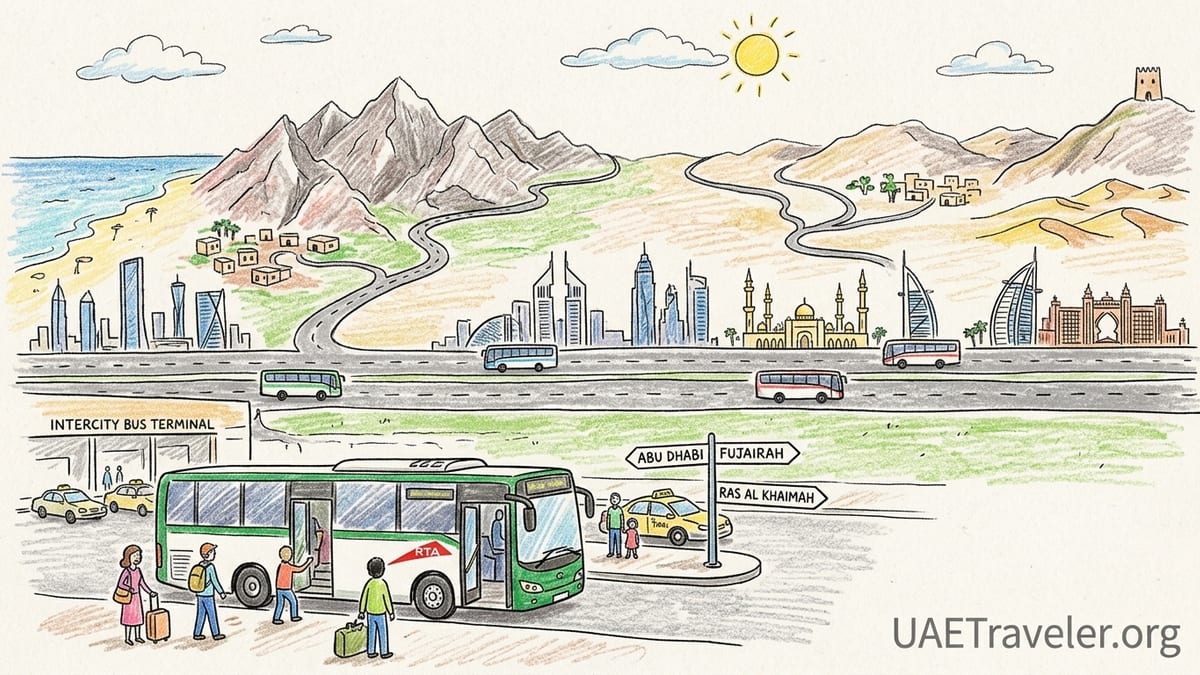
The Reality of Getting Around the UAE Without a Car
On paper, the UAE’s inter-emirate transport network looks straightforward. Dubai’s Roads and Transport Authority, Abu Dhabi Mobility, Sharjah Roads and Transport Authority and Ras Al Khaimah Transport Authority all operate modern, air-conditioned coach services linking major cities. In practice, the network is strongest along the Dubai–Abu Dhabi corridor and between Dubai, Sharjah and Ajman. Once you add Fujairah, Ras Al Khaimah or Umm Al Quwain, or try to reach mountains, wadis or remote beaches, the gaps in public transport become clear.
Most intercity buses connect large terminals such as Al Ghubaiba and Union in Dubai, Al Jubail in Sharjah, Abu Dhabi Central Bus Station in Mussafah and the main terminals in Ajman and Ras Al Khaimah. Fares are generally around AED 25 to AED 35 per leg for long routes, with advertised journey times of 1 to 3 hours depending on traffic and distance. Payment is usually made via the local smart cards, primarily Nol in Dubai and Hafilat in Abu Dhabi, along with cash at some intercity counters. These buses work very well if you are going from downtown to downtown and are happy to use taxis or local buses at each end.
The challenge begins once you step off the coach. LuLu Mall in Fujairah, the main terminal in Ras Al Khaimah and Sharjah’s Al Jubail are several kilometres from beach resorts, hiking trailheads, mangrove kayak bases and desert camps. The last few kilometres almost always require a taxi or hotel transfer. For travellers who want to see Hatta’s dams, Jebel Jais’ viewpoints or remote mangroves near Khor Fakkan, a rental car or private driver is often more realistic than trying to stitch together multiple buses and cabs.
Another reality is that official timetables for some corridors are fragmented across different authority websites, and some services are periodically suspended or adjusted. Information published in 2024 and 2025 is still broadly accurate in 2026 for key routes such as Dubai to Abu Dhabi and Dubai to Ras Al Khaimah, but travellers should always check the latest timings on the relevant transport apps before travel. What follows uses current fares and patterns as a framework, while highlighting where on-the-ground verification is essential.
Dubai to Abu Dhabi: E100, E101 and Airport Connections
The Dubai to Abu Dhabi corridor is the backbone of inter-emirate travel. Abu Dhabi Mobility currently lists E100, E101 and historically E102 as the main intercity routes between Abu Dhabi Central Bus Station in Mussafah and Dubai, with a standard inter-emirate fare of around AED 25 each way. In recent months the E100 and E101 have been the workhorses, running roughly every 20 to 30 minutes from early morning until late at night.
E100 usually links Al Ghubaiba Bus Station in Bur Dubai with Abu Dhabi Central Bus Station. E101 connects Ibn Battuta Bus Station, directly beside the Red Line Metro, with Abu Dhabi Central. Journey times are typically about 2 hours, extending to 2.5 hours during peak traffic. Official and recent independent guides agree on a fare of about AED 25 per person one way, paid using a Nol or Hafilat card with enough balance or by purchasing a ticket at the counter before boarding, depending on the current integration between the two systems.
From Abu Dhabi Central Bus Station you will almost always need a taxi or local bus to reach areas such as Yas Island, Saadiyat Island or Reem Island. For example, arriving in the evening and taking a taxi from the station to a Yas Island hotel usually costs somewhere in the region of AED 45 to AED 70 depending on traffic and exact location. From Ibn Battuta on the Dubai side, you have a seamless connection to the Metro, which makes this route very attractive if you are staying in Dubai Marina, Jumeirah Lakes Towers or around the Mall of the Emirates.
Airport travellers have two main options. Some E102-style routes historically connected Zayed International Airport with Dubai via Mussafah and Ibn Battuta, but these have seen changes and partial suspensions. In 2026 many passengers instead use dedicated airport coaches or shuttle services operating from Zayed International Airport to Ibn Battuta Mall, usually for a fare broadly in line with the intercity bus, then continue by Metro or taxi. Because airport bus branding and numbers have changed more frequently than the core E100 and E101, flyers should confirm the current airport coach from airport information desks or official transport apps on the day of travel.
Dubai, Sharjah and Ajman: Dense Corridors and Crowded Buses
The urban strip running from old Dubai through Deira and along Al Ittihad Road into Sharjah and Ajman is one of the busiest bus corridors in the country. Dubai RTA and Sharjah RTA operate several numbered routes between Dubai’s Union and Al Ghubaiba stations and Sharjah’s Al Jubail terminal, where easy onward connections continue to Ajman and Umm Al Quwain. Although route numbers shift occasionally, services broadly follow the same corridor, with typical fares in the region of AED 12 to AED 17 for Dubai to Sharjah and slightly more if you continue to Ajman.
Because this corridor carries tens of thousands of daily commuters, frequencies are high during the morning and evening peaks, often with buses at 10 to 20 minute intervals. Travel times, however, can be unpredictable. A ride from Dubai’s Union Bus Station to Al Jubail in Sharjah may take 35 to 45 minutes off-peak, but can stretch past 70 minutes when traffic thickens around Al Nahda and Al Wahda. From Al Jubail it is straightforward to connect to Ajman and Umm Al Quwain using Sharjah and Ajman-operated routes that fan out along the E11 coastal highway.
For tourists staying in central Dubai and visiting Sharjah’s museums or Ajman’s corniche for a day, buses are cost-effective but require patience. A couple travelling from Dubai Marina might take the Metro to Union, connect to a Sharjah-bound intercity bus to Al Jubail, then either walk or take a short taxi ride to the Museum of Islamic Civilization or Sharjah Art Museum. The public-transport cost for two adults is usually under AED 50 return, but they will spend a good portion of the day sitting in traffic. In contrast, a taxi from Dubai Marina directly to central Sharjah can cost around AED 80 to AED 120 each way depending on congestion, but saves at least an hour compared to the bus-plus-Metro combination.
Ajman is usually accessed via Sharjah in practical terms. Travellers commonly ride from Dubai to Al Jubail, then hop on an Ajman-bound coach, paying an additional fare of about AED 8 to AED 12. The coach drops them at Ajman bus station on Sheikh Rashid bin Humaid Street, from where taxis reach beachfront resorts in less than 10 minutes for roughly AED 15 to AED 25. The key point is that public transport serves the city cores well but does not run along the full beachfront, so even budget-focused visitors should factor in short taxi rides.
Dubai to Fujairah and Ras Al Khaimah, with Umm Al Quwain in Between
Dubai’s mountainous and northern neighbours require longer planning horizons. The main Dubai to Fujairah route is the E700, which links the Al Etisalat or Union area of Dubai with Fujairah Bus Station via Al Dhaid and Masafi. Official RTA material lists a journey time of about 2.5 to 3 hours, with ticket prices reported around AED 25 to AED 30 one way. Buses are air-conditioned coaches with luggage space, popular with both residents and tourists heading to Fujairah’s beaches and the historic Fujairah Fort.
Once you arrive in Fujairah, you will almost certainly need an additional taxi ride if your accommodation is along the coastal strip north of the city, such as Al Aqah Beach. A typical taxi ride from Fujairah bus station to a beach hotel can cost in the range of AED 35 to AED 70 depending on distance. For travellers going snorkelling at Snoopy Island or diving around Dibba, remember that there is no direct public bus to the resort clusters, so factor in both time and taxi budget.
Dubai to Ras Al Khaimah is served by a dedicated intercity coach operated by Ras Al Khaimah Transport Authority, departing from Dubai’s Union Bus Station. Recent guides based on RAKTA’s timetable indicate a departure window broadly from around 7:30 in the morning until late evening, with a fare in the region of AED 30 per person one way. Journey times average 1 hour 45 minutes to 2 hours depending on stops and traffic around Sharjah and Ajman. The bus terminates at RAKTA’s main bus station near the Ras Al Khaimah Transport Authority headquarters.
From Ras Al Khaimah’s central bus station, taxis are unavoidable for most tourist activities. A cab from the station to the Jebel Jais mountain road typically costs somewhere between AED 80 and AED 120 one way, while a ride to the Al Hamra and Mina Al Arab resort areas is usually in the AED 30 to AED 60 band. There is no public bus up to the Jebel Jais viewing decks, adventure park or via ferrata routes. Visitors planning an early morning hike or zipline run therefore often find a rental car or pre-booked driver more practical than relying on station taxis at dawn.
Umm Al Quwain rarely features as a primary public-transport destination. In reality, most travellers reach it by bus to Ajman or Ras Al Khaimah and then taxi, or by driving themselves. Sharjah RTA’s network from Al Jubail includes services toward Umm Al Quwain along the E11, and some Ras Al Khaimah coaches pass through the emirate’s territory on the highway, but the stops are geared to residents rather than tourists. A realistic example is a traveller busing from Dubai to Ajman, then taking a taxi north along the coast to a kite-surfing spot or mangrove campsite in Umm Al Quwain for an extra AED 40 to AED 80 each way, depending on distance from Ajman city.
Where Buses Stop Being Enough: Mountains, Beaches and Mangroves
Intercity buses in the UAE excel at connecting the main urban areas, but their usefulness drops sharply once you aim for outdoor attractions. The mountain roads to Hatta, the Jebel Jais summit area, wadis around Masafi and Dibba, and many of the country’s best beaches and mangrove lagoons lie well beyond the reach of scheduled bus routes. Even when a bus gets you to a nearby city, the last leg can be 30 to 70 kilometres of road with no public transport, often at times of day when taxi availability is limited.
Take Jebel Jais as an example. You can reach Ras Al Khaimah bus station from Dubai for about AED 30. However, the steep and winding road up to the main viewing platforms is more than 25 kilometres from the city, and there are no public buses serving it. Taxis are willing to go up and wait, but they price the round trip to reflect distance and waiting time. A small group might end up paying in the region of AED 200 to AED 300 for the return taxi, in addition to the intercity fares, which erodes much of the cost advantage over hiring a car.
Hatta presents similar constraints. Historically there have been bus routes from Dubai to Hatta, but their schedules, boarding points and operating periods have changed several times, and some services have been suspended. In 2026, travellers wanting to kayak on Hatta Dam, cycle mountain trails or stay in eco-lodges usually opt for rental cars or guided tours from Dubai that include transport. The lack of late-evening buses and the distances between trailheads, dams and accommodation make relying on public buses impractical.
Along the east coast and in the northern emirates, mangrove and beach attractions are also poorly matched with public transport. Kayak launches near Khor Fakkan and Kalba, quiet beaches north of Ras Al Khaimah city and scattered campsites in Umm Al Quwain are not located on standard bus routes. Even if you can get close using a combination of intercity and local buses, returning after sunset may be impossible once peak commuter service ends. Travellers with fixed tour departure times or sunrise photography plans should assume they will need a private vehicle rather than trying to improvise with buses on the day.
Rental Cars, Taxis and Private Drivers: Rules, Costs and Hidden Extras
Because of the limitations of public transport beyond city centres, many visitors resort to rental cars or private drivers to explore the UAE. International visitors can usually drive on their home country licence if it is from a country recognised by the UAE authorities, but some nationalities require an International Driving Permit in addition to the original licence. It is essential to check your specific case with your rental company before arrival. Police and rental firms can request original documents during checks, and driving without a valid licence can invalidate insurance coverage.
Rental car pricing in 2026 for a compact vehicle typically starts around AED 90 to AED 130 per day from airport and city-centre agencies, falling for longer rentals. Agencies usually block a security deposit on a credit card, often in the range of AED 1000 to AED 2000 for standard cars, released a few weeks after the vehicle is returned. Insurance policies nearly always include an excess, so the renter may be responsible for the first AED 1000 to AED 3000 of any damage. Collision damage waiver upgrades are widely offered if you prefer to reduce or remove this excess, at additional daily cost.
Mileage limits are another potential extra. While many mainstream agencies advertise unlimited mileage within the UAE, some budget-focused companies cap daily distance, charging per kilometre beyond that. Given that a return drive from Dubai to Jebel Jais alone can be roughly 340 kilometres, road-trippers should verify mileage policies carefully. Salik tolls in Dubai and Darb tolls in Abu Dhabi are normally billed after the rental ends, deducted from the deposit or charged to your card. Expect to see individual toll charges in the range of a few dirhams per gate, which adds up if you cross multiple times per day.
Young-driver surcharges apply to renters under a certain age, often 25. Agencies may either refuse to rent to drivers under 21 or 23, or apply an extra daily fee. For example, a 22-year-old traveller hiring a car in Dubai may face an additional AED 20 to AED 40 per day or be limited to specific vehicle categories. Parking fees vary by emirate, with metered street parking common in central Dubai, Abu Dhabi and Sharjah. Hotel parking is often free for guests but can be chargeable in busy downtown districts and around some beachfront resorts, so factor this into your budget when comparing with intercity buses and taxis.
Taxis and private drivers fill the gap for those who prefer not to drive. Metered taxis in Abu Dhabi and Dubai have published starting fares and per-kilometre rates that make them viable for shorter trips within the city, but an inter-emirate run from Dubai Marina to Abu Dhabi Corniche or from Ras Al Khaimah to Dubai Airport can easily exceed AED 250 to AED 400 one way. Informal private drivers often advertise fixed-rate trips between the emirates in modern sedans or SUVs. While these can be comfortable and competitively priced for groups, travellers should ensure that the service is properly licensed and insured rather than relying on unregulated messaging-app offers.
What It Really Costs: Solo, Couple and Family Scenarios
To understand when public transport makes sense, it helps to look at real-world cost scenarios for one traveller, a couple and a family of four. The figures below use approximate 2026 fares and assume standard conditions, not surge pricing or premium private transfers. All costs are per one-way leg unless otherwise stated.
Consider a simple Dubai to Abu Dhabi day trip from Ibn Battuta to Abu Dhabi Central Bus Station. A solo traveller pays around AED 25 each way on the E101, plus perhaps AED 20 for two local Abu Dhabi buses or a short taxi to and from a city-centre attraction, totalling about AED 70 for the full return journey. A couple on the same itinerary spends around AED 140 combined. A family of four with teenagers pays roughly AED 25 per person per leg on the bus and slightly more for local taxis, so the total for the day might land between AED 220 and AED 260. A standard taxi from Dubai Marina to central Abu Dhabi could cost in the range of AED 350 to AED 450 one way, which is obviously poor value for a solo traveller but begins to look more acceptable for a family of four when door-to-door convenience is factored in.
Now look at a Dubai to Ras Al Khaimah weekend, staying in a beach resort near Al Hamra. A solo traveller using the RAKTA coach from Union at around AED 30, then a taxi from Ras Al Khaimah bus station to the resort for approximately AED 40, spends about AED 70 per direction, AED 140 return. A couple spends roughly AED 280 return. A family of four can expect to pay around AED 60 for bus tickets plus AED 40 for the taxi each way, adding up to about AED 200 per direction, AED 400 return. By comparison, renting a compact car for two days at AED 120 per day, plus around AED 80 in fuel and AED 40 in tolls and parking, might come to about AED 360 in total, and the car can also be used for side trips to Jebel Jais and local attractions without additional public-transport fares.
Finally, imagine a Fujairah weekend focused on diving near Al Aqah. Public transport would involve an E700 bus from Dubai to Fujairah for about AED 25 to AED 30 per person, then a taxi for perhaps AED 60 to AED 80 each way to the resort. A solo diver spends around AED 170 to AED 220 in total for the return, a couple about AED 340 to AED 440, and a family of four over AED 600 once resort transfers are included. A three-day car rental might cost between AED 300 and AED 400 including fuel and tolls, which quickly beats the combined cost of intercity buses and multiple long resort transfers for a family group.
These examples show a clear pattern. Buses win on price for solo travellers moving strictly between city centres, especially along Dubai–Abu Dhabi and Dubai–Sharjah–Ajman. As soon as you add long resort or mountain transfers, taxis or private drivers, and multiple family members, a rental car starts to become cheaper or at least comparable on cost, with a substantial gain in flexibility.
Smart Transport Strategies for 3, 7 and 14 Day Trips
For a short three-day break focused on one city plus a straightforward day trip, public transport and taxis are usually adequate. A traveller staying in Downtown Dubai, for example, could rely on the Dubai Metro and trams for local movement and use an E101 bus from Ibn Battuta for a single day trip to Abu Dhabi. The total transport spend might sit comfortably under AED 250 for a solo visitor and around AED 450 for a couple, while avoiding the hassle of driving and parking. In Abu Dhabi, local buses and inexpensive taxis cover the last mile from the central station to major sights like the Corniche and Louvre Abu Dhabi.
A week-long itinerary covering multiple emirates is different. Suppose you want to base yourself in Dubai but also overnight in Ras Al Khaimah and visit Sharjah’s museums. For travellers comfortable with buses and willing to manage luggage, a combination of E100/E101, RAKTA’s Dubai coach and Sharjah-bound intercity routes can keep costs very low, especially for solo visitors. However, a couple or family of four planning several intercity legs over seven days often finds that a single weekly rental car is comparable or cheaper than repeated intercity tickets and taxi transfers. It also opens up sunset visits to Jebel Jais, early-morning photography on quiet beaches and flexibility if plans change due to weather or energy levels.
For a 14-day trip that aims to showcase both cities and outdoor landscapes, a hybrid strategy works well. One common approach is to spend the first three or four days car-free in Dubai or Abu Dhabi, using Metro, trams and local buses, then rent a car for a 7 to 10 day loop through Ras Al Khaimah, Fujairah, Hatta and the smaller northern emirates. This keeps car rental days, deposits and tolls to the period when you genuinely need the flexibility, while leveraging excellent urban public transport at the beginning and end of the trip. Solo budget travellers might still piece together buses and occasional private transfers, but for most couples and families, a rental car or contracted driver for the second half of a two-week itinerary delivers much better value and experience.
Private drivers and curated transfers fit best into higher-budget or time-sensitive itineraries. A family landing with ski bags or kite-surf equipment at Zayed International Airport, for example, may choose a door-to-door SUV transfer directly to a Ras Al Khaimah resort rather than juggling buses and taxis late at night. While this can cost several hundred dirhams, the time saved and reduction in stress is significant. Over a long stay, however, repeatedly booking private transfers becomes more expensive than renting a vehicle, so these services are best reserved for arrival and departure or specific long, tiring legs.
The Takeaway
Inter-emirate travel in the UAE is a story of two networks. On the one hand, a reliable, affordable grid of air-conditioned buses links Dubai, Abu Dhabi, Sharjah, Ajman, Fujairah and Ras Al Khaimah along well-established corridors. On the other, mountains, remote beaches and mangrove lagoons remain firmly in the domain of rental cars, taxis and private drivers. The trick is to match your mode to your route and group size, rather than defaulting to a single method of transport for the entire trip.
If you are a solo traveller bouncing between city museums, malls and waterfronts, the E100 and E101 buses, RAKTA’s Dubai coach and the dense Dubai–Sharjah–Ajman corridor can keep your costs very low, especially when combined with the Metro and local buses. Couples and families of four quickly reach the tipping point where a compact rental car, even after allowing for deposits, insurance excesses and tolls, is no more expensive and often significantly more practical.
When planning a three-, seven- or fourteen-day stay, think carefully about which days truly require a vehicle. Build city-centre sightseeing around public transport, then hire a car or book a private driver only for the segments that involve mountains, scattered resorts or early and late activities. Check live information on RTA, Abu Dhabi Mobility, Sharjah RTA and Ras Al Khaimah Transport Authority apps a day or two before your journeys, and keep some taxi budget for the inevitable last few kilometres from bus stations to beaches and trailheads. With this mindset, travelling between the seven emirates becomes not just manageable, but one of the memorable threads that binds your UAE trip together.
FAQ
Q1. Do I need an International Driving Permit to rent a car in the UAE?
Most visitors from countries whose licences are recognised by UAE authorities can rent using their original licence, but some nationalities do require an International Driving Permit in addition. Because the rules depend on your passport and licence country, confirm with your rental company before you travel.
Q2. How much does the bus from Dubai to Abu Dhabi cost in 2026?
The main intercity routes between Dubai and Abu Dhabi, such as E100 and E101 between Al Ghubaiba or Ibn Battuta and Abu Dhabi Central Bus Station, generally charge around AED 25 per person each way, with journey times of about two hours depending on traffic.
Q3. Can I pay intercity bus fares with my Dubai Nol card everywhere?
Nol is widely accepted on Dubai-operated buses and many intercity routes starting from Dubai, but Abu Dhabi’s network is based on the Hafilat system and some services still require separate cards or tickets. Always check payment options at the station or in the official transport app before boarding.
Q4. Is public transport enough to reach Jebel Jais and Hatta?
No. Intercity buses will get you to Ras Al Khaimah city or towards Hatta’s general area, but there are no regular public buses up the Jebel Jais mountain road, and Hatta’s attractions are spread out. For both destinations, a rental car, taxi or organized tour is usually necessary.
Q5. How expensive are tolls like Salik and Darb when using a rental car?
Salik gates in Dubai and Darb in Abu Dhabi charge a few dirhams per crossing. Over a week of regular driving between emirates, many visitors see a total toll bill between roughly AED 50 and AED 150, which rental companies charge to your card or deduct from your deposit after the trip.
Q6. When does a rental car become cheaper than using buses and taxis?
For solo travellers who only move between city centres, buses and local transport are usually cheaper. For couples and especially families of four who plan several intercity legs plus long taxi rides to resorts or mountains, a compact rental car for the same period often costs the same or less while providing much more flexibility.
Q7. Are there realistic public transport options to Umm Al Quwain?
There are bus routes along the coast via Sharjah and Ajman that serve Umm Al Quwain, but they are designed around residents and work commutes rather than visitors. In practice, most travellers reach Umm Al Quwain by a combination of bus to Ajman or Ras Al Khaimah and taxi, or by driving themselves.
Q8. How early should I arrive for popular intercity buses?
On busy corridors such as Dubai to Abu Dhabi or Dubai to Sharjah, it is sensible to arrive at least 15 to 20 minutes before your preferred departure, particularly on Thursday evenings, Friday afternoons and Sunday mornings when many residents are commuting or travelling for the weekend.
Q9. Are guided day tours between emirates worth the cost?
Guided tours that include transport can be good value if you want to visit several sights in one day without driving, especially to areas with weak public transport like Hatta or Jebel Jais. While they cost more than a bus ticket, they often include entrance fees, guiding and convenient hotel pick-up and drop-off.
Q10. Is it safe and practical to rely on taxis for late-night returns?
Taxis in the UAE are generally safe, regulated and available around the clock in major cities. However, at remote locations such as mountain roads or small beach areas, late-night availability can be limited. In those cases, arranging a return pick-up in advance or using your own rental car is more reliable.