


The United Arab Emirates is often reduced to a single image of futuristic Dubai, yet the country is a federation of seven distinct emirates that function almost like different destinations within one compact state. For travelers who want to go beyond a quick city break, understanding how Abu Dhabi, Dubai, Sharjah, Ajman, Umm Al Quwain, Ras Al Khaimah and Fujairah differ is the key to planning a smarter route, realistic budget and more rewarding experiences.
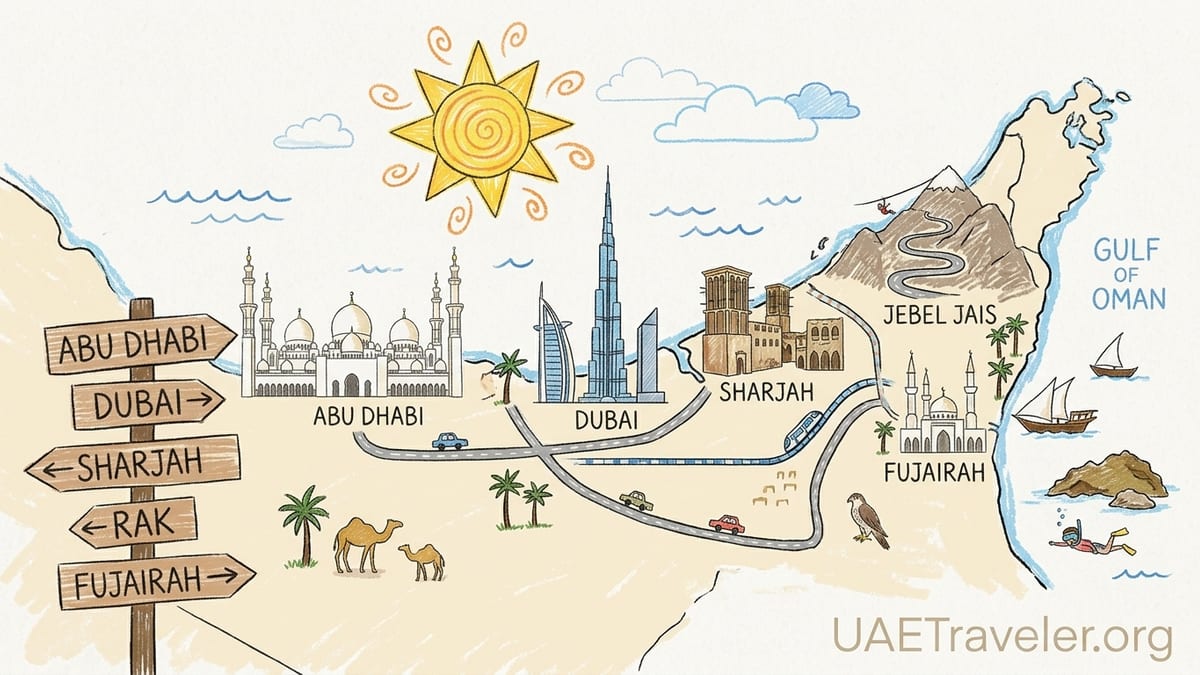
Big Picture: Map, Distances and How the Emirates Compare
Imagine the UAE as a crescent of cities and beaches curving around the southern shore of the Arabian Gulf, with the Hajar Mountains and the Gulf of Oman forming a rugged eastern edge. Abu Dhabi sits in the southwest as the largest emirate by land and the federal capital, Dubai and Sharjah form the intense urban core in the middle, and smaller Ajman, Umm Al Quwain and Ras Al Khaimah line the northern coast. Fujairah is the outlier, facing the Gulf of Oman on the east coast with green wadis and dramatic cliffs where other emirates have desert flats.
Driving links everything. The main E11 highway runs along the Gulf coast from Abu Dhabi through Dubai, Sharjah, Ajman, Umm Al Quwain and Ras Al Khaimah. In normal traffic, Dubai to Abu Dhabi city is about 140 kilometers and usually around 1 hour 30 minutes by car, Dubai to Sharjah about 25 to 30 kilometers and often 30 to 45 minutes outside peak hours, and Dubai to Ras Al Khaimah roughly 110 kilometers that take about 1 hour 15 minutes. Eastward, Dubai to Fujairah city is about 120 kilometers through mountain passes in 1 hour 30 minutes, while Dubai to Hatta and to Khor Fakkan on the east coast of Sharjah are also realistic day trips by rental car or private transfer.
As a very rough cost comparison, Abu Dhabi and Dubai sit at the top for hotel and dining prices, Sharjah is slightly cheaper with fewer high-end resorts, Ras Al Khaimah and Fujairah often offer resort value compared with Dubai’s beach strip, and Ajman and Umm Al Quwain still have midrange hotels and older resorts whose nightly rates can undercut neighboring emirates. For example, in high season it is normal to see a branded beachfront hotel in Dubai priced noticeably higher than a comparable property on Ras Al Khaimah’s Al Marjan Island or Fujairah’s Al Aqah coast, even though the beach quality and resort facilities are broadly similar.
In terms of travel style, Abu Dhabi blends heritage and big-ticket modern culture, Dubai excels in city experiences and iconic sights, Sharjah is strongest for museums and traditional neighborhoods, Ajman offers compact, local-feeling beach time, Umm Al Quwain is quiet and nature-focused with mangroves, Ras Al Khaimah is the base for Jebel Jais mountain adventures, and Fujairah is ideal for those who want an east-coast mix of beaches, diving and wadis with a slower pace.
Abu Dhabi: Capital City, Sheikh Zayed Grand Mosque and Oasis Heritage
Abu Dhabi is the political capital and by far the largest emirate by territory, stretching from oil-producing islands in the Gulf to the edge of the Empty Quarter desert. Most visitors stay in Abu Dhabi city, a modern island metropolis of glass towers, beaches and long corniches, but the emirate also includes Al Ain, an inland oasis city on the border with Oman that is central to Emirati history and agriculture.
No trip to the UAE is complete without seeing Sheikh Zayed Grand Mosque, one of the country’s most important religious and architectural landmarks. The mosque is on the mainland just off the E11 highway. Visitors are welcomed outside prayer times, with modest clothing and a dress code that includes covered shoulders and legs for all, and headscarves for women; those who arrive unprepared are usually able to buy or rent appropriate garments at the visitor center. In practice, many travelers combine the mosque with a visit to the nearby Qasr Al Watan presidential palace and the waterfront around the Corniche in a single day using taxis or ride-hailing apps.
Al Ain, about 150 kilometers and roughly 1 hour 40 minutes by road from central Abu Dhabi, deserves at least an overnight stay if you want to do more than pass through. Here you find palm-filled oases irrigated by traditional aflaj channels, mud-brick forts like Al Jahili, and the winding road up Jebel Hafit, a mountain viewpoint that gives a sense of the region’s desert and border landscapes. A traveler might spend a morning exploring the Al Ain Oasis on foot, stop at the National Museum for context on Bedouin life, then drive the mountain road in late afternoon for sunset views back over the city and dunes.
Accommodation in Abu Dhabi runs from ultra-luxury waterfront resorts on Saadiyat Island to city business hotels that can be good value on weekends and in summer. Taxis are regulated and metered, and public buses connect major districts, but most independent travelers either rely on ride-hailing or rent a car to include Al Ain and possibly Liwa in the far desert. For planning, allow at least two full days for Abu Dhabi city itself, an extra day trip or overnight for Al Ain, and longer if you intend to do desert stays.
Dubai: Iconic Skyline, Burj Khalifa and Nearby Hatta Mountains
Dubai is the most visited emirate and often the entry point to the UAE thanks to its large international airport. The city stretches along the coast in a long ribbon of neighborhoods from the older districts of Deira and Bur Dubai around Dubai Creek to newer areas such as Downtown Dubai, Dubai Marina and the man-made Palm Jumeirah island. Public transport is better developed here than elsewhere in the country, with the Dubai Metro, modern trams, and air-conditioned buses complementing taxis and ride-hailing services.
Burj Khalifa anchors Downtown Dubai and remains the emirate’s most famous sight. The tower’s observation decks, accessed through the Dubai Mall complex, are among the most popular paid attractions in the region. Tickets are typically sold in timed slots with dynamic pricing that makes sunset hours more expensive than mid-afternoon or late at night. Many visitors pair a visit to the observation deck with the evening fountain shows in the artificial lake at the tower’s base and dinner in one of the surrounding restaurants that look onto the water.
For a complete sense of Dubai’s geography, it helps to see both the city and its mountain hinterland. Hatta, an exclave of Dubai in the Hajar Mountains, sits about 130 kilometers from central Dubai and is usually reached in around 1 hour 45 minutes by car using highways that briefly cross Oman-adjacent territory. The area has developed as an outdoor hub, with a dam surrounded by rocky hills, marked mountain-biking trails, hiking routes in cooler months and a cluster of boutique lodgings and trailer-style stays run under the Hatta brand. Travelers commonly book a guided day trip that includes kayaking on the dam and a short hike, or stay overnight to escape the city heat and light pollution.
Dubai can be expensive, with high-end hotels along the beach and in Downtown often pricing well above smaller inner-city hotels. To control costs, many travelers stay in Deira or Bur Dubai, eat in local cafeterias or South Asian restaurants, use the metro where practical, and reserve pricier experiences such as Burj Khalifa tickets or desert safaris for a few selected days. A first-time visitor who wants a balanced impression of the city, a desert excursion and a possible day trip to Abu Dhabi or Sharjah should plan on five to seven nights.
Sharjah: Cultural Capital, Heart of Sharjah, Mleiha and the East Coast
Sharjah borders Dubai so closely that the built-up areas merge, yet it is a very different travel proposition with a stronger emphasis on culture and more conservative public life. The city has invested heavily in museums, heritage areas and public art under the umbrella of the Sharjah Museums Authority and related institutions, earning a reputation as a cultural capital of the Arab world.
The Heart of Sharjah restoration district, near the traditional waterfront, is the best starting point. Low-rise coral-stone and gypsum buildings house the Sharjah Heritage Museum, souqs, cafes and restored merchant houses. It is an area where you can stroll in the shade, see traditional wind towers and courtyards, and get a sense of how Gulf trading towns looked before oil wealth transformed the skylines. Modest dress is appreciated, and while visitors will see many expatriate workers commuting across the border from Dubai, the feel in the evenings is more family-oriented and less nightlife-driven than Dubai’s resorts or marina districts.
Beyond the city, Sharjah controls a significant stretch of inland desert and mountain territory, including the Mleiha Archaeological Centre about 60 kilometers from the city. Mleiha offers guided tours to pre-Islamic tombs and rock formations, as well as desert activities such as dune driving and stargazing, all framed around archaeology rather than pure thrill rides. It is a solid example of how the UAE is trying to interpret its ancient history for visitors, contrasting with the ultra-modern image of the coastal cities.
Sharjah is also unusual because it owns coastal enclaves on the Gulf of Oman, most notably Khor Fakkan. This small city, about 140 kilometers or roughly two hours by road from Sharjah city through tunnels and mountain roads, has a curving bay, public beach, corniche and a growing range of hotels. For travelers who want a quieter alternative to Dubai’s Gulf beaches, a logical route is to combine a few days in Sharjah city’s cultural quarter with a night or two in Khor Fakkan or other east-coast communities before looping back via Fujairah.
Ajman and Umm Al Quwain: Compact Coasts, Corniches and Mangroves
Ajman is the smallest emirate by land area and is effectively a northern extension of the Greater Dubai–Sharjah urban zone, yet it has its own small city center, fishing harbor and a strip of modest and midrange beachfront hotels. The Ajman Corniche is the focal point, with a beach, promenade and low-rise apartment blocks. Visitors who base themselves here normally do so to access the beach at slightly lower accommodation prices than similar properties in Dubai, while still being within driving distance of Dubai’s major malls and attractions.
A short drive inland takes you to Masfout, Ajman’s mountain exclave close to the Hajar range and the border with Oman. This area is cooler than the coast during winter and is being promoted for hiking, biking and simple rural escapes. In practice, travelers with a rental car might pair a night or two on Ajman’s coast with a day in Masfout, walking among rocky outcrops and farms, before continuing on towards Hatta, Ras Al Khaimah or back to Dubai.
North of Ajman, Umm Al Quwain is one of the least-developed emirates in terms of high-rise tourism, which is precisely its appeal for some visitors. The emirate is built around a lagoon with mangroves and islands, and many activities revolve around nature. Kayaking through mangrove channels, birdwatching and visiting low-key waterparks and beaches are typical reasons to stop. Compared with Dubai or Abu Dhabi, the skyline is low, the traffic lighter and the general atmosphere more small-town. Travelers who value quiet coastal stays and do not need big-brand malls or nightlife sometimes choose a hotel or rental property here as a base for a few days of rest within an hour’s drive of Sharjah and Dubai.
Public transport is limited in both Ajman and Umm Al Quwain, so a rental car is the most practical way to explore Masfout, reach remote mangrove launch points, or combine these emirates with Ras Al Khaimah in a single coastal drive. For most itineraries, one or two nights in each is enough unless you are specifically seeking a longer, low-key beach break away from the more famous resorts.
Ras Al Khaimah: Jebel Jais, Desert and Northern Beaches
Ras Al Khaimah, often shortened to RAK, sits at the northern end of the UAE’s Gulf coast, backed by some of the most accessible high mountains in the region. The city itself has a waterfront corniche, older neighborhoods and a growing cluster of resorts along the coast, especially around Al Marjan Island, a man-made archipelago that has become a focus for new hotels and apartments.
The main reason many visitors detour to Ras Al Khaimah is Jebel Jais, the highest peak in the UAE and a major outdoor destination. The mountain is about 60 kilometers inland from the city and roughly 160 kilometers, or about two hours of driving, from central Dubai depending on traffic. A well-built road climbs through dramatic limestone landscapes to viewing platforms and a visitor area, with cooler temperatures than the coast, especially from late autumn to early spring. Along the upper sections you find adventure attractions such as the Jais Flight zipline and other seasonal activities that can be checked and booked in advance, particularly on weekends and holidays when demand is higher.
Aside from the mountain, Ras Al Khaimah has desert camps, historic forts and coastal areas suitable for relaxed days between more active excursions. Some visitors book package stays in all-inclusive beach resorts and only leave to make one long half-day trip up Jebel Jais, while others use the city as a base to explore both the mountain and neighboring emirates like Umm Al Quwain and Fujairah. Driving conditions are familiar to anyone used to modern highways, and for those without a car, local operators run small-group tours to Jebel Jais from both Ras Al Khaimah and Dubai.
Because it offers both beaches and a mountain climate, Ras Al Khaimah works well for families and travelers who want variety without constant hotel changes. Allow two or three nights if you plan to visit Jebel Jais, spend time by the sea and possibly take a desert excursion, and consider timing your mountain visit for early morning or late afternoon light when visibility and temperatures are more favorable.
Fujairah: East-Coast Beaches, Al Bidya Mosque and Al Aqah
Fujairah is the only emirate whose coastline lies entirely on the Gulf of Oman, separated from the main Gulf coast cities by the Hajar Mountains. Fujairah city itself is the commercial center and port, but for most visitors the focus is the string of coastal villages and resorts northwards, where the mountains drop close to the sea and coral reefs lie offshore.
One of the most important heritage sites here is Al Bidya Mosque, often described as the oldest known mosque in the UAE. This small, mud-brick structure with four squat domes sits on a slight rise between the road and the sea, with a watchtower above it on a rocky hill. The mosque is still in use, so non-Muslim visitors observe it respectfully from outside prayer times and dress conservatively. It makes a useful stop on a coastal drive between Fujairah city and Dibba, tying together the region’s religious history with its maritime setting.
Further north, Al Aqah has become synonymous with Fujairah’s main resort strip. Here, branded hotels line a long beach of pale sand facing out towards Snoopy Island, a rocky islet popular for snorkeling. Dive centers based in local hotels or independent shops offer boat trips and equipment rental for certified divers and beginners. Because the east coast has different currents and underwater conditions to the Gulf, many Dubai-based residents drive the roughly two hours to Al Aqah at weekends specifically for diving, snorkeling and cooler evenings in winter.
Reaching Fujairah from Dubai or Sharjah usually involves crossing the mountains on modern highways that include tunnels and winding sections. This means the journey itself is part of the experience, with rocky ridges, wadis and occasional camel pens visible from the road. It is realistic to visit Fujairah as a long day trip from Dubai, but a more relaxed option is to spend two or three nights at an Al Aqah beach resort and use one day for coastal sightseeing that includes Al Bidya Mosque, Fujairah Fort and nearby wadis.
Seasons, Transport and Combining Emirates in One Trip
Climate is a major factor in how you experience the seven emirates. From roughly June to September, daytime coastal temperatures commonly exceed 40 degrees Celsius with high humidity, which can make outdoor sightseeing, desert trips and mountain hikes uncomfortable except very early or late in the day. Shoulder seasons around April to early May and late October to November are more manageable, while the period from roughly December through March is prime time for outdoor activities, mountain visits and walking tours in places like the Heart of Sharjah, Al Ain Oasis or the corniches.
Most visitors move between emirates by car on highways that feel similar to those in Western Europe or North America, with multiple lanes and service stations. Rental cars are widely available at Dubai and Abu Dhabi airports and in city branches, and international licenses are generally accepted for short visits. For those who prefer not to drive, each emirate has regulated taxis, and ride-hailing services operate in Abu Dhabi, Dubai, Sharjah and the northern cities, though availability can thin out late at night or in smaller communities.
Public transport between emirates has been evolving. Intercity buses link Dubai with Abu Dhabi, Sharjah, Ajman, Ras Al Khaimah, Fujairah and other towns, often departing from major bus stations attached to metro hubs or central terminals. These buses are usually air-conditioned, relatively inexpensive by international standards and used by commuters as well as travelers, although schedules can change and some routes have been adjusted as new rail projects develop. Always check current departure points and times shortly before travel, especially in 2026 as intercity transport is in transition.
Logical multi-emirate combinations depend on your time. With five days, many travelers focus on Dubai with one or two day trips to Abu Dhabi and Sharjah. With seven to ten days, it becomes realistic to add an east coast segment in Fujairah or Khor Fakkan, or a mountain and beach combination in Ras Al Khaimah. Those with two weeks or more can comfortably include Al Ain in Abu Dhabi’s interior, Ajman and Umm Al Quwain for quieter beaches, and repeat visits to favorite districts without rushing. Because the physical distances are short, the main constraints are traffic around rush hours and the desire to avoid too many hotel changes.
FAQ
Q1. How many days do I need to see all seven emirates of the UAE?
Seeing all seven emirates in a meaningful way usually requires at least ten to fourteen days, allowing for two or three nights each in Dubai or Abu Dhabi and then shorter stays or focused day trips to Sharjah, Ajman, Umm Al Quwain, Ras Al Khaimah and Fujairah. It is possible to cross every emirate by car in far less time, but that tends to reduce visits to quick photo stops rather than real experiences.
Q2. Can I visit Sheikh Zayed Grand Mosque and Dubai in one day without a car?
It is possible but involves careful timing. Many travelers join organized day tours from Dubai that include round-trip transport, mosque entry formalities and sometimes an additional stop such as the Louvre Abu Dhabi. Independent visitors can combine an intercity bus or future rail service with Abu Dhabi taxis, but this requires extra buffer time for connections and mosque security checks.
Q3. What should I wear when visiting mosques and heritage areas in the UAE?
For major mosques such as Sheikh Zayed Grand Mosque, modest clothing that covers shoulders, arms and legs is expected for everyone, and women are asked to cover their hair with a scarf. Clothes should not be transparent or heavily decorated with slogans. In heritage areas, museums and souqs, modest but comfortable dress such as light long trousers, skirts below the knee and short or long sleeves is generally appropriate.
Q4. Is renting a car necessary to explore beyond Dubai and Abu Dhabi?
A rental car is not strictly necessary but gives significant flexibility. Intercity buses, taxis and tours can get you to major sights such as Abu Dhabi city, Ras Al Khaimah, Fujairah and Sharjah, yet reaching places like Masfout, some wadis near Fujairah or certain sections of Umm Al Quwain’s mangroves is easier with your own vehicle. Drivers used to multilane highways usually adapt quickly to the UAE road network.
Q5. When is the best time of year to visit Jebel Jais or Hatta for outdoor activities?
The most comfortable period for mountain hiking, cycling and other outdoor activities at Jebel Jais and Hatta runs from roughly November through March, when daytime temperatures are cooler and evenings can feel almost chilly at higher elevations. Summer visits are still possible but generally limited to short, early-morning or evening outings due to heat.
Q6. Are beaches in Ajman, Umm Al Quwain and Fujairah suitable for families?
Yes, many beaches in these emirates are family-oriented, with calmer atmospheres than some of Dubai’s more crowded waterfronts. Ajman’s Corniche, resorts in Umm Al Quwain and Fujairah’s Al Aqah area all host families seeking space to swim, walk and relax, and some hotels provide kids’ clubs, shaded pools and lifeguard services.
Q7. How expensive are activities like the Burj Khalifa observation deck or mountain ziplines?
Prices for headline attractions such as the Burj Khalifa observation decks and Jebel Jais adventure experiences can be significant compared with museum tickets or local transport. Costs vary by time slot and package, and peak times such as sunset or weekends are often more expensive. It is wise to check current prices directly with operators and reserve selected big-ticket activities in advance while balancing them with low-cost experiences like public beaches or free heritage walks.
Q8. Can I stay in one emirate and take day trips to the others?
Staying in one base, most commonly Dubai, and taking day trips to other emirates is a practical strategy because distances are relatively short. Many travelers, for example, sleep in Dubai and join day tours to Abu Dhabi, Sharjah or Ras Al Khaimah. However, for places with a distinct atmosphere such as Al Ain, Fujairah’s Al Aqah or Khor Fakkan, one or two nights on location usually provide a better sense of place than a rushed day trip.
Q9. Is alcohol available everywhere in the UAE’s seven emirates?
Alcohol regulations differ between emirates. Hotels and licensed venues in Dubai, Abu Dhabi, Ras Al Khaimah and many other places serve alcohol to non-Muslim adults, while Sharjah maintains stricter rules where alcohol is not served in normal hotels and restaurants. Travelers who wish to drink should check individual hotel policies in advance and remember that public intoxication and drink-driving are treated very seriously across the country.
Q10. How should I split my time between city, desert, mountains and coast?
A balanced first-time itinerary might allocate around half of the days to city experiences in Dubai and Abu Dhabi, a couple of days to cultural and heritage areas in Sharjah and Al Ain, and the remaining time between a desert camp near Abu Dhabi or Dubai and coastal or mountain stays in Ras Al Khaimah or Fujairah. Adjustments then depend on personal priorities such as beaches, museums, shopping or hiking.