


Driving east from Dubai just after lunchtime, I expected another photogenic desert excursion with a bit of history bolted on. What I found at Mleiha Archaeological Centre in Sharjah was something very different: a place where human prehistory, Bronze Age tombs, rugged jebels and carefully managed adventure tourism now sit inside a newly UNESCO listed desert landscape. Over the course of an afternoon and evening, the archaeology stopped being background decoration and became the main story of the UAE for me, running from 210,000 year old stone tools to late pre Islamic kingdoms and modern environmental dilemmas in the dunes.
Getting to Mleiha from Dubai and Booking the Experience
My day at Mleiha started on a weekday in October, leaving Dubai around 1.30 pm to avoid the morning commute traffic on Emirates Road. With light traffic, the drive from central Dubai to the Mleiha Archaeological Centre car park took just under an hour and ten minutes, using the E611, then cutting across through Dhaid toward the low limestone ridges that rise out of Sharjah’s central plain. The approach road to the centre is fully paved; any normal rental saloon car can get you to the museum, café and main parking area without trouble.
To make the most of the visit, I booked directly through the official Mleiha National Park platform a day in advance. I chose a combination that the site actively promotes in 2026: an afternoon Archaeological Tour of the Bronze and Iron Age sites followed by a Sunset Fossil Rock & Camel Rock excursion that includes museum entry. At the time of my visit, the sunset tour with museum access was listed at 175 AED per adult and 120 AED per child, while a basic museum ticket alone cost 25 AED for adults and 15 AED for children, with a family ticket at 75 AED. These prices matched both the official site and recent independent guides that cross checked the park’s rates in September 2026.
The booking process itself was straightforward. After selecting the tours, I received an email confirming the meeting time at the Archaeological Centre reception, with a note that daytime excursions stop about ninety minutes before sunset. That warning matters in winter when a 4 pm arrival can mean you have missed the last archaeological departure. Payment was online by card; no extra transaction fees appeared on my bank statement.
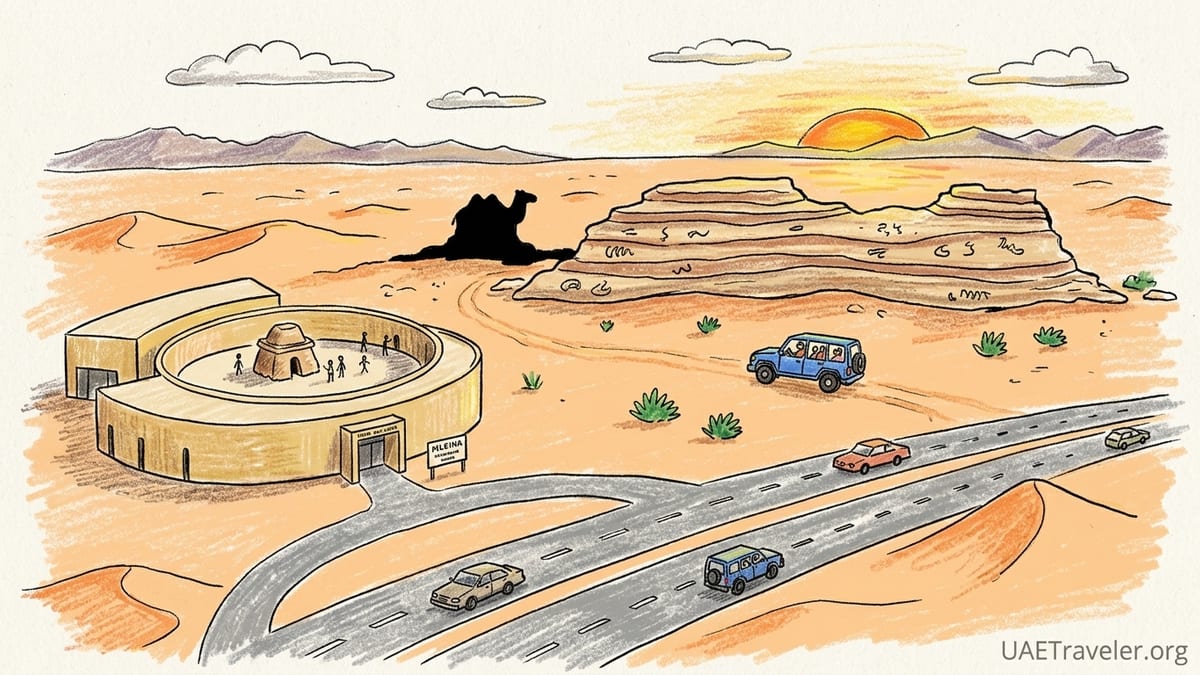
I allowed two full hours for the outward journey from Dubai, including a quick fuel stop and a ten minute buffer in case of congestion near Dhaid. In practice, the roads were smooth and clearly signed in English and Arabic, and the last stretch across the plain felt almost empty. What appeared on the horizon first was not the museum but the bluff of Fossil Rock, its layered flank rising above apricot coloured dunes and telegraphing that this would be a desert geology lesson as much as a museum visit.
Inside Mleiha Archaeological Centre: Objects and Ancient Environments
Mleiha Archaeological Centre is built low against the desert, its sandy coloured walls folding discreetly around a 4,500 year old Umm an Nar period tomb that sits exposed in the courtyard. You enter into a compact but carefully curated exhibition that starts not with glossy heritage slogans, but with deep time. Large wall panels and interactive displays show the prehistoric environment of this corner of Arabia, when it oscillated between wetter savannah like phases and the hyper arid desert we see today.
One of the first displays I encountered was a three dimensional model showing the Faya Range, the Mleiha Madam plain and the Hajar Mountains. Lights mapped how water once flowed through now dry wadis, making it clear why people repeatedly settled this area over the last 210,000 years. Touch screens allowed you to tap through different climatic periods, with graphics explaining how shifts in the Indian Ocean monsoon alternately filled and emptied lakes along the plain. It was the clearest visual explanation I have seen of why the Gulf interior was not always the inhospitable desert we imagine.
In glass cases nearby sit flint tools from Jebel Faya and other local sites, some roughly 125,000 to more than 200,000 years old according to recent excavations. Their labels link them directly to the newly inscribed UNESCO Faya Palaeolandscape, which covers a broad cultural landscape of jebels, plains and dunes between the Gulf coast and the Hajar foothills. The museum interpretation is explicit that these finds are part of a larger story of early modern humans moving out of Africa and adapting to arid zones, not isolated curiosities in Sharjah.
Further along, the exhibition shifts into the Bronze and Iron Age, with reconstructed domestic spaces, pottery, copper artefacts and burial goods excavated in the immediate vicinity. I spent several minutes with an interactive screen that let you rotate a virtual Umm an Nar style tomb, seeing how its circular stone chambers fit multiple burials over generations. That digital model turned out to be an exact counterpart of the actual tomb outside, and it made the later visit to the real structure much more legible.
The Umm an Nar Tomb: A Circular Archive in the Courtyard
The first stop once our small group left the air conditioned exhibition was the Umm an Nar tomb preserved in the courtyard of the centre itself. Our guide, an archaeologically trained educator employed by the park, emphasised that the museum was literally built around this structure to anchor the exhibits in a genuine site. The tomb dates to roughly 2600 to 2000 BCE and is part of a wider tradition found on islands off Abu Dhabi and along the northern coast of Oman, but here it sits several kilometres inland on what would once have been a fertile plain.
Standing beside the tomb, you see a low circular wall of carefully fitted limestone blocks, about ten metres across, with restored sections showing the original corbelled roofline. The guide explained how the interior would have been divided into multiple chamber segments, with human remains and grave goods deposited over time. Unlike modern graves, these were collective, multi generational monuments that asserted continuity of communities tied to specific water sources and trade routes.
Crucially, our guide distinguished what the archaeology can actually prove from popular desert folklore. When someone in the group asked whether these were “Bedouin tombs,” he corrected the term gently, noting that while later nomadic tribes did pass through the region, the Umm an Nar communities were early oasis and coastal settlers whose economy mixed date cultivation, herding and maritime trade. Stories you sometimes hear locally about “tombs of ancient Bedouin kings” are modern mythmaking, not supported by excavation reports.
From the courtyard, we walked a short distance along a paved, wheelchair friendly path to a slightly raised viewpoint that overlooked several fenced excavation areas. Our guide pointed out wall lines of a late pre Islamic settlement, explaining how ground penetrating surveys and targeted trenches had revealed a substantial town here between roughly the 3rd century BCE and the 3rd century CE. It was a reminder that Mleiha was once the centre of a southeast Arabian kingdom, now separately recognised on the World Heritage List, not just a scattering of tombs in the sand.
Into the Faya Palaeolandscape: Archaeology on the Edge of the Desert
The second part of the tour was by vehicle. We boarded an air conditioned Toyota Land Cruiser, one of several maintained by the centre for archaeological and desert excursions. Seat belts were mandatory and the driver gave a brief safety talk, including a warning not to wander off marked paths at the sites, as some areas retain unexcavated deposits and fragile surfaces.
Leaving the museum, the track threaded between low gravel fans and orange dunes toward the limestone ridges of the Faya Range. The guide explained that we were now moving inside the broader Faya Palaeolandscape, which UNESCO inscribed in 2025 as a single protected cultural landscape. He stressed that the designation covers an extensive area of jebels, plains and wadis, and that it does not mean every campsite, dune buggy track or roadside café around Mleiha is individually UNESCO listed, despite what some local adverts imply.
Our first stop was at a fenced Bronze Age and Iron Age zone where foundations of houses and storage spaces have been partially exposed. Under a simple shade shelter, the guide pointed to changes in stone size and wall thickness that mark different phases of occupation, and to the proximity of a now dry wadi that would have provided seasonal water. He spoke about how people here balanced settled agriculture with mobile herding, moving flocks toward the mountains in hotter months while maintaining a permanent base linked to regional trade.
Here again, he was careful to separate “what we know” from “what we tell around the fire.” Tales about hidden treasure under every tumulus, or perfectly preserved warrior skeletons holding swords, belong to campfire stories rather than the excavation notebooks. The real finds are more modest but no less impressive: grindstones, storage jars, copper fragments and animal bones that, when analysed, show diet shifts as climate dried and trade routes changed.
Fossil Rock and Camel Rock at Sunset: Geology, Light and Vehicles
After an hour and a half of archaeology focused stops, we returned briefly to the centre before boarding the vehicle again for the sunset Fossil Rock and Camel Rock tour. This time, the route headed more deeply into soft sand, so only the 4x4 Land Cruiser continued; standard saloon cars remained in the car park. Our convoy of three vehicles drove in a staggered line, keeping to existing tracks where possible to minimise new scars on the dunes.
Fossil Rock, or Jebel Mleiha, is a prominent limestone outcrop whose flanks hold visible marine fossils dating back around 70 million years, when this region lay beneath a shallow sea. As we climbed the sandy slope on foot to a safe viewpoint near the base of the cliff, the guide pointed out bivalve and other shell impressions weathering out of the stone. This was geology you could touch, though he asked us not to pry any fossils loose. Removing them is prohibited and undermines both research and the landscape experience.
The light here just before sunset was remarkable. With the sun dropping behind the distant Hajar Mountains, the dunes to the west glowed deep orange, while the limestone surface of Fossil Rock took on a muted, bluish tone. From our vantage point, we could see both the ordered buildings of the Archaeological Centre in the middle distance and the vast, dune covered plain stretching toward the horizon. It was the most powerful visual connection of all between the human story and the much longer geological one.
We then drove a short distance to Camel Rock, another eroded outcrop whose silhouette resembles a seated camel. It is more of a scenic stop than a scientific one, but the guide still rooted it in the landscape. He explained how wind erosion and occasional rainstorms had sculpted the rocks and redistributed sand, and he again reminded us that this photogenic setting lies inside an environmentally protected area. By the time the sun dipped completely, our small group had taken plenty of photos, but we stayed clustered near the vehicles, avoiding trampling the sparse vegetation that anchors the dunes.
Heat, Walking Difficulty, Accessibility and Road Conditions
By visiting in October, I caught the transition from summer heat into more manageable autumn temperatures. Afternoon highs still nudged the mid thirties Celsius, but the dry air and occasional breeze across the plain made short walks bearable. We spent most of the time either inside the air conditioned museum or in the shaded vehicles; the actual on foot segments around the tomb, settlement remains, Fossil Rock and Camel Rock added up to no more than forty five minutes of gentle walking spread over several hours.
The museum interior is flat, with ramps and wide doorways, and the courtyard path to the Umm an Nar tomb is paved. A manual wheelchair user in our group moved comfortably between exhibition areas and the courtyard with staff assistance at door thresholds. The archaeological viewpoints we visited by vehicle had firm, compacted surfaces and only low steps or ramps, though accessing the sandy slopes near Fossil Rock required medium effort on soft sand and would be challenging for travellers with limited mobility or balance issues.
Road conditions up to the Archaeological Centre were excellent. The main approach is via multi lane highways, then a well maintained two lane road across the plain. Inside the park’s immediate area, gravel and graded sand tracks connect the museum to outlying sites. Only the dune sections beyond these graded tracks demanded low tyre pressures and high clearance 4x4s, which were provided by the centre. Guides reiterated that private off roaders now need specific permits to drive inside sensitive parts of the heritage area, and that the easiest and most responsible way for first time visitors to see Fossil Rock is through the centre’s own tours rather than independent dune bashing.
Heat management is part of the experience. The guides encouraged everyone to carry at least one litre of water per person for the afternoon, and the café at the centre sells chilled drinks and simple snacks. There is no shade at Fossil Rock or Camel Rock beyond the vehicles themselves. Sun protection is essential, even outside peak summer: a hat, sunglasses and long sleeves make the difference between comfortable exploration and a draining, overheated evening.
Archaeology, Adventure and Environmental Impact
Mleiha deliberately combines archaeological interpretation with adventure experiences such as dune buggy rides, guided horse trekking, overnight desert camps and stargazing sessions. It would be easy for the archaeology to be overshadowed by the more adrenaline focused options. In practice, on the combination I booked, the balance remained firmly in favour of history and landscape understanding.
On our sunset tour, there was no aggressive dune bashing, no high speed crest jumping or deep engine revving that you still see in some commercial desert safaris elsewhere in the UAE. The drivers chose moderate lines on the dunes, avoided steep slip faces and followed existing tracks where possible. The guide acknowledged openly that even careful driving leaves traces, compacts sand and can stress vegetation and small fauna, which is why the park restricts routes and asks visitors not to bring additional vehicles into sensitive zones without permission.
Environmental messaging ran through the commentary. At one stop, the guide picked up a rusting drinks can half buried in sand and used it to illustrate how rubbish can persist for decades in arid environments, outlasting tyre tracks and even reshaped dunes. He linked this to the archaeological record, noting how future excavators might read our current period as a layer of plastics and metal tossed into otherwise clean desert deposits. The contrast between millennia old stone tools and last weekend’s picnic waste was uncomfortably sharp.
Even the optional adventure activities are linked back to place. Horse riding is framed as a way to experience traditional modes of movement along the edge of the jebels, and stargazing sessions are timed to connect constellations used by desert travellers with the same night sky that Palaeolithic groups would have navigated. On my visit, I did not stay for stargazing or overnight camping, so I cannot comment from first hand experience, but recent price lists show group stargazing at around 150 AED per adult and overnight camp packages with simple tents, a short stargazing slot and breakfast starting from roughly 300 AED per adult.
Costs, Food Options and Time Commitment
By the end of the evening, I had a clear picture of the true cost and time commitment for making Mleiha a signature day trip from Dubai or Sharjah. My own outlay, excluding fuel, was 175 AED for the combined museum and sunset Fossil Rock tour. Had I added a separate Archaeological Tour earlier in the day, the price would have climbed by roughly another 100 to 175 AED per person, depending on seasonal offers. The standalone museum entry at 25 AED would only make sense for travellers exploring nearby on their own or joining a group that already includes site access.
Food is straightforward but not elaborate. The on site café serves coffee, soft drinks, bottled water, sandwiches and light hot dishes such as pasta or grilled chicken. Prices are higher than a roadside cafeteria, but not unreasonable for a remote visitor centre in the UAE interior. A simple meal with a drink came to under 60 AED. There are no other restaurants within easy walking distance, so anyone with dietary restrictions would be wise to bring snacks that suit them.
In total, my excursion ran from 1.30 pm departure in Dubai to about 9.45 pm return, including the hour plus drive each way, nearly two hours in the museum and courtyard, and around three hours for the combined archaeological stops and sunset dunes. It is possible to compress the visit into a half day by driving from Sharjah city instead, which can be as little as forty five minutes each way in good traffic, but I would not want less than four hours on the ground if archaeology is your main interest.
Transport wise, self driving is by far the most flexible method. Some Dubai based tour operators now package hotel pickup with Mleiha’s own experiences, but these add a layer of cost and reduce your control over timings. Because the Archaeological Centre’s own tours are already well structured, many independent travellers simply hire a car in Dubai or Sharjah, drive to the museum and then join the guided excursions from there.
The Takeaway
Before visiting Mleiha, my mental image of the UAE’s past was dominated by coastal forts, pearling boats and oil era skyscrapers. A single afternoon in the Faya Palaeolandscape shifted that completely. Handling replicas of 200,000 year old tools, standing beside a 4,500 year old tomb in the courtyard and then looking back at the illuminated museum from the flank of Fossil Rock at sunset made it clear that this region has been a crossroads of people and climate change for far longer than most guidebooks convey.
The archaeological discovery that impressed me most was not a single object, but the cumulative evidence that early modern humans persisted here through multiple climatic swings, repeatedly exploiting the same combination of water sources, raw materials and vantage points along the jebels. Seeing the continuity between Palaeolithic shelters at Jebel Faya, Bronze Age tombs at Mleiha and late pre Islamic settlements on the plain, all now wrapped into a UNESCO recognised desert landscape, made the UAE’s interior feel much less like blank space between cities and more like a layered historical archive.
What disappointed me, admittedly from a high starting bar, was how quickly some visitors around me defaulted to treating Fossil Rock and Camel Rock as just another desert backdrop for social media shots, ignoring the fossils at their feet and the archaeological zones only a short drive away. A handful of dune buggies buzzing on the horizon, outside the park managed routes, were a reminder that not all off road driving here is sensitive or properly regulated yet.
Would I return for another guided desert experience at Mleiha? Yes, and next time I would deliberately book one of the more specialised archaeological or landscape tours, perhaps combining a Jebel Buhais visit with an evening stargazing session. What Mleiha offers, more than any other site I have visited in the UAE, is a coherent story that ties human prehistory, Bronze Age urbanism, late pre Islamic kingdoms, desert ecology and modern conservation together. For travellers who want the desert to be more than a backdrop to dune bashing, this is the signature firsthand archaeological experience the country has been quietly building toward.
FAQ
Q1. How far is Mleiha Archaeological Centre from Dubai and Sharjah?
From central Dubai, the drive to Mleiha Archaeological Centre usually takes about one hour to one hour fifteen minutes by car, using Emirates Road and the turnoff toward Dhaid. From Sharjah city, it is shorter, often around forty five minutes in light traffic.
Q2. Do I need a 4x4 to visit the museum and Umm an Nar tomb?
No. The road to the museum, car park and courtyard Umm an Nar tomb is fully paved, so any normal car can reach it. You only need a 4x4 for guided excursions into the surrounding dunes and up toward Fossil Rock and Camel Rock, which the centre provides as part of its tours.
Q3. How much does it cost to visit Mleiha Archaeological Centre?
As of late 2026, standalone museum entry is about 25 AED for adults, 15 AED for children and 75 AED for a family ticket. Popular combined experiences, such as a sunset Fossil Rock tour including museum access, start around 175 AED per adult and 120 AED per child, with more specialised archaeological or overnight packages priced higher.
Q4. Is Mleiha part of a UNESCO World Heritage Site?
Yes. Mleiha sits within the broader Faya Palaeolandscape, a UNESCO World Heritage cultural landscape inscribed in 2025, and the nearby late pre Islamic centre of Mleiha is separately recognised on the World Heritage List. The key point is that the designation covers a wide landscape of jebels, plains and archaeological sites, not every individual attraction or commercial activity in the area.
Q5. Can I drive my own 4x4 to Fossil Rock and Camel Rock?
Some experienced off road drivers still approach Fossil Rock and Camel Rock independently, but new regulations treat the area as a protected archaeological and environmental zone. The most responsible option for first time visitors is to join the centre’s guided 4x4 tours, which follow approved routes and include commentary on geology and heritage.
Q6. How difficult is the walking on Mleiha’s tours?
Most walks on standard archaeological and sunset tours are short and gentle, spread over several stops. Paths around the museum and courtyard are paved or compacted, while the slopes near Fossil Rock and Camel Rock involve medium effort on soft sand. Travellers with limited mobility may wish to stay near the vehicle at those dune stops.
Q7. When is the best time of year to visit Mleiha?
The most comfortable months are roughly November to March, when afternoon temperatures are lower and sunset comes earlier, which suits archaeological walks and sunset photography. Summer visits are possible, but intense heat means you will spend more time in the vehicle and museum and need to take extra precautions against dehydration and sun exposure.
Q8. Are there food and drink options at Mleiha Archaeological Centre?
Yes. The centre has a café serving hot and cold drinks, sandwiches and light meals. There are no other restaurants within easy walking distance, so visitors with specific dietary needs should bring suitable snacks. Drinking water is available for purchase, and guides encourage carrying at least one litre per person for afternoon tours.
Q9. Is Mleiha suitable for children and families?
Mleiha works well for families who enjoy history and nature. The museum has clear, interactive displays and the guided tours keep driving segments relatively short between stops. Children can see real fossils in the rock and walk around an ancient tomb, though parents should be ready to supervise closely near dune edges and follow safety instructions at all times.
Q10. Can I combine Mleiha with stargazing or overnight camping?
Yes. The Archaeological Centre offers bookable stargazing sessions and simple overnight desert camp packages that usually include dinner, basic tents, a sunrise dune drive and a short guided look at the night sky. These experiences cost extra, starting around the low hundreds of dirhams per person, and should be reserved in advance, especially in the cooler months when demand is highest.