


On a recent UAE family holiday, I wanted a proper beach break without paying peak Dubai prices. That led me to two alternative coastal contenders: a mid-range beachfront hotel on Ajman’s Corniche and a similarly priced resort on Ras Al Khaimah’s Al Marjan Island. I booked at least two nights in each, traveling with two adults and two children, to see which destination really works better as a base for a family beach holiday near Dubai.
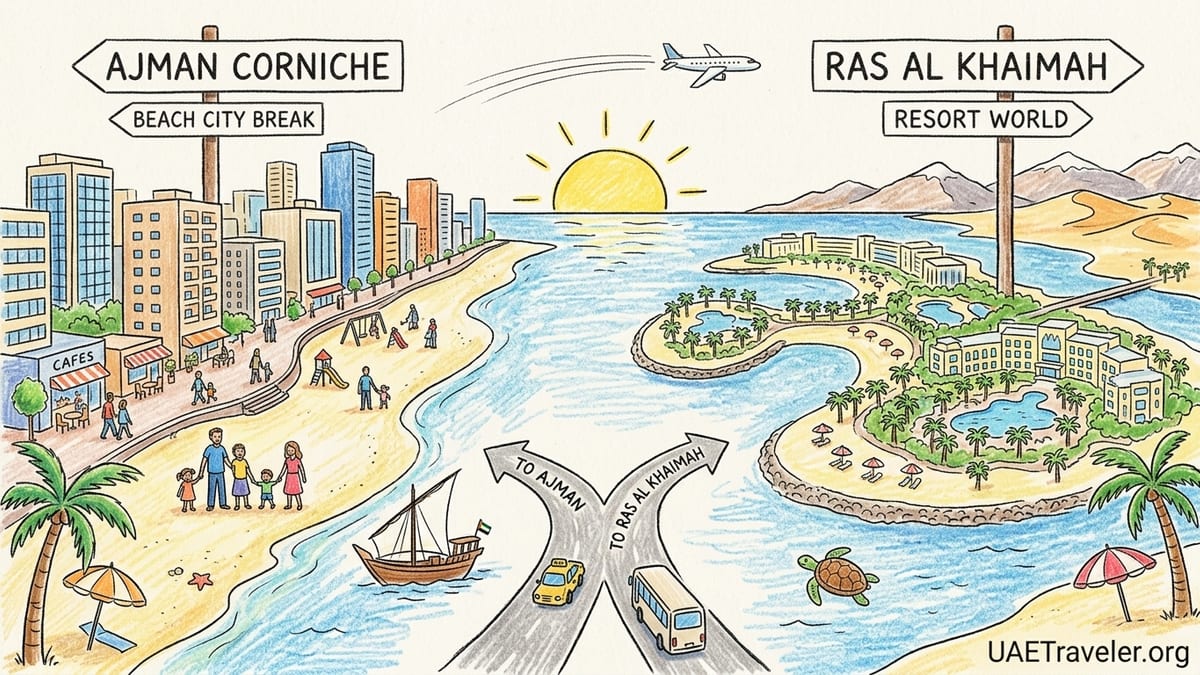
Why I Chose Ajman and Ras Al Khaimah Over Dubai
Dubai’s beachfront resorts are deservedly famous, but once I started pricing a week in popular areas such as JBR and Palm Jumeirah, total costs escalated fast. For the same dates in late winter, entry-level Dubai family rooms at large beachfront properties were coming in several hundred dirhams per night higher than mid-range options in Ajman and Ras Al Khaimah, before even counting food and activities. I wanted warm sea, good pools and space for the kids, but did not need a big-city skyline view every day.
Ajman appealed because it sits just up the coast from Sharjah and Dubai, sharing the same stretch of Arabian Gulf shoreline, but with markedly lower hotel prices and a more local, low-rise Corniche. Official tourism and transport sources note that Ajman has no airport of its own and is effectively part of the greater Sharjah–Dubai urban area, which keeps transfer costs down if you are landing at Dubai International Airport.([en.wikipedia.org](https://en.wikipedia.org/wiki/Ajman?utm_source=openai))
Ras Al Khaimah, by contrast, is a separate northern emirate framed by desert and mountains, marketed heavily as a quieter, more natural alternative to Dubai. It has around 64 kilometres of coastline, a growing list of resorts, and a reputation in family travel media as offering all-inclusive beachfront stays roughly 20 to 30 percent cheaper than comparable Dubai properties during the same season, depending on promotions and exact category.([visitrasalkhaimah.com](https://visitrasalkhaimah.com/blog/ras-al-khaimah-all-inclusive/?utm_source=openai))
For this comparison, I deliberately picked a four-star beachfront hotel on Ajman Corniche and a similarly priced four-star resort on Ras Al Khaimah’s Al Marjan Island. Both offered family-friendly pools and kids’ facilities. My aim was not to review a single brand, but to compare the two environments at like-for-like price points, using real transfer times, on-the-ground costs and which inclusions we actually used as a family of four.
Staying on Ajman Corniche: Beachfront City Break
Ajman Corniche is a long, straight waterfront lined with low- and mid-rise apartment blocks, a scattering of cafés, playgrounds and several beachfront hotels. It feels very much part of a lived-in city rather than a purpose-built resort strip. On weekend evenings, Emirati and expatriate families stroll the promenade, kiosks sell karak tea and sweet corn, and the traffic can be busy but rarely overwhelming for pedestrians, thanks to broad pavements and frequent crossings.
The hotel I chose sat directly on the Corniche with its own fenced-off beach section and a family pool behind the sand. The private strip meant loungers and umbrellas were reserved for guests, but the sea itself is public, as across the UAE. Compared with Dubai’s big-name beaches, Ajman’s shoreline felt narrower and closer to the main road, but the sand was soft and light, with a gentle slope into the water. There were some shells and occasional small bits of litter higher up the beach, yet the swimming area itself was clean, with hotel staff raking the sand each morning.
Sea conditions during our March stay were inviting: the Arabian Gulf here usually sits somewhere in the low to mid-20s Celsius in late winter, climbing above 30 degrees in peak summer. Lifeguards monitored the beach during daylight, and we had only mild chop even on breezier afternoons. Visibility in the water was slightly cloudy compared with the east coast, but the kids happily paddled and used inflatable toys close to shore. For longer swims I gravitated to the hotel pool, which felt cooler and clearer.
Inside, our room was a standard family configuration: one king bed and a sofa bed, plus the option of a rollaway. It was not huge, but workable for a few nights, with a partial sea view above the Corniche traffic. Parking was free in an underground garage, and I noticed several UAE-plated SUVs lined up, a sign that Ajman still attracts many domestic weekender families from nearby emirates.
Ajman’s Restaurants, Walking Options and Getting into Dubai
One of Ajman’s strengths is that you are not completely captive to your hotel for food. Step out onto the Corniche and you find shawarma stands, juice bars, simple seafood grills and a few branded coffee shops within a five to ten minute walk. Prices are notably lower than along Dubai’s tourist beachfronts. A casual sit-down family meal of grilled fish, rice and soft drinks set us back significantly less than an equivalent dinner at a resort restaurant later in the trip, in some cases under half the price for four people, depending on dishes ordered.
The downside is that Ajman’s Corniche is still a cityfront, not a self-contained resort. Pedestrian infrastructure is decent along the waterfront itself, but once you go a few blocks inland, shade and pavements become patchier. Outside peak winter, heat and humidity can make daytime exploring tiring with small children. In the evenings, however, we enjoyed easy strolls up and down the seafront, stopping at playgrounds and watching locals fish from the sea wall.
For trips to Dubai and Sharjah, Ajman’s geography is hard to beat. Dubai International Airport sits roughly 25 to 35 kilometres away, and Dubai taxi guides estimate that metered rides from Ajman into central Dubai, depending on neighborhood, usually run from about 70 to 130 dirhams one way in 2026, with journey times of 35 to 90 minutes depending on traffic.([gulfchauffeur.com](https://gulfchauffeur.com/guides/uae-taxi-fare-guide?utm_source=openai)) Ride-hailing apps and inter-emirate buses add options, though bus routes are less direct for first-time visitors than simply using taxis.
From our Corniche base, we rode a taxi to Dubai Festival City for a shopping and dining evening, and another to the historic Al Fahidi district on the creek. The convenience was excellent: journeys of under an hour each way, predictable costs and drop-offs exactly where we wanted. The balance felt ideal for families who want a beach base but still plan two or three city excursions in a week.
Ras Al Khaimah’s Al Marjan Island: Self-Contained Family Resort World
After Ajman, we drove about one hour and thirty minutes north to Ras Al Khaimah’s Al Marjan Island, a man-made archipelago shaped like four coral branches projecting into the Arabian Gulf. The island hosts many of the emirate’s flagship beachfront resorts and is connected to the mainland by highway, about 75 to 100 kilometres from Dubai depending on your starting point. Official tourism information cites a typical Dubai to Ras Al Khaimah driving time of around 1.5 to 2 hours, which echoed our experience from Dubai Airport earlier in the trip.([visitrasalkhaimah.com](https://visitrasalkhaimah.com/plan-your-trip/travel-information/?utm_source=openai))
Al Marjan immediately feels more resort-focused than Ajman Corniche. Hotels here sit on wider sweeps of engineered beach, with landscaped promenades, low traffic away from the main entry road and almost everything designed around holidaymakers. From our balcony, we saw other large resorts spaced along the shore, each with multiple pools, water slides, beach bars and kids’ areas.
The resort we selected offered a classic family package: large pool complex, a shallow splash area, a supervised kids’ club, evening entertainment and an advertised all-inclusive plan. It sat in a similar nightly price bracket to the Ajman hotel for our dates when booked in advance in shoulder season, but crucially, here the rate could bundle three meals a day, snacks and many drinks, whereas Ajman’s deal had only included breakfast.
Our room in Ras Al Khaimah was more spacious than the Ajman equivalent, with a dedicated seating corner, a balcony and a proper twin bedding setup for the children. Storage and floor space made a noticeable difference over a seven-night stay, especially as we accumulated beach toys, inflatables and shopping. The trade-off was that the view was more resort-focused, with pools and neighboring hotels in sight rather than a city seafront atmosphere.
Understanding All-Inclusive vs Half-Board in Ras Al Khaimah
Ras Al Khaimah has positioned itself as one of the UAE’s main hubs for all-inclusive beach holidays, and many of its major resorts on Al Marjan Island and nearby Al Hamra advertise versions of all-inclusive or full-board. The reality on the ground is more nuanced. Some properties offer true all-inclusive packages where three buffet meals, many snacks and a defined list of alcoholic and non-alcoholic drinks are available throughout much of the day, often between midday and midnight. Others use terms like full-board or half-board, which generally cover breakfast plus either one or two additional meals, but exclude most drinks apart from basic water or juices at breakfast, and may not include à la carte venues.([visitrasalkhaimah.com](https://visitrasalkhaimah.com/blog/ras-al-khaimah-all-inclusive/?utm_source=openai))
At our Ras Al Khaimah resort, the advertised all-inclusive package turned out to be more of a standard all-inclusive with some limitations: buffet breakfast, lunch and dinner at the main restaurant, soft drinks, house beers and wines within certain hours, selected cocktails, and afternoon snacks at a pool bar. Specialty restaurants on site either carried surcharges per person or worked on a dine-around credit system that did not fully cover the higher-priced menus. Premium imported beverages were firmly extra.
This is where it pays for families to read the detailed package sheets provided on resort websites or booking confirmations. For example, some Al Marjan Island properties clearly specify that all-inclusive drinks run from midday to midnight and list exactly which bars participate. If you are expecting to sit on your balcony with room-service drinks late at night, or to visit a rooftop lounge, that may not be covered. Likewise, a half-board upgrade at a similar Ras Al Khaimah resort might look cheaper on paper, but once you cost in drinks by the pool, ice creams and à la carte dinners, your total spend can edge close to an all-inclusive package across a full week.
In Ajman, by contrast, my beachfront hotel offered breakfast-only and half-board options, but no all-inclusive tier. That reflected the city setting: with plenty of independent restaurants nearby, most guests seemed happy to eat out along the Corniche or in Sharjah and Dubai. This made Ajman potentially better for travelers who value culinary variety, while Ras Al Khaimah felt geared toward families who prefer to settle into one resort and not think about individual meal bills.
Beach, Pools and Everyday Family Life in Each Destination
Comparing beach quality between Ajman Corniche and Al Marjan Island is a matter of expectations. Ajman’s beach felt authentic and urban, a natural-ish strip softened and maintained by each hotel. Traffic and city sounds were never far away, and the narrowness of the sand at high tide meant loungers sat close to one another. However, the water was warm, waves were modest, and for short daily swims and sandcastle sessions it was absolutely adequate.
On Al Marjan Island, the engineered beaches were wider and deeper, with more distance between loungers and the waterline. Sand had a more uniform, pale golden look and was very clean underfoot. Because the island curves into the Gulf, parts of the shoreline are sheltered, creating calm, pool-like swimming conditions that worked well for younger children. The flip side was that the water felt slightly less wild than a natural oceanfront. For perspective, both coasts face the Arabian Gulf, which differs from the more dramatic wave and reef patterns you might find on the UAE’s eastern coast near Fujairah, where resorts look onto the Gulf of Oman.
Pool-wise, Ras Al Khaimah clearly came out ahead. Our resort offered several pools: a large main lagoon, a quieter adults-oriented area and a colourful kids’ zone with small slides and sprinklers. Sun loungers did fill up quickly on weekend mornings, but midweek there was plenty of space. The kids’ club ran scheduled activities such as treasure hunts and craft sessions, and a small splash park near the beach kept younger children occupied for long stretches.
In Ajman, our hotel had a single main pool and a smaller paddling section for toddlers. It was perfectly fine for a couple of hours each day but did not have the same degree of variety. There was no structured kids’ club programme, only an unsupervised indoor playroom. Over a longer stay, I can imagine children getting restless compared with the array of slides and organised games typical of Al Marjan Island or Al Hamra Village resorts.
Breakfast quality was comparable at both properties, with extensive buffets of Middle Eastern and international dishes. In Ras Al Khaimah, the spread was slightly more elaborate, reflecting its positioning as a longer-stay family resort: more live cooking stations, a wider bakery selection and dedicated kids’ counters with cereals and mini pancakes. In daily life, we used the Ras Al Khaimah resort’s on-site restaurants for nearly every meal, whereas in Ajman we mostly used breakfast and then ate our main meals outside the hotel along the Corniche or in nearby malls.
Transfers, Taxis and the Real Cost of a Family Beach Holiday
Getting from Dubai Airport to each destination set the tone for how often we used taxis during the stay. Ajman’s proximity meant that a metered taxi from Dubai Airport to the Corniche cost in the lower hundreds of dirhams, and ride time, outside rush hours, hovered around 40 minutes. For a three-night stay, with two round-trip outings into Dubai and a couple of short local rides, our total ground transport cost from Ajman remained manageable.
Ras Al Khaimah required a more substantial initial transfer. Informal reports and transport guides suggest that direct taxis from Dubai Airport to Al Marjan Island or Al Hamra typically range somewhere around 250 to 350 dirhams one way for a standard taxi, depending on time of day and traffic, although higher-end private transfers can cost more.([rome2rio.com](https://www.rome2rio.com/s/Ras-Al-Khaimah/Dubai-Airport-DXB?utm_source=openai)) The drive takes roughly 60 to 90 minutes, longer in peak traffic hours heading out of Dubai. This made Ras Al Khaimah more expensive to reach, though still realistic for a week-long stay when spread across several days.
Once on Al Marjan Island, taxi usage dropped. The island is not designed for constant off-site dining or shopping. There are few independent restaurants within easy walking distance outside the hotels themselves, and comments from residents and repeat visitors reinforce that life there is much easier with a private car if you want to explore frequently.([reddit.com](https://www.reddit.com/r/RasAlKhaimah/comments/1u0yyjh/is_al_murjan_island_a_good_place_to_live/?utm_source=openai)) During our stay, we left the resort area only twice: once to visit a mall on the mainland and once for a dune-side excursion. Each round-trip taxi added a noticeable amount to the holiday budget.
To compare total costs honestly, I looked at typical 2026 shoulder-season pricing for a family of four sharing one room, using similar board basis in each destination. For a three-night stay on Ajman Corniche with breakfast only, mid-range beachfront hotels were quoting approximate totals around the mid-1000s of dirhams including taxes and service charges, with meals taken mostly outside the hotel adding a few hundred dirhams depending on dining choices. For Ras Al Khaimah, a three-night all-inclusive stay at a comparable four-star Al Marjan Island resort was coming in higher in headline price, but when including three meals a day and drinks, the gap narrowed significantly.
Scaled to a seven-night stay, Ajman remained cheaper on accommodation alone, particularly if you are content with a breakfast-only plan and intend to eat at local restaurants. However, once we added realistic spending on lunches, dinners, soft drinks and snacks, the Ras Al Khaimah all-inclusive package began to look more predictable and sometimes better value, especially for families with hungry teenagers who gravitate to buffets and poolside snacks throughout the day.
Weekend Crowds, Noise and The Reality Behind the Photos
Another noticeable difference lay in how each destination felt on UAE weekends, typically Friday evening to Sunday. In Ajman, the Corniche became busier with local families, parked cars lining the road and music from passing vehicles. Our hotel’s beach area never felt overcrowded, but the ambiance was decidedly livelier, especially into the late evening. If your room faces the Corniche, expect some street noise and the glow of city lights.
On Al Marjan Island, weekends meant higher occupancy, more children in the pools and buffet queues at peak breakfast times. Evening entertainment by the pool or on beach stages, including live bands and DJ sets, ran until around 10 or 11 pm at our resort. Rooms facing the central pool could hear the shows quite clearly, so light sleepers might prefer garden or outer-facing rooms. The upside was a festival-like holiday atmosphere, with foam parties, kids’ discos and outdoor movie screenings laid on by the entertainment team.
In terms of development, Ajman’s Corniche is already quite built up, with a mix of older and newer buildings. Some lots remain under construction or renovation, which can affect certain sea views, but you never feel in the middle of a building site. In Ras Al Khaimah, parts of Al Marjan Island and nearby coastal corridors are still evolving. Cranes on future hotel plots and roadworks were visible from sections of the beach and highway, a reminder that the area is a work in progress as new resorts and, in the longer term, large integrated projects continue to rise.([rakparty.com](https://rakparty.com/news/al-marjan-island-complete-guide-to-raks-waterfront-destination?utm_source=openai))
Promotional photos often show both Ajman and Al Marjan beaches at their most tranquil and empty. Our experience was more nuanced. Ajman’s sand can look almost white in marketing material, but in person it is a natural beige, occasionally dotted with shells and a few cigarette ends if you stroll beyond hotel zones. Al Marjan’s all-inclusive resorts tend to photograph long, empty loungers and perfectly flat seas. During school holidays and long weekends, reality is a backdrop of inflatable toys, excited children, and towels hung as markers on the best spots from early morning. None of this is inherently negative, but it is worth aligning expectations if you imagine a near-private beach environment.
What I Expected vs What I Found: The Verdict
Going in, I expected Ajman to serve as a handy, good-value base for exploring Dubai, with a serviceable city beach as a bonus, and Ras Al Khaimah to deliver the classic resort bubble where we would largely stay put. That broadly matched reality, though some details surprised me. Ajman felt more characterful and local than I anticipated, while Ras Al Khaimah’s resort machine was even more polished and self-contained than brochures suggested.
In Ajman, I booked a mid-range Corniche hotel with breakfast, thinking we would spend most of our budget in Dubai on sightseeing and dining. In practice, we ended up enjoying several evenings along the Ajman waterfront itself, eating grilled fish at simple local restaurants and people-watching. The freedom to leave the hotel and find cheaper meals within a few minutes’ walk felt like a genuine advantage, particularly when the kids were tired and we did not want a formal, drawn-out dinner.
In Ras Al Khaimah, I deliberately chose a similarly priced four-star resort on Al Marjan Island with an all-inclusive plan. The beach and pools were unquestionably better for extended family time. The children spent hours in the splash park and kids’ club, leaving adults stretches of relaxation by the quieter pool. Food was plentiful, and while buffet repetition set in by day five, overall quality and variety edged out the Ajman hotel’s breakfast offerings. Service levels were also slightly higher, helped by a larger staff-to-guest ratio typical of destination resorts.
Disappointments came mostly from minor mismatches between marketing language and inclusions. At the Ras Al Khaimah resort, a couple of enticing specialty restaurants required supplements that were not immediately obvious at booking stage. Some premium coffees and fresh juices were outside the all-inclusive drinks list. In Ajman, the main letdown was room size and city noise compared with the more tranquil resort setting further north. None of these issues were trip-ruining, but they matter when calculating the “real family cost” of a holiday.
If I had to choose which resort and destination I would return to for a pure beach holiday without major city sightseeing, Ras Al Khaimah would win. The combination of wider, calmer beaches, multiple pools, kids’ activities and an all-inclusive structure created a more relaxed rhythm for a full week. For a shorter break focused on combining some Dubai days with a more affordable beachfront base, however, I would pick Ajman again for its convenient location and local dining scene.
The Takeaway: Who Each Destination Suits Best
For families with small children, Ras Al Khaimah’s Al Marjan Island or Al Hamra resorts are hard to beat. The shallow, sheltered beaches, extensive pool complexes and structured kids’ clubs mean parents are not constantly improvising entertainment. Being able to walk from room to pool to lunch without organizing taxis or reading menus with toddlers in tow is a genuine quality-of-life benefit. All-inclusive plans also help avoid surprises when your child decides they are hungry again ten minutes after finishing a meal.
For families with teenagers, the equation becomes more balanced. Teenagers might appreciate the independence of wandering Ajman’s Corniche, visiting nearby malls in Sharjah or Dubai, and having a wider variety of food and coffee options beyond the resort buffet. On the other hand, resorts in Ras Al Khaimah often provide beach volleyball, water sports, gym access and evening shows that can keep older kids engaged without daily outings.
For couples, the choice hinges on whether you want nightlife and urban experiences or quiet sea views. Ajman makes it easy to dip into Dubai’s restaurants, rooftop venues and cultural sites, then retreat to a calmer, cheaper hotel by the sea. Ras Al Khaimah is better suited to those who are content to slow down, read by the pool and perhaps take the occasional excursion into the desert or mountains rather than chasing city lights every night.
For value-conscious travelers, Ajman generally comes out slightly cheaper, especially on shorter trips and for those comfortable with budgeting meals individually at local eateries. Ras Al Khaimah’s all-inclusive deals can be excellent value when you factor in everything they include, but you should still read the fine print on drinks and specialty dining. Travelers who prioritize an all-inclusive beach holiday over city sightseeing will likely find that paying a bit more upfront for a Ras Al Khaimah package yields better overall relaxation and a clearer sense of total cost when they settle the bill.
FAQ
Q1: Is Ajman or Ras Al Khaimah closer to Dubai Airport for a beach holiday?
Ajman is significantly closer, with typical taxi journeys from Dubai Airport taking around 40 minutes outside peak traffic, compared with roughly 60 to 90 minutes to reach resorts on Ras Al Khaimah’s Al Marjan Island or Al Hamra coastline.
Q2: Which has better beaches for young children, Ajman Corniche or Al Marjan Island?
Al Marjan Island generally offers wider, cleaner and more sheltered beaches, with gently sloping entries and calm water that works especially well for younger children, whereas Ajman’s Corniche beach is narrower and more urban but still suitable for paddling and short swims.
Q3: Are all Ras Al Khaimah resorts truly all-inclusive?
No. Some Ras Al Khaimah resorts provide full all-inclusive packages with meals, snacks and many drinks included, while others sell half-board or full-board plans that cover only meals and exclude most drinks and specialty restaurants, so it is important to read each hotel’s package details.
Q4: Can I easily visit Dubai from Ras Al Khaimah for a day trip?
Yes, it is possible to visit Dubai from Ras Al Khaimah by taxi or private transfer, but journeys usually take 1.5 to 2 hours each way and can be relatively expensive, so most families limit such trips to one or two days during a week-long stay.
Q5: Is Ajman safe and walkable along the Corniche with children?
Ajman’s Corniche has wide pavements, playgrounds and a family atmosphere in the evenings, making it broadly comfortable for walking with children, though you still need to be careful when crossing busy roads and mindful of heat during the daytime, especially outside winter months.
Q6: How do real costs compare between a breakfast-only Ajman stay and a Ras Al Khaimah all-inclusive?
Accommodation in Ajman typically costs less per night, but once you add restaurant meals, drinks and snacks, a Ras Al Khaimah all-inclusive package can come close in total price, and sometimes works out better value over a longer seven-night stay, particularly for families who eat and drink mostly within the resort.
Q7: Are there many restaurants outside the resorts on Al Marjan Island?
Al Marjan Island has some independent cafés and restaurants, but far fewer than a cityfront like Ajman, so most guests dine mainly within their resort unless they are willing to take taxis to malls or dining areas on the mainland.
Q8: How do the pools and kids’ facilities compare between Ajman and Ras Al Khaimah?
Ras Al Khaimah’s major beach resorts typically feature multiple pools, splash parks and structured kids’ clubs, offering more variety than the single or limited pools and simpler playrooms that are common at mid-range Ajman Corniche hotels.
Q9: Do Ajman and Ras Al Khaimah beaches look like those on the UAE’s east coast near Fujairah?
No. Ajman and Ras Al Khaimah both face the calmer Arabian Gulf, with relatively gentle waves and sandy shallows, while Fujairah’s east coast fronts the Gulf of Oman, which tends to have stronger wave action, different currents and, in some areas, rockier shorelines and coral suitable for snorkeling and diving.
Q10: If I want a mostly beach-focused holiday and do not plan much city sightseeing, which should I choose?
For a primarily beach-focused, low-planning holiday, a Ras Al Khaimah resort with a well-defined all-inclusive package is usually the better choice, as it offers more extensive beachfront facilities, pools and on-site activities, letting you settle in with fewer daily decisions and additional costs than a more urban Ajman Corniche stay.