


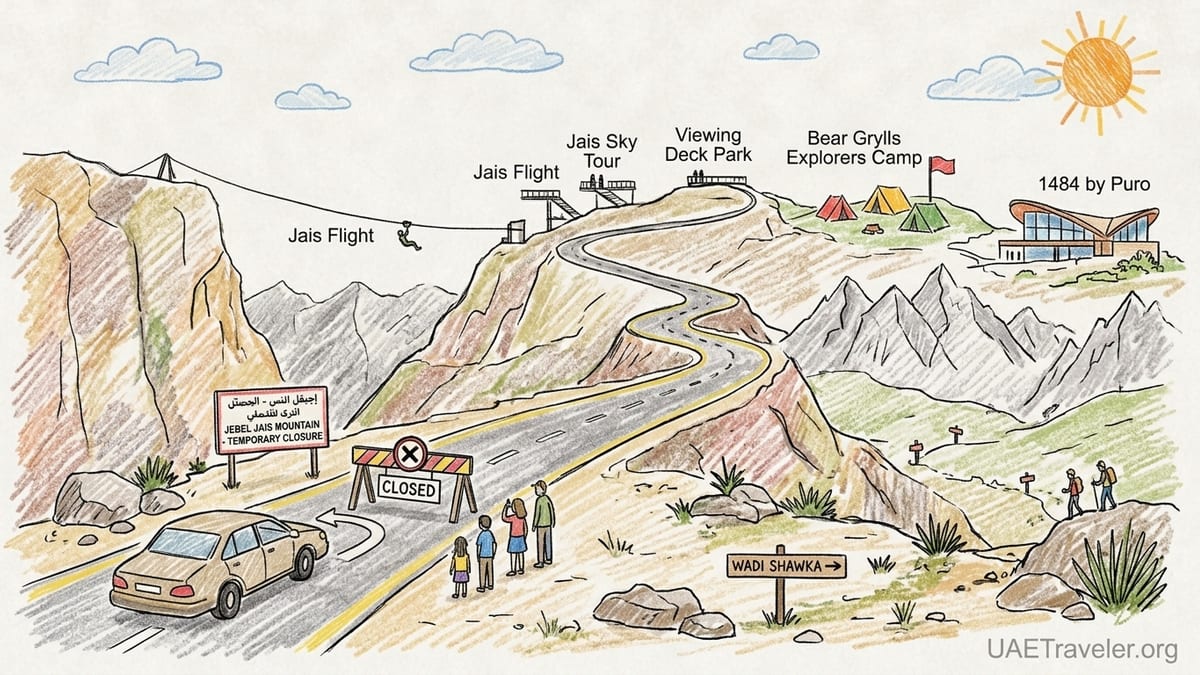
Jebel Jais, the UAE’s highest peak in Ras Al Khaimah, has become a flagship destination for mountain adventure in the northern Emirates. Yet as of late October 2026, access to much of the upper mountain remains disrupted by ongoing road repairs and safety work, affecting headline attractions such as the Jais Flight zipline, Jais Sky Tour, Jais Viewing Deck Park, Bear Grylls Explorers Camp and the 1484 by Puro restaurant. This guide explains the current situation, how to check the latest status before you travel, and how to plan both for a future visit once the mountain fully reopens and for an alternative adventure while closures remain in place.
Current Access and Closure Status in Late 2026
In December 2025 intense rainfall triggered rockfalls and damage along the road to Jebel Jais. Authorities and the operator responded by suspending all mountain attractions for inspections and engineering work, including the Jais Flight zipline, Jais Sky Tour, Jais Viewing Deck Park, Bear Grylls Explorers Camp, Jais Sledder and the 1484 by Puro restaurant. Some activities briefly returned during early 2026, but an official bulletin released in October 2026 confirmed that key sites at the top of the mountain were once again closed while road repairs and further safety measures continued, with no firm reopening date announced.
On the ground, this has translated into physical roadblocks along the Jebel Jais mountain road. Drivers in mid October 2026 have reported being turned around within the first kilometre of the ascent, rather than being able to reach the higher car parks or the Adventure Park reception. Others have noted that previous arrangements, where access was allowed up to Bear Grylls Explorers Camp for campers and day visitors while upper sections remained closed, no longer reliably apply. In short, conditions are fluid, and it is not safe to assume that you can simply drive to the summit or walk into any attraction without prior confirmation.
For visitors planning a trip in late 2026, the most responsible approach is to treat Jebel Jais as effectively off limits for major adventure activities until the operator clearly states otherwise. Even if some stretches of road open intermittently, there is ongoing heavy engineering work, unstable slopes in places and a risk of renewed rockfall during rare but intense rainstorms. This is not the moment to improvise a family picnic or attempt to reach unofficial trailheads in a private vehicle.
Because the repair schedule has not been published in detail and is subject to change, there is currently no reliable way to predict when Jais Flight, Jais Sky Tour, Bear Grylls Explorers Camp, the Viewing Deck Park and 1484 by Puro will resume normal operations. Any guide, blog or ticketing site that suggests precise opening dates beyond what the official operator confirms should be treated with caution. Until a clear reopening announcement is made, you should avoid prepaying for zipline tickets or planning your itinerary around Jebel Jais alone.
How to Check Live Status Before You Commit
Because there is no single official road-status hotline for Jebel Jais, confirming access requires a combination of checks. The most direct source is the operator’s own channels. Before you set out, review the latest updates from the Jebel Jais adventure park operator and Ras Al Khaimah’s tourism authorities, paying attention to any notices about road closures, attraction shutdowns or restricted entry to vehicles without confirmed bookings. These notices tend to be issued in English and Arabic and may be updated more quickly than third party travel sites.
If you already hold a hotel booking in Ras Al Khaimah or on nearby Al Marjan Island, use the concierge or front desk as an additional layer of verification. Major resorts such as beach hotels in Al Hamra or desert properties near Al Wadi often receive operational updates from local authorities and tour partners. Ask specifically whether guests are currently able to reach Jebel Jais, how far private cars are allowed to drive, and whether any tour operators are actively running trips up the mountain this week.
Third party ticketing sites, tour companies and social media posts can be helpful but should be treated as secondary sources rather than definitive proof. For example, a booking portal that still lists Jais Flight departures at fixed times with prices from around 325 to 400 dirhams does not guarantee the zipline is operating on your chosen date, especially while the mountain road is under repair. Use these listings as a way to understand the usual product and price range, but call or email the operator through official contact details to confirm whether the date you are considering is actually open before you book.
Finally, consider the time gap between any information you find and your planned visit. A detailed report published in September 2026 about temporary shutdowns may no longer be accurate by December, and a positive review from early 2026 does not override an October 2026 closure notice. When in doubt, assume restrictions remain in place unless you receive a clear, recent confirmation from the operator or tourism authority.
Understanding Jais Flight and Jais Sky Tour (For When They Reopen)
Once road repairs are complete and operations resume, Jebel Jais will again revolve around its two headline zipline products. Jais Flight is designed as the high adrenaline centrepiece. It is a single, high speed aerial crossing of roughly 2.83 kilometres that runs along the flank of the mountain. Riders are usually clipped into a harness in a prone “superman” position, face forward with arms tucked in, and can reach speeds that have historically approached 150 to 160 kilometres per hour in the steepest section, depending on weight and wind conditions. The experience is short but intense, often lasting around two to three minutes of flight after a detailed safety briefing and harnessing sequence.
Jais Sky Tour is a different style of experience. Instead of one long run, it is a self guided aerial course that typically strings six shorter ziplines together over roughly five kilometres of cable, connecting multiple cliff edge platforms and including a walk across a suspended sky bridge several hundred metres above the ground. Speeds on these shorter lines are more moderate, often around 60 kilometres per hour, and the duration of the full tour is around two hours, including time at each platform and the bridge crossing. It suits visitors who prefer a combination of thrills and time to absorb the mountain scenery rather than a single, ultra fast run.
Because of these differences, Jais Flight and Jais Sky Tour appeal to slightly different audiences. A visitor flying in from Europe for a weekend might choose Jais Flight to tick “world famous zipline” off their list, while a group of friends who enjoy via ferratas and canopy tours elsewhere in the world may prefer the multi platform Sky Tour for its variety and the social aspect of moving together between platforms. Families with teenagers often look to the Sky Tour as a shared experience, while more committed adventure travellers sometimes book both products on separate days when schedules and budgets allow.
In practice, mountain conditions and operational priorities also affect how each product runs. High winds, low cloud or rain can close either or both experiences at short notice. The operator has historically maintained strict cutoffs for weight, height and weather to keep riders within the design envelope of the cables and brakes. When planning a future trip after reopening, expect the possibility of last minute schedule changes and build flexibility into your Ras Al Khaimah stay, for example by staying two or three nights instead of a single night.
Tickets, Prices and Safety Rules (Historical Until Operations Resume)
Before the latest closures, advertised prices for Jais Flight and Jais Sky Tour typically sat in the mid hundreds of dirhams. Publicly available material from late 2025 and early 2026 frequently cited starting prices for Jais Flight in the region of 325 to 400 dirhams per person, depending on season and promotions, while Jais Sky Tour often appeared around 299 to 399 dirhams. These figures should be treated as historical benchmarks only. The operator has not yet published an official 2026 to 2027 price list synchronised with the completion of current road works, and prices may change when operations restart.
What is much less likely to change are the core safety rules. In recent seasons Jais Flight’s weight window has typically run from roughly 40 to 120 kilograms, while Jais Sky Tour usually had a slightly narrower range, around 40 to 100 kilograms, with minimum height requirements around 122 to 130 centimetres. Children under 18 could participate when they met these limits, but needed a parent or legal guardian present at check in to sign a waiver, and in some cases to ride the lines in a paired or supervised configuration. Participants were required to bring valid identification, such as a passport or Emirates ID, for age and identity verification.
Dress codes have consistently emphasised practicality and safety. That means athletic clothing that allows a full range of movement, and closed toe shoes such as trainers or hiking shoes. Skirts, dresses, sandals, flip flops, high heels and loose footwear have been prohibited, partly because they can slip off in midair and partly because they do not work well with the harness systems and access stairs. Guests are advised to bring a light jacket or extra layer in the cooler months, when temperatures at the top of Jebel Jais can run around ten degrees lower than along the coast, especially in the evening.
Check in logistics are another constant. Historically, both Jais Flight and Jais Sky Tour have required guests to arrive at the Jais Adventure Park welcome centre at least 30 minutes before the booked slot for weighing, harness fitting and safety briefings, and late arrivals were typically treated as no-shows with no refund. From the welcome centre, guests have usually been transported by shuttle vehicle higher up the mountain to the launch platform areas rather than hiking along the road themselves. Cancellation terms for standard tickets through the operator or major resellers have usually allowed free cancellation up to a defined cut off, commonly 24 to 48 hours before the scheduled time, but exact rules vary by seller and product, so you should recheck the conditions that apply to your specific booking once sales reopen.
Hiking, Viewpoints, Camping and Mountain Weather
Beyond the ziplines, Jebel Jais is valued for its rugged Hajar mountain landscape, cooler temperatures and extensive hiking potential. Ras Al Khaimah tourism authorities have been developing an official trail network in recent years, with mapped routes across the upper slopes and connecting wadis. When fully open, these routes range from short viewpoint walks starting near road parking bays through to longer day hikes along ridgelines or into high plateaus. Signage and waymarking have improved compared to a decade ago, but navigation in rocky terrain still demands attention, and hikers should not rely solely on painted arrows or cairns.
Camping is another traditional draw. Before the recent wave of safety closures, visitors often drove up from Dubai or Abu Dhabi on winter weekends, setting up tents on gravel lay-bys or at informal clearings near the road. Following heavy rain and landslides, however, authorities began enforcing stricter rules around where camping is permitted. Some roadside pullouts were blocked to prevent overcrowding and unsafe barbecues beside traffic. Until a new set of rules is clearly communicated with reopening, prospective campers should plan to either use managed options like Bear Grylls Explorers Camp, when it comes back online, or book with licensed operators who can confirm which sites are currently allowed.
Weather is one of the most important factors for any Jebel Jais plan. While the mountains provide welcome relief from coastal heat, they also concentrate rare but powerful storms. Rock strata and loose scree above the road can release without warning when saturated, sending rocks onto both tarmac and hiking tracks. Dry riverbeds, known as wadis, can transform into torrents in a short time if rain falls higher in the catchment, even when the sky appears clear where you are standing. Visiting in the cooler months from November to March offers more pleasant temperatures, but you should keep a close eye on official weather forecasts, avoid hiking in narrow gorges if rain is possible, and be prepared to cancel or cut short plans if conditions deteriorate.
The drive itself deserves respect. The Jebel Jais road is a paved, snaking route with numerous hairpins and long drops beyond the guardrails. In good weather on a quiet weekday the ascent is straightforward for experienced drivers, but on busy winter weekends traffic density, distracted motorists and sudden fog near the top can multiply risks. Brakes can overheat on the way down if drivers ride the pedal instead of using low gears, and rock fragments sometimes litter the shoulders after a storm. When the mountain reopens, plan to drive up and down in daylight, leave generous gaps between vehicles, and pull off only at designated viewpoints rather than on blind bends.
Alternatives While Jebel Jais Remains Disrupted
The temporary loss of full access to Jebel Jais does not mean Ras Al Khaimah has no mountain or desert adventure left to offer. Wadi Shawka, in the southern part of the emirate, provides one of the best accessible introductions to the Hajar mountains while the high road is under repair. The area around Shawka Dam combines gravel tracks, rocky staircases and gentle ridge lines with seasonal pools after winter rains. Numerous local guides and hiking groups offer routes ranging from three to ten kilometres, including family friendly loops that can be completed in two to three hours and slightly more strenuous climbs to higher viewpoints.
Closer to Jebel Jais itself, lower elevation wadis such as Wadi Shah and Wadi Naqab remain important hiking hubs. These valleys carve deep into the mountainsides and host abandoned villages, terraced fields and seasonal watercourses. They are more committing environments than Wadi Shawka, with steeper gradients and a history of rescue callouts when inexperienced hikers underestimate distances, summer heat or navigation challenges. Unless you are confident in desert mountain travel, it is wise to join a reputable hiking company or local guiding service for these routes, at least on your first visit.
On the coast, Al Hamra and Al Marjan Island provide a contrasting base of beaches, marinas and resort facilities approximately 30 to 45 minutes’ drive from the mountains. While you wait for Jebel Jais to reopen, you can construct a mixed itinerary that combines a morning hike at Wadi Shawka with an afternoon by the pool, a sea kayak session in the mangroves near Al Rams, or a visit to cultural attractions such as Dhayah Fort and the old pearling settlement at Al Jazirah Al Hamra. Desert oriented experiences in the inland Al Wadi area, including fat bike rides, horse or camel excursions and guided stargazing evenings, round out the offer.
For visitors intent on a zipline fix specifically, consider urban options in Dubai or adventure parks in other Emirates as interim experiences, even though they lack Jebel Jais’s altitude and mountain setting. While this guide focuses on Ras Al Khaimah, using a city based zipline or a lower elevation canopy park as a warm up can still add variety to your UAE itinerary while you monitor news of Jebel Jais’s full return.
Getting There: Rental Cars, Private Drivers and Organised Tours
In normal times, the majority of visitors approach Jebel Jais from Dubai or Abu Dhabi by rental car. The drive from Dubai to Ras Al Khaimah city typically takes around one and a half hours on good highways, followed by roughly 30 to 45 minutes up the mountain road when it is fully open. Hiring a car at Dubai International Airport and driving yourself offers maximum flexibility and is often the most economical option for couples or families who plan to explore multiple sites like Wadi Shawka, beach resorts and city malls in a single trip. International brands and regional agencies operate side by side, and compact crossovers are popular for the extra ground clearance and luggage space.
However, self driving into mountain terrain is not for everyone. Visitors who are not comfortable with sustained descents, sharp bends or unfamiliar road etiquette sometimes prefer to book a private driver for the Jebel Jais section, either through their hotel or through a dedicated transfer company in Ras Al Khaimah. This option generally costs more than a small rental car but can be worthwhile for multigenerational groups, those travelling with young children, or travellers who arrive jet lagged and would rather not focus on navigation. When Jebel Jais reopens, expect to see packages that bundle hotel pickup in Dubai or Ras Al Khaimah, transport to the adventure park reception, and time to complete Jais Flight, Jais Sky Tour or both.
Licensed guided tours occupy a middle ground. Several adventure companies and tour operators are based in the UAE and specialise in mountain activities, from half day hikes to combined sightseeing and zipline packages. Once Jebel Jais is back online, these operators are likely to resume products that include transport from Dubai or Ras Al Khaimah, guidance on suitable clothing and equipment, and assistance at check in. Joining a guided tour removes the burden of driving and managing timings yourself, and can be particularly helpful on busy winter weekends when parking is scarce at popular coastal and mountain spots.
Whichever transport mode you choose, build redundancy into your schedule. In the past, travellers have occasionally missed their Jais Flight departure slot because a long weekend traffic jam formed on the Jebel Jais road or because a minor accident blocked a hairpin temporarily. In the future, ongoing maintenance works could also slow traffic even after formal closures are lifted. A conservative plan would see you overnight in Ras Al Khaimah the night before your booking, drive up in the early morning with time to spare, and avoid locking in onward commitments such as flights on the same day as your mountain adventure.
Sample Itineraries: After Reopening and While Closed
Once Jebel Jais reopens fully, a classic one and a half day mountain focused itinerary from Dubai or Abu Dhabi might begin with a morning drive to Ras Al Khaimah and check in at a beach resort in Al Hamra. After lunch and a short rest, you could head to the Jebel Jais road in mid afternoon, allowing for slower traffic and a few photo stops at lower viewpoints. A late afternoon or sunset Jais Sky Tour would give you both adrenaline and an extended taste of the cliffs and ridges, followed by a booked dinner at 1484 by Puro if the restaurant is back in operation. Overnight on the coast, then a second morning might be reserved for Jais Flight, aiming for an early slot before the heat and crowds build, before returning to the beach or heading back to Dubai.
Adventure travellers with more time could extend this into a long weekend. Arrive in Ras Al Khaimah on Thursday evening, spend Friday hiking one of the official Jebel Jais trails with a licensed mountain guide, camp at Bear Grylls Explorers Camp or another sanctioned campsite, then book Jais Flight for Saturday morning. Depending on energy levels, the remainder of the weekend could include a Wadi Shawka hike, a cultural excursion to Dhayah Fort and Al Jazirah Al Hamra, or a desert evening at Al Wadi with dune drives and a campfire meal. Such an itinerary spreads risk by not hinging all expectations on a single zipline slot and makes room for weather or operational changes.
While closures are still in effect, a realistic two day substitute concentrates on lower elevation hikes and mixed experiences. On day one, base yourself at a resort in Al Hamra or Al Marjan Island and drive to Wadi Shawka early in the morning for a three to four hour loop hike, finishing before midday heat peaks. After lunch back at the resort, choose a relaxed afternoon such as paddleboarding off the beach or a heritage visit to Al Jazirah Al Hamra’s coral stone lanes. On day two, explore the inland desert around Al Wadi with a guided fatbike ride or camel trek, followed by an evening stargazing session and traditional style dinner.
Families might prefer an even gentler variant. Instead of committing to a long Wadi Shawka circuit, pick one of the shorter marked trails near the dam, bring a picnic for a shaded corner away from the main parking area, and reserve a kid friendly beach club afternoon. Swap the more demanding desert rides for a low key visit to Dhayah Fort, which involves a stair climb but rewards you with views over palm groves and the sea. This way, you still enjoy the outdoors ethos of Ras Al Khaimah without needing access to the high Jebel Jais road.
The Takeaway
Jebel Jais remains the signature high mountain playground of the United Arab Emirates, but as of late October 2026, engineering works and safety concerns mean that its most famous experiences are on pause. Road restrictions and attraction closures affect Jais Flight, Jais Sky Tour, the Viewing Deck Park, Bear Grylls Explorers Camp and 1484 by Puro, and there is no confirmed date for full reopening. Treat any future zipline prices or schedules you see as provisional until the operator and Ras Al Khaimah’s tourism authorities formally announce that normal operations have resumed.
In the meantime, it is both safer and more rewarding to pivot your expectations. Build trips around alternative mountain areas such as Wadi Shawka and the lower wadis near Jebel Jais, combine these with the coast at Al Hamra and Al Marjan, and explore the desert around Al Wadi. When the high road eventually reopens, you will be well prepared: familiar with the region’s climate, used to driving in mountain foothills, and equipped with realistic expectations about zipline rules, mountain weather and the need for flexibility.
When that day comes, Jebel Jais will once again offer some of the most distinctive outdoor experiences in the Gulf, from flying prone above sunlit ridges on Jais Flight to stepping out onto high platforms during Jais Sky Tour, hiking mapped trails along barren but beautiful slopes, or watching the sunset from a restaurant balcony nearly 1500 metres above sea level. Until then, plan with caution, verify every assumption directly with the operator, and see the current pause not as a cancellation, but as a chance to explore the wider landscapes of Ras Al Khaimah.
FAQ
Q1: Is Jebel Jais open to visitors right now in October 2026?
As of late October 2026, substantial sections of the Jebel Jais mountain road remain restricted and major attractions at the top, including Jais Flight, Jais Sky Tour, Jais Viewing Deck Park, Bear Grylls Explorers Camp and 1484 by Puro, are officially described as temporarily closed for road repairs and safety works, with no firm reopening date announced.
Q2: Should I buy Jais Flight or Jais Sky Tour tickets in advance for travel later this year?
Given the current uncertainty and lack of a confirmed reopening date, it is not advisable to prepay for Jais Flight or Jais Sky Tour for 2026 travel until the operator clearly announces that operations have resumed and you have direct confirmation for your specific date.
Q3: What is the main difference between Jais Flight and Jais Sky Tour?
Jais Flight is a single high speed zipline run of about 2.83 kilometres where you ride in a prone “superman” position at very high speeds, while Jais Sky Tour is a multi stage experience that links several shorter ziplines and a high suspension bridge over roughly two hours, focusing more on a sequence of platforms and viewpoints than on one long descent.
Q4: What are the usual weight and age limits for the Jebel Jais ziplines?
Historically, both Jais Flight and Jais Sky Tour have imposed strict weight and height limits, typically accepting riders from around 40 kilograms with upper limits between about 100 and 120 kilograms and minimum heights around 122 to 130 centimetres, with under 18s allowed only if they meet these requirements and have a parent or legal guardian present to sign a waiver.
Q5: How can I check if the Jebel Jais road and attractions have reopened before my trip?
You should verify status through the official Jebel Jais operator channels and Ras Al Khaimah tourism announcements, then double check with your hotel, tour provider or a direct phone or email contact shortly before you travel, rather than relying solely on older blog posts or ticket listings.
Q6: What should I wear if the Jebel Jais ziplines are open during my visit?
If and when the ziplines reopen, plan to wear athletic clothing that allows movement, plus closed toe shoes such as trainers or light hiking boots, and avoid skirts, dresses, sandals or loose footwear; in cooler months add a light jacket because temperatures at the top can be noticeably lower than on the coast.
Q7: Are there good hiking alternatives to Jebel Jais while closures remain in place?
Yes, Wadi Shawka in southern Ras Al Khaimah offers accessible loop hikes near a dam, while lower mountain valleys such as Wadi Shah and Wadi Naqab provide more demanding routes, especially when tackled with a licensed local guide who knows the terrain and current access rules.
Q8: Is it better to rent a car or book a tour when Jebel Jais reopens?
Rental cars usually offer the most flexibility and can be cost effective for families, but visitors uneasy about mountain driving may prefer a private driver or an organised tour that includes transport, leaving them free to focus on the experience rather than the road.
Q9: How dangerous are rockfalls and flash floods in the Jebel Jais area?
While catastrophic events are rare, intense rain in the Hajar mountains can trigger rockfalls onto roads and trails and cause wadis to flood quickly, so closures and warnings after storms should be taken seriously and hikers should avoid narrow gorges or steep scree slopes when bad weather is possible.
Q10: What can I do in Ras Al Khaimah if Jebel Jais stays closed during my visit?
You can still enjoy a mix of activities such as hiking at Wadi Shawka, exploring historic sites like Dhayah Fort and Al Jazirah Al Hamra, relaxing at beach resorts in Al Hamra or Al Marjan Island, and joining desert experiences in the Al Wadi area that include wildlife viewing, cycling, horse riding or stargazing.