


The phrase “UAE Grand Tour” sounds reassuringly complete. It suggests a sweep through all seven emirates, a curated road trip that distills the country into one tidy booking. Yet when I began unpacking one of the most visible offers on the market, the eleven-day Grand Classic itinerary sold under the UAE Grand Tour banner, the geography did not quite add up. Dubai, Sharjah, Ajman, Fujairah, Ras Al Khaimah, Abu Dhabi and Al Ain were all named. Umm Al Quwain was not. And Al Ain is part of Abu Dhabi, not an eighth emirate. That mismatch between marketing language and the actual map is where this investigation begins.
What the UAE Grand Tour Initiative Promises
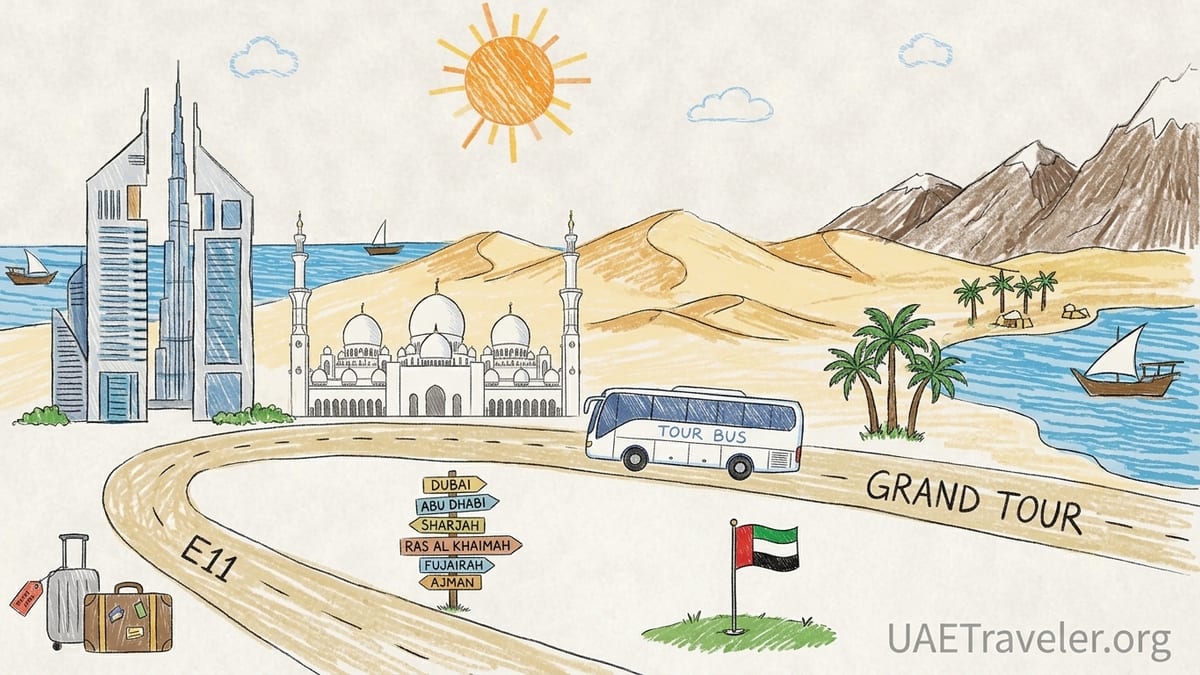
The UAE Grand Tour initiative promotes itself as a way to experience the whole country in a single, seamless journey, bundling multiple emirates, hotel nights, transport and guided sightseeing under one booking. On the official Grand Tour Classic page, the eleven-day route is explicitly listed as Dubai, Sharjah, Ajman, Fujairah, Ras Al Khaimah, Abu Dhabi and Al Ain, with ten nights in a mix of four and five-star hotels, private transportation and a driver-guide. There is no separate mention of Umm Al Quwain in the route summary or in the day-by-day tabs that describe the individual stops and activities.
At first glance, the promotional language leans heavily on the allure of “all seven emirates in one journey” and similar phrasing, backed by a flight-and-driving route map that visually traces an arc through the country. The itinerary copy emphasises classic highlights like Dubai Creek, Sharjah’s museums, Fujairah’s east coast, Ras Al Khaimah’s desert, Abu Dhabi’s cultural sites and Al Ain’s oases. For prospective visitors skimming quickly, it is easy to assume that such a nationwide sweep must by definition include all seven emirates, even when only six are named.
Pricing on comparable multi-emirate packages promoted through regional outlets often starts around the equivalent of a few thousand dirhams per person for a week to ten days, depending on hotel category and group size. Marketing headlines tout “all 7 emirates” and “most comprehensive UAE package” while the fine print uses more cautious phrasing like “visit all 7 emirates + iconic experiences in 10 days” or “covers the seven emirates over X nights,” language that can be interpreted generously if the bus happens to drive across an emirate without stopping.
My own travels in the UAE have taken me repeatedly to Dubai and Abu Dhabi, up to Ras Al Khaimah’s mountains, across to Fujairah and down to the inland city of Al Ain. The distances are manageable and the inter-emirate roads efficient. That is exactly why I find the promise of an effortless, all-in-one Grand Tour so tempting. But it also makes me sensitive to how little time some packages actually leave for on-the-ground exploration, especially when they claim to cover nearly the entire map.
The Seven Emirates Problem: Where Is Umm Al Quwain?
To understand what is missing, it helps to restate the basics. The United Arab Emirates is a federation of seven distinct emirates: Abu Dhabi, Dubai, Sharjah, Ajman, Umm Al Quwain, Ras Al Khaimah and Fujairah. Abu Dhabi is the largest by area and includes both Abu Dhabi city and Al Ain, along with the Al Dhafra desert region. Al Ain is therefore a major inland city within Abu Dhabi emirate, not a separate emirate of its own, despite how often it is listed alongside emirate capitals in tourism material.
Against that political map, the Grand Classic eleven-day route is straightforwardly six-emirate. It openly features Abu Dhabi (twice, if you count Al Ain separately), Dubai, Sharjah, Ajman, Ras Al Khaimah and Fujairah. Umm Al Quwain, a small but distinct emirate on the northern coast between Ajman and Ras Al Khaimah, does not appear as a named stop, city, beach or heritage site in the published outline. There is no mention of its lagoon, mangroves, traditional dhow yards or smaller family parks that have historically drawn domestic visitors.
Because marketing headlines for the broader Grand Tour initiative signal seven-emirate ambition, I looked carefully for alternative versions of the Grand Classic that might quietly slot in Umm Al Quwain. Some regional tour operators selling “7 Emirates of UAE” group trips do include quick photo stops in every emirate, sometimes via a ten-hour bus day that rattles through Sharjah and Ajman in the morning, Ras Al Khaimah by lunchtime, Fujairah and Al Ain on later days and Abu Dhabi at the end. In those itineraries, Umm Al Quwain is often ticked off by a short pause at a beach or a flagpole on the E11 highway. That is technically a visit, but it is telling that the stop is so easy to omit that another Grand Tour-branded product does not mention it at all.
The absence of Umm Al Quwain matters less for its specific attractions and more as a test of how literally travellers should read the language of “all seven emirates.” A package that quietly counts driving across an emirate as “coverage,” without disclosing that you will not actually stop there, is trading on the symbolism of completeness more than the substance of place-based experience. In the case of the Grand Classic, the route appears honest at the level of words on the page, but the wider initiative’s branding can easily leave customers with the mistaken impression that any Grand Tour package equals a seven-emirate passport stamp collection.
Five-Star Hotels, Meals and What You Actually Get
The Grand Classic outline promises ten nights in “selected 4 and 5-star hotels,” with daily breakfast and some additional meals. On paper, that sounds on par with what independent travellers book when they search for reputable brands in Dubai Marina, Abu Dhabi’s Corniche or the resort strips of Ras Al Khaimah and Fujairah. The crucial difference is that many packages do not consistently name the actual hotels in the public brochure. They rely on phrases like “or similar” next to one or two examples, and reserve the right to change properties based on seasonal availability and group size. That makes it difficult to compare the value of the included rooms to what the same hotels sell for on open platforms.
Five-star in the UAE can mean radically different things depending on age, location and target market. A beach resort in Ras Al Khaimah with its own stretch of sand and multiple restaurants can routinely charge more per night than an inland business hotel off Sheikh Zayed Road in Dubai that carries the same star rating. Abu Dhabi’s flagship properties near the Corniche and Saadiyat Island sit in yet another price and quality bracket again. Having stayed in a range of mid to high-end hotels across Dubai, Abu Dhabi and the northern emirates, I have learned to look beyond the star category and into details like room size, beach access, noise insulation and renovation dates. Package language that simply collects all of this under “4 and 5-star” is vague enough that it does not really answer the question of whether the nightly rate you are paying in a package is competitive.
Meal inclusions also tend to sound more generous than they feel in practice. Some Grand Tour-style itineraries bundle breakfast daily, plus a handful of set-menu lunches on city touring days and one or two buffet dinners, often tied to a desert safari evening. On a ten or eleven-night trip, that might equate to around a third of your meals, often at hotel buffets or group restaurants chosen more for convenience and parking than culinary character. In Dubai and Abu Dhabi, where independent dining choices are nearly limitless and range from shawarma counters to Michelin-starred tasting menus, I have consistently found better food and value by stepping out of the hotel and paying out of pocket, instead of locking most meals into a fixed package upfront.
When comparing this to independent booking, the key is transparency. If a package identifies specific hotels and confirms whether dinners are full buffets with drinks or basic half-board, you can plug those numbers into any online search to see whether the collective room and meal cost matches the package price. Where the Grand Classic and similar offers leave gaps, particularly around which five-stars are realistic at the advertised starting rate, it becomes hard to judge whether you are paying a fair premium for convenience or simply subsidising group mark-ups.
Transport, Sightseeing Time and the Reality of the Schedule
The promise of private, air-conditioned transportation with a driver-guide is one of the stronger selling points of the Grand Classic itinerary. Driving in the UAE is straightforward on the main highways, but it can feel intense for first-time visitors dealing with fast traffic, unfamiliar lane discipline and complex interchanges around Dubai and Abu Dhabi. Having spent many hours on the E11 and the inland desert roads, I understand why some travellers would gladly pay to hand those keys to a professional.
However, when you spread the eleven-day route across the map, a pattern emerges. Several days involve long north-south transfers between emirates, sometimes combined with city sightseeing on either end. For example, one sample multi-emirate itinerary promoted to regional markets squeezes Abu Dhabi’s Sheikh Zayed Grand Mosque, Corniche photos, external stops at the presidential palaces and a Yas Island mall visit into a single ten-hour day, before checking into a hotel. Another day sends the group from Al Ain across the mountains to Fujairah for coastal sightseeing, followed by a night transfer. On paper, all the landmarks are “covered,” but the ratio of bus time to unhurried exploration is not always spelled out.
This is where sightseeing time quietly erodes. A “full day” allocated to Sharjah and Ajman might start with a late hotel departure after breakfast, include hour-long segments in traffic, two or three brief museum stops and a walk through a souk before the return drive. By late afternoon, the group is checking back into a Dubai hotel, having technically visited two additional emirates but barely scratching the surface of either. Compare that to an independently planned day where you might spend three hours in Sharjah’s Heart of Sharjah heritage area, visit two museums in depth and linger over coffee by the corniche, then finish with sunset at Ajman’s beach before a relaxed highway drive back.
The inclusion of entrance tickets in Grand Tour packages also merits scrutiny. Some itineraries cover key paid entries such as Dubai Museum equivalents, a desert safari with dune bashing and dinner, selected museum tickets in Sharjah and Ras Al Khaimah, and mosque tours in Abu Dhabi or Fujairah. Others rely more heavily on exterior photo stops, waterfront strolls and free-access viewpoints. One multi-emirate tour description simply notes that “some attractions may have optional entry fees depending on your selected package,” which pushes the true cost of sightseeing off the advertised headline price and into on-the-ground upselling.
Independent travellers who rent a car or hire point-to-point drivers for specific days face a different trade-off. They must navigate and park themselves or coordinate with drivers who may not double as guides, but they control departure times, rest stops and how long to linger at each site. Based on my own experience driving between Dubai, Ras Al Khaimah, Fujairah and Abu Dhabi, the roads are in very good condition, fuel is relatively affordable compared to many countries, and intercity buses between major hubs such as Dubai and Abu Dhabi offer frequent, low-cost alternatives. The real question is whether the time savings and comfort of a dedicated driver-guide, as packaged in a Grand Tour, justify the additional cost once you subtract the portions of the schedule that are essentially long highway transfers.
Optional Excursions, Flexibility and the Final Checkout Price
Most Grand Tour-style offers use optional excursions as both a safety valve and a revenue stream. The base price might include essential city tours and one or two headline experiences, while helicopter rides, dhow cruises, premium desert camps, theme park tickets on Yas Island or zipline runs in Ras Al Khaimah are presented as add-ons. For travellers who enjoy customising on the fly, this can feel empowering. For those who expected a more all-inclusive package, it can mean an unplanned climb in the actual amount paid.
Flexibility within the group structure is another area where marketing and reality diverge. Descriptions often mention that itineraries can be “adjusted to your dates, pace and taste” before confirmation, especially in semi-private or small-group formats. In practice, once a group departure is fixed, day-to-day timings tend to be rigid. Hotel breakfast windows, coach departure slots and pre-booked time slots at major attractions limit how much the schedule can bend for individual preferences. Travellers who want to spend an extra hour at a particular museum, or who would prefer to skip an included mall stop for an independent café, may find there is little room for deviation.
When you add everything up at checkout, the final price of a Grand Tour package is almost always significantly higher than the sum of bare hotel rates and basic transport costs. Part of that difference funds the tour operator’s expertise, negotiation power and risk management. Group bookings can secure better rates at certain properties, and there is genuine value in having a single point of contact to rearrange transport or hotels if plans change suddenly. However, part of the gap is also absorbed by marketing overheads, commissions along the distribution chain and margins on optional extras.
Without transparent breakdowns, it can be difficult for travellers to understand which portion of the premium is paying for meaningful support and which portion is simply the cost of convenience. Where operators provide sample cost comparisons or at least name the standard hotels, vehicle types and included entrances, the premium is easier to justify. Where they do not, the risk grows that you are paying for a glossy “Grand Tour” label more than for a truly optimised, flexible journey.
Independent Alternatives: What Comparable DIY Travel Looks Like
To test the value of a multi-emirate package like the Grand Classic, it helps to imagine a comparable independent itinerary over ten or eleven days. Start with three nights in Dubai for arrival, jet lag and initial city exploration. Add two nights in Abu Dhabi to take in the mosque, the Corniche and at least one major museum, plus an extra night in Al Ain or the surrounding desert if oasis history or mountain views appeal. Then allocate the remaining nights across Ras Al Khaimah’s beaches or mountains and Fujairah’s east coast, leaving Sharjah, Ajman and Umm Al Quwain as day trips or short pauses along the way.
Booked independently, this structure allows far more control over pacing. You can choose a mid-range hotel with strong reviews rather than a five-star that leans on brand recognition but delivers a generic experience. You can decide whether to splurge on one standout desert resort night instead of several nights in business hotels that happen to carry four or five stars. On my last circuit between Dubai, Ras Al Khaimah and Fujairah, I used a mix of rental car days and hotel-arranged transfers, which cost less overall than a private driver-guide for the entire duration but still avoided long-haul public transport with luggage.
Attraction tickets are also easy to assemble à la carte. Mosque visits in Abu Dhabi and some cultural sites in Sharjah remain free but require modest transport costs and dress-code planning. Heritage museums in Ras Al Khaimah, Ajman and Fujairah charge low entry fees that can be paid directly at the door. Desert safaris from Dubai, Abu Dhabi or Ras Al Khaimah can be booked with reputable operators that publish clear inclusions, from dune bashing and camel rides to traditional dinners and short shows. The total cost of these experiences, when chosen carefully, often undercuts the bundled price in a package that also includes less compelling group meals or shopping stops you might have skipped.
Independent travel does introduce more logistical friction. You must research and compare hotel locations, read recent reviews, double-check whether rental car insurance options meet your comfort level and keep an eye on driving times. For some visitors, especially those landing in the region for the first time or travelling with older relatives, the reassurance of a door-to-door Grand Tour can be worth paying a premium. The key is that the premium should be attached to clearly defined services, not vague promises about “seven emirates” that mask the omission of Umm Al Quwain or the conflation of Al Ain with a separate emirate.
Which Grand Tour Claims Hold Up, and Which Feel Weak?
After parsing the language and structure of multi-emirate packages like the Grand Classic, several claims emerge as genuinely valuable. Having a licensed driver-guide across multiple emirates does simplify travel days and can deepen your understanding of local history and contemporary life, particularly in places where signage is sparse. Centralised booking of hotels and transfers reduces the mental load of coordinating check-in times, luggage and backup plans. For travellers with limited time to plan, this operational backbone is one of the strongest reasons to choose a package.
On the other hand, some marketing phrases feel markedly weaker when held up against the actual itineraries. References to “all seven emirates” that rely on technicalities rather than clearly disclosed stops are misleading. The persistent habit of listing Al Ain alongside Dubai, Abu Dhabi, Sharjah and the others as if it were a separate political entity glosses over the basic fact that it belongs to Abu Dhabi emirate, and distracts from the more interesting story of how the federation is structured. Similarly, blanket “4 and 5-star hotel” language without naming properties or clarifying their location leaves too much room for expectations to diverge from reality.
Meal and entrance inclusions can also be weaker than they appear at first glance. Including daily hotel breakfast is standard almost everywhere in the UAE and does not, in itself, justify a significant premium. A handful of group lunches and buffet dinners may be convenient, but they often channel visitors into generic dining rooms at hours chosen for group transport, rather than letting them sample the richer independent food scene. Coverage of entrance tickets is valuable where it involves genuinely high-demand or higher-cost sites that require advance booking. When it is limited to inexpensive or free-access attractions, it leans more toward the symbolic than the substantive.
Ultimately, the Grand Tour concept is not inherently flawed. The issue lies in how loosely some operators deploy its promise of national completeness, and how hazy they allow the details to remain around hotel standards, sightseeing depth and total costs. Travellers who approach these packages with informed skepticism, grounded in a clear understanding of the seven-emirate map and their own priorities, are best placed to decide whether the convenience premium corresponds to their real needs.
The Takeaway
If you are considering a UAE Grand Tour package, the first and most important step is to separate the marketing language from the itinerary facts. Ask yourself whether the route genuinely reaches all seven emirates, and whether it does more than drive across the missing one on a highway. In the case of the eleven-day Grand Classic, the published list of Dubai, Sharjah, Ajman, Fujairah, Ras Al Khaimah, Abu Dhabi and Al Ain amounts to six emirates plus an inland Abu Dhabi city, not a full national sweep. That does not make the trip worthless, but it does mean you should not book it under the illusion that your passport or memories will reflect a complete emirate set.
Second, treat star ratings and inclusions as starting points for questions, not answers. Ask the operator to name the actual hotels they usually book at the advertised price and to confirm whether upgrades are structural or subject to last-minute changes. Request a line-item list of what meals and entrance tickets are covered, and compare those against real-world prices you can find publicly. If the package includes expensive or logistically complex elements such as private desert camps, mountain roads that are difficult to access by taxi or premium museum entries that require timed slots, then a higher package premium can be well justified. If most inclusions are basic hotel breakfasts, generic group buffets and low-cost city museums, you may find that an independent itinerary offers better value and richer experiences.
Third, pay attention to pace. Use a map to trace each day’s journey and estimate how many hours you will spend on the road versus exploring on foot. Multi-emirate itineraries that tick off Sharjah, Ajman, Umm Al Quwain and Ras Al Khaimah in a single long day will give you bragging rights but limited sense of place. Slower itineraries that concentrate on fewer emirates or offer at least one full, unstructured day in a key city often leave stronger memories. From my own time zigzagging between Dubai’s waterfronts, Abu Dhabi’s cultural districts, Ras Al Khaimah’s mountains and Fujairah’s coast, the most rewarding days were always the ones with room for serendipity, not the ones dominated by bus windows.
Finally, do not dismiss guided holidays altogether. Instead, apply sharper criteria. Look for operators who are explicit about which emirates you will meaningfully visit, and how. Favour itineraries that name hotels, outline meal types clearly and specify which attractions are fully included versus optional. Consider hybrid approaches where you might use a Grand Tour-style package for a core segment, such as a three or four-night inland and desert circuit, then bolt on self-booked city days at the beginning or end. In a country as compact and well-connected as the UAE, flexibility is easy to build in, provided you do not surrender it too early to vague promises of “grand” coverage.
FAQ
Q1. Does the UAE Grand Tour Classic itinerary really cover all seven emirates?
No. The published Grand Classic route lists Dubai, Sharjah, Ajman, Fujairah, Ras Al Khaimah, Abu Dhabi and Al Ain, which amounts to six emirates plus Al Ain, a city within Abu Dhabi emirate. Umm Al Quwain is not separately listed as a stop.
Q2. Is Al Ain its own emirate?
No. Al Ain is a major inland city in Abu Dhabi emirate, close to the Omani border. Some marketing material lists it alongside emirate capitals, which can mislead visitors into thinking it is an eighth emirate, but politically it belongs to Abu Dhabi.
Q3. Could Umm Al Quwain still be included as an unpublished stop on a Grand Tour?
Some multi-emirate itineraries in the region include brief photo stops or drive-through segments in Umm Al Quwain without highlighting them heavily in marketing copy. In the case of the Grand Classic, there is no clear published evidence of a dedicated Umm Al Quwain visit, so travellers should ask directly before assuming it is covered.
Q4. Are the advertised five-star hotels in Grand Tour packages good value?
They can be, but only if you know which properties are actually used. The phrase “4 and 5-star hotels or similar” is too vague to judge value. Request a sample hotel list and compare public nightly rates with the package cost to see whether the premium you pay is reasonable.
Q5. Do package meal inclusions significantly reduce overall travel costs?
Not always. Daily hotel breakfast is standard in many UAE hotels and does not add much extra value. Group lunches and buffet dinners can be convenient but may not match the quality or variety you could find by dining independently, especially in Dubai and Abu Dhabi, where local and international food options are abundant.
Q6. How much actual sightseeing time do Grand Tour itineraries allow in each emirate?
Time varies widely. Some “full day” excursions combine multiple emirates with long highway transfers, leaving only short museum visits or photo stops. It is important to read the day-by-day timings and drive distances carefully, or ask the operator to clarify how many hours you will actually spend on the ground in each place.
Q7. Is it difficult to visit several emirates independently without a package?
For many travellers it is manageable. Major roads are well maintained, fuel is relatively affordable and intercity buses link key hubs like Dubai and Abu Dhabi. Renting a car or hiring drivers for specific days allows you to control pacing and stop where you want, although it does require more planning and confidence with navigation.
Q8. What are the strongest arguments in favour of booking a UAE Grand Tour package?
The main strengths are convenience and support. You gain a single booking that covers hotels, key transfers and much of your sightseeing, along with a driver-guide who handles navigation and logistics. This can be particularly valuable for first-time visitors, larger family groups or travellers who are short on planning time.
Q9. What are better criteria for choosing a multi-emirate package?
Prioritise clarity over slogans. Look for itineraries that explicitly state which emirates you will visit, name the hotels where you will stay, specify which meals and entrance tickets are included and show realistic daily driving times. Packages that are transparent on these points are easier to compare with independent options.
Q10. If I care about visiting all seven emirates, what should I do?
First, confirm in writing with any tour operator exactly how and where each emirate is visited, including Umm Al Quwain. Alternatively, plan your own seven-emirate circuit by combining a rental car or hired driver with overnight stays in Dubai, Abu Dhabi and one or two northern or eastern emirates, using shorter day trips to tick off the remaining ones at a comfortable pace.