


Ask a dozen travelers which emirate is “best” in the United Arab Emirates and you will usually hear just two names: Dubai and Abu Dhabi. Yet after driving and riding across the country, staying in beachfront hotels and budget city rooms, wandering souks and new museums, and getting lost on mountain roads, I came away with a very different, much more nuanced picture. This is my personal ranking of all seven emirates, based strictly on places where I have actually slept, eaten, and explored, with clearly marked sections where I relied only on research rather than firsthand experience. Your own ranking may look very different, but if you are trying to decide how to divide a limited number of nights across the UAE, this is the trade-off map I wish I had before my first trip.
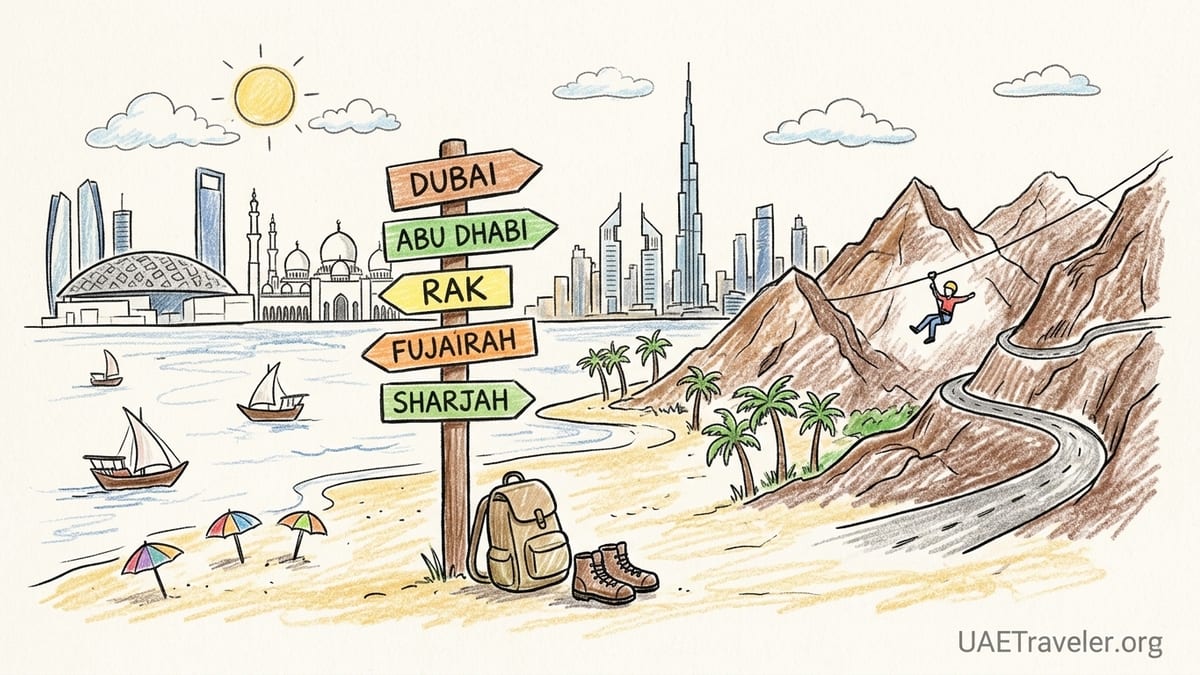
How I Actually Ranked the Seven Emirates
Before declaring any “best” emirate, it helps to be transparent about how this list came together. I have personally visited and overnighted in Dubai, Abu Dhabi, Sharjah, Ras Al Khaimah, Fujairah and Ajman, and spent a long afternoon in Umm Al Quwain on a coastal road trip. That means I have at least some on-the-ground experience in all seven, although my time in Umm Al Quwain was shorter and more limited than in the others. Where I lean on desk research instead of personal memory, I flag it clearly.
To keep things consistent, I compared every emirate using the same criteria: sightseeing, cultural depth, beaches, outdoor activities, food, accommodation, atmosphere, transport and value. For each of these, I asked two questions. First, what did I actually experience here, from specific museums and beach clubs to road conditions, restaurant bills and hotel nights. Second, how does that compare with what I paid and what was available across the border in the next emirate along the highway.
Prices in this article are based on what I paid on visits between late 2023 and mid 2025, converted to approximate UAE dirham amounts and rounded to keep things readable. For example, I paid about 420 to 500 dirhams per night for mid-range chain hotels in Dubai Marina and Downtown, around 350 to 450 dirhams for similar quality in Abu Dhabi on Saadiyat Island and near the Corniche, and as low as 220 to 260 dirhams for sea-facing rooms at large resorts in Ras Al Khaimah and Fujairah on weekday nights. Budget city hotels in Sharjah and Ajman often dipped under 180 dirhams when booked a month or more in advance.
With that context, my overall personal ranking for a general visitor looks like this: 1) Abu Dhabi, 2) Ras Al Khaimah, 3) Dubai, 4) Sharjah, 5) Fujairah, 6) Ajman, 7) Umm Al Quwain. Below that headline, though, I break out separate rankings for couples, families, first-time international visitors, adventure travelers and budget-conscious visitors, because the “best” emirate changes quickly once you decide whether your priority is museums, mountains or how far your dirham goes.
Dubai vs Abu Dhabi: Blockbusters and Depth
Dubai was my first entry point into the UAE and probably the most familiar skyline on earth at this point. My first stay was in Dubai Marina, in a mid-range international chain hotel where I paid about 480 dirhams per night for a standard room in November, breakfast included. The Marina promenade and nearby Jumeirah Beach Residence were exactly what the brochure promised: long beachfront walks, endless cafes, plenty of people-watching and almost no sense of an older city beneath it all. Sightseeing in Dubai is dominated by blockbuster experiences. I spent one afternoon at the Burj Khalifa and Dubai Mall area, where the ticket for the standard viewing deck level cost a little over 180 dirhams when booked ahead, roughly comparable to major observation decks in New York or London. Watching the fountain show in the evening, surrounded by designer stores and crowded terraces, felt impressive but also curated, more like a theme park than a lived-in city.
What began to shift my perspective was an early-morning wander around Dubai Creek. Taking an abra across the water for just a few dirhams, then exploring the spice and gold souks, I finally felt a hint of old trading Dubai. Even here, though, many stalls were calibrated to tour groups, and a lot of my conversations ended with offers for watches or fabrics rather than stories. As a place for sightseeing variety, Dubai is superb. On one trip I visited the Miracle Garden in the late afternoon, with an entrance fee of around 95 dirhams, then drove out towards the desert in a rented compact car that cost me about 130 dirhams per day plus fuel to join a guided dune-bashing and barbecue evening at roughly 250 dirhams per person. It was effortless fun but also deeply choreographed, with convoy-style driving, timed sunset stops and buffet lines.
Abu Dhabi, in contrast, felt quieter, wealthier and more rooted. My first stay was at a hotel on Saadiyat Island that cost roughly 420 dirhams per night in shoulder season, more competitive than similar beachfront options in Dubai. The public beach there was wide, with fine sand and gentler crowds than Jumeirah Beach. The highlight of Abu Dhabi for me, and the main reason it edges Dubai in my ranking, is its cultural depth. I spent almost an entire day between the Sheikh Zayed Grand Mosque and the Louvre Abu Dhabi. Entry to the mosque is free, but I paid around 35 dirhams for an audio guide and modest clothing cover. The building felt like a functioning religious site first and a photo backdrop second, especially at sunset when locals and visitors lined up quietly for evening prayer.
The Louvre Abu Dhabi, with a ticket price of about 60 dirhams on my last visit, combined serious art with architecture that demanded lingering. I remember sitting under the pierced dome roof watching shafts of light shift with the tide, something I simply could not experience in Dubai’s largely indoor attractions. In the city proper, the Corniche offered several kilometers of cycling and strolling with views back towards the skyline. I rented a bike for two hours from a station near the beach for around 40 dirhams, which felt like good value compared with other global capitals. For food, Abu Dhabi surprised me with neighborhood Yemeni and Indian restaurants that priced main dishes in the 25 to 40 dirham range, cheaper and more local-feeling than many of my Marina and Downtown Dubai meals where casual dinners rarely dipped below 60 dirhams per person without alcohol.
Sharjah and Ajman: Culture, Conservatism and Slower Beaches
Sharjah sits almost inseparably close to Dubai, but crossing the border by taxi felt like entering a parallel version of the UAE. I based myself for three nights near the Sharjah Corniche in a small hotel that cost about 200 dirhams per night in March, booked directly. The first thing I noticed was the absence of alcohol in hotel bars and restaurants, which matched Sharjah’s reputation as the most conservative emirate. The trade-off for that extra layer of restriction was cultural substance. I spent a full day in the Heart of Sharjah heritage area, wandering between restored coral-stone buildings, tiny cafes and several small museums. Entry fees were modest, often around 10 to 20 dirhams or free, and staff were more inclined to explain local history than to sell add-ons.
The Sharjah Art Museum and the Museum of Islamic Civilization stood out for their collections and for how quiet they were compared with Dubai’s malls and Abu Dhabi’s headline museums. I remember standing alone in front of detailed calligraphy pieces for long stretches without anyone nudging me aside for a selfie. For food, Sharjah’s strengths were simple Indian, Pakistani and Levantine places where lunchtime thali plates or grills could still be had for under 25 dirhams, which felt like a welcome break after several days of Marina brunch pricing. On the downside, traffic between Sharjah and Dubai was the worst I experienced anywhere in the UAE. A late-afternoon taxi back from Dubai Mall to my Sharjah hotel took nearly ninety minutes and cost close to 110 dirhams, a poor use of both time and budget.
Ajman, just up the coast, was my first taste of a slower beachfront emirate. I stayed in a mid-range resort facing Ajman Corniche for a night on a weekday, paying around 260 dirhams for a sea-view room, which would have cost at least 50 percent more in Dubai. The beach was narrower but less crowded, used more by local families in the late afternoon than by Instagram shoots. From my balcony I watched small wooden fishing boats heading out at dawn, something that rarely interrupts the horizon over Jumeirah. There is limited sightseeing in a conventional sense in Ajman. I visited the small Ajman Museum inside an 18th century fort, paying a modest entry fee that was under 10 dirhams, and then spent most of my time walking the corniche and poking into shawarma stands and juice bars where a filling meal rarely passed 20 dirhams.
The trade-offs in Ajman were obvious. If you come for blockbuster attractions, you may run out of things to do within 24 hours. Public transport was thin, so I relied almost entirely on taxis, with short city hops costing 15 to 25 dirhams each. Yet for travelers who want a quieter seafront and lower hotel rates while still being within a 45 to 60 minute drive of Dubai and Sharjah’s museums, Ajman made sense. In my personal ranking, it lands in the lower half not because it is unpleasant, but because it functions best as a spillover base rather than a primary destination for most visitors.
Ras Al Khaimah and Fujairah: Mountains, Coast and Outdoor Time
Ras Al Khaimah was the emirate that surprised me the most, and it is why it appears in second place overall in my list, above Dubai. I drove there from Dubai in a rented compact car over well-maintained highways, covering the distance in under ninety minutes outside rush hour. My base for three nights was a large beachfront resort near Al Marjan Island where weekday rates in May dropped to around 240 dirhams per night, breakfast included. The beach there was broad and the atmosphere more relaxed than in Dubai, with more regional families and fewer short-haul party groups. The best day of the trip involved driving inland towards Jebel Jais, the highest peak in the UAE. The road snaked into the Hajar Mountains with viewpoints that felt nothing like the urban Gulf. Fuel costs were low, roughly 60 dirhams to top up the tank after an entire day of driving.
I booked a slot on the famous mountain zipline, which, at the time I visited, cost just under 400 dirhams per person. It was not cheap, but the combination of hairpin drive, cooler air and a view across bare ridges justified the expense as a signature adventure day in the UAE. Even without the zipline, the hikes from roadside parking spots offered enough short trails to fill a day for anyone comfortable with rocky paths and direct sun. Food in Ras Al Khaimah ranged from hotel buffets priced comparably to Dubai’s mid-market options to local grills and cafeterias in the city where 20 to 30 dirhams still bought filling plates of mandi or shawarma. For me, the combination of lower hotel prices, real outdoor options and family-friendly resorts made Ras Al Khaimah a strong rival to both Dubai and Abu Dhabi as a place to actually stay several nights.
On the opposite coast, Fujairah offered a markedly different mood again. I arrived by car from Sharjah, taking the route that cut through the Hajar Mountains, with brown rocky hills replacing the glass towers of the Gulf cities. My first night was at a modest hotel in Fujairah City for about 200 dirhams, followed by two nights at a beach resort closer to Al Aqah where rates hovered around 260 to 280 dirhams midweek. The standout experiences were snorkeling off the east coast and driving the coastal road that threads between sea and mountains. I joined a half-day boat trip with simple snorkeling gear included for about 250 dirhams per person. Visibility was not on par with tropical reef destinations, but it was still a welcome chance to see fish and coral after days of urban wandering.
Fujairah’s beaches felt more low-key and sometimes rougher underfoot than those in Abu Dhabi or Dubai, and some stretches showed signs of port development. On the cultural side, Fujairah Fort and the nearby heritage village offered a compact look at older Emirati defensive and domestic architecture, with entry fees measured in small notes rather than big credit card charges. In the evening, local cafeterias served grilled fish and rice for under 35 dirhams per person, and I saw far fewer large tour buses than anywhere in Dubai or Abu Dhabi. For travelers who prioritize mountains, coastline and a sense of being “outside the city,” Fujairah earns its place in the middle of my ranking, just behind Sharjah, but it can feel thin on nightlife and big-ticket attractions.
Umm Al Quwain: Quiet Corners and Honest Limitations
My experience of Umm Al Quwain was limited to a long afternoon stop on a coastal road trip, so this section is deliberately more cautious than the others. I arrived from Ajman by car, following a mostly straight highway, and turned off towards the older town and lagoon. What immediately stood out was the lack of crowds. In mid-afternoon, the public beach was dotted with only a handful of families, and fishing boats rested along a shoreline that felt closer to how much of the Gulf coast must have looked before large-scale development. I paid a small parking fee at one beach park, under 10 dirhams, and walked for nearly an hour without encountering a single tour group.
I ate at a small seafood restaurant just off the main road, choosing grilled fish and rice for about 30 dirhams, served without the polished plating or heavy branding of the Dubai and Ras Al Khaimah resorts. Service was friendly but unhurried. In terms of sightseeing, beyond the simple fort and a few older buildings, there was little that I could explore deeply without more time and a local guide. From research rather than direct experience, I know there are mangrove channels and nature reserves accessible by kayak and boat tours, with operators in recent years pricing half-day excursions in the 200 to 300 dirham range per person. Since I did not join one myself, I cannot vouch for specific companies or itineraries.
Accommodation-wise, my only firsthand knowledge comes from scanning hotel boards as I drove past. Rates advertised on roadside signs suggested that weekday rooms in basic beach hotels could be had in the low 200 dirham range, significantly less than equivalent sea-facing properties in Dubai or Abu Dhabi. However, until I actually stay overnight, I treat Umm Al Quwain more as an intriguing detour than a base. That uncertainty is why it sits at the bottom of my current ranking. It does not mean it lacks charm or potential, only that my personal experience there is thin compared with the time I invested in every other emirate on this list.
Transport and value here are closely linked. Without a car, reaching Umm Al Quwain relies on taxis or occasional intercity buses, which can eat away at the apparent savings on accommodation and food. With a rental car, fuel costs remain low, but you need to be comfortable navigating less developed stretches of coastline and carrying more of your own snacks and water, since convenience stores and cafes are less frequent than along the main Dubai Abu Dhabi corridor.
Who Wins for Different Types of Travelers
Because no single emirate wins in every category, I found it more helpful to sketch separate personal rankings for different traveler profiles, based entirely on trips I have actually taken and bills I have actually paid. For couples, especially those who enjoy a mix of culture, beaches and good mid-range hotels, my ranking is: 1) Abu Dhabi, 2) Ras Al Khaimah, 3) Dubai, 4) Fujairah, 5) Sharjah, 6) Ajman, 7) Umm Al Quwain. Abu Dhabi edges ahead because of evenings spent walking the Corniche, visiting the Louvre and dining at mid-priced restaurants on Saadiyat Island where a two-course meal without alcohol typically came in around 250 to 300 dirhams for two, comparable to Dubai prices but with more atmosphere and less intensity.
For families, especially those with school-age children, my list shifts slightly: 1) Ras Al Khaimah, 2) Dubai, 3) Abu Dhabi, 4) Fujairah, 5) Ajman, 6) Sharjah, 7) Umm Al Quwain. Ras Al Khaimah’s large all-ages resorts, multiple swimming pools, relative affordability and easy day trips into the mountains make it a strong base. In one resort, a family room with breakfast and kids’ club access in early June came in just under 500 dirhams per night, notably less than equivalent beachfront properties in Dubai, where similar packages were often 700 dirhams and up. Dubai holds second place for families because of its density of aquariums, waterparks and malls, even if entrance fees add up quickly. Abu Dhabi offers excellent museums and the mosque, but distances between attractions can be longer.
For first-time international visitors who may never return to the UAE, I reluctantly put Dubai in first place, followed by Abu Dhabi, Ras Al Khaimah, Sharjah, Fujairah, Ajman and Umm Al Quwain. Dubai simply delivers the most concentrated version of the modern Gulf city fantasy in a compact radius around Downtown, the Marina and Palm Jumeirah. Even if it is not my personal favorite for repeat visits, I remember the jolt of seeing the skyline from a taxi at night for the first time and understanding why it anchors so many marketing campaigns. Abu Dhabi deserves at least two nights on any first trip for its mosque and museums. Ras Al Khaimah climbs into third for first-timers who are willing to add a few extra days for a more relaxed resort and mountain experience.
Adventure travelers and hikers will naturally gravitate more towards Ras Al Khaimah and Fujairah, followed by Eastern Sharjah and then Dubai and Abu Dhabi. My own adventure ranking is: 1) Ras Al Khaimah, 2) Fujairah, 3) Sharjah, 4) Dubai, 5) Abu Dhabi, 6) Ajman, 7) Umm Al Quwain, with the caveat that much of the best hiking in Eastern Sharjah requires research and sometimes local knowledge to access safely. Budget-conscious visitors, finally, will find the best balance of cost and experience by basing themselves in Sharjah, Ajman or occasionally Ras Al Khaimah, then day-tripping into Dubai or Abu Dhabi. On one ten-day trip where I prioritized value, I averaged around 220 dirhams per night by mixing Sharjah and Ajman stays, and used intercity buses and shared taxis costing between 15 and 30 dirhams per leg to reach Dubai’s main districts.
Transport, Driving and Everyday Practicalities
Driving across the UAE turned out to be far more straightforward than I expected, and it is part of why my ranking rewards emirates like Ras Al Khaimah and Fujairah that shine once you have access to highways and mountain roads. At Dubai and Abu Dhabi airports, compact car rentals from international brands regularly priced between 110 and 150 dirhams per day when booked a few weeks in advance, with fuel costs surprisingly low compared with Europe or North America. On one seven-day road trip, I spent under 200 dirhams total on petrol while covering Dubai, Sharjah, Ajman, Ras Al Khaimah and Fujairah, helped by efficient highways and moderate distances.
The most stressful driving moments came near rush hours on the Dubai Sharjah corridor, where dense traffic and aggressive lane changes required full concentration. In contrast, the drive to Jebel Jais, though full of bends, felt orderly, with clear signage and frequent viewpoints. Police checkpoints near some borders were professional and routine, usually just a quick glance at documents. Speed cameras appear frequently on main roads, and fines can be high, so using the cruise control and sticking to posted limits became second nature.
Where I did not drive, taxis and ride-hailing filled the gaps. In Dubai, typical city rides within Downtown or Marina often cost 20 to 35 dirhams. The airport to Marina journey by official taxi came in around 80 to 100 dirhams depending on traffic. Abu Dhabi’s taxis were slightly cheaper per kilometer, and I regularly paid around 25 dirhams for cross-town rides. Buses connected major emirates, with Dubai to Abu Dhabi fares in the 25 to 35 dirham range and travel times of around ninety minutes to two hours depending on the route. For budget travelers, those buses are essential for keeping total costs under control without renting a car.
Everyday practicalities also influenced my ranking. In Dubai and Abu Dhabi, finding late-night food was simple. Food courts, shawarma stands and hotel cafes often stayed open past midnight, although prices in tourist districts skewed higher. Sharjah and Ajman offered cheaper, more local late-night eats, but with fewer English menu translations, which might challenge some visitors but adds to the sense of being in a real working city. Dress codes in malls and public spaces were broadly similar across emirates, although Sharjah felt slightly more conservative in practice, with more women in abayas and fewer beach outfits far from the sea. In all the emirates I visited, I felt safe walking in the evening, including as traffic thinned in parts of Ras Al Khaimah and Fujairah.
The Takeaway
If I were planning another two-week trip to the UAE tomorrow, knowing what I know now, I would give the most nights to Abu Dhabi and Ras Al Khaimah, with Dubai in third place. Abu Dhabi would probably receive five or six nights: enough time to return to the mosque at different times of day, linger longer at the Louvre and other cultural sites, explore Saadiyat and Yas islands properly, and take at least one day trip into the desert interior. Ras Al Khaimah would earn four or five nights for its balance of relaxed beachfront resorts and easy access to mountain roads and hiking trails. Dubai, which dazzled me on my first visit but felt increasingly choreographed on subsequent trips, would get three or four nights focused on the creek, one or two headline attractions and a little time in the Marina.
Sharjah and Fujairah would share whatever extra nights I had left. Sharjah deserves at least two full days for its museums and heritage districts, especially if you enjoy slower, more contemplative travel and do not need nightlife. Fujairah, and the east coast more broadly, rewards anyone who likes empty stretches of beach, quieter coastal drives and a different perspective on the Hajar Mountains. Ajman, in my view, suits a one- or two-night stay at most, mainly for travelers who want a cheaper, calmer beach base within an hour or so of Dubai. Umm Al Quwain, given my current limited experience and reliance on brief exploration and research, still feels more like a half- or full-day detour on a coastal road trip than a primary destination.
Reasonable travelers could absolutely disagree with this ranking. Visitors who love nightlife, shopping malls and choreographed attractions may put Dubai firmly at number one and never feel the need to venture beyond a day trip to Abu Dhabi. Families with children obsessed with theme parks might rank Abu Dhabi higher once they factor in its island attractions. Serious hikers and rock climbers could easily bump Ras Al Khaimah and Fujairah above both big cities. Strict budget travelers, meanwhile, might elevate Sharjah or Ajman to the top simply because they can sleep, eat and move around for far less while still day-tripping to the showpiece skylines.
What I can say with confidence is that the UAE only starts to make real sense when you treat the seven emirates as a network of complementary destinations instead of a single airport city with a few add-ons. Decide what kind of trip you want, pick two or three emirates that match that mood, and spend enough nights there to get beyond the polished surfaces. The rankings in this article are one traveler’s reflection. The most useful outcome is not that you agree with them, but that they help you shape a version of the UAE that fits your own style, budget and curiosity.
FAQ
Q1. How many days should I spend in the UAE to see more than just Dubai?
For a first trip that goes beyond Dubai, I recommend at least 8 to 10 days. That allows three or four nights in Dubai, two or three in Abu Dhabi and a couple of nights in Ras Al Khaimah or Sharjah without feeling rushed on transfers.
Q2. Is it realistic to visit all seven emirates in one trip?
Yes, it is realistic if you have a rental car and at least a week, but it will feel like a checklist. I suggest focusing on two or three emirates for overnight stays and treating the others as day trips, especially Ajman and Umm Al Quwain.
Q3. Do I need a car to enjoy Ras Al Khaimah and Fujairah?
You can reach both by bus or taxi, but a rental car gives you far more flexibility and often saves money for small groups. Many of the best viewpoints and short hikes in Ras Al Khaimah and along the Fujairah coast are easiest to reach by car.
Q4. Which emirate is best if I am on a tight budget?
Based on my stays and restaurant bills, Sharjah and Ajman offered the best combination of low hotel prices and affordable food, while still sitting within easy reach of Dubai by bus or taxi when you want big-city sightseeing.
Q5. Where should first-time visitors base themselves if they only have five nights?
For five nights, I would split them between Dubai and Abu Dhabi, with three in Dubai for the classic skyline, creek and malls, and two in Abu Dhabi for the mosque, museums and a more relaxed waterfront atmosphere.
Q6. Is Sharjah too conservative for typical tourists?
Sharjah is more conservative than Dubai, especially regarding alcohol and beach dress, but most visitors who dress modestly and respect local norms find it welcoming. Its museums and heritage districts are a highlight, not a compromise.
Q7. Which emirate has the best beaches overall?
In my experience, Saadiyat Island in Abu Dhabi and several of the large resorts in Ras Al Khaimah offered the best combination of wide sandy beaches, clear water and a relaxed atmosphere, with Dubai’s Jumeirah area a close runner-up.
Q8. How expensive are activities like desert safaris and ziplines?
On my recent trips, standard evening desert safaris from Dubai or Abu Dhabi were often priced around 200 to 300 dirhams per person, while the Jebel Jais zipline in Ras Al Khaimah was just under 400 dirhams per person, not including transport.
Q9. Is it safe to drive between emirates as a visitor?
Yes, assuming you are comfortable with multilane highways and follow posted limits. Roads are generally well maintained, fuel stations are frequent and police checkpoints are routine but professional. I felt safe driving between all the emirates I visited.
Q10. If I want mainly culture and history, which emirate should I prioritize?
If culture and history are your main focus, prioritize Abu Dhabi for its major museum and mosque, and Sharjah for its dense cluster of smaller museums and restored heritage areas. Staying in both gives a much fuller picture of the country’s past and present.