


On paper, the United Arab Emirates is a land of record-breaking skylines and enormous malls. On the ground, if you are willing to drive a little farther and get a little dustier, a very different country appears. It is a place of copper-coloured desert plateaus, cool mountain air, ancient forts, date-palm oases and quiet mangrove creeks where flamingos feed at low tide. This is a guide to the UAE that has stayed with me long after the city lights of Dubai faded in the rear-view mirror.
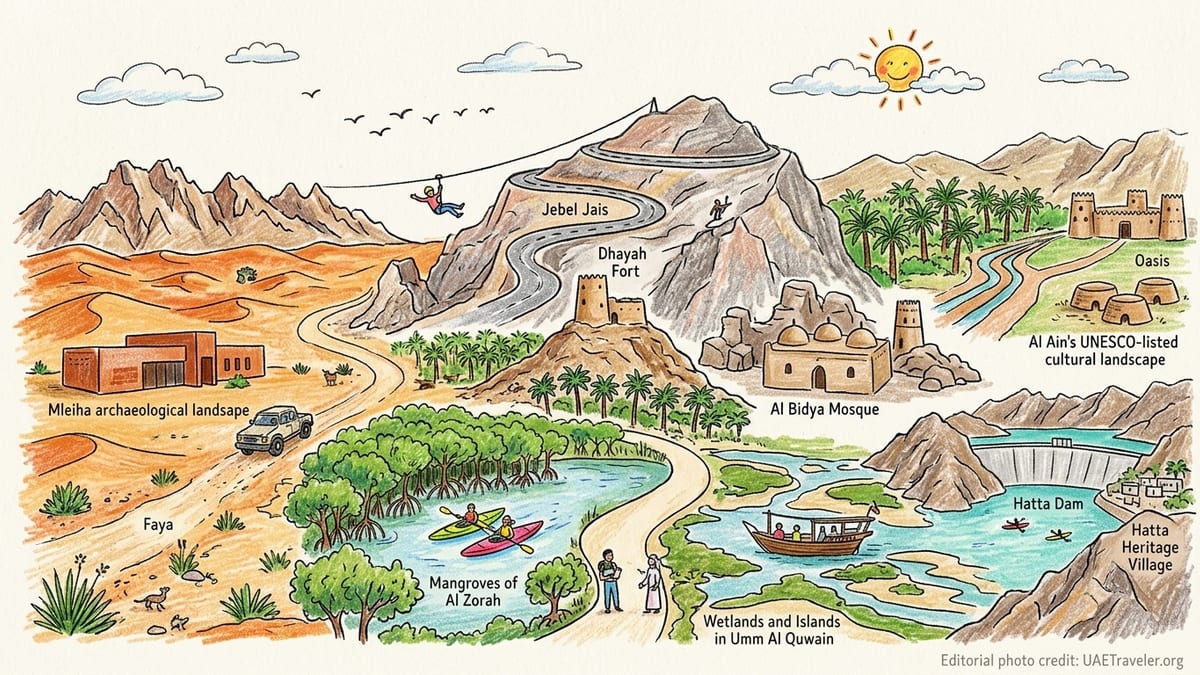
Mleiha and the Faya Archaeological Landscape, Sharjah
The road to Mleiha leaves the coastal sprawl of Sharjah and slides inland toward the Hajar Mountains. Within forty minutes the tower blocks thin out and the sand changes colour, deepening to a burnt orange that glows, especially in late afternoon light. As you approach the Mleiha Archaeological Centre, low dunes start to wrap around the tarmac and the jagged Faya mountain ridge rises sharply on your right. The building itself is a low, rust-coloured structure that seems to grow out of the desert, which already feels like a different planet from Dubai’s polished waterfronts.
Inside, the centre’s galleries trace human settlement in this landscape across many thousands of years, from Bronze Age tombs to pre-Islamic trade routes. Exhibits are compact but thoughtfully curated, and the real highlight begins once you step back outside with a guide. A short drive in a 4x4 leads to archaeological sites in the Faya area that are still being studied, along with famous natural landmarks such as Fossil Rock and Camel Rock. Mleiha is not on the UNESCO World Heritage List, but its archaeology is widely recognised as nationally significant and Sharjah authorities are developing the broader Mleiha National Park as a protected heritage landscape.
Mleiha Archaeological Centre generally opens from late morning to evening, though hours can shift slightly season by season, so it is worth checking exact timings shortly before you travel. Admissions to the museum itself are modest, and the real cost decision is which tour to book. Guided excursions by the official Mleiha team typically start around the price of a casual city attraction and increase for sunset desert drives or stargazing packages that include dinner in the dunes. From my own visit, the evening archaeological and desert tour felt worth the extra money, particularly because the guide handled all access permissions, driving on soft sand and interpretation at the sites.
If I could change anything about my first trip to Mleiha, it would be the amount of time I allowed. I gave it half a day, which was enough to see the centre and drive to one viewpoint, but it did not allow for slower walks among the dunes or for the dedicated hiking trails that have been mapped into the Faya range. Next time I would stay overnight in Sharjah city or in one of the desert camps associated with Mleiha and devote a full day to the plateau. The best months to do this are between November and March, when daytime temperatures are far more forgiving and the desert wind can feel unexpectedly cool by sunset.
Kayaking the Mangroves of Al Zorah, Ajman
Al Zorah lies just north of Ajman city, a planned community wrapped around a tidal lagoon and a protected mangrove forest. Driving in from Dubai, you stay on the main coastal highway before turning toward the water, where new apartment blocks quickly give way to a silvery boardwalk and an expanse of low green trees. These are the mangroves of Al Zorah, where the sounds of traffic fade into birdsong and the splash of paddles on water.
Several licensed operators run kayak and stand-up paddleboard tours within the Al Zorah reserve. Current published rates for a guided mangrove paddle in 2026 sit roughly in the three-digit dirham range per adult, depending on the length of the trip and whether it includes transfers or refreshments. Family-sized sit-on-top kayaks and tandem boats are the norm, and most tours last between 90 minutes and two hours on the water. Life jackets are provided, and for visitors who are not confident paddlers, sitting in the front while a guide or stronger companion steers is an easy way to experience the reserve.
On the water, the terrain is a maze of narrow channels between tall mangrove roots and open pools that mirror the sky. On my late winter visit, the air was cool enough for a light jacket at the 8am departure, and the creeks were full of birdlife. Flocks of flamingos fed in the shallows, while herons lifted off from the banks as we approached. The only sounds were the scrape of the paddle, the buzz of distant construction and the calls of birds echoing across the water. This felt like a part of the UAE that many residents never see, even though it sits within an hour of the country’s biggest city.
Al Zorah’s mangroves are a designated nature reserve rather than a UNESCO site, and operators are careful to keep groups small and to avoid loud music or landing in sensitive areas. The main restrictions are simple: no swimming, no littering and no bringing pets on the water. The best season for kayaking is between November and April, when midday temperatures are reasonable and morning trips can be comfortably cool. There are resorts and serviced apartments around the lagoon, but you can just as easily stay in Ajman city or even in northern Dubai and drive in for a half-day outing. If you can, time your visit for a mid-tide morning, when channels are passable but birds are still feeding in relatively shallow water.
Quiet Wetlands and Islands in Umm Al Quwain
Umm Al Quwain is the quietest of the northern emirates, a small stretch of coast where the highway narrows, fishing harbours line the khors and the skyline is mostly low-rise. The wetlands north of the main town are a patchwork of mangrove islands, tidal creeks and sandbars that feel almost forgotten compared with Dubai’s engineered waterfronts. Driving in from Sharjah, I left the main road toward the old town and mosque, then followed signs for boat tours that slip into the back channels behind the peninsula.
The experience here is looser and more old-fashioned than in Al Zorah. Several operators run traditional boats and simple kayaks into the wetlands, often from small jetties beside basic cafes or camps. Prices for a shared boat trip are usually lower than in Ajman or Dubai, with per-person rates that sit closer to a modest local excursion than a high-end tour. It is important, however, to ask about life jackets, group size and exact route before you step aboard, as standards and offerings vary. Some companies focus on mangrove birdwatching, while others combine a crossing of the lagoon with time on sandy islets used for casual camping and barbecues.
Out on the water, Umm Al Quwain feels even quieter than Ajman. There is less surrounding development, and once you leave the main channel you can easily lose sight of the town entirely. My strongest memory is of the late-afternoon light turning the water to a metallic grey-blue while small fish jumped around the boat and a line of cormorants roosted on a half-submerged sandbar. The tide runs strongly here and many channels dry to mudflats, so tours are heavily tide-dependent. If there was one thing I underestimated, it was how long transfers and waiting for the correct tide would take. In the end, what I had imagined as a two-hour side trip expanded into most of an afternoon.
Umm Al Quwain’s wetlands are not yet under a widely publicised international protection scheme, but they serve as important habitat for seabirds and marine life, and local authorities have started to promote the area as an eco-tourism zone. Sensitive behaviour here matters: avoiding loud music, taking all rubbish back to shore and resisting the temptation to disturb wildlife on the sandbanks are simple, practical steps. Accommodation options remain limited to a small number of beach resorts and budget hotels, so many visitors base themselves in another emirate and drive in. For a relaxed, low-key experience, a half day is enough, but if birdwatching or camping on the islands appeals, arriving early and planning for a full day around the tides is wise.
Jebel Jais and Dhayah Fort, Ras Al Khaimah
The drive to Jebel Jais, the UAE’s highest mountain road, is an experience in itself. Leaving Ras Al Khaimah city, the route passes date farms and gravel plains before climbing into the Hajar range on a well-engineered, winding road. Trucks give way to families in compact cars and motorbikes that weave from viewpoint to viewpoint. Higher up, the air cools noticeably and the smell of hot tarmac is replaced by crisp mountain air mixed with the aroma of food trucks brewing coffee at the viewing decks.
Nearing the top, a viewing park offers wide platforms overlooking a canyon of limestone ridges. Here, operators run Jais Flight, promoted as one of the world’s longest ziplines at over two kilometres in length, reaching high speeds over the ravine. Official fact sheets from Ras Al Khaimah’s tourism authority describe a cluster of experiences on the mountain, from zipline adventures to hiking trails and a survival-themed camp lower down the slopes. As of 2026 there have been periodic operational updates, so anyone planning to visit specifically for the zipline or for driving all the way to the upper decks should check the latest status and any booking requirements or road access rules shortly before travelling.
My own visit focused less on adrenaline and more on the mountain environment itself. Walking out along the viewing platforms near sunset, temperatures were several degrees lower than on the coast and a wind sharpened as the sun dropped behind the opposite ridge. The terrain here is rugged and stony rather than lush, but the scale of the canyon and the shifting bands of colour in the rock make it unforgettable. Allow at least half a day if you are driving from Dubai or Abu Dhabi, and more if you plan to hike designated trails or add a zipline slot, which typically occupies a good portion of the afternoon when including check-in, safety briefings and waiting times.
Back at sea level, Dhayah Fort offers a different kind of elevation. Located amid date palm groves north of Ras Al Khaimah city, this small hilltop fort is the country’s last surviving traditional hill fort and is included on the UNESCO Tentative List rather than being an inscribed World Heritage Site. Reaching it involves climbing a long flight of stone steps that zigzag up a rocky mound. In the middle of the day, in warm months, this can feel punishing, and there is no artificial lighting on the upper paths, so officials advise visiting in daylight. When I visited in the late afternoon of January, the low sun turned the palm gardens below a vivid green, and the view stretched across the mangrove-fringed creeks to the sea on one side and the mountains on the other.
The fort itself is small but atmospheric, with simple outer walls, corner towers and a compact courtyard. Entry is currently free, and there is limited shade at the top, so water, a hat and decent footwear are essential. A realistic visit time for Dhayah Fort alone is about an hour, including the climb and photo stops, but combining it with a wider loop through the neighbouring villages and into the mountains can easily fill half a day. Accommodation in Ras Al Khaimah ranges from large beachfront resorts on artificial islands to smaller hotels in town; staying overnight makes it easier to see both Jebel Jais and Dhayah Fort without rushing.
Al Bidya Mosque and Fujairah’s Coastal Villages
Driving along the east coast toward Fujairah, the geography shifts from the flat deserts of the Gulf side to a narrow strip of villages squeezed between mountains and the Arabian Sea. Fishing boats line pebbly beaches, and small mosques stand almost at the water’s edge. Just north of Fujairah city, Al Bidya Mosque sits on a low rise, surrounded by rocky outcrops and a scattering of watchtowers. Widely regarded as one of the oldest mosques in the UAE, it is a compact structure of mud and stone with four squat domes and a simple interior that can only accommodate a small group of worshippers at a time.
Arriving here around mid-morning, the air was already warm, but the interior of the mosque remained cool and dim, lit mostly by small windows and the open doorway. The call to prayer from nearby minarets rolled in across the village, and the traffic on the main road felt oddly distant. Non-Muslim visitors are generally welcome outside of prayer times as long as they dress modestly, remove shoes and avoid entering during busy Friday midday prayers. There is no formal admission fee, though small donations for site upkeep are appreciated, and photography of the exterior is widely accepted while interior photography should be kept respectful and discreet.
From Al Bidya, the coastal road continues past small villages toward Dibba and the craggy inlets of the Musandam Peninsula. Simple guesthouses, apartment hotels and a handful of beach resorts are spread along this stretch, many of which can arrange boat trips for snorkelling, fishing or coastal cruising. The atmosphere is low-key and local. In the evenings, families gather on the roadside promenades while fishermen haul in nets by hand. My mistake on the first trip was treating Al Bidya as a quick roadside pause. In reality, slowing down to climb the nearby watchtowers, walk parts of the shoreline and linger in local cafes turned it into one of the most memorable parts of the journey.
The east coast is not a UNESCO site, but its mix of tangible heritage and everyday coastal life gives a sense of the Emirates as they were before the rise of mega-projects. Plan at least a half day if you are coming from Dubai and want to include swimming or boat trips, and a full day if you aim to reach the frontier of Musandam and back. The best months are again between November and April, when the sea is pleasant and the coastal humidity is manageable.
Al Ain: Oases, Forts and a UNESCO-Listed Cultural Landscape
Al Ain, on the inland border with Oman, is often described as the “Garden City” of the UAE. It feels different from any other emirate capital, with wide tree-lined avenues, low-rise neighbourhoods and, most striking of all, a chain of date-palm oases woven into the urban fabric. The Cultural Sites of Al Ain, including Hafit, Hili, Bidaa Bint Saud and the oasis areas, were inscribed as the UAE’s first UNESCO World Heritage Site in 2011. This recognition reflects thousands of years of human settlement, visible in Bronze Age tombs, mud-brick forts and the still-functioning falaj irrigation channels that feed the palms.
The easiest place to feel this history is Al Ain Oasis in the city centre. Entering from a modern street, you step immediately into deep shade, where tall palms block the sun and narrow earthen paths lead between plots of cultivated land. Interpretive panels explain how water is allocated and channelled, while the soft trickle of the falaj contrasts with the relative quiet of the city beyond the walls. On my latest visit, in early spring, the oasis paths were several degrees cooler than the street, and the only sounds were birds, the distant hum of traffic and the occasional clip-clop of a bicycle as a local gardener cycled by.
Nearby, historic sites such as Al Jahili Fort and Qasr Al Muwaiji have been carefully restored as museums. These adobe fortresses once guarded caravan routes and oasis communities, and today they host exhibitions on the ruling family and on the broader history of the region. Entry to these sites is often free or set at a nominal charge, reflecting their role as cultural institutions rather than commercial attractions. Together with the oasis itself, they justify at least a full day in Al Ain for travellers who are interested in history, architecture and a slower, greener side of the country.
Al Ain’s UNESCO status sometimes causes confusion. The listing applies not just to individual buildings but to a cultural landscape encompassing archaeological sites, ancient tombs, irrigation technology and oases. It is different from a nature reserve designation, although the palm groves and nearby Jebel Hafit mountain do support distinct ecosystems. Practical restrictions for visitors are straightforward: respect private agricultural plots, avoid climbing on fragile walls and follow any photography guidance in mosque or palace areas. Al Ain is easily reached by road from Abu Dhabi or Dubai in around two hours, and there is a good range of city hotels, from international chains to smaller local properties. Because there is a lot of walking in the oases and forts, cooler months from November through March are by far the most comfortable time to visit.
Hatta: Cool Air, Trails and Dam Waters in Dubai’s Highlands
Hatta lies in a mountain enclave of Dubai, reached by a highway that leaves the city and threads between rocky ridges toward the Omani border. Roadside dunes give way to rugged hills, and by the time you reach Hatta town the air is usually several degrees cooler than on the coast. The town itself feels more like a rural mountain settlement than a global city outpost, with low villas, a restored heritage village and rocky wadis cutting between outcrops. For residents of Dubai and Abu Dhabi, it has become a favourite weekend escape for exactly these reasons.
Hatta Dam is the area’s visual centrepiece. A short drive from town, the road climbs past a small heritage park and then curves across the top of a concrete dam. On one side, steep ochre cliffs rise directly from a narrow turquoise reservoir. Operators at the waterfront rent kayaks, pedal boats and small electric craft, with published prices in 2026 for basic kayaks starting from around a mid-range two-digit sum per hour. You cannot currently bring your own kayak or board, so all equipment comes from the official concession on site, which simplifies logistics but means you should be prepared to queue at busy weekend times.
Out on the water, the reservoir is usually calm, and sound carries sharply between the cliffs. When I visited on a winter weekday morning, the sky was a soft blue, and apart from the splash of paddles and the occasional shout from a group of friends, the scene was quiet. In summer, the same basin turns hot and glaring by mid-morning, and while the kayak operator often continues to run, many other outdoor activities in Hatta close or scale back from late May through early autumn because of heat. The best conditions for mixed hiking and paddling are between November and March.
Beyond the dam, Hatta has developed a network of marked hiking and mountain biking trails that start near a central adventure hub. There are routes suitable for families as well as more technical tracks for experienced riders, and the total signed distance now runs to several dozen kilometres. Accommodation ranges from a comfortable hotel near Hatta Fort to glamping trailers and cabins, which can be booked as part of packages that include guided activities. My single-night stay felt too short; with one more day, I would have added a longer hike into the surrounding hills and a slow afternoon in the heritage village, which is often bypassed in the rush to the dam.
Planning Time and Seasons Across These Hidden Gems
Across these destinations, the most important planning lesson is that travel time and heat shape everything. Distances on the map look short, yet even with excellent roads it can take an hour or more to clear urban traffic and reach open desert or mountains. Mleiha and Al Zorah work well as half-day trips from Dubai or Sharjah, but combining both in a single day would leave little time for walking, paddling or lingering in cafes. Jebel Jais and Al Ain each deserve a full day if you are coming from another emirate, and Hatta rewards at least one night to do more than a single kayak session.
Seasonally, November to March is when these areas are at their best. Daytime highs are often in the mid-twenties Celsius rather than the forties, and evenings in the mountains can even feel chilly. This makes climbing to Dhayah Fort, walking in Al Ain’s oases or hiking in Hatta genuinely enjoyable. By contrast, in peak summer, midday visits to exposed sites become uncomfortable and sometimes unsafe, and activity operators may shorten hours or close particular trails. If your travel dates fall in the warmer months, targeting early morning and late afternoon slots, wearing sun protection and carrying plenty of water become non-negotiable habits.
In terms of access and restrictions, none of the places in this guide require special permits for general sightseeing, but there are practical rules to respect. In mosques such as Al Bidya, modest dress and avoidance of prayer times are expected. In oases and villages, visitors should not enter private farmland without permission. In mangrove reserves and mountain areas, staying on marked routes and following guides’ instructions helps protect both the environment and your own safety. Where UNESCO designations apply, such as in Al Ain, they mostly influence conservation and management rather than visitor procedures, but they underscore the importance of treading lightly.
The Takeaway
If your image of the UAE is defined by choreographed fountains and mirrored skyscrapers, days spent in Mleiha, Al Zorah, Umm Al Quwain, Ras Al Khaimah, Fujairah, Al Ain and Hatta will quietly rewrite that picture. These places smell of date palms and sea air, sound like wind in the mountains and birds in the mangroves, and look out over horizons where no tower interrupts the view. They also demand a slightly different style of travel. You need to rent a car or book a driver, start early, bring layers for cool evenings and, above all, leave space in your itinerary for unscripted stops.
From my own journeys, a few experiences stand out as worth planning an entire day around. A full day in Al Ain, combining Al Ain Oasis, Al Jahili Fort and a sunset drive toward Jebel Hafit, reveals a side of the country that is as green and historic as it is modern. Another day devoted to Jebel Jais and Dhayah Fort, with time to linger at viewpoints and in palm groves, delivers both mountain drama and intimate heritage. In Dubai’s own highlands, two unhurried days in Hatta, mixing dam paddling, trail hikes and time in the heritage village, feel like a mini-break from the coast.
Paid tours that genuinely improved access or understanding were those that opened up complex landscapes rather than simply transferring me from hotel to viewpoint. In Mleiha, a guided archaeological and desert tour made sense of layers of history that would have been invisible from a rental car. In the Al Zorah and Umm Al Quwain wetlands, going with licensed kayak or boat operators who knew the tides and birdlife turned a basic paddle into a quiet masterclass on the coastal ecosystem. On Jebel Jais, booking an organised adventure package or survival course helped manage safety on exposed terrain. None of these erased the sense of discovery. Instead, they created the conditions for it, leaving space to notice the colour of the rock, the shape of the clouds and the sound of wind through palm fronds in a country that more often makes headlines for its glass and steel.
FAQ
Q1. Are these destinations suitable for first-time visitors to the UAE who are based in Dubai?
Yes, all of these places can be reached by road from Dubai, and several such as Mleiha, Al Zorah and Hatta are popular as first forays beyond the city. The main considerations are allowing enough driving time and, if you are not comfortable driving, booking organised tours or private transfers in advance.
Q2. Do I need a 4x4 vehicle to visit Mleiha, Jebel Jais or Hatta?
For the main visitor centres, viewing platforms and town areas, a regular saloon or small SUV is usually sufficient in good weather. However, if you plan to leave the paved roads for desert tracks near Mleiha or for remote wadis near Hatta, a proper 4x4 and an experienced driver are essential, which is why many travellers opt for guided tours for those sections.
Q3. Which of these places are official UNESCO World Heritage Sites?
Only the Cultural Sites of Al Ain, which include Al Ain Oasis, Hafit, Hili, Bidaa Bint Saud and associated oases, are inscribed as a UNESCO World Heritage Site. Dhayah Fort is listed on the UNESCO Tentative List, while Mleiha, Hatta, Al Zorah, Umm Al Quwain’s wetlands and Al Bidya are nationally important but not part of a UNESCO World Heritage listing.
Q4. When is the best time of year to visit these mountain, mangrove and heritage sites?
The most comfortable period is from November to March, when daytime temperatures are generally much lower and outdoor activities such as hiking, kayaking and climbing fort steps are pleasant. Shoulder months on either side can also work if you focus on early mornings and late afternoons and avoid midday heat.
Q5. How much should I budget for activities like kayaking and guided tours?
Kayak rentals at Hatta Dam or Al Zorah typically start in the lower to mid double digits in dirhams per person for an hour, while guided mangrove or archaeological tours are usually priced in the low to mid hundreds of dirhams depending on duration and inclusions. Many forts and oases either charge nominal entrance fees or are free, so the main costs tend to be transport, equipment rental and specialist guiding.
Q6. Can I visit mosques like Al Bidya Mosque if I am not Muslim?
Non-Muslim visitors are generally welcome at Al Bidya Mosque outside of prayer times, provided they dress modestly, remove their shoes before entering and behave respectfully. It is advisable to avoid visiting during busy Friday midday prayers and to follow any on-site guidance about photography, particularly inside.
Q7. Is swimming allowed in the mangroves and wetlands around Ajman and Umm Al Quwain?
Swimming is usually not permitted within protected mangrove reserves such as Al Zorah, where the focus is on low-impact activities like kayaking and birdwatching. In Umm Al Quwain, some boat trips stop at sandy islets where paddling in shallow water may be allowed, but it is important to follow your operator’s instructions to avoid disturbing wildlife and sensitive habitats.
Q8. How many days should I plan if I want to see most of these hidden gems?
If you are based in Dubai or Abu Dhabi, a compact but rewarding itinerary would be at least five to seven days, allowing one day each for Al Ain, Ras Al Khaimah’s Jebel Jais and Dhayah Fort, Hatta, the Fujairah coast and Al Bidya Mosque, and separate half days for Mleiha and the mangroves of Al Zorah or Umm Al Quwain. Adding extra days gives more flexibility for weather and rest.
Q9. Are these destinations family-friendly for children and older travellers?
Yes, with some adjustments. Oases, forts with moderate stair climbs, coastal villages and calm kayak trips can be very enjoyable for children and older visitors, especially in cooler months. Very steep climbs, long hikes or high-adrenaline activities on Jebel Jais may not suit all ages or fitness levels, so families often combine gentler walks and picnics with shorter, less demanding activities.
Q10. Do I need to book tours and activities in advance, or can I arrange everything on arrival?
For popular activities with capacity limits, such as zipline experiences on Jebel Jais or weekend kayaking sessions at Hatta Dam and Al Zorah, advance booking is strongly recommended, especially in the peak winter season and on public holidays. For more open sites such as oases, forts and coastal villages, you can generally visit without reservations, though confirming opening hours shortly before you go is still sensible.