

Before this trip, my mental picture of the United Arab Emirates was all glass towers, rooftop pools and five-star hotel lobbies. Spending a full day between Old Dubai around the Creek and Abu Dhabi’s Qasr Al Hosn district rewired that image. On foot, in restored courtyard houses and cool stone corridors, crossing the Creek on a wooden abra and sipping bitter Emirati coffee inside a centuries-old fort, I found two very different ways the country tells its story: one through the bustle of trade and migration, the other through a watchtower that grew into a seat of power.
Setting the Scene: Two Capitals, Two Gateways to the Past
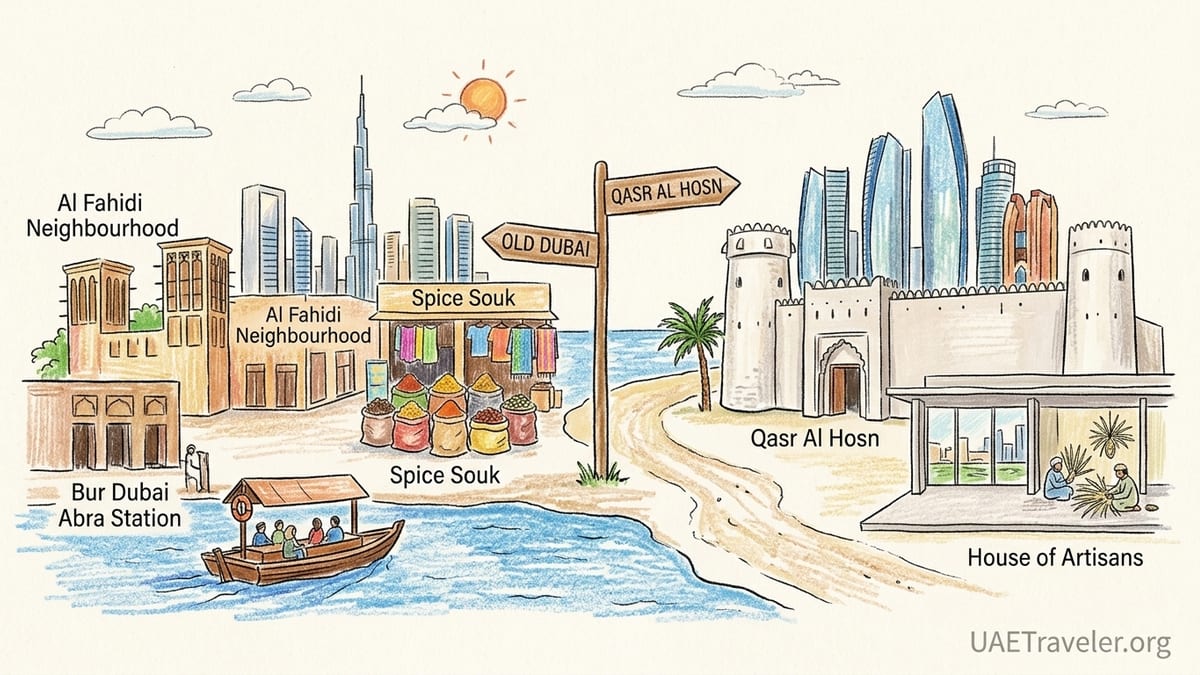
I split my time deliberately: around six hours tracing the lanes of Al Fahidi, the Textile and Spice Souks and the abra crossings of Dubai Creek, then another half day in Abu Dhabi at Qasr Al Hosn, the House of Artisans and the Cultural Foundation next door. On a map, the two heritage areas sit barely 140 kilometres apart. In reality, they feel like two different chapters of the same book: Dubai’s chapter about merchants and migration, Abu Dhabi’s about water, protection and rule.
In Dubai, I started in Bur Dubai, the historic district south of the Creek, walking from the Al Fahidi Metro area into the Al Fahidi Historical Neighbourhood. Here, the skyscrapers recede and the city shrinks to the scale of courtyard houses, wind towers and sand-colored alleys. Just across the water in Deira, the Spice and Textile Souks still line narrow lanes that smell of cardamom and oud. The Creek itself, once a natural inlet that drew traders and pearl divers, remains the spine that holds these fragments together.
Abu Dhabi’s story is organized around a single landmark. Qasr Al Hosn, originally a watchtower built in the 18th century to guard a freshwater well, later expanded into a coral-stone fort and the home of the Al Nahyan ruling family, now stands amid the glass of downtown. The surrounding Qasr Al Hosn site weaves in the House of Artisans and the Cultural Foundation, so that within a few minutes’ walk you move from defensive architecture to soft palm-weave mats and contemporary galleries.
Experiencing both in the same trip made it easier to see a pattern. Old Dubai preserves the feel of a port and marketplace, where customs and architecture evolved with each new trader who arrived by dhow. Abu Dhabi’s heritage core preserves the moment a tribal settlement became a capital, when control of water and tribal alliances mattered as much as pearl beds offshore.
Walking Al Fahidi: Lanes, Wind Towers and Daily Life Before Oil
My Old Dubai morning began inside Al Fahidi, the compact historic quarter along the Creek. The houses here are restored, but they follow historic layouts: high outer walls for privacy, central courtyards for light and ventilation, and wind towers designed to catch breezes and funnel them down into rooms before air conditioning existed. It takes only a few turns off the main path to realize how carefully the district has been curated, yet it still offers genuine corners of quiet shade where a ceiling fan hums over a small art gallery or café.
I joined a scheduled cultural session at a local cultural centre inside one of the traditional houses. Seated on floor cushions around low tables in a shaded courtyard, an Emirati host talked us through daily life along Dubai Creek before oil revenues transformed the city. She spoke about families that divided their year between the coast and inland date-palm areas, the limited but vital freshwater resources, and how the Creek enabled long-distance trade despite the harsh climate. It was one thing to read that Dubai once relied on pearls and re-export trade; hearing a local describe how her grandfather worked in the pearling season, or how her grandmother used wind towers and thick coral-stone walls to keep rooms cool, made the district’s architecture feel less like a backdrop and more like a tool for survival.
In one room, black-and-white photographs showed the Creek crowded with wooden dhows long before today’s cargo ports. Another display traced the shift from natural pearls to Japanese cultured pearls in the early twentieth century, and how the collapse of traditional pearling pushed Dubai to invest heavily in turning its Creek into a deeper, more efficient port. These explanations connected directly to the view a short walk away, where wooden abras still carry people between the banks and cargo dhows load goods at the wharf.
Al Fahidi’s galleries and cafés add a contemporary layer. I stepped into a small calligraphy gallery housed in a restored courtyard home, where the thick walls and simple wooden doors have been preserved. The owner, a long-time resident, explained that many of these houses were once home to merchants who traded with Iran, India and East Africa. He pointed out a wind tower and noted how similar structures appear across the Gulf and southern Iran, a reminder that Old Dubai’s history is as much about regional exchange as it is about local tradition.
Crossing Dubai Creek by Abra and Meeting the Souks
Leaving Al Fahidi, I walked past the simple Bur Dubai waterfront, where wooden abras line up at the Bur Dubai Abra Station. There is little ceremony: you step onto a low, open boat, hand the boatman 1 dirham in cash and sit shoulder to shoulder with commuters and tourists. The crossing to Deira on the north bank takes about five minutes, but it felt like a time capsule. The breeze off the water, the engine noise, the sight of cargo dhows loaded with boxes bound for Iran or East Africa all reinforce that the Creek remains a working artery, not just a scenic canal.
On the Deira side, I walked inland a few minutes to the Spice Souk. Stalls spill sacks of saffron-colored threads, dried limes, cinnamon sticks and hibiscus petals onto the lane. Here the preservation is less architectural and more atmospheric. Shopkeepers call out in Arabic, Urdu, Hindi and English. One vendor offered a small paper cup of sweet karkadeh tea while explaining the difference between Iranian and Spanish saffron. After ten minutes of smelling and tasting, I bought a modest mix: 50 grams of mixed spices for machboos, a local rice dish, and a small bag of dried limes, paying around 25 dirhams in total. The vendor wrote cooking tips on a scrap of paper and insisted I should call the souk “Dubai’s open kitchen.”
A short walk away, along covered alleys where fabric hangs in bright cascades, I reached the Textile Souk area. Although many of the buildings here have been reconstructed or modernized, their footprint follows earlier souk layouts that grew up in the nineteenth century, when Dubai’s rulers encouraged foreign traders to settle near the Creek. Here I bargained gently for a length of lightweight cotton in a geometric motif suitable for a simple shirt, paying about 40 dirhams after a friendly exchange that involved tea, laughter and a calculator. The transaction felt undeniably commercial, but it echoed how trade has always worked along the Creek: negotiation framed by hospitality.
The purchases themselves were modest. What stayed with me more was how the abra and the souks illustrated Dubai’s early urban development. Without the Creek, there would have been no reason for merchants from Persia or India to settle in such numbers on these banks. The souks’ dense layouts, with shops back-to-back and lanes narrowed for shade, show how scarce space was along the water and how valuable proximity to the mooring points remained. Even as high-rise towers loom in the distance, the abra’s 1-dirham fare and the hand-painted shop signs in the souk remind you that this is where the city’s habit of trading anything, with anyone, first took shape.
What Old Dubai Gets Right (and Where It Feels Commercial)
As a visitor, I found Old Dubai’s interpretation of history powerful precisely because it is layered over everyday life. The abra is both a living transport system and an echo of older crossings. The Creek still hosts working dhows that move goods along Gulf and Indian Ocean routes. The souks remain places where real residents buy spices, fabrics and everyday items, even if tourist shops selling magnets and pashminas have crept into the mix.
At the same time, there is no denying a commercial sheen. Certain parts of the Textile Souk in particular felt like a continuous sales pitch, with aggressive invitations to buy brand-name knockoffs and trinkets. In narrower lanes, touts attempted to press watches and perfumes into my hands. These encounters do not invalidate the area’s historical importance, but they do shape its mood. You are often treated as a customer first, an interested listener second.
Architecturally, Al Fahidi is one of the most evocative spots in the city. The careful restoration of plasterwork, wooden doors and wind towers, along with discreet signage, helps convey how the quarters may have looked a century ago. Some visitors may wish for more in-depth explanation panels on the walls or inside houses, but the combination of guided cultural sessions and self-guided wandering works reasonably well for those who are willing to ask questions.
In terms of cost, Old Dubai is accessible. My half-day across Al Fahidi and the souks, including two abra crossings, a cultural session with refreshments, a simple lunch in a local eatery and small spice and fabric purchases, came to roughly 150 to 180 dirhams. Most of that went to food and souvenirs. Entrance to the lanes is free, the abra fare remains very low, and you can calibrate spending according to appetite and bargaining skills.
Inside Qasr Al Hosn: A Fort That Watched a City Grow
Abu Dhabi’s Qasr Al Hosn could not feel more different. I arrived late morning and stepped into a wide open plaza of pale stone and sand, the fort’s white walls and corner towers rising against a skyline of modern glass. The contrast is intentional. Where Old Dubai stretches along the Creek, Qasr Al Hosn compresses Abu Dhabi’s story into one enclosure.
After buying a ticket at the visitor centre, which cost 30 dirhams and also granted access to allied experiences, I entered through a shaded corridor into the older inner fort. Here, coral and sea stone blocks, covered with lime render, form thick walls pierced by small windows. The first exhibits trace how the fort began in the 1760s as a watchtower guarding a freshwater well, crucial in a region where permanent water sources were rare. Panels and artifacts explain how the tower expanded into a defensive fort and then, under later rulers, into a residential and administrative palace.
Walking through open courtyards, I saw majlis rooms where rulers received tribal leaders and foreign envoys, modest family quarters, and narrow staircases leading up to defensive positions. One exhibit focused on the decline of the pearling economy and the period of hardship that followed, then on the transformative impact of oil concessions and exports in the twentieth century. Here the narrative is explicitly political and institutional: Qasr Al Hosn is positioned as the heart of decision-making that guided Abu Dhabi from a small settlement to the capital of a new federation.
Unlike Old Dubai, where the Creek and souks still operate as part of the urban economy, Qasr Al Hosn functions first as a curated museum. The rooms display documents, maps, photographs and personal items from members of the ruling family. Audio-visual installations play oral histories and historic footage, including scenes of the surrounding area when it was still sand and sea. Guides stationed in key rooms answered questions about architectural details and family histories, lending a human voice to what could otherwise feel like a static monument.
House of Artisans and Coffee: Crafts Still Practiced by Hand
Just outside the main fort complex, the House of Artisans focuses on traditional Emirati crafts. Entry was included in my ticket. Inside, I found a series of light-filled rooms where craftspeople demonstrated weaving, palm-leaf work and embroidery. The atmosphere was much quieter than the Dubai souks. Here, artisans sat on floor cushions or low stools, working steadily while a few visitors watched and asked questions.
In one corner, an older woman showed Al Sadu weaving, a traditional Bedouin craft that produces geometric patterns on woolen textiles used for tents, cushions and camel trappings. She worked a narrow loom, hands moving with practiced rhythm as she explained, through an interpreter, how certain patterns are associated with specific tribes or regions. The bright reds and blacks of her textile contrasted strongly with the pale interior around her, making it clear how such pieces brought color into desert life.
Nearby, two women prepared and demonstrated palm-leaf weaving, known as safeefah. Strips of dried palm fronds were braided and coiled into baskets, mats and simple containers, objects that once held dates, grains and household goods. Watching their hands work, I realized this was the first time on the trip I had seen palm-leaf work up close rather than as decorative props in a hotel lobby. The artisans spoke softly but with pride about learning from older relatives and about continuing to teach the craft today, often in workshops for school groups.
In another room, a specialist in Talli, or traditional embroidery, worked with metallic threads on a small stand to create intricate trims that once edged women’s garments. She showed how the work requires a careful, even tension and considerable patience. Here, the historical interpretation was less about dates and more about continuity: these crafts still exist, even if many households now buy factory-made equivalents.
Afterwards, I followed signs to a small Bait Al Gahwa area linked to the Qasr Al Hosn complex, where staff demonstrated the ceremonial preparation and serving of Emirati coffee. Roasted beans were ground in front of us, cardamom added, and the pale, fragrant coffee poured into small finjan cups and served with dates. The host explained how offering coffee in a specific sequence remains a marker of hospitality and respect, especially during important gatherings. This coffee moment, tasted inside a historic site, helped connect the political history of the fort to everyday social customs.
The Cultural Foundation: From Archives of Power to Public Culture
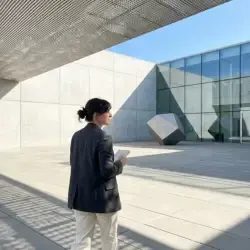
From Qasr Al Hosn’s courtyard it is a short walk to the Cultural Foundation, a low modernist building that predates many of Abu Dhabi’s newest glass towers. Entry to its galleries and reading areas was free during my visit. Inside, cool halls housed temporary art exhibitions by regional artists, a children’s library and performance spaces. Large windows frame views back to the fort, reinforcing that the site is meant to be experienced as a cultural campus rather than an isolated monument.
Compared with Old Dubai’s organic mix of merchants’ houses and souks, the Cultural Foundation feels planned, almost institutional. Yet it plays an important role in how Abu Dhabi presents its past. Exhibition panels referenced the city’s transformation from a pearling and fishing settlement to an oil-rich capital, while contemporary artworks examined themes of memory, migration and landscape. One installation used archive photos of the fort and early city blocks alongside recordings of residents talking about their first encounters with paved roads or high-rise apartments.
Spending time here after walking through Qasr Al Hosn and the House of Artisans underscored Abu Dhabi’s narrative strategy. The story is not only about rulers and treaties but also about how that history produced a modern cultural scene. While Old Dubai weaves its history into functioning markets, Abu Dhabi uses this triangle of fort, artisan house and cultural centre to frame history as a foundation for national identity.
Costs in Abu Dhabi’s heritage core are easy to track. The 30-dirham ticket covered Qasr Al Hosn and affiliated experiences. The House of Artisans and Cultural Foundation did not require additional payment for basic entry. A simple local lunch and coffee in the area added another 60 to 70 dirhams. Compared to many big-city museums around the world, the value felt high, especially given the quality of restoration and interpretation.
Comparing Preservation, Interpretation and Atmosphere
Seeing Old Dubai and Qasr Al Hosn back to back highlighted how differently the two cities approach their past. In Dubai, preservation centres on fabric and function: alleys, courtyards, wind towers and traditional boats are maintained or reconstructed, but much of the storytelling happens informally, through conversations with guides, shopkeepers and cultural hosts. In Abu Dhabi, preservation focuses intently on a single emblematic structure, with a clear narrative about rulers, state formation and national heritage, supported by labels, timelines and curated displays.
Architecturally, both sites are compelling. Al Fahidi’s low-rise coral stone and gypsum buildings feel intimate and human-scaled, inviting aimless wandering and serendipitous finds. Qasr Al Hosn, by contrast, feels monumental despite its modest footprint, in part because of the wide open plaza that isolates it from surrounding towers. The materials in Abu Dhabi’s fort, from coral stone to lime renders, are visibly older and more fragile, and this is reflected in the careful conservation approach. Dubai’s restorations are more robust, able to host cafés, galleries and small hotels without obvious strain.
Guide quality and interpretation differ as well. My cultural session in Al Fahidi was conversational and personal, with a strong focus on social customs, food and family life. In Qasr Al Hosn, staff members were well-informed about dates, rulers and construction phases, and clearly trained to explain broader political and economic shifts. Together, they provided complementary views: one rooted in everyday experience, the other in governance and statecraft.
Crowding and commercialization were more noticeable along Dubai Creek. At peak times, the lanes around the Spice and Textile Souks can feel dense, and persistent sales pitches may test the patience of some visitors. Qasr Al Hosn, by comparison, felt calm even in mid-afternoon, with spacious courtyards and manageable visitor numbers. There are gift shops selling books, crafts and souvenirs, but they are peripheral to the experience rather than woven into every corridor.
Spending, Accessibility and the Taste of Place
Tracking costs across both cities revealed another contrast. In Old Dubai, my spending was fragmented: 1 dirham for each abra ride, 25 dirhams for spices, 40 dirhams for fabric, around 40 dirhams for a plate of chicken machboos and a fresh juice in a small Creek-side restaurant, plus coffee and a snack in Al Fahidi for about 20 dirhams. Altogether, my half-day came to around 150 to 180 dirhams, much of it in small cash transactions. There is no central ticket office controlling the experience; you simply move from one micro-transaction to another.
In Abu Dhabi’s Qasr Al Hosn district, my expenses felt more centralized. The 30-dirham ticket unlocked most of what I wanted to see. Inside, there were opportunities to pay extra for specialized workshops, but the weaving and palm-leaf demonstrations I watched were included. A coffee and dessert in a nearby café cost roughly 35 dirhams, and a simple Emirati-style lunch added another 30 to 40 dirhams. The full half-day experience cost slightly less than Old Dubai overall, despite offering more structured interpretation.
Accessibility is reasonably good in both areas, though with caveats. Old Dubai’s narrow alleys and uneven surfaces may challenge visitors with mobility issues, and some abra boats require stepping down from the quay without railings. Shade exists, but the layout is organic rather than designed for comfort. Qasr Al Hosn, on the other hand, benefits from modern planning. Ramps, wide paths and air-conditioned galleries make it easier to navigate for a broader range of visitors, including families with strollers and those who rely on wheelchairs or walking aids.
Food punctuated both days and grounded the history in sensory memory. In Dubai, the machboos rice, served with tender chicken and garnished with fried onions, tasted of the spice mix I had seen and purchased earlier in the souk. In Abu Dhabi, the small finjan of cardamom coffee and soft dates in the Bait Al Gahwa area turned abstract talk of hospitality into something you could taste. Between plates and cups, the UAE’s past felt less like words on a panel and more like something living and shared.
The Takeaway
By the end of these two half days, I no longer thought of the UAE as a uniform landscape of glass and highways. Old Dubai left me with the story of a slender inlet that attracted traders, pearl divers and migrants, a place where a 1-dirham boat ride still connects neighborhoods shaped by centuries of exchange. Qasr Al Hosn, in turn, etched into my mind the image of a watchtower guarding water, slowly expanding into a fort, then into the nerve centre of a new state that would eventually channel oil wealth into schools, hospitals and cultural institutions.
The strongest cultural encounter in Dubai happened not in a museum but in a souk stall, when a spice seller showed me how to crush dried limes between my fingers to release their aroma, then mapped out on a scrap of paper how families might use similar mixes at home. It was a moment of generosity born of trade. In Abu Dhabi, it was the quiet of the weaving room in the House of Artisans, where the gentle clack of the loom and the focus in the artisan’s eyes suggested a continuity that predates both oil and skyscrapers.
If I had more time on a future trip, I would likely return to Old Dubai to walk the lanes of Al Fahidi at different times of day, perhaps joining additional cultural meals or coffee sessions to deepen my understanding of Creek-side life. I would also gladly revisit Qasr Al Hosn, particularly when new exhibitions rotate through the Cultural Foundation or when special craft workshops open to visitors. Together, these heritage districts show that the UAE’s past is not a single story. It is a series of meeting points between sea and desert, trade and rule, survival and ambition, all still evident if you know where to walk and which doors to step through.
FAQ
Q1. How much time should I plan for Old Dubai around the Creek?
Plan at least half a day, around four to six hours, to walk Al Fahidi, cross the Creek by abra and explore at least one or two souks without rushing.
Q2. What does an abra ride across Dubai Creek cost?
The standard wooden abra used by commuters typically costs about 1 dirham per person each way, paid in cash directly to the boat operator.
Q3. Are the Al Fahidi Historical Neighbourhood and souks free to enter?
Yes, you can walk through Al Fahidi and the nearby Textile and Spice Souks without an entrance fee, though specific museums or cultural sessions may charge.
Q4. How much is the ticket for Qasr Al Hosn in Abu Dhabi?
A standard adult ticket for Qasr Al Hosn is around 30 dirhams and usually includes access to associated areas such as the House of Artisans.
Q5. Is the House of Artisans included in the Qasr Al Hosn visit?
Yes, entry to the House of Artisans is included with the main Qasr Al Hosn ticket, though some specialized workshops or events may cost extra.
Q6. Which heritage area is better for visitors with limited mobility?
Qasr Al Hosn and its plaza generally offer better accessibility, with ramps and smoother paths, while Old Dubai’s narrow alleys and boats can be more challenging.
Q7. Can I buy authentic local crafts at Qasr Al Hosn?
Yes, there are opportunities to buy items such as woven textiles, palm-leaf baskets or embroidered pieces linked to the crafts demonstrated at the House of Artisans.
Q8. Is Old Dubai very touristy compared to Qasr Al Hosn?
Old Dubai, especially the Textile and Spice Souks, feels more commercial and tourist-oriented, while Qasr Al Hosn has a calmer, museum-like atmosphere.
Q9. What should I wear when visiting these heritage sites?
Both areas are relatively informal, but modest clothing that covers shoulders and knees is recommended out of respect and for comfort in the sun.
Q10. If I can only choose one, should I visit Old Dubai or Qasr Al Hosn?
Choose Old Dubai if you want living markets and abra rides, and Qasr Al Hosn if you prefer a structured, museum-style journey through political and social history.