


When glossy brochures talk about an “unforgettable night on the water” in the United Arab Emirates, they usually mean one of two things: a dinner cruise in Dubai Marina or a dhow-style evening along Abu Dhabi’s seafront. Over two consecutive weekends in 2026, I booked broadly comparable, midrange dinner cruises in both cities, avoiding ultra-premium megayachts on one side and rock-bottom budget boats on the other. I wanted a fair, first-person comparison of what your evening actually feels like: the boarding, the skyline, the crowd, the food, the music and the value for money when you add up tickets, transport and drinks for two adults.
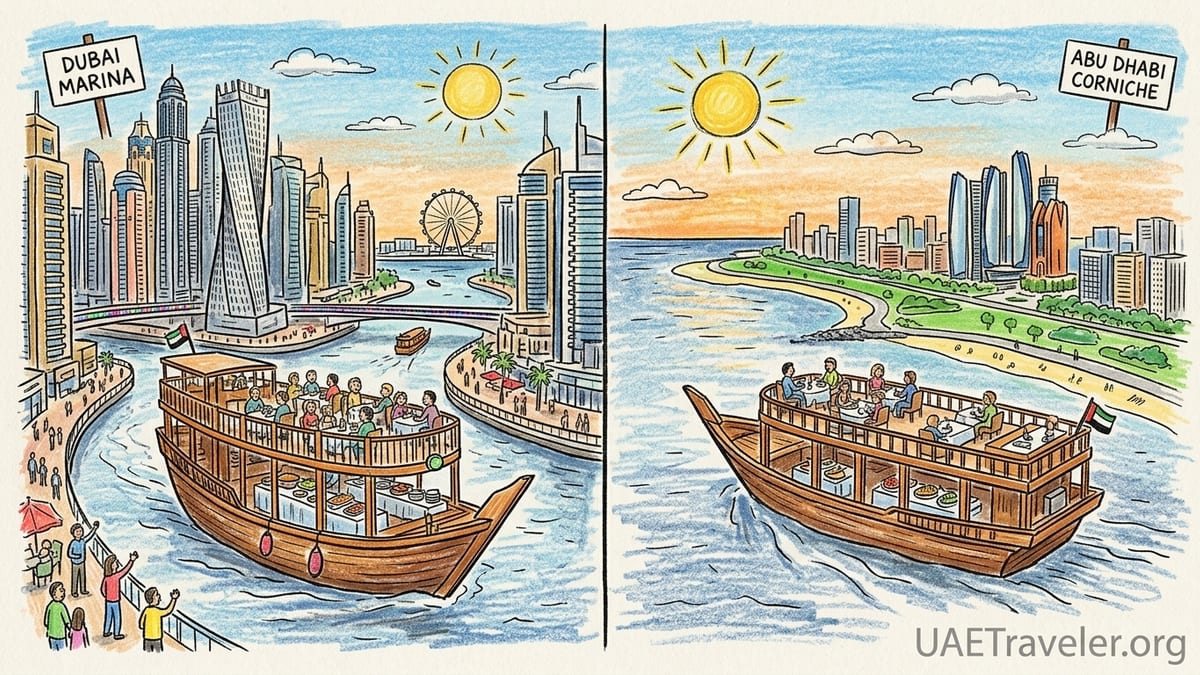
Choosing Like-for-Like Cruises in Two Very Different Cities
To make this comparison meaningful, I set a few rules. First, I had to book shared, scheduled dinner cruises, not private charters. Second, I chose midrange options in both cities rather than pairing a luxury megayacht in Dubai with a bargain-basement boat in Abu Dhabi. Finally, the boats needed to be roughly similar in style and inclusions, with a buffet dinner, soft drinks and outdoor seating on an upper deck.
In Dubai Marina I chose a traditional wooden dhow operating the standard evening dinner route from the Marina Mall and Pier 7 area, sold at around 150 to 200 dirhams per adult including buffet dinner and soft drinks, with a two hour cruise window from roughly 8:30 to 10:30 p.m. Multiple operators, from independent outfits to larger brands, now follow that format, cruising past Marina towers, Jumeirah Beach Residences, Bluewaters Island and the Ain Dubai wheel when sea conditions allow.
For Abu Dhabi, classic Corniche-based dhow cruises have become less common, with many wooden boats now working out of Yas Island marinas or offering private charters. I specifically sought a scheduled dinner cruise that still used the Corniche as its backdrop and boarded from the main island side, not Yas. That led me to a wooden-boat dinner product marketed through Abu Dhabi tour companies as a Corniche evening cruise, using a traditional-style vessel with an air-conditioned lower deck and open upper deck, priced close to 150 to 170 dirhams per adult for a two hour sailing with buffet and soft drinks.
Those choices gave me two comparable evenings: wooden boats, shared tables, international buffets, soft drinks included and around two hours on the water. What differed, as I quickly learned, was everything else, from the route and crowd size to boarding efficiency and the feeling on deck once the city lights came on.
Boarding and First Impressions: Pier 7 vs Corniche Port
On the night of my Dubai Marina cruise, I arrived by taxi at Dubai Marina Mall and walked to the Pier 7 boarding area. Many operators here use the same stretch of quay behind the Pier 7 restaurant building, so the waterfront was already busy forty minutes before departure. Staff stood with clipboards and handheld signs, calling out company names and departure times above the hum of evening traffic and the thump of music from nearby yachts.
Check-in itself was straightforward. After giving my name and booking reference, I received a colored sticker to indicate my operator and deck preference. Boarding began about forty-five minutes before the scheduled 8:30 p.m. sailing, but the atmosphere felt more like a mini festival than a quiet embarkation. Several dhows and yachts were loading side by side, with guests snapping selfies against the twisting Cayan Tower and the illuminated walls of Marina Mall. It was exciting but slightly chaotic, and the pier grew crowded as latecomers rushed in the last fifteen minutes.
Abu Dhabi’s Corniche boarding felt the opposite. My taxi dropped me near the small marina area along the Corniche road, where the tour operator had specified a clear meeting point beside a low building by the water. Only one boat was loading at that time. A representative with a printed manifest checked passports and names against the booking, handed us simple wristbands and invited everyone to sit on benches facing the water until the crew finished preparations.
Instead of neon lights and pop music from neighboring boats, the soundscape was mostly the slap of small waves and the distant hum of cars along the Corniche. Boarding started about thirty minutes before departure and moved calmly, with small groups guided across the gangway one by one. There was no jostling at the ramp and no sense of multiple cruises competing for the same space. My first impression was that Dubai offered spectacle from the moment you stepped onto the pier, while Abu Dhabi delivered something more understated and orderly.
Routes, Skylines and On-the-Water Atmosphere
Once we left the dock in Dubai Marina, the route immediately felt cinematic. The dhow slipped past tower after tower, their glass facades reflecting in the marina water like a river of neon. We glided beneath footbridges trimmed with LED strips, past alfresco restaurants filled with diners, and along the inward-curving canal where high-rises pressed close on both sides. Cameras and phones appeared at nearly every table as the boat made slow progress toward the open water.
Our captain steered out toward the mouth of the marina, giving everyone views of Jumeirah Beach Residences and the row of hotels facing the shoreline. Beyond, we traced a line along the edge of Bluewaters Island, with the vast black circle of Ain Dubai rising over the boat. Even though the wheel has not been operating, it still dominates the skyline, and from the open upper deck I could feel the sea breeze coming off the Gulf and see the darker expanse of water beyond the developed coastline.
On Abu Dhabi’s Corniche cruise, the feeling was very different. After casting off from the small port, we followed a gently curving route that kept the Corniche skyline on one side and the breakwater and offshore islands on the other. The buildings in Abu Dhabi do not crowd right up to the water in the same way as Dubai Marina, and long stretches of landscaped corniche, parks and walking paths sat between the towers and the sea. The effect from the boat was more horizontal and spacious, with clusters of mid and high-rise towers separated by open dark patches of public beach and parkland.
As twilight faded, familiar silhouettes appeared on the horizon, including the Etihad Towers cluster and the outlines of older office buildings on Abu Dhabi Island. Streetlights along the Corniche drew long golden lines on the water, but the skyline never wrapped around the vessel the way Dubai’s does. The atmosphere on deck matched that. Conversations stayed low, there was almost no engine roar once we settled into cruising speed, and, unlike in Dubai, I could hear the wind and water more clearly than the music.
Buffets, Drinks and Service Quality
For many travelers, the dinner itself can be the deciding factor, so I paid close attention to both buffets. On the Dubai Marina dhow, the dinner service began roughly thirty minutes into the cruise. The crew announced that the buffet was open, and a queue quickly snaked from the serving area on the lower deck up the staircase. The operator offered a standard international spread: mixed salads, hummus, bread rolls, grilled chicken, a fish dish, vegetable curry, rice and a small dessert table with bite-sized cakes and fruit. Soft drinks and water were self-service from large dispensers, while tea and coffee were poured by staff toward the end of the meal.
The food quality in Dubai was solid but clearly batch-catered, closer to a busy three or low four star hotel buffet than a fine dining restaurant. Hot dishes were replenished regularly, but at peak time the line moved slowly, and I waited about fifteen minutes from joining the queue to sitting back down with a plate. That delay was the main downside of the evening. Once back at my table on the open upper deck, I enjoyed the meal more. Eating chicken skewers and basmati rice while skyscrapers slid by felt satisfyingly on-theme for a “Dubai at night” experience.
In Abu Dhabi, the buffet opened slightly later, about forty minutes into the cruise, and the announcement was more measured. Guests were invited to come by table number, which avoided the long single queue I had seen in Dubai. The dishes were broadly similar: salads, mezze items like hummus and moutabal, grilled meats, baked fish, a vegetarian main and rice, followed by simple desserts and fruit. Soft drinks and water were again included, but here staff offered to bring refills to the table, which reduced traffic near the buffet area.
While the range was slightly smaller in Abu Dhabi, I found the food marginally better seasoned, particularly the grilled fish and mezze. Because the boat carried fewer passengers than my Dubai dhow, nothing sat for long in the trays, and the kitchen had an easier time keeping everything at the right temperature. I never queued more than a few minutes, and the crew had time for small interactions, asking if we wanted extra bread or more tea. The service felt more attentive overall, helped by the quieter onboard atmosphere and lower passenger count.
Music, Entertainment and Crowd Levels
The Dubai Marina cruise leaned confidently into entertainment. As soon as most guests had passed through the buffet line, a recorded soundtrack of chart music and Arabic pop filled the open upper deck, occasionally mixed with announcements about photo opportunities. A traditional Tanoura dancer later performed on the lower deck, spinning in a brightly lit skirt to applause and phones held high. People moved around constantly between decks, seeking better camera angles of the skyline or trying to record short clips of the show.
The crowd on my Dubai night skewed international and energetic: families from South Asia, couples from Europe, small groups of friends and tour groups from multiple countries. Tables on the upper deck were arranged tightly to maximize capacity, with little privacy between parties, and every available outdoor chair seemed filled by the time we reached the mouth of the marina. It was easy to chat with neighbors, share tips on Dubai attractions and exchange toasts with nearby tables, but it did not feel secluded or particularly calm.
Abu Dhabi’s Corniche cruise presented a softer soundscape. There was background music, but it stayed at a conversational volume, mostly instrumental tracks and low-key Arabic songs. There was no live dance performance and no aggressive upselling of souvenir photographs. Instead, the entertainment came from the shifting city lights, the slow passage of other small boats and the glow of the Corniche road curving around the island.
The guest mix in Abu Dhabi was more local and regional, with several Emirati families, expatriate residents and a handful of tourists. The upper deck tables were spaced further apart, and even at peak time a few chairs remained empty. I could talk without raising my voice, and at one point there was a comfortable lull where almost everyone sat quietly, watching the skyline instead of their phones. If Dubai Marina felt like an open-air dinner party, Abu Dhabi resembled a relaxed waterfront restaurant that happened to be moving.
Boats, Seating and Whether the Upper Deck Was Worth It
Both cruises used traditional-style wooden boats, often described locally as dhows, although many have been significantly upgraded from their trading-boat origins. In Dubai, my vessel had an air-conditioned lower deck enclosed in glass and an open upper deck with simple metal-framed chairs and square tables. Lighting on the exterior was bright, with LED strips tracing the railings and colorful spotlights pointed back at the hull, which looked impressive from the pier but slightly reduced the night vision from the deck.
I had preselected upper deck seating when I booked, paying a modest supplement compared with the standard ticket that may have placed me on the lower deck if the boat filled. On boarding, staff directed me straight up the metal staircase and allowed some freedom in choosing a table within the open area. The upgrade felt justified. The lower deck carried most of the buffet and dance activity and would have offered air conditioning but limited photo angles through the windows. On the upper deck I had uninterrupted views of towers and shoreline, at the price of warm, humid air and a higher noise level from neighboring tables.
On the Abu Dhabi cruise, the boat’s lower deck was also enclosed and air-conditioned, but the lighting outside was more subdued. The upper deck featured wooden chairs and slightly larger tables spaced more generously along the railings. My booking did not charge a separate upper deck fee but did confirm outdoor seating in advance, and staff again guided us upstairs on arrival. There was a looser hierarchy on this cruise: guests could move between decks as they pleased, and the boat never felt full enough to trigger a battle for rail-side seats.
Comparing both evenings, paying extra for the upper deck in Dubai made a clear difference to my experience. The marina’s signature is its close-up vertical skyline, and that is best enjoyed from an open deck. In Abu Dhabi, because the skyline sits further back from the water and the atmosphere is quieter overall, the distinction between decks mattered less. I would still choose outdoor seating for the breeze and open views, but I would not feel compelled to pay a significant premium for it unless traveling in peak season when humidity or heat might make the air-conditioned lower deck more appealing.
Time on the Water, Delays, Cleanliness and Photography
In Dubai Marina, official timings stated two hours on the water, boarding from around 8:00 p.m., departure at 8:30 and return at 10:30. In practice, we slipped the lines about ten minutes late as a few final guests hurried down the pier, and we were back at the quay just after 10:35 p.m. That meant roughly one hour and fifty-five minutes between departure and docking, which matched the advertised duration closely. The slight delay did not affect the feeling of a full evening, especially since the busy boarding area already felt like part of the experience.
Abu Dhabi’s Corniche cruise promised a similar two hour window, and it kept to schedule almost exactly. The boat left within five minutes of the planned time and returned with only a brief pause near the port to allow another small vessel to clear the berth. From a timing perspective, both products delivered what they sold, though Abu Dhabi’s cruise felt marginally more punctual and less reactive to late arrivals.
Cleanliness on both boats was generally good. The Dubai dhow’s bathrooms were compact but serviceable, and staff made visible efforts to clear tables and wipe surfaces between buffet waves. That said, with a larger passenger load, there were unavoidable signs of heavy use: napkins needing prompt collection, one soft drink dispenser briefly running low, and a short queue for handwashing at peak buffet time. Abu Dhabi’s smaller guest count again played in its favor. Shared spaces stayed tidy throughout, and the crew seemed to anticipate needs before they became visible issues, refilling water jugs and removing used plates quickly.
For photography, Dubai Marina clearly had the edge in drama. From the open upper deck, it was easy to capture frames of stacked towers, architectural landmarks like the twisting Cayan Tower and the sweep of JBR and Bluewaters in the background. The challenge was movement, both from the boat and from other guests shifting around the railing to shoot their own footage. Tripods would have been impractical, but handheld smartphone photos came out surprisingly well thanks to abundant artificial light. In Abu Dhabi, photos had a softer, more understated quality. The skyline receded slightly into the background, and images tended to be wider, with more sky and water. It suited couples and travelers seeking calmer, more romantic frames rather than pulse-quick city shots.
What It All Cost for Two Adults
Because value for money matters, I tracked what each evening cost for two adults from hotel door to boat and back, using real prices current in late 2026. In Dubai Marina, my midrange dhow dinner ticket including buffet and soft drinks cost the equivalent of about 200 dirhams per adult when booked directly through a reputable operator’s website, placing it squarely in the midrange bracket between budget offers around 130 to 170 dirhams and premium megayacht dinners that can run from roughly 249 to more than 400 dirhams per person.
I paid a small supplement for confirmed upper deck seating, taking the per person ticket closer to the middle of that range. Shared hotel transfers in Dubai, when added, often run between 30 and 40 dirhams per person return from central areas. For two adults, my all-in Dubai Marina evening including upper deck upgrade and shared transfer came to just under 500 dirhams before any optional extras. Alcoholic drinks were not included, and a couple of paid beverages on board quickly added another modest amount to the total.
In Abu Dhabi, the Corniche dinner cruise ticket was slightly cheaper per person, sitting in the band of around 150 to 170 dirhams including buffet and soft drinks. There was no separate line item for upper deck, which kept the pricing simpler. Because the boarding point was closer to my city hotel than Pier 7 had been to my Dubai accommodation, taxi fares were lower and there was no need for a packaged transfer. The result was that two adult tickets plus return taxis stayed noticeably under the figure I had paid in Dubai, even before drinks.
Neither cruise felt overpriced for what it offered, but the Dubai Marina product clearly allocates more of your money to the high-impact skyline route, busier entertainment and higher operating costs in a very dense waterfront district. Abu Dhabi’s Corniche boat provided a calmer, slightly shorter-feeling experience at a lower all-in outlay, which will appeal to travelers who want a pleasant night on the water without turning it into the centerpiece splurge of their trip.
The More Romantic Evening and the Views I Still Remember
When I look back on these two nights, the most vivid single view belongs to Dubai. Standing at the rail as our dhow glided out of the narrow marina channel and the towers rose on both sides felt undeniably spectacular. The overlapping reflections on the water, the humming bridges and the sudden opening toward JBR and Bluewaters created a sense of scale that no still photo in a brochure quite prepares you for. If your priority is to feel you are at the heart of a futuristic city, Dubai Marina delivers that emotion instantly.
Yet the evening I would call more romantic took place in Abu Dhabi. On the Corniche cruise there was more space between tables, fewer loud conversations and a greater emphasis on the skyline as a backdrop rather than the main show. At one point, as we passed a section of parkland with only dim lights on shore, the sound dropped enough that I could hear cutlery and the faint clink of glasses, and couples along the rail simply watched the city glow at a distance. It felt less like a tour and more like a date night that happened to be afloat.
For couples choosing a honeymoon or anniversary activity, the decision may come down to personality. If you enjoy energy, music and the feeling of being surrounded by architecture, the Dubai Marina cruise has a clear edge. If you prefer quieter conversations and a skyline that stays just far enough away to frame the evening rather than dominate it, Abu Dhabi’s Corniche route is likely to suit you better.
As for the meal itself, Abu Dhabi narrowly wins on flavor and service, while Dubai offers a slightly wider selection and livelier buffet atmosphere. Onboard cleanliness, staff friendliness and overall organization were strong on both sides, with Abu Dhabi again benefiting from a smaller crowd and Dubai impressing through practiced efficiency in a very busy marina.
The Takeaway
So which evening on the water did I enjoy more: Dubai Marina or Abu Dhabi Corniche? If I judge purely by visual impact, Dubai Marina takes the crown. The combination of tightly packed towers, illuminated bridges and the sweep of JBR and Bluewaters felt like a distilled version of the modern Dubai image that fills travel magazines. The route gave me dozens of memorable photographs and a constant sense of motion and spectacle.
However, when I consider the full experience from the moment I left my hotel to the moment I returned, Abu Dhabi’s Corniche dinner cruise quietly edged ahead. The calmer boarding, the uncrowded upper deck, the more personal service and the slightly better-seasoned food all combined into a night that felt less like a group excursion and more like an intimate waterfront dinner. It also cost a bit less once transport and drinks were factored in, without feeling like a compromise.
If I had just one evening in the region and wanted to check an iconic experience off my list, I would probably choose the Dubai Marina dhow first. It delivers the postcard skyline and high energy that many visitors associate with the Emirates. But if I were living in the country or returning as a repeat visitor looking for a slower, more romantic night, I would book the Abu Dhabi Corniche cruise again, or even consider a simple waterfront restaurant along the Corniche with outdoor seating and sunset views.
In the end, both cities offer worthwhile evenings on the water, but in different keys. Dubai plays on volume and spectacle, Abu Dhabi on space and serenity. Knowing which tune you prefer before you book will do more for your trip than any marketing slogan, and it will help you decide whether your perfect night afloat involves a packed upper deck of excited visitors or a quieter table for two watching the city lights from a gentle distance.
FAQ
Q1. Is the Dubai Marina dinner cruise worth it for first-time visitors?
For a first visit, the Dubai Marina dinner cruise is a strong choice because it combines a classic buffet experience with some of the most dramatic nighttime skyline views in the city, including the towers around Pier 7, JBR and Bluewaters.
Q2. How much should two adults budget for a midrange Dubai Marina dinner cruise?
For two adults on a midrange wooden-boat dinner cruise in Dubai Marina, expect to budget around the mid hundreds of dirhams in total once you include tickets with buffet and soft drinks, an upper deck supplement if you choose it, shared transfers or taxis and a couple of paid drinks.
Q3. Are Abu Dhabi Corniche dinner cruises still available, or have they all moved to Yas Island?
Classic Corniche-based dhow departures are less common than they once were, and several operators now favor Yas Island marinas, but some tour companies still sell Corniche-focused evening cruises using traditional-style boats that keep the main island skyline in view for much of the route.
Q4. Which cruise feels more romantic for couples?
While Dubai Marina offers a more spectacular skyline, many couples may find the Abu Dhabi Corniche cruise more romantic because it is generally quieter, carries fewer passengers and allows for more private-feeling conversations on deck.
Q5. Do I really need to pay extra for upper deck or premium seating?
In Dubai Marina, paying a bit more to secure outdoor upper deck seating can significantly improve your experience, as it gives you unobstructed views of the towers and shoreline. On the Abu Dhabi Corniche route, the difference between decks is less dramatic, so an upgrade is helpful but not essential unless the boat is close to full capacity.
Q6. How long do the cruises actually last on the water?
Both Dubai Marina and Abu Dhabi Corniche dinner cruises typically plan for about two hours of sailing time in the evening, with boarding starting roughly thirty to forty-five minutes before departure and only small variations caused by port traffic or late-arriving guests.
Q7. What should I wear for these dinner cruises?
Smart casual clothing works well for both cruises. Lightweight fabrics are best in the Gulf climate, and it is sensible to carry a light layer in the cooler months and wear comfortable shoes for boarding ramps and moving between decks.
Q8. Are alcoholic drinks included in the ticket price?
On most midrange wooden-boat dinner cruises in both Dubai and Abu Dhabi, the base ticket includes a buffet meal and unlimited soft drinks and water, while alcoholic beverages, if available, are sold separately as individual drinks or part of higher-tier packages.
Q9. Is it easy to take good photos during the cruise?
Dubai Marina is especially photogenic thanks to its dense high-rise skyline and bright lights, which help smartphone cameras perform well in low light. Abu Dhabi’s Corniche produces gentler, wider skyline shots, and both routes provide plenty of opportunities to capture reflections on the water and city silhouettes.
Q10. If I do not like boats, is there an alternative evening waterfront experience?
If you prefer to stay on land, both Dubai and Abu Dhabi offer excellent waterfront promenades and seafront restaurants, including terraces along Dubai Marina and outdoor dining spots on Abu Dhabi’s Corniche, where you can enjoy city and water views without boarding a vessel.