


Standing above Dubai in the Burj Khalifa and above Abu Dhabi in the Observation Deck at 300 within Conrad Abu Dhabi Etihad Towers delivers two very different versions of the same idea: seeing the UAE from the sky. I paid for tickets to both, rode the elevators, joined the queues and kept notes on what I actually saw, what it cost, and how each experience felt in real time. This is a ground-level comparison of two high-altitude icons for travelers deciding where to spend their time and money.
How I Planned and What I Paid for Both Cities
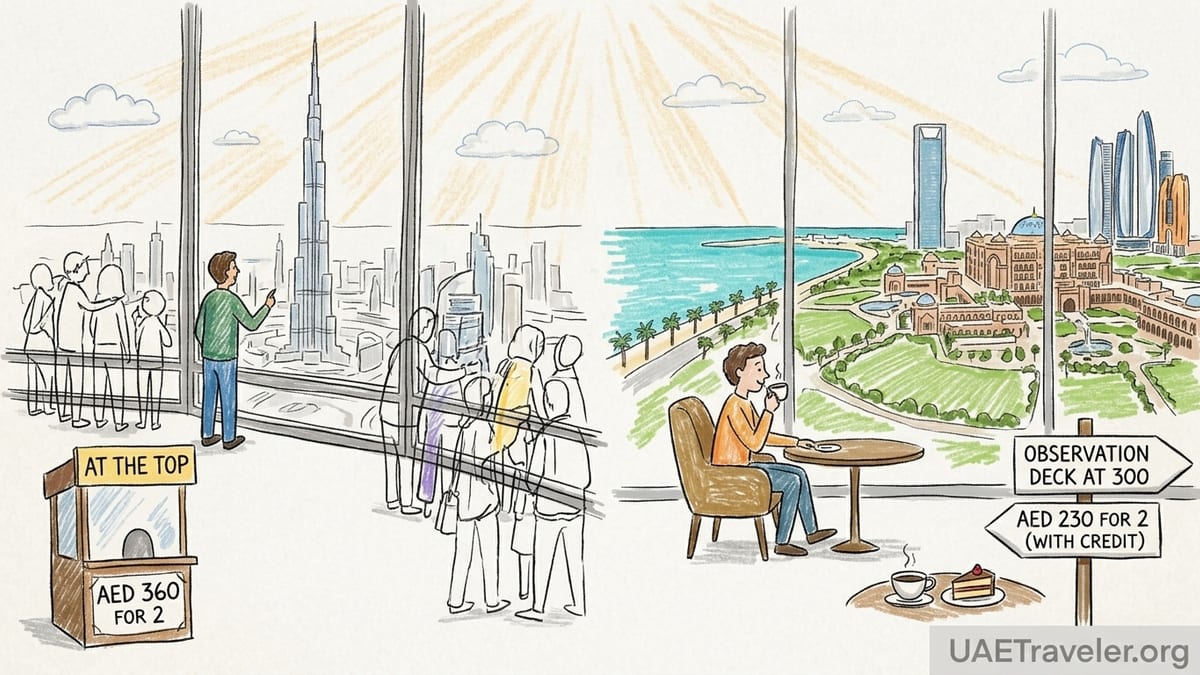
For a fair comparison, I booked standard daytime experiences in both Dubai and Abu Dhabi, within the same October week, to keep weather and seasonal haze as similar as possible. In Dubai, I chose the popular "At The Top" ticket for levels 124 and 125 of Burj Khalifa, booked through the official channel in advance. On the day I checked, non-prime hours were priced around AED 179 per adult for the 124/125 floors, with sunset and evening time slots higher. For two adults that meant roughly AED 360 before transport or refreshments.
In Abu Dhabi, I booked direct access to the Observation Deck at 300 at Conrad Abu Dhabi Etihad Towers. The official rate when I visited was AED 95 per adult, including a food and beverage credit of approximately AED 50 to AED 55 that had to be used on-site the same day. Children aged 6 to 11 paid a reduced fee without credit, and younger children entered free. Two adults, therefore, came to AED 190 total, effectively reduced once we used the included credit on drinks and snacks.
Transport added a noticeable difference to the final bill. In Dubai, I used the Red Line metro to Burj Khalifa / Dubai Mall station, then walked the air-conditioned internal link to the mall. The metro fare for two from a central hotel area came to roughly AED 16 return, plus some extra for a short taxi back after dinner. In Abu Dhabi, where metro options are not available, I used a taxi from the Corniche area to Conrad Abu Dhabi Etihad Towers and back, spending about AED 40 to AED 50 in total. When I added up two observation deck tickets and basic transport in each city, Dubai came in near AED 400 for two adults, while Abu Dhabi was closer to AED 230.
I did not bundle either experience with tours or third-party passes because I wanted control over time slots and to see the real base prices. Third-party resellers often fold in transfers or extras, but they can obscure what you are actually paying for the view itself. Booking directly allowed me to track exact entry costs and then separately count what I spent on food, coffee and souvenirs in both places.
Arriving at Burj Khalifa: Dubai Mall, Wayfinding and Queues
The Burj Khalifa visit starts long before you see an elevator. From the Burj Khalifa / Dubai Mall metro station, I followed the covered, air-conditioned walkway into Dubai Mall, a walk of roughly 10 to 15 minutes at a normal pace. Inside the mall, signs to "At The Top, Burj Khalifa" led down escalators towards the lower ground level near the Fashion Parking P1 area. Even before reaching the official entrance, the density of people increased noticeably as shoppers, fountain viewers and Burj visitors all funneled into the same area.
Security screening formed the first real queue. On a weekday mid-afternoon time slot, I waited about 15 minutes to pass through scanners and bag checks. After that came the ticket and time-slot verification and then another queue to enter the pre-show area. From the moment I left the main mall corridors to the moment I boarded the elevator, roughly 35 minutes had passed. Staff were visible and generally efficient, but the sheer number of visitors meant slow progress, particularly at the points where groups re-gathered after security.
The approach cleverly builds anticipation with multimedia displays that walk you through the construction of Burj Khalifa, its statistics and the surrounding Downtown Dubai development. It feels polished and choreographed, but also crowded. Families had to keep a close eye on children in the pushing and stopping flow, especially near bottlenecks where people clustered to photograph scale models and historic images.
If you are sensitive to crowds or traveling with very young children, this pre-elevator phase is where the experience begins to feel like a theme park attraction rather than a calm architectural visit. That contrast becomes important later when you compare it with how quietly the Observation Deck at 300 experience begins inside a hotel lobby in Abu Dhabi.
The Elevator Ride and Atmosphere at the Top of Burj Khalifa
From the boarding area, groups are ushered into high-speed elevators that are fully enclosed, with no external window views. Instead, digital projections on the interior walls offer an animated ascent that distracts you from rapidly changing pressure and the subtle popping in your ears. The lift accelerates smoothly, and the sense of speed is more in your stomach and ears than your eyes. The ride to level 124 takes around a minute, but the build-up and boarding make it feel more significant.
Stepping out onto level 124 felt like entering a viewing gallery already in full swing. The space wraps around the building, and the first impression is of floor-to-ceiling glass crowded with people pressing close for selfies. I visited under late-afternoon light, a couple of hours before sunset. The sky was pale blue but with a visible haze layer softening the horizon, something common in Dubai that flattens contrast and can wash out distant desert views.
Crowding along the windows is real. At peak moments, almost every pane had someone posing in front of it, and those trying simply to look out had to wait politely for gaps. The open-air terrace, reached through a short interior corridor, provided some relief. It is not a fully open deck but rather a partially open area with tall glass panels and slots for clearer views. Here, I could feel the wind and hear some street-level noise muted by height, which made the height feel more tangible than it did through the sealed glass.
The atmosphere overall was energetic but not especially serene. There were couples filming video montages, families juggling children and cameras, and tour groups listening to guides explain landmarks. In practical terms, the crowd made it harder to linger quietly at a single window. I found myself rotating around the level, grabbing a minute at one viewpoint before sidestepping to another. It was impressive to be in the tallest building in the world, but the feeling was more public event than personal retreat.
What I Actually Saw from Burj Khalifa and How Haze and Reflections Affected It
From the Burj Khalifa observation floors, Dubai spreads out in a series of clusters rather than as a single skyline. Directly below lies Downtown Dubai, with Dubai Fountain and the vast footprint of Dubai Mall clearly visible. Sheikh Zayed Road snakes away with its row of towers, and, on a clear day, you can see toward Business Bay and the outlines of older districts in the distance. The Arabian Gulf appears as a flat band of color beyond beachfront developments, though on my visit its edge blended into haze rather than forming a crisp horizon line.
Haze had the most impact on the more distant attractions. The Palm Jumeirah, which some visitors hope to see distinctly, was suggested more by patches of construction and clusters of towers than by a clear palm-shaped outline. Out in the desert direction, the sand-colored suburbs faded gradually into a beige band under the sky. The view directly downwards, however, was sharp. Watching tiny cars circle the tower base and the angular shadows of nearby buildings gave a strong sense of scale that no photograph quite prepares you for.
Inside, window reflections frequently interfered with photography. Bright interior lighting and the constant motion of visitors meant that glass often caught ghosted reflections of people, ceiling lights and display screens. To work around this, I had to press my camera lens very close to the glass and shield it with my hand, or step into small darker sections where interior lights were less intense. On the open terrace, the glass panels were cleaner from reflections, but you must shoot through gaps or accept lines and smudges as part of the composition.
Despite these challenges, the views are undeniably dramatic. The vertical drop from levels 124 and 125, around 450 meters above ground, translates into a wide angle across the entire urban core. Yet the combination of haze and reflections means that what you imagine beforehand, often from flawlessly edited marketing images, is more pristine than what you actually see in person. The experience is best when you treat it as a broad impressionistic panorama rather than expecting perfect postcard clarity in every direction.
Quiet Contrast: Reaching the Observation Deck at 300 in Abu Dhabi
The journey to the Observation Deck at 300 could not feel more different. Instead of navigating a mega-mall, visitors enter through the polished lobby of Conrad Abu Dhabi Etihad Towers on the West Corniche. From outside, the cluster of Etihad Towers sits almost directly opposite Emirates Palace and near the curve of the Corniche, which already hints at what you will see from above. I arrived by taxi and was dropped directly at the hotel entrance, where a short walk across the lobby brought me to signs for the deck.
A small reception desk checks your booking and collects payment if you have not prepaid. There was no airport-style security line, and on my weekday late-afternoon visit I waited less than five minutes from arrival at the desk to being escorted to the elevators. The entire process felt like entering a hotel lounge rather than a mass attraction. Staff were unhurried, and there was space to stand without being jostled, which set a noticeably calmer tone from the start.
The elevator to level 74 is a standard high-rise hotel lift rather than a themed ride. There is no light show or countdown, just a smooth vertical transition. Ear pressure changes slightly but far less intensely than in the Burj Khalifa because the deck is around 300 meters above ground, not around 450 meters or more. When the doors opened, I stepped into an enclosed, carpeted lounge ringed by floor-to-ceiling windows, with soft background music and the gentle clink of cups and plates from the café.
There was no fixed time limit printed on my ticket, and staff confirmed that visitors could stay as long as they liked within operating hours. This immediately changed how I moved through the space. Instead of rushing to the nearest empty window, I took a seat first, ordered a drink using the included credit, and then circled the windows slowly, knowing I had several unhurried hours if I wanted them.
The 360-degree Abu Dhabi View and How It Really Looked
The Observation Deck at 300 delivers a full 360-degree view of Abu Dhabi’s coastline, islands and city grid. One side looks directly down onto Emirates Palace and its lawns, with the road curling between the palace complex and the water. The contrast between the geometric glass towers and the low, sand-colored palatial architecture is striking at this height. You can also see the newer Emirates Palace Mandarin Oriental branding elements if you know where to look, though they are small from level 74.
Another stretch of windows frames the Corniche, the city’s waterfront promenade. From above, the Corniche Road runs like a bright ribbon beside the curve of manicured parks and beaches, which slope down to shallow turquoise water. The sheltered gulf here is calmer and a slightly different shade of blue than the open coastlines you may know from Dubai. Farther out, you can trace the outlines of Lulu Island and other low-lying islands that sit just off the city’s edge.
Looking inland reveals dense blocks of mid-rise and high-rise buildings, but unlike Dubai, the skyline is more horizontal than vertical from this viewpoint. The cityscape appears broader rather than dramatically tall, with clusters of administrative and commercial towers broken up by open spaces and wide roads. On my visit, the air clarity in Abu Dhabi was a touch better than it had been in Dubai earlier that week, which may have been simple luck with wind direction and humidity. Distant details such as cranes across the water and shipping movements were more visible, and the color contrast between sea, sand, road and glass read more strongly to the naked eye.
Because the deck is entirely enclosed, there is no wind and no open-air terrace. Window reflections still exist, especially behind the seating areas where lights and decorative fixtures show up faintly in the glass. However, the lower visitor volume and the ability to reposition chairs closer to certain windows made it easier to avoid strong reflections. By walking a few meters to darker corners of the lounge or pressing closer to the glass, I captured relatively clean photos of Emirates Palace, the Corniche and the island chain without fighting crowds for a narrow shooting gap.
Seating, Service and Real Value of the Food and Drink Credit
Seating is where the Observation Deck at 300 clearly pulls ahead. The main space is arranged like an upscale café, with a mix of armchairs, small sofas and window-side tables. Couples tended to gravitate to the two-seat tables right against the glass, while families chose larger clusters of chairs slightly back from the windows where children could sit, move around and share snacks. I saw several families settle in with strollers and young kids in a way that would be hard to imagine among the standing crowds at Burj Khalifa.
Each adult ticket included a food and beverage credit that, in practice, covered a quality coffee or soft drink plus a small pastry or shared snack. Two credits between us paid for an Americano, a latte and a slice of cake that we shared. Prices on the menu were higher than a typical street café but in line with hotel-lounge expectations, so the credit shaved a meaningful amount off what would otherwise have been a fairly expensive round. If you order only drinks, you can easily stay within the credit and pay nothing extra.
Beyond the numbers, the availability of seats changed how the visit felt. We spent close to 90 minutes on the deck, divided between sipping coffee, walking slow loops around the windows and simply sitting while watching the late-afternoon light shift across the water. Staff did not rush us, and the noise level remained low enough that quiet conversation felt natural. It was closer to being a guest in a private lounge with a spectacular view than being one of many hundreds passing through a global attraction.
In contrast, Burj Khalifa’s standard observation levels offer very limited dedicated seating. There are a few benches and ledges where people can rest, but most visitors stand or lean on the railings. Refreshments are available in kiosks and at lower-level cafes once you return to Dubai Mall, not as part of a bundled credit. I bought bottled water and coffee after my visit in the mall itself, adding around AED 40 to the day without any included offset. That may seem minor in the context of a Dubai holiday, but it does underline the more transactional feeling of the Burj Khalifa experience compared with the more relaxed, semi-inclusive structure in Abu Dhabi.
Comparing Time Limits, Comfort and Family Friendliness
At Burj Khalifa, my ticket did not list a maximum stay, but in practice the pressure of crowds and the flow management design gently push visitors to keep moving. Counting queue times, elevator rides, time on the deck and the return, my total experience lasted about 2 to 2.5 hours door to door from entering the lower ground level of Dubai Mall to stepping back into the mall. Actual time spent on the observation levels themselves was around 45 to 60 minutes, of which much involved jockeying for positions at windows and capturing photographs.
Families with older children who enjoy the novelty of being very high up and watching the tiny city below will certainly find moments of awe. However, younger children I observed became restless fairly quickly, partly because of the standing and partly because it is difficult for them to see past adults at crowded windows. Parents often ended up lifting them repeatedly or finding less crowded corners with somewhat compromised views. Stroller maneuvering in the main corridors was possible but required patience.
In Abu Dhabi, there was no sense of being timed. We stayed on the Observation Deck at 300 for an hour and a half without any hint from staff that we should vacate seats. Other visitors around us appeared to do the same, lingering with laptops, sketchbooks or just long conversations. For families, this slower pace and abundance of seats makes it easier to manage naps, snacks and attention spans. Children could sit directly at window tables, look out while eating or coloring, and move between seats and glass without having to squeeze through rows of standing adults.
Comfort extends to the pre- and post-visit logistics. Exiting Burj Khalifa means rejoining organized queues for the return elevators, sometimes adding another 20 to 30 minutes to the process at busy times. By contrast, leaving the Observation Deck at 300 was as simple as signaling a staff member, taking the next lift down and walking a few steps back through the hotel lobby to the taxi stand. That soft landing at the end of the experience contributed significantly to how personal the Abu Dhabi visit felt, even at a lower absolute height.
Costs for Two Adults, Including Transport and Extras
When I totalled everything for two adults, the cost gap between the two cities was clear. In Dubai, two standard "At The Top" tickets at around AED 179 each came to approximately AED 360. Metro fares for two from a central hotel area added about AED 16 return, and an additional taxi hop later in the evening pushed urban transport for the outing close to AED 40. Add roughly AED 40 spent on café drinks and snacks afterward, and the total bill for our Burj Khalifa excursion hovered in the AED 440 to AED 450 range for two adults.
In Abu Dhabi, two Observation Deck at 300 tickets at AED 95 each cost AED 190 in total, including a food and beverage credit per person that we used fully on coffee and cake. After applying the credits, our out-of-pocket spend on refreshments dropped close to zero, aside from a small top-up when we upgraded one drink to a more premium option. Taxi transport from the Corniche hotel area to Conrad Abu Dhabi Etihad Towers and back cost in the region of AED 40 to AED 50. Our total for the afternoon stay at the deck therefore came in around AED 230 to AED 240.
In pure financial terms, our Abu Dhabi high-view experience cost roughly half of what we spent to see Dubai from the Burj Khalifa. The difference grows if you choose Burj Khalifa’s higher-priced sunset or "At The Top SKY" options at level 148, or if you add on professional photo packages or bundled souvenirs. For price-sensitive travelers or those planning to visit both Emirates on the same trip, this cost structure makes the Observation Deck at 300 a notably budget-friendlier way to get a skyline experience, especially once refreshments and seating comfort are factored in.
Of course, part of what you pay for at Burj Khalifa is the bragging right of entering the world's tallest building and standing at a level that few other towers match. That intangible value is hard to price, but it does matter for some visitors. The question becomes whether that prestige premium aligns with what you personally enjoy: a headline achievement to tick off a list, or a more relaxed, lounge-style encounter with a cityscape.
The Takeaway: Which Skyline and Experience Won for Me
From a purely visual standpoint, Dubai’s skyline from Burj Khalifa is the more dramatic in terms of height and density. The drop to the fountains and mall, the crisscrossing highways, and the forest of towers in the distance all broadcast scale. When you look straight down and see Dubai’s mega-projects arranged far below, there is a sense of engineering spectacle that no other viewpoint easily matches. If you have dreamed for years of visiting the tallest building in the world, that moment when the elevator doors open on level 124 still carries emotional weight, crowds and haze included.
However, in terms of a personal, comfortable experience, the Observation Deck at 300 in Abu Dhabi stood out more strongly for me. The lounge setting, reduced visitor numbers, guaranteed seating and inclusion of a food and drink credit combined into a visit that felt less like clocked tourism and more like being welcomed into a high-up living room. I remember specific conversations over coffee while watching the light shift over Emirates Palace and the Corniche, details that were harder to savour amid the constant movement on the Burj Khalifa floors.
If I were planning the trip again, I would still book Burj Khalifa once, but I would choose a clear weekday morning time slot, avoid public holidays and build in generous buffer time for queues. I would also accept that haze and window reflections are part of the reality, not flaws to be worked around. For Abu Dhabi, I would absolutely return to the Observation Deck at 300, perhaps timing it for a late-afternoon session that runs into sunset, using the credit for a light early dinner of snacks and non-alcoholic drinks while the city lights slowly appear.
As for value, Abu Dhabi’s less expensive option delivered surprisingly strong returns for the cost. For about half the overall spend of our Burj Khalifa outing, we received more comfort, more time seated by the glass, and views that, while from a lower height, felt closer and more legible. For travelers choosing only one high-view experience in the UAE, my practical advice is this: pick Burj Khalifa if standing inside the world’s tallest building is central to your travel story, and pick Observation Deck at 300 if you care more about lingering quietly above a city with a drink in hand and room to breathe.
FAQ
Q1. Which is more expensive for two adults, Burj Khalifa or Observation Deck at 300?
The standard Burj Khalifa "At The Top" visit for two adults, once you include tickets, basic transport and simple refreshments, typically costs around twice as much as a comparable visit for two to the Observation Deck at 300 in Conrad Abu Dhabi Etihad Towers, especially when you account for Abu Dhabi’s included food and drink credit.
Q2. How long should I allow for a Burj Khalifa visit from entering Dubai Mall to leaving again?
Based on my experience, you should allow around 2 to 2.5 hours total, including 30 to 40 minutes of queues and security before boarding the elevator, about 45 to 60 minutes on the observation levels themselves, and additional time queuing for the elevators back down and navigating through Dubai Mall afterward.
Q3. Can I stay as long as I want at the Observation Deck at 300?
During my visit, there was no fixed time limit printed on the ticket, and staff confirmed that visitors could stay as long as they liked within daily opening hours, which allowed us to linger for roughly 90 minutes without any pressure to leave our seats.
Q4. Which offers better views, Burj Khalifa or the Observation Deck at 300?
Burj Khalifa offers higher and more extensive urban views, with Downtown Dubai, Sheikh Zayed Road and distant suburbs laid out below, while Observation Deck at 300 provides a lower but more intimate 360-degree panorama of Emirates Palace, the Corniche, coastal islands and Abu Dhabi’s broader city grid; which is "better" depends on whether you prefer dramatic height or clearer, closer detail.
Q5. How bad are the queues at Burj Khalifa compared to the Observation Deck at 300?
Queues at Burj Khalifa were significant during my mid-afternoon weekday visit, with a combined 30 to 40 minutes before going up and additional waiting for the return elevators, whereas the Observation Deck at 300 involved only a short check-in at a small reception desk and a near-immediate elevator ride with no meaningful waiting time.
Q6. Is either observation deck better for families with young children?
In my experience, Observation Deck at 300 is more family-friendly for young children, thanks to ample seating, a relaxed lounge atmosphere and easier sightlines from tables near the windows, while Burj Khalifa’s standing crowds and window competition can make it harder for small children to see and more tiring for parents.
Q7. Do the tickets include any food or drinks?
Standard Burj Khalifa "At The Top" tickets did not include food or drinks during my visit, so any refreshments had to be purchased separately in Dubai Mall, whereas Observation Deck at 300 tickets came with a built-in food and beverage credit for each adult that we successfully used on coffee and cake during our time on the deck.
Q8. How do haze and window reflections affect the views?
At Burj Khalifa, high altitude and bright interiors meant distant landmarks were somewhat softened by haze, and interior reflections often appeared on the glass, requiring patience to find clear angles, while at Observation Deck at 300 the slightly lower height and quieter lounge made reflections easier to manage and distant coastal and island details generally appeared a bit clearer during my visit.
Q9. Is it worth visiting both Burj Khalifa and Observation Deck at 300 on one trip?
If your budget and schedule allow, visiting both offers complementary experiences: Burj Khalifa delivers the spectacle of being in the world’s tallest building above Dubai, while the Observation Deck at 300 provides a calmer, more personal way to absorb Abu Dhabi’s waterfront and island geography from a comfortable lounge setting.
Q10. If I can choose only one, which observation deck should I book?
If standing inside a global icon and seeing Dubai’s skyline from extreme height is a priority, choose Burj Khalifa; if you value comfort, lower cost, included refreshments and the ability to sit quietly with a full 360-degree coastal view, the Observation Deck at 300 in Abu Dhabi offers better overall value and a more relaxed experience.