


Abu Dhabi deserves long, quiet hours: wandering the marble courtyards of Sheikh Zayed Grand Mosque, lingering in Louvre Abu Dhabi’s galleries, or watching the sun fade over Saadiyat. Yet many day tours from Dubai promise all of this plus Yas Island thrills in a single whirlwind outing. To test what those glossy brochures really deliver, I joined a shared Abu Dhabi city tour from Dubai in October 2026, notebook and stopwatch in hand. What follows is a minute-by-minute account of what actually happened, how it compared with the advertised itinerary, what it really cost, and the smarter ways to plan your own day in the UAE capital.
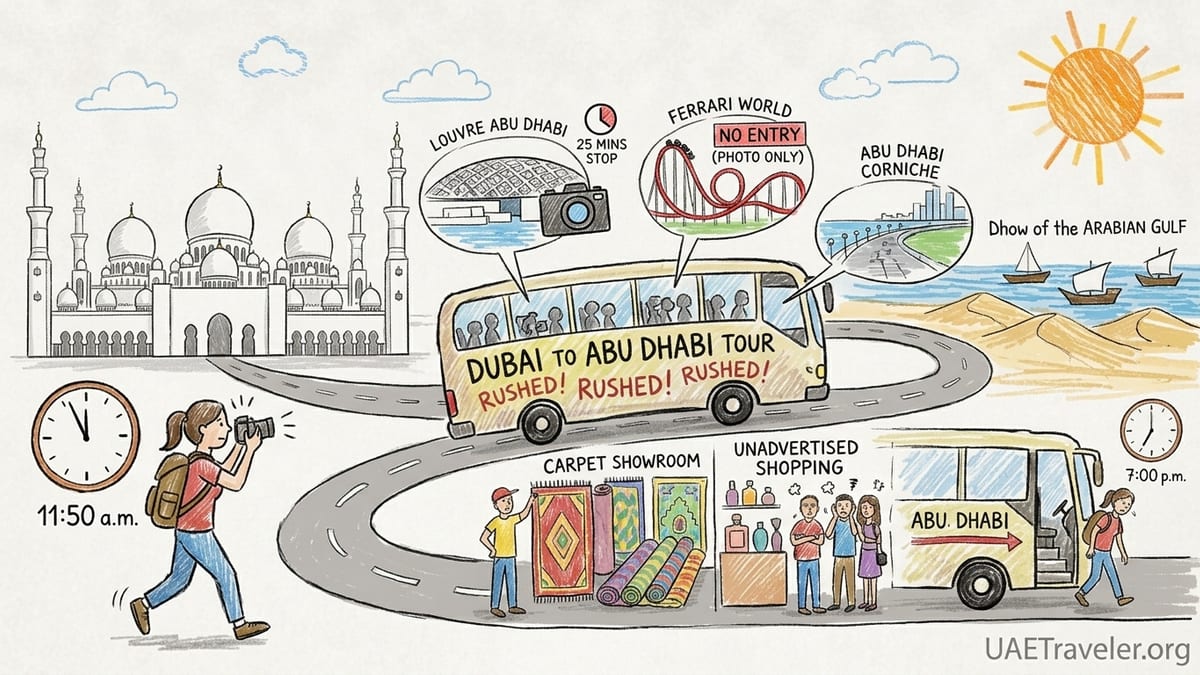
The Promise on Paper: An “Abu Dhabi in One Day” Super Tour
I booked a widely sold shared “Abu Dhabi Full-Day City Tour from Dubai” through a major online reseller, operated locally by a well known coach company. The advertised itinerary looked ambitious but technically possible: hotel pickup around 8:30 a.m.; Sheikh Zayed Grand Mosque for a full visit; a drive along the Corniche; Emirates Palace photo stop; dates market; a stop at Louvre Abu Dhabi with optional entry; a visit to Yas Island with a Ferrari World photo stop; plus time for lunch, then return to Dubai around 7:00 p.m. The headline price at the time of booking was about 120 dirhams per person without lunch, roughly 33 US dollars, with all attraction admissions explicitly listed as “not included.”
On the tour description page, each major stop was framed in confident language. The mosque was described as a “comprehensive guided visit.” Louvre Abu Dhabi was described as a “museum stop” without the clear warning, used by more honest operators, that it would be a photo stop unless you added extra time. Ferrari World appeared in the bullet points as though you would be stepping inside the theme park, even though an all day ticket on its own usually costs several hundred dirhams, more than the tour itself.
Crucially, the small print disclosed only that pickup would happen “up to 60 minutes before tour start” and that some attractions might be “seen from outside in case of traffic or special events.” Nothing in the marketing language prepared passengers for how much of the day would vanish to slow hotel pickups, highway traffic, and commercial shopping stops that were not mentioned in the advertisement at all.
With that in mind, I joined the tour not to stage a sting operation, but simply to experience what an ordinary visitor who booked in good faith would actually get.
The Day Itself: A Nearly Minute-by-Minute Timeline
The voucher listed my pickup time as “8:15 to 8:45 a.m.” from a central Dubai Marina hotel. The driver arrived at 8:55 a.m., already late and with no apology, explaining that I was the sixth stop. We left my hotel at 9:00 a.m. and then spent another 35 minutes circling nearby districts to collect more passengers from Jumeirah Lakes Towers and Barsha Heights. By the time we reached a petrol station lay-by on Sheikh Zayed Road to transfer into the main coach, it was 9:40 a.m. and we had gone barely a few kilometers.
We finally set off toward Abu Dhabi at 9:55 a.m., with 41 passengers and a single guide. The guide delivered a brief, five-minute overview of the UAE and basic mosque dress code, then retreated to the front seat. The highway run between outer Dubai and the entrance to Abu Dhabi Island took about 80 minutes in light traffic. We reached the area around Sheikh Zayed Grand Mosque shortly after 11:15 a.m. but then lost almost 20 minutes in the access road queue for tour buses and at the coach parking area.
At 11:35 a.m., our coach doors opened and the guide hurried everyone off, insisting we had “only one hour” for the mosque. First we had to walk through the air conditioned visitor center, clear security scanners, and queue again for the escalator to the underground passage. That took 15 minutes. Several passengers who had not read the dress code were sent back to purchase or rent abayas and long trousers.
My own watch showed exactly 11:50 a.m. when I finally emerged into the mosque courtyard and saw the famous white domes for the first time. Our guide immediately announced that we should be back at the meeting point at 12:30 p.m. sharp. That left 40 minutes for one of the largest and most intricate mosques in the world, a site that easily absorbs two unhurried hours for those who want to join a free guided tour and explore the inner colonnades.
The Grand Mosque: From “Guided Visit” to Rushed Photo Stop
The advertised itinerary promised a proper guided tour of Sheikh Zayed Grand Mosque, currently the most visited landmark in Abu Dhabi and a place that has recently introduced a modest entry fee for non worshippers. In October 2026, visitors are required to pre book a visit pass online through the mosque’s official system, and the dress code is strict, particularly for women. Publications such as Experience Abu Dhabi and the mosque’s own visitor information stress that modest clothing and a headscarf for women are mandatory, and that organized tours should respect these rules and allow adequate time for security and orientation.
In practice, our “guided visit” to the mosque was a 10 minute walk and talk followed by a scramble to take as many photos as possible. The guide walked us from the underground escalator through the main visitor colonnade, paused twice to point out the crystal chandeliers and the main prayer hall’s carpet, then announced, “You have 20 minutes free time from now.” There was no attempt to join a mosque run tour, no time to sit quietly, and certainly no space to appreciate the architectural symbolism and calligraphy that make the building so special.
Worse, the time limit was driven entirely by the tour company’s desire to add more stops to the day, rather than by any constraint imposed by the site. On weekends and peak hours, free mosque tours in English can be joined by visitors without charge, but they often last 30 to 45 minutes on their own. To do that and also have time to explore the onsite exhibitions, you need at least 90 minutes on the ground. Our entire gate to gate visit, from coach parking to re boarding, was 68 minutes.
That rushed feeling shaped the mood on the bus afterward. Several passengers compared the experience to “checking a box” so they could say they had seen the mosque, without ever feeling they had actually visited it. When the driver pulled away from the parking bay at 12:43 p.m., many faces were still pressed against the window, trying to capture last glimpses on their phones.
Louvre, Ferrari World and the Invisible Hours in Between
From the mosque, the brochure promised a drive along the Corniche and a “stop at Louvre Abu Dhabi.” Our guide informed us on the microphone that due to “time and traffic” we would only view the Corniche from the coach windows. Nobody objected, partly because most passengers did not realize this was their only chance to see Abu Dhabi’s waterfront. We crawled along a portion of the seafront ring road for about 15 minutes, then rejoined the highway toward Saadiyat Island without stopping.
We arrived in the outer parking area of Louvre Abu Dhabi at 1:25 p.m. The guide told everyone that full museum entry requires at least two hours and that tickets were “not included today.” Instead, we were given exactly 25 minutes, including the walk to and from the drop off point. The group dutifully filed toward the water, took photographs beneath Jean Nouvel’s latticed dome, admired the reflections, and rushed back. The museum’s own guidance suggests that visitors allow around two to three hours for a meaningful visit, including permanent collections and special exhibitions. Several passengers later confessed that they thought Louvre Abu Dhabi admission was part of the tour until that moment.
From Saadiyat, the coach continued to Yas Island, with a brief commentary on the Formula 1 circuit and entertainment complex. At 2:05 p.m., we pulled into a large parking area opposite the entrance to Ferrari World. The guide proudly announced a “Ferrari World photo stop.” Nobody was offered the option to enter the park, and there would not have been enough time in any case. We were given 15 minutes to pose with the red roller coaster tracks in the background, browse a nearby souvenir kiosk, and use the restrooms. Then we re boarded for lunch.
This pattern reveals the hidden cost of the “see everything” design. Between 9:55 a.m. and 2:20 p.m., when we finally sat down to eat, we had spent just over two hours on actual sites and nearly three and a half hours driving, queuing or walking between parking areas and entrances. Yet in the marketing copy, each quick stop was described as if it were a proper visit. The museum became a “Louvre Abu Dhabi experience” and Ferrari World a “Yas Island attraction stop,” blurring the line between genuine sightseeing and mere proximity.
Shopping Detours, Overpriced Lunch and the Real Price Tag
The tour description promised “free time for lunch in a local mall or food court, meals at own expense.” Instead, at 2:20 p.m. the coach pulled into a small commercial building that housed a carpet gallery, a perfume shop and a single, modest restaurant on the upper floor. The guide explained that we had a one hour lunch break and that we could “optionally” visit the carpet and perfume showrooms. In reality, the path to the restaurant led through both shops, and the staff were ready.
Inside, the carpet salesman delivered a polished 10 minute presentation on hand woven rugs. Some guests were clearly uncomfortable but felt trapped by the narrow aisles. A few were persuaded to purchase small items. While there is nothing inherently wrong with including commercial stops on a tour, this arrangement had not been disclosed at booking, and it cut into our limited time in Abu Dhabi’s historic center.
Lunch itself was a set buffet priced around 70 dirhams per person, roughly double what a comparable meal would cost in an ordinary city mall food court. There were no alternative eateries within easy walking distance. Several passengers, having skipped breakfast due to the early pickup window, felt compelled to pay. The guide did not receive cash directly but hovered nearby, and the staff spoke of “your tour group price” as if it were a discount.
By the time everyone had eaten, used the restrooms and settled their bills, it was 3:25 p.m. We still had not visited the dates market or any meaningful cultural quarter in the city center. Back on the coach, the guide announced that, due to the late hour, the dates market would be “a quick stop.” It became a 12 minute drop in a small indoor hall, interesting for a first time visitor but shallow and hurried. The older Heritage Village area, which some city tours include, was quietly dropped from our schedule without mention.
Advertised Itinerary vs Delivered Reality
To understand just how different the day turned out from the glossy promise, it helps to lay the advertised and actual timelines side by side. The brochure suggested eight to nine hours of touring, including multiple in depth stops. My watch showed that we were out for nearly eleven hours, but large portions of that were swallowed up by transport and commercial stops.
Here is a simplified comparison of advertised versus delivered timing, based on my notes:
Hotel pickup advertised: 8:30 a.m. Actual first movement from my hotel: 9:00 a.m. Arrival at coach terminal and departure toward Abu Dhabi: 9:55 a.m. Sheikh Zayed Grand Mosque “guided visit” advertised at roughly two hours, including transport. Actual time from coach parking to departure: 11:35 a.m. to 12:43 p.m., with no formal mosque guide. Louvre Abu Dhabi stop advertised as an opportunity to visit the museum. Actual time on site: about 25 minutes outside only, no group ticketing or museum entry. Ferrari World mentioned in marketing as a highlight. Actual experience: 15 minute photo stop outside the mall and park entrance. Lunch described vaguely as “free time” but delivered as a fixed stop at a partner restaurant complex, with shopping presentations and inflated buffet prices.
The final insult came on the return leg. We left central Abu Dhabi around 4:10 p.m., drove directly back along the highway, and reached the Dubai city boundary at 5:45 p.m. But due to the need to drop guests at multiple hotels and a second transfer at the petrol station lay by, I did not step back into my hotel lobby until 7:05 p.m. In total, the day lasted just over 10 hours door to door, of which a little more than three hours were spent meaningfully inside major sights.
When you factor in the mosque’s new entry fee, the cost of lunch and optional purchases, the “cheap” 120 dirham tour began to look less like a bargain and more like a cleverly structured delivery system for passengers to specific commercial partners. The company was not breaking any law, and some passengers seemed satisfied. Yet the gap between what had been advertised and what was delivered was wide enough to matter.
Could You Do Better on Your Own for a Similar Price?
One of the most important questions for any traveler is whether a shared coach tour genuinely saves money and time or simply bundles costs in a way that looks attractive in search results. In the Dubai to Abu Dhabi corridor, independent options have improved rapidly, including the arrival of Etihad Rail passenger services in 2026. To compare fairly, you have to consider both direct expenses and the value of your limited holiday hours.
By late 2026, a typical round trip ride on the new Etihad Rail passenger service between Dubai and Abu Dhabi is priced in a broadly affordable band compared with intercity bus tickets. Local reporting around the launch has highlighted coach style seating, modern air conditioning and journey times in the range of 70 to 90 minutes between stations. However, as residents have pointed out, the rail line uses inland corridors originally designed for freight, so the passenger stations are located far from the main tourist districts. This means that travelers still need to budget separately for taxis or ride hailing services from the rail station to the Grand Mosque, Saadiyat and Yas Island.
An independent day trip might look like this. You take an early morning Etihad Rail train from Dubai to Abu Dhabi, then hire a taxi directly to Sheikh Zayed Grand Mosque, arriving soon after opening to avoid the worst crowds. After spending 90 minutes to two hours inside the mosque, you take another taxi to Louvre Abu Dhabi and spend two to three hours in the air conditioned galleries and under the dome. You then choose either a brief walk around the older downtown area or a late afternoon hop to Yas Island if theme parks appeal. Finally, you head back to the station and return to Dubai on an evening train.
If you are traveling as a pair or a family, the cumulative cost of rail tickets plus taxis to three or four locations can come close to the per person price of a shared bus tour. The difference is what you get for that money. Instead of 30 minutes under Louvre Abu Dhabi’s dome, you enjoy the art collections at your own pace. Instead of a forced carpet showroom detour, you eat where and what you prefer, perhaps at a café on Saadiyat or a street side shawarma stall near the Corniche. Most importantly, you trade hours stuck in a coach’s hotel pickup loop for flexible door to door segments that better match your own interests.
For small groups, hiring a private driver in Dubai for a full day run to Abu Dhabi and back can also be surprisingly reasonable, especially if you negotiate a flat rate that includes 10 to 12 hours of service. While such drivers cannot act as licensed guides inside the mosque or museums, they can drop you close to entrances, coordinate timing and remove the biggest inefficiencies of shared touring: waiting for 40 other people to re board every time the bus stops.
Where Etihad Rail Helps and Where It Does Not
The launch of Etihad Rail’s passenger services in 2026 has understandably generated excitement. Trains between Abu Dhabi, Dubai and beyond promise a more sustainable, less stressful way to cross the desert than long car journeys or packed intercity buses. For independent travelers, that is genuinely good news, but it is not the magic bullet that rail marketing sometimes suggests.
First, the rail network connects peripheral stations rather than city center terminals. In Dubai, the key Etihad Rail station is in an inland area near existing freight lines, linked by roads rather than within easy walking distance of the beach hotels that line Jumeirah. In Abu Dhabi, the station lies inland from the island core where most tourist sites sit. A passenger stepping off the train still has to pay for taxis, ride hailing or local buses to reach Sheikh Zayed Grand Mosque, the cultural district on Saadiyat, or the entertainment cluster at Yas Island.
Second, trains operate on fixed schedules. If you leave the Louvre galleries later than planned, you may cut it uncomfortably close to your return service. With a rented car or a private driver you can adapt your timing around the natural rhythms of your visit and the day’s weather. Rail’s strength is comfort and predictability over medium distances, not local flexibility.
Third, rail fares cover only the trunk journey. They do not bundle in attraction admissions, meals or local transfers in the way that some tours do. That can be an advantage for travelers who prefer control and transparency, but it also means that the sticker price for a train ticket should not be mistaken for the full cost of an Abu Dhabi day out. In reality, a realistic independent budget has to combine rail or bus fares with point to point city movement.
Seen in this light, Etihad Rail is a powerful new backbone for independent trips but not a replacement for thoughtful planning on the ground. A rushed shared tour that already wastes hours in pickups and tourist shops does not become more attractive simply because you reach Abu Dhabi on a sleek new train instead of a highway coach.
The Tours I Would Avoid After This Experience
After a long, fragmented day that left three major sights feeling like items on a checklist, I came home with a clearer sense of which Abu Dhabi day tours from Dubai I would avoid in future. The first red flag is any tour that advertises more than three major paid attractions in a single day but charges only slightly more than the cost of intercity transport. If your brochure promises Sheikh Zayed Grand Mosque, Louvre Abu Dhabi, Ferrari World, Yas Marina Circuit, Emirates Palace, the Corniche, dates market and Heritage Village all in one outing, something will have to give. Often, what gives is your time inside each site.
The second warning sign is vague language in the itinerary. Phrases such as “view from outside,” “photo stop,” or “see” without the word “visit” often mean that you will remain in or near the coach. When those same attractions are also shown in marketing photos that look like you are inside them, the gap between expectation and reality widens. Responsible operators are explicit. They state clearly that, for example, Ferrari World will be a 15 minute external stop and that Louvre Abu Dhabi will not be entered on a standard city tour.
The third concern is any package that does not disclose where lunch will be, how long you will have and whether there are shopping stops linked to commissions. My tour’s unadvertised carpet and perfume detour consumed almost an hour that could have been spent wandering the Corniche or the compact old souk area. While some travelers enjoy shopping, it should never replace meaningful sightseeing without your clear consent at the time of booking.
Finally, I would step away from tours that cannot specify a realistic range for time at the mosque. If the operator cannot assure at least 60 to 90 minutes on the ground at Sheikh Zayed Grand Mosque, excluding highway travel, then the visit risks becoming a mere photography break at one of the world’s most important contemporary religious buildings.
The Takeaway
Abu Dhabi is not a box to tick on a list of Dubai day trips. It is the federal capital of the United Arab Emirates, home to one of the most visited mosques on earth, an ambitious global museum and a fast evolving waterfront skyline. Trying to squeeze the Grand Mosque, Louvre Abu Dhabi, Yas Island, Emirates Palace, Heritage Village, dates market and multiple shopping opportunities into a single shared tour ends up short changing almost everything.
The day I spent on a low cost coach tour from Dubai revealed a consistent pattern. Advertised itineraries overstated how much could be done; vague wording blurred the distinction between proper visits and drive by views; and the apparently attractive headline price was offset by shortchanged attraction time, expensive partnered lunches and detours into commission based shops. Although my tour delivered on the most basic promise of transporting me between Dubai and Abu Dhabi and back, it did little to help me understand or appreciate the city I had come to see.
For travelers who value depth over breadth, better options exist. A transparent mosque and Louvre package that clearly includes admission and promises generous time at both sites is far preferable to a scattergun city circuit. An independent day using Etihad Rail and taxis can give you control and flexibility, particularly if your priorities are limited to two or three key attractions. And for those who can spare the time, an overnight stay in Abu Dhabi lets you see the mosque at dusk, linger in the museum without watching the clock and stroll the Corniche after dark, all without the pressure of a return deadline to Dubai.
In the end, the best Abu Dhabi experience is rarely the one that promises the most stops. It is the one that respects your time, is honest about what it does and does not include, and leaves you with real memories of the places you came to see instead of a blur of bus windows and souvenir counters.
FAQ
Q1. Is a shared Abu Dhabi day tour from Dubai ever a good idea?
For some travelers, yes. If you have very limited time, prefer to be escorted and accept that you will only get brief introductions to each site, a shared tour can provide simple door to door logistics. The key is to choose an operator that clearly labels photo stops, admits when major attractions will not be entered and allows at least one unhurried highlight such as Sheikh Zayed Grand Mosque.
Q2. How much time should I plan to spend at Sheikh Zayed Grand Mosque?
If you want more than a quick photo, aim for at least 90 minutes on site, not counting travel. That allows time for the security and access process, a slow walk through the courtyards and colonnades, and either a mosque run guided tour or a self guided circuit around the main prayer hall and reflective pools.
Q3. Can I realistically visit the Grand Mosque and Louvre Abu Dhabi in one day from Dubai?
Yes, if you focus on those two and perhaps one additional short stop. With an early departure, you can spend the late morning at the mosque, enjoy lunch on Saadiyat or nearby, then dedicate two to three hours to Louvre Abu Dhabi before returning to Dubai by evening. Trying to add multiple theme parks and extended city drives on top of that is when the day becomes rushed.
Q4. Does Etihad Rail replace the need for organized tours?
No. Etihad Rail is an excellent new backbone for intercity travel, but its stations are located inland and do not remove the need for local transfers. You will still need taxis or ride hailing to reach the Grand Mosque, Saadiyat and Yas Island, and you must organize your own tickets and timing at each attraction.
Q5. How do I spot exaggerated or misleading tour itineraries online?
Look for long lists of attractions in a single day, unclear phrases such as “see” or “view from outside,” and a price that seems too low to include entry to costly sites. Read recent traveler reviews that mention actual timing at the mosque and Louvre and watch for repeated complaints about shopping stops and rushed visits.
Q6. Are shopping stops always a bad sign on a tour?
Not necessarily, but they should be clearly disclosed and optional. When commercial galleries or carpet shops are inserted without warning and replace promised cultural stops or meaningful free time, that is a strong indication that the tour has been designed around commissions rather than your experience.
Q7. Would you recommend hiring a private driver instead of a shared tour?
For small groups who value flexibility, a private driver can be an excellent choice. You pay more per vehicle but gain the ability to control departure times, sequence your stops and leave when you are ready rather than when 40 other passengers have re boarded the bus.
Q8. Is an overnight stay in Abu Dhabi worth it if I am based in Dubai?
If your schedule and budget allow, absolutely. Staying one night lets you visit the Grand Mosque at quieter times, spend unhurried hours in Louvre Abu Dhabi, enjoy the Corniche in the evening and perhaps fit in Yas Island or the mangroves without being tied to a same day return deadline.
Q9. How can I ensure a mosque visit will not be rushed on a tour?
Ask the operator directly how much ground time you will have at Sheikh Zayed Grand Mosque, not just the combined driving and visiting window. Look for tours that promise at least 60 to 90 minutes there and that understand the need to factor in dress code checks, security and walking distances from coach parking to the main courtyard.
Q10. What is the single biggest mistake travelers make with Abu Dhabi day trips?
The most common mistake is trying to do too much in one day because the brochures suggest it is possible. Focusing on two or three key experiences, such as the Grand Mosque, Louvre Abu Dhabi and a brief city walk, usually leads to a far more satisfying visit than chasing a checklist of distant highlights from the window of a moving bus.