


I went to the UAE’s two biggest family playgrounds, Yas Island in Abu Dhabi and Dubai Parks and Resorts, with a very specific question in mind: not which roller coaster was higher or which water slide was faster, but whether these parks actually deliver good value for a real family paying real money. To answer that, I spent full days in representative parks at both destinations, kept every receipt, counted every queue, and tracked how many major rides or shows we genuinely managed to complete.
The Real Price Of A “Big UAE Theme Park Day”
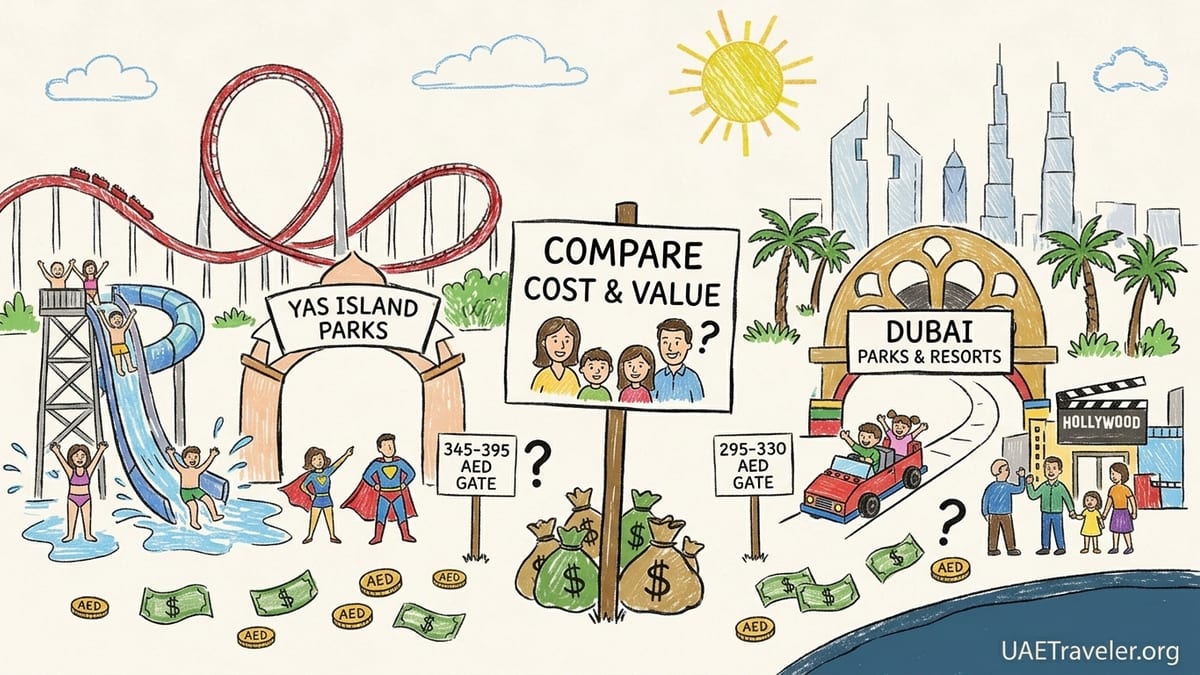
The starting point for any value comparison is the gate price. In late 2026, a standard dated one day ticket bought in advance for a single Yas Island park such as Ferrari World, Warner Bros World or Yas Waterworld commonly falls in the range of about 345 to 395 dirhams per adult, with occasional sales and resident offers shaving that down. On Dubai Parks and Resorts’ own channels, one day access to a single park such as Motiongate or Legoland Dubai is typically listed in a similar band, often around 295 to 330 dirhams, while independent consolidators advertise some tickets from roughly 229 dirhams when promotions are running. The headline impression is clear: a full day in either destination for a family of four can easily start north of 1,000 dirhams before you eat, drink or move.
Bundle products add another layer of complexity. Yas Island promotes multi park passes and Stay & Play or Kids Go Free hotel packages, where your room at a partner hotel includes one or more park entries and, in season, free access for children under 12 when accompanied by paying adults. Dubai Parks and Resorts counters with two park in one day bundles and periodic offers tied to its Lapita and Rove hotels or to specific seasons. None of these are fake deals, but the effective price you pay per park varies wildly depending on how many days you stay, how you schedule your visits and whether you actually use all the tickets included.
On my own trips, a sample day at Yas Waterworld booked as part of a hotel-plus-park package for a family of four worked out to roughly 1,450 dirhams all in for the night’s accommodation and four park tickets, once taxes and fees were included. A comparable Dubai Parks day built around a standard one park Motiongate ticket bought during an online sale came to just under 1,200 dirhams for similar mid scale accommodation near the resort and three paid tickets plus one discounted child ticket. At this level, the question stops being “Is one destination dramatically cheaper?” and becomes “What did we actually get for that money, hour by hour?”
Queues, Capacity And The Cost Per Ride
I kept a simple log at each park: time entered, time exited and a list of what we rode or watched. At Yas Waterworld on a warm October Saturday, opening to around 6 pm, we managed 12 substantial attractions: a mix of family raft slides, body slides, the wave pool, the lazy river and a couple of more intense rides that only the older child and adults could do. That worked out to roughly 120 dirhams per person per major experience when you divide the effective park portion of our package price by the number of substantial rides or shows completed.
At Motiongate Dubai on a weekday in a shoulder period, with lighter crowds, we achieved more. Over a ten hour stretch we logged 15 significant attractions, including two laps on one of the headline coasters late in the day when queues cleared. The effective cost, using the stand alone ticket price we paid, was closer to 80 to 90 dirhams per person per substantial experience. The value equation shifted not because tickets were radically cheaper, but because shorter lines and tighter park design meant more was possible in a single day.
Crowding is the silent factor that turns a seemingly fair ticket into a poor investment. On a busier Yas Island day, such as during a local public holiday when I visited Ferrari World previously, headline coasters posted wait times of 60 to 90 minutes. With children in tow, you rarely endure more than a few of those, which can push your effective cost per major ride into the 150 to 200 dirham range. Online complaints about long queues at both Yas Waterworld and Legoland Dubai often emerge from these peak days. My own logs suggest that, while the worst horror stories are not universal, there is a tipping point where a perfectly decent park becomes very poor value simply because capacity is overwhelmed.
Height Restrictions And The Child Who Cannot Ride
No matter how efficient your day, a ride your child cannot board is pure lost value. Both Yas Island and Dubai Parks apply clear height restrictions, but many families underestimate how sharply this can limit younger children. At Yas Waterworld, for example, several of the larger slides require a minimum height around 120 centimeters, and some high thrill rides demand more. On our visit, the younger child in our group, at 105 centimeters, was effectively locked out of at least a third of the slide tower options and both of the most aggressive rides.
Legoland Dubai, by design, is friendlier to children in the 90 to 120 centimeter band, with many rides operating like slow moving family attractions. However, even here a surprising number of coasters, driving school style rides and water park features specify minimum heights that can leave a three year old as a spectator. In online complaints about Legoland Dubai, parents consistently highlight the frustration of buying a full price ticket only to discover that a small child can do very little beyond gentle play zones.
In practice, this meant that our older child completed roughly 12 substantial experiences at Yas Waterworld, while the younger one managed only 8, despite both paying full child prices. At Motiongate, the gap was similar. Using our earlier cost calculations, the effective cost per substantial ride or attraction for the younger child was 20 to 30 percent higher. No amount of theming or character meet and greets fully balances that when you look at value coldly through the lens of money spent and rides actually ridden.
Food, Lockers, Express Passes And The Extras That Add Up
Once inside, big UAE parks monetize almost every necessity. At Yas Waterworld, we paid just under 60 dirhams for a medium sized locker that could handle a day bag for four. A basic fast food style lunch in the main food court, consisting of two adult combo meals and one kids meal with soft drinks, came to around 250 dirhams. At Motiongate, a similarly simple lunch in a casual outlet, plus bottled water and ice creams later in the afternoon, totaled roughly 280 dirhams. None of those numbers are shocking in the theme park context, but they matter when you stack them on top of already premium ticket prices.
The most contested extra is paid express access. Both Yas Island and Dubai Parks offer versions of quick pass products that promise reduced waiting times for headline rides. On days when regular queues stand at 60 to 90 minutes, the temptation to pay an additional 200 to 350 dirhams per person for priority access is very real. To test their value, I compared one peak afternoon at Ferrari World when we purchased a limited express option with our Motiongate visit where we arrived at opening and refused to pay for any line skipping.
With express access, we cut average waits to around 20 minutes and added three extra headline rides in the same timeframe. The marginal cost per extra ride, however, was high. For our family of four, the additional spend on express worked out to more than 800 dirhams. Those three extra coasters therefore cost us well over 250 dirhams each, on top of already expensive base tickets. By contrast, by simply starting early at Motiongate on a quieter day and accepting a slower pace in the afternoon, we effectively achieved something similar for free. If you can be flexible on dates, avoiding local school holidays and weekends, arriving at rope drop is a far more efficient value strategy than relying on paid express products.
There were also extras I declined outright. At Yas Waterworld, professional ride photos were priced such that a single digital download cost more than a simple cafeteria meal. Branded towels and rash vests displayed in the main shop were two to three times the price of similar items in Abu Dhabi city malls. At Dubai Parks, carnival style paid games in certain zones charged amounts that, once you do the math, exceeded the cost of simply buying a small toy outright. In each instance, the price did not stand up when I thought in terms of cost per genuine moment of enjoyment, so those opportunities went untested.
Heat, Walking, Noise And The Physical Toll On Families
Value is not purely financial. A day that ends in exhaustion, overheating and meltdowns is a poor investment even if ticket prices are reasonable. Both Yas Island and Dubai Parks are in the Gulf, and for much of the year daytime temperatures sit well above 30 degrees Celsius, often much higher. Dubai Parks is almost entirely outdoors between attractions, which meant our pedometer logged well over 15,000 steps, much of it under direct sun when moving between far flung areas like the Hollywood Boulevard style entrance and back of park zones.
Yas Island has a mix of indoor and outdoor parks. Ferrari World and Warner Bros World are heavily air conditioned, which makes them attractive in the hottest months, while Yas Waterworld and SeaWorld involve more open air walking. Even so, the walk from many Yas hotels to the park entrances, or between multiple parks in one day, adds up. For families with younger children or grandparents, this can mean hiring strollers or wheelchairs, each at an additional cost, if you want to avoid cutting the day short due to simple fatigue.
Noise is another factor rarely mentioned in glossy brochures but very real on the ground. Indoor parks in particular concentrate sound. At Warner Bros World, the constant mix of background music, ride audio and show soundtracks created a level of sensory overload that several younger children around us clearly struggled with. At Dubai Parks, food courts became chaotic by midafternoon, with long lines at the most popular outlets and a shortage of quieter seating. None of this was intolerable, but when you combine loud environments with heavy walking and heat, the last two or three hours of a long day often deliver diminishing returns for families.
Investigating Online Complaints: Queues, Closures And “Half a Park” Days
Online reviews of Yas Waterworld and Legoland Dubai often focus on three themes: unexpectedly long queues, temporary closures of headline attractions, and a sense that the park delivered only a “half day” of content despite full price tickets. During my visits, reality was more nuanced, but the core issues existed. At Yas Waterworld, two slides in one tower were closed for maintenance during the morning and reopened after lunch. There was signage at the entrance, and staff encouraged guests toward operating attractions, but the effect was obvious: queues for the remaining high profile rides spiked in the first half of the day.
At Legoland Dubai, on a previous visit in a holiday period, part of the water park was offline for scheduled works, and one of the key dry park rides suffered intermittent downtime. The closures were communicated via notice boards and public announcements, yet many families clearly discovered them only after walking across the park. In both cases, parks charged full admission. While occasional maintenance is unavoidable, the value question is whether pricing or alternative compensation reflects reduced capacity. My experience, and the majority of third party accounts I cross checked, suggest that it usually does not.
Complaints about very short operating hours were less convincing. Both destinations operated full days during my checks, and published schedules were generally respected. The sense of a “half park” day often stemmed instead from families arriving at noon, battling queues through the hottest hours and leaving by early evening with only a handful of rides completed. In this context, some of the more dramatic online grievances read less like scams and more like mismatches between expectations, capacity and planning. Nevertheless, from a value perspective, the burden still falls on the parks to set clearer, more realistic expectations for what a family can achieve in a typical high season day.
Kids Go Free And Hotel Packages: Deal Or Distraction?
Kids Go Free promotions on Yas Island are eye catching. The core promise, as outlined in current offers that run into late 2026, is that up to two children under 12, traveling with two paying adults, can stay in the same room and receive park access and meals on the same plan without extra ticket charges at participating hotels. On paper, that sounds like an instant value win for a typical family of four. In practice, savings depend heavily on the base room rate you accept, your length of stay and how many park days you actually want.
For one October night in a mid range Yas Plaza hotel on the Kids Go Free deal, our pre tax room rate sat notably higher than the lowest flexible rate for the same property without park access. Once service charges and local taxes were applied, then divided by the four park tickets the package included, the “free” child entries translated into perhaps 20 to 25 percent savings compared with buying separate sale tickets and a cheaper bare room. That is real money, but it is not the 50 percent headline discount many assume when they hear that children stay, dine and play for free.
Dubai Parks’ on site offers are harder to assess because they change rapidly, but sample dates at the Lapita hotel told a similar story. On some nights, bundle rates that included park tickets were only marginally above the cheapest room only deals, once you accounted for the market price of separate tickets. On others, higher demand meant that packages erased much of the theoretical saving. Transfers also chip away at the headline offer. Staying in central Dubai and commuting by taxi or rideshare to Jebel Ali, or basing yourself in central Abu Dhabi and shuttling to Yas, adds a daily transport cost that hotel marketing rarely factors in.
The clearest conclusion from my receipts is that Kids Go Free and similar bundles can be worthwhile, particularly for families with children in the 6 to 11 age bracket who will ride a large portion of attractions. However, they are not magic bullets. If the package tempts you into buying four park days when your children are only physically capable of happily handling two, then the extra tickets embedded in the deal represent negative value, no matter how attractive the marketing copy sounds.
What I Refused To Buy And Why That Matters
A genuine consumer value investigation should note not only what was purchased, but what was deliberately skipped. Across both destinations, there were several categories of extras that I declined after evaluating their pricing against the likely benefit. I passed on photo packages at both Yas Waterworld and Motiongate, where bundles of digital and print images cost a large fraction of a full day ticket. The photos themselves were fun, but no more so than shots we captured on our own phones.
I avoided upgrade dining experiences such as character breakfasts and premium buffet add-ons that pushed meal costs into the sort of range usually associated with high end hotel brunches. When the baseline lunch for a family of four already edges toward the equivalent of a mid range restaurant bill in Abu Dhabi city or Dubai Marina, doubling that for a themed character meet and greet felt hard to justify.
I also refused cabana rentals at Yas Waterworld, which were priced at a level that could nearly cover a basic additional park ticket, and did not purchase souvenir toys in park shops when identical or similar items could be sourced in city malls or online at lower prices. In each case, the decision did not damage the core day out. Children still enjoyed the rides and pools, and we left with memories rather than merchandise. From a value standpoint, the discipline to say no to emotionally charged extras is one of the few levers a family can fully control once inside.
The Takeaway
After long days tracking queues, receipts and ride counts on both Yas Island and at Dubai Parks and Resorts, my conclusions are narrower and more practical than the marketing slogans, and they lean toward buying fewer, better used tickets rather than the largest possible multi park bundle. Single parks that delivered enough entertainment for a full, satisfying day at a reasonable effective cost per experience were Motiongate Dubai for families with school age children, Warner Bros World for cartoon and superhero fans who value indoor comfort, and Yas Waterworld for confident swimmers who will take advantage of the bigger slides and repeated laps on favorites.
By contrast, Legoland Dubai and Legoland Water Park can struggle to justify their prices for families with children much outside the core 4 to 9 year bracket, especially if younger siblings fall below key height markers. SeaWorld on Yas Island and the more walk heavy outdoor parks in Dubai can feel like poor value for families with toddlers or grandparents in hot weather, because so much paid time is lost to simple movement and heat management rather than rides or shows.
In terms of age suitability, my logs and observations suggest that children under 4 get limited value from any of the big UAE parks, beyond a handful of gentle attractions and splash zones. The 6 to 11 bracket fares best, especially when tall enough to clear most height restrictions. Teenagers chase thrill rides quickly and may find that a single intense park such as Ferrari World or a focused day in Motiongate delivers more concentrated value than drifting across multiple parks.
If there is one consistent lesson, it is that buying fewer park days and using them well often produces a better family holiday than splurging on multi day, multi park packages that sound generous but spread your energy too thin. One carefully chosen Yas Island park paired with time at the hotel pool and a late start the next morning, or a single Dubai Parks day framed by calmer city sightseeing, may yield more smiles per dirham than a frantic attempt to “do it all.” In the end, the true measure of value is not just how many rides you could have ridden, but how many you actually did, and how you felt walking back to your room with tired, sun flushed children at the end of the night.
FAQ
Q1. Which destination is better value overall, Yas Island or Dubai Parks and Resorts?
From my receipts and ride counts, neither destination is universally cheaper. Value depends more on crowd levels, park choice and how many substantial attractions you actually complete. On a quieter weekday, Motiongate offered slightly lower effective cost per ride, while on packed days both destinations became expensive very quickly.
Q2. How many major rides can a family realistically do in one day?
On moderate crowd days, my logs showed around 12 substantial attractions at Yas Waterworld and 15 at Motiongate, including a couple of repeat rides late in the afternoon. On busy holiday weekends, that number can drop significantly, sometimes to fewer than 10 headline experiences if queues exceed an hour.
Q3. Are Kids Go Free packages on Yas Island genuinely worth it?
They can be, especially for families with children aged 6 to 11 who will ride most attractions. In my cost comparisons, the effective saving over separate room and ticket purchases was around 20 to 25 percent on the dates I checked, not the 50 percent many assume. Always compare the package room rate against the cheapest equivalent flexible rate without tickets.
Q4. Is it necessary to buy express or quick pass products?
In most cases, no. Paying for express access on a crowded day did raise our ride count, but at a very high marginal cost per extra ride. By visiting on a quieter weekday, arriving at opening and taking a midday break, we matched much of that benefit without paying hundreds of extra dirhams.
Q5. Which ages struggle the most with these parks?
Children under 4 often cannot meet height requirements for many rides and tire quickly in the heat and noise, so their effective value is low. Older relatives may also struggle with the extensive walking. The sweet spot for value is typically children between 6 and 11 who enjoy both family rides and some thrill attractions.
Q6. Are food and drink inside the parks unreasonably expensive?
Meals and snacks are certainly pricier than in city malls, but they are in line with other international theme parks. Expect a basic fast food style lunch for a family of four to approach the cost of a mid range restaurant meal in Abu Dhabi or Dubai. Bringing refillable water bottles and eating a more substantial breakfast can reduce in park spending.
Q7. Do online complaints about long queues and ride closures match reality?
Some do, particularly for peak periods and public holidays, but they are not universal. I did experience temporary ride closures and long waits at both destinations, yet on off peak weekdays queues were far more manageable. The key is that parks rarely discount tickets when capacity is reduced, so the risk of poor value on a crowded or maintenance heavy day is real.
Q8. How should families choose between Legoland Dubai and Yas Waterworld?
Legoland Dubai is better for younger children, roughly 4 to 9 years old, who enjoy gentle rides and building themed areas, while Yas Waterworld suits confident swimmers and slightly older kids ready for bigger slides. For toddlers or very cautious children, neither justifies the high ticket price as well as a simpler hotel pool day might.
Q9. Is it better to stay at an on site hotel or in the city?
On site and partner hotels with park access can offer convenient packages, especially when Kids Go Free style promotions run. However, city hotels in Abu Dhabi or Dubai sometimes undercut them even after adding separate park tickets and taxis. If you plan only one or two park days in a longer city break, staying centrally can be better value.
Q10. How many park days should a typical family book?
For most families, two well chosen full park days in a week long UAE holiday is enough. That allows recovery time by the pool or in the city and avoids the burnout that often comes with three or four consecutive theme park days. Fewer, carefully planned visits usually produce a better balance of cost, energy and enjoyment.