


After years of writing about the United Arab Emirates, I finally did what many first-time visitors debate in online forums but rarely test in real life. I booked parallel trips, spending three nights in Dubai and three nights in Abu Dhabi in comparable four-star hotels, tracked every dirham on metro rides, taxis, attraction tickets, breakfasts and beach days, then compared how it actually felt to stay in each city. The result is a practical, price-grounded guide to where I would stay again, and when it makes sense to split a week between the two very different urban experiences.
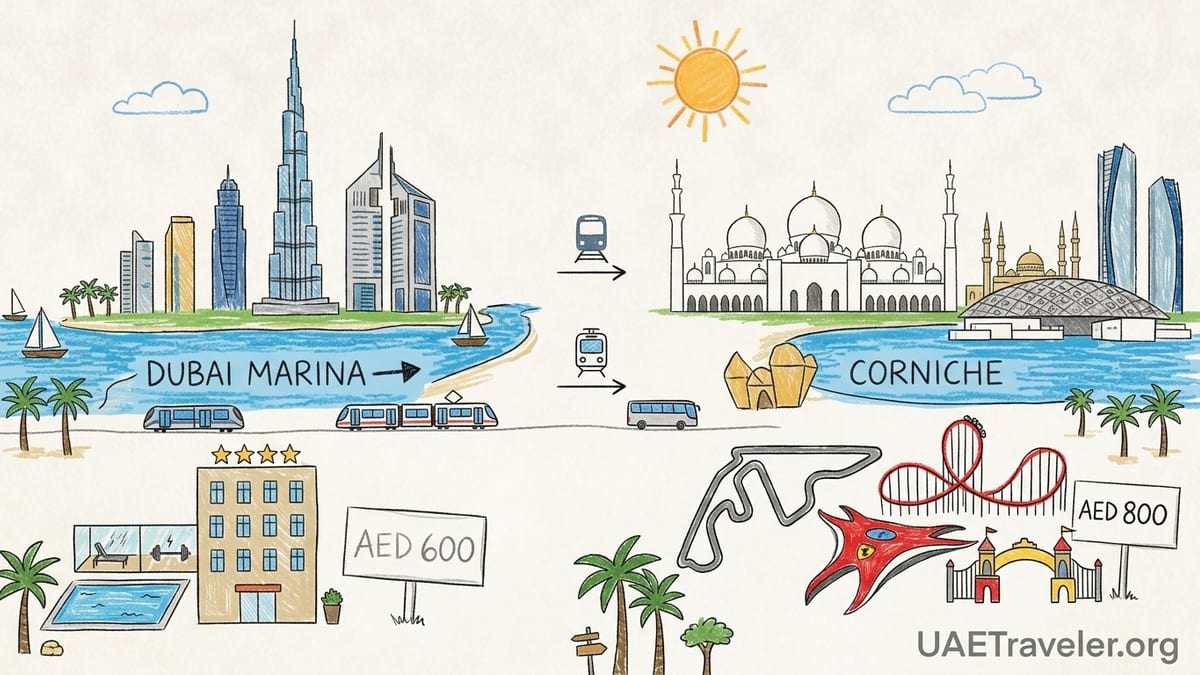
How I Structured the Dubai vs Abu Dhabi Comparison
To keep things fair, I used a similar hotel category in both cities: modern four-star properties with pools and gyms, not ultra-luxury resorts but not bare-bones either. In Dubai, I stayed near Dubai Marina for three nights. In Abu Dhabi, I based myself on Yas Island for three nights, then did a comparison visit to hotels on the Corniche and Saadiyat Island before deciding where I would book next time. I tracked real-world rates and on-the-ground costs in October 2026, excluding flash sales and member-only deals that most casual travelers never see.
For pricing benchmarks, Dubai Marina four-star hotels for two adults averaged roughly 450 to 800 AED per night before tax, with mid-range options around 600 AED. Downtown Dubai four-stars often sat slightly higher, around 700 to 1,100 AED, while Palm Jumeirah resorts and beach clubs pushed nightly rates and fees much higher. Deira and Old Dubai, by contrast, still had standard hotels in the 200 to 350 AED bracket before tax for the same dates, illustrating the wide spread within one city.
In Abu Dhabi, general four-star averages across the city hovered around 160 to 200 USD per night (roughly 590 to 735 AED), with Yas Island properties clustering toward the higher end of that range, especially those attached to theme parks or the Formula 1 circuit. Across several weeks of price checks, standard rooms at well-reviewed Yas hotels often settled near 800 to 1,000 AED per night for flexible rates, while inland business hotels could be far cheaper. This meant my Yas stay was roughly comparable to a good-quality Dubai Marina hotel, which is important when comparing value.
Throughout, I recorded whether breakfast, taxes, resort fees, on-site parking and attraction bundles were included, and calculated how much those inclusions actually reduced total daily spending. I also tracked what I spent, or would expect to spend, on metro and tram rides in Dubai, taxis and buses in Abu Dhabi, meals in mid-range restaurants, beach access, and one desert-style day in each city.
Dubai Neighborhoods: Marina, JBR, Downtown, Deira and Palm Compared
For first-time visitors, the choice of Dubai neighborhood shapes the entire trip. In Dubai Marina and neighboring Jumeirah Beach Residence (JBR), I could step out of my hotel and walk to the waterfront in minutes, with a dense strip of restaurants, cafes and supermarkets. The Marina Promenade and JBR Walk are among the most walkable areas in the city, especially in the cooler months. From my hotel near DMCC Metro station, it was a five to ten minute walk to the metro and tram, which meant I could reach Downtown Dubai and the Dubai Mall area in about 30 to 40 minutes by train for roughly 5 to 7.50 AED each way with a Nol card.
Downtown Dubai, around Burj Khalifa and Dubai Mall, felt more vertical and business-like but was unbeatable if your priority is shopping and big-name attractions like the Dubai Fountain or Burj Khalifa observation decks. Many hotels here connect directly to air-conditioned walkways into the mall, which matters when temperatures are high. However, room rates for similar four-star quality usually ran at least 20 to 30 percent higher than my Marina benchmark, and everyday meals on the mall side of Downtown ran pricier than equivalent meals in Marina side streets or in older neighborhoods.
Deira and Old Dubai offered a very different experience and often the lowest prices. Four-star hotels near the Creek routinely undercut Marina prices by 40 percent or more. The trade-off was distance to the beach and the main clusters of modern attractions. Metro access was usually good, with stations like Union and Deira City Centre well connected, but if you imagine a spontaneous late afternoon walk from your hotel to a public beach, Deira is not the easiest base. It worked best as a budget-friendly starting point if your priorities include the gold and spice souks, the creek abras and more local eateries.
Palm Jumeirah impressed visually but came with cost and convenience trade-offs. Most beachfront resorts on the Palm charged premium nightly rates, and several added higher resort fees and paid beach club access for non-package guests. The Palm Monorail connects to the tram, which then meets the metro, but total journey time to Downtown could easily stretch to 45 minutes or more, and many guests default to taxis. If you specifically want a resort-style stay with minimal city exploring, Palm Jumeirah makes sense. If you plan to zigzag between museums, malls and old Dubai, the Palm’s isolation, traffic at peak times and taxi reliance quickly add to both time and cost.
Abu Dhabi Areas: Corniche, Yas Island and Saadiyat in Practice
Abu Dhabi’s geography is more spread out, with key hotel clusters on the Corniche, Yas Island and Saadiyat Island. My three-night stay on Yas Island put me next to Ferrari World, Warner Bros. World Abu Dhabi and Yas Waterworld, as well as the Formula 1 circuit and a large mall. Several hotels here included theme-park access as part of special packages. For example, bundled offers commonly added two park tickets for each night’s stay, which can represent hundreds of dirhams in value if you actually plan long park days. In my case, using those tickets for full park days meant I spent less on extra activities, but more on in-park food and souvenirs, which averaged 60 to 100 AED per person for simple meals and drinks.
Yas Island’s downside was distance from Abu Dhabi’s cultural heart. To reach Sheikh Zayed Grand Mosque, I needed a taxi of roughly 25 to 35 kilometers depending on the hotel. A daytime metered taxi in Abu Dhabi typically starts around 12 AED with a per kilometer rate of about 1.8 AED, so mosque trips often landed in the 60 to 80 AED range one way, depending on traffic. To reach the Corniche or the modern districts around Al Bateen, taxis frequently cost 80 to 100 AED per direction, and travel time could sit near 35 to 45 minutes.
The Corniche area felt more central. Here, seafront promenades, public and paid beaches, and older city streets intersect. Four-star hotels on or near the Corniche had nightly rates roughly similar to standard city-wide averages, but properties directly on the waterfront with private beaches did command premiums. The advantage was that I could reach the waterfront on foot, and taxi rides to cultural attractions like Qasr Al Hosn, the World Trade Center Souk, or the mosque were shorter and cheaper. However, reaching Yas theme parks from the Corniche regularly took 30 to 40 minutes in a taxi and cost another 70 to 100 AED each way.
Saadiyat Island sits locally between these two worlds. Its hotel stock is dominated by upscale and luxury resorts with long, natural beaches and protected dune landscapes. Room rates for four and five-star beachfront resorts on Saadiyat are often higher than both the Corniche and Yas Island, but the beach experience is arguably the best in the emirate. Saadiyat also places you relatively close to Louvre Abu Dhabi and the emerging cultural district, which can be reached in a short taxi ride. For travelers primarily focused on art, architecture and relaxed beach days, Saadiyat offered the strongest combination, at the cost of higher room rates.
Hotel Inclusions, Resort Fees and What Actually Saved Money
One of the most revealing parts of this comparison was how hotel inclusions played out on the final bill. In Dubai Marina, my four-star hotel quoted around 650 AED per night including taxes and the local tourism dirham fee, but this did not include breakfast. Adding breakfast at the hotel buffet would have cost around 100 to 120 AED per person per day. Instead, I walked to nearby cafes and spent closer to 40 to 55 AED per person on coffee and a light breakfast, reducing daily costs and mixing chains with local spots.
Parking in Dubai was free at my Marina hotel, which mattered because I rented a car for one day to visit the desert and outlying neighborhoods. In Downtown Dubai and particularly on Palm Jumeirah, more hotels are moving toward paid parking or valet-only models, which can add 50 to 100 AED per day. Extra beach access fees were another hidden cost. Several city hotels that advertise “beach access” actually sell discounted day passes to affiliated beach clubs rather than having their own sands, adding 100 to 200 AED per person on a supposed beach day if you are not careful at the booking stage.
On Yas Island, many hotels included free parking and pool access, but beach access varied. Some properties offered complimentary shuttles to public or semi-private beaches, while others required separate beach club fees. The most tangible savings came from theme park packages. For instance, booking a room-and-park bundle where two adult tickets to a major park were included could effectively reduce your ticket cost to well below gate prices, but only if you genuinely spent full days inside those parks. If you bought that bundle but ended up spending most of your time at the mosque or Louvre Abu Dhabi, the inclusion had little financial benefit.
Across both cities, breakfast-included rates were worth paying for when the cost difference was small and I planned long days away from the hotel. In my accounting, when the breakfast add-on cost less than about 60 AED per person compared with room-only, it usually saved money versus going out, especially in resort areas with few cheap alternatives nearby. In compact urban areas with supermarkets and cafes, room-only remained more economical.
Getting Around: Dubai Metro and Tram vs Abu Dhabi Taxis, Buses and Rail
Dubai’s metro and tram dramatically reduced my transport costs. With a standard Nol card, single fares in 2026 sat around 3 to 7.50 AED depending on how many fare zones I crossed, with integrated pricing across metro, tram and buses when I transferred within a single journey window. In practice, this meant that traveling from Dubai Marina to Dubai Mall and back for a day of shopping cost roughly 12 to 15 AED total per person, compared with taxi rides that can push 60 to 80 AED each way in traffic.
The Dubai Tram linked my Marina hotel to JBR and to the Palm Monorail, adding flexibility without needing a taxi for short coastal hops. The main drawback was crowding at peak hours and the sometimes-long walks between metro stations and final destinations in the heat. For families with small children or heavy shopping bags, what looks cheap on paper can still feel tiring, which is one reason many Dubai visitors still default to taxis or ride-hailing for at least part of their trip.
In Abu Dhabi, I found myself using taxis far more often. The city’s bus network uses a Hafilat card system with a flat fare of about 2 AED inside city limits, and suburban routes add a small per kilometer supplement. Buses to and within Yas Island exist, including dedicated routes to malls and to the airport area, but headways and routing did not always match casual visitor schedules. Daytime taxi flag-fall around 12 AED and a per kilometer rate near 1.8 AED made most inner-city trips land in the 20 to 40 AED range, while cross-city journeys to or from Yas Island frequently reached 80 to 100 AED.
Between Dubai and Abu Dhabi, I tested the intercity bus and priced out taxis and rail. Intercity buses operated by Dubai’s Roads and Transport Authority connect Ibn Battuta or Al Ghubaiba in Dubai with Abu Dhabi’s central bus station. Fares for these routes typically sit in the range of 25 to 35 AED per person, with journey times of about 1 hour 45 minutes to 2 hours depending on traffic. Conventional taxis for the same route often charge in the 230 to 260 AED bracket one way. A newer intercity rail service is also being introduced, with sample comfort-class fares in the 35 to 40 AED range between Dubai and Abu Dhabi, but as of late 2026 this is still rolling out and may not align yet with every visitor’s travel window.
Attraction, Restaurant, Beach and Desert-Safari Spending in Both Cities
When comparing total trip costs, attractions and meals can rival hotel bills. In Dubai, my headline attractions were a ticket to the Burj Khalifa observation deck, a desert experience, and some selective spending on paid beach access. Standard timed tickets to the lower Burj Khalifa observation decks often price in a range of roughly 170 to 230 AED per adult, with higher rates for prime sunset slots and higher viewing levels. For a couple, that meant around 350 to 450 AED just for that one view experience. A shared desert excursion with dune bashing, camel rides and a barbecue dinner typically cost 250 to 400 AED per adult depending on inclusions and hotel pick-up, so for two adults I budgeted roughly 600 to 700 AED for one evening.
In Abu Dhabi, my main cultural spends went to Louvre Abu Dhabi and time around Sheikh Zayed Grand Mosque. Louvre Abu Dhabi adult tickets sat around 60 to 80 AED, significantly less than Dubai’s tower-view experiences, and I easily spent half a day exploring the galleries and waterfront views. Access to the mosque itself is free, though guided tours and private transport obviously cost extra. Theme park tickets on Yas Island, however, more than closed the price gap with Dubai’s paid attractions. Standalone day tickets to major parks regularly price in the several hundred dirhams per person range outside of promotions. This is where hotel-and-park bundles can visibly lower your per-day spend if parks are central to your plans.
Restaurant spending for mid-range meals came out surprisingly similar in both cities when I avoided hotel restaurants and mall fine dining. Casual sit-down meals in Marina backstreets, Old Dubai and Abu Dhabi city neighborhoods regularly landed in the 50 to 90 AED per person range without alcohol, including a main dish and soft drink or juice. Waterfront and hotel-based venues often doubled that total. Alcoholic drinks in licensed venues remain a significant budget line, whether on Dubai’s Marina promenade or in Saadiyat beach resorts, with single cocktails frequently costing 45 to 70 AED or more.
Beach spending varied more. In Dubai, days at free public beaches like JBR Beach or Kite Beach kept costs minimal beyond sunbed or umbrella rentals, whereas day passes to private hotels or beach clubs often ran between 150 and 350 AED per person, sometimes with a part-credit toward food and drinks. On Saadiyat and some Corniche-adjacent resorts, beach access came bundled into the higher room rate, which meant I paid more nightly but less per beach day once there. For a beach-focused couple weighing a Dubai resort versus a Saadiyat stay, this balance between higher base room rates and lower day-to-day beach fees is critical to model.
Four-Night Cost Comparison: Couples vs Families
To clarify the numbers, I modeled a four-night stay in each city for a couple and a family of four, using mid-range but realistic assumptions. These are estimates from October 2026 in shoulder-season conditions and are intended as planning ballparks, not exact quotes.
For a couple in Dubai, I assumed a four-night stay in a Dubai Marina four-star hotel at 650 AED per night including tax, for a total of 2,600 AED. Breakfast was taken outside the hotel, averaging 100 AED per day for two, or 400 AED across four days. Lunches and dinners at mid-range restaurants came to around 350 to 400 AED per day combined, or roughly 1,500 AED for four days. I added three metro days at approximately 20 AED per person per day, which gave about 240 AED for all public transport for two. One shared desert evening at 650 AED and two attraction days (for example Burj Khalifa and a paid beach day) adding another 800 to 900 AED brought the couple’s total four-night spend to roughly 6,200 to 6,500 AED, excluding flights and shopping.
For a couple in Abu Dhabi based on Yas Island, I used a four-night stay at 850 AED per night including taxes, for 3,400 AED. If the hotel included two park tickets for one day in a package, that removed the need to buy one day of theme park tickets outright, saving perhaps 600 to 800 AED compared with gate rates, but food inside the park still added roughly 300 AED for the day. Breakfast-included rates at Yas often came standard or with small supplements, so I budgeted 200 AED per day for additional meals outside breakfast, assuming a mix of mall and hotel dining, for 800 AED over four days. Taxi transport between Yas and key sights like Sheikh Zayed Grand Mosque, Louvre Abu Dhabi and the Corniche added another estimated 500 to 700 AED over the stay. A combined Louvre visit and another cultural or waterfront experience easily added another 300 to 400 AED for tickets and incidentals. That put the four-night Abu Dhabi couple budget around 6,000 to 6,400 AED when one full theme-park day was included in the room rate.
For a family of four in Dubai, the main difference was accommodation and attraction ticket multipliers. A family-friendly Marina apartment hotel or two-queen room might run 900 to 1,100 AED per night with breakfast for children included or discounted, generating a four-night room total of around 3,800 to 4,400 AED. Public transport for two adults and two older children using metro and tram for four days could be around 400 to 500 AED total if used daily. A family-oriented desert tour or dune-bashing package for four might cost 1,200 to 1,600 AED. Two paid attraction days, such as an observation deck and a waterpark, could easily add 2,000 to 2,500 AED for four tickets. Restaurant spending, assuming mixed street food, mall food courts and a few sit-down dinners, might land around 3,000 AED over four days. Altogether, a realistic four-night Dubai family budget often fell into the 10,000 to 12,000 AED range.
In Abu Dhabi, a family of four staying on Yas Island at 1,100 to 1,300 AED per night in a room or suite that accommodates four would see a four-night room bill around 4,400 to 5,200 AED. If the hotel package included theme park tickets for all four family members for one or two days, that could represent savings of several thousand dirhams, because standalone family tickets for two parks can easily exceed 3,000 AED. Taxis and occasional buses between Yas, the mosque, Louvre and Corniche could total 700 to 900 AED over four days. Meals, thanks to mall food courts and hotel kids’ menus, might track slightly below Dubai at perhaps 2,500 to 3,000 AED. On this model, a four-night Abu Dhabi family stay clustering its paid fun inside Yas parks could sit in the 9,000 to 11,000 AED band, broadly comparable to Dubai but with spending concentrated in theme parks instead of a wide spread of city attractions.
Where I Would Stay Again: Hotels, Exploring Ease and Surprises
Looking back across both stays, my hotel choices shaped not just my itinerary but my stress levels. In Dubai, I would happily stay again in Dubai Marina or possibly in a slightly inland but metro-accessible area such as Jumeirah Lakes Towers, which can offer lower rates while remaining well connected. The combination of walkable promenades, a short tram hop to JBR and access to the red line metro for Downtown, Old Dubai and beyond gave me a sense of flexibility without relying constantly on taxis. Crowding on the metro at peak hours and long evening traffic jams through the Marina streets were the main frustrations, but they felt manageable.
In Abu Dhabi, I enjoyed Yas Island for what it is: a self-contained leisure bubble. If I were planning two or three full theme park days and did not mind spending much of my time in a controlled, commercial environment, I would absolutely book there again, especially if I could secure a strong park-inclusive package. However, on this particular trip I found myself pulled more toward the mosque, Louvre Abu Dhabi and the older urban fabric along the Corniche. For that agenda, a Corniche or Saadiyat base would have made exploring easier and cheaper, reducing the number of long taxi rides and allowing more spontaneous walks at sunset.
Attractions that truly justified their prices were different in each city. In Dubai, I found the desert evening with a reputable operator and the views from around Burj Khalifa paired with Dubai Fountain shows at ground level offered good value for an iconic “I was here” memory. In Abu Dhabi, Louvre Abu Dhabi felt underpriced for the architectural and cultural experience it delivers, and evening visits to Sheikh Zayed Grand Mosque created some of the most memorable images of the entire trip at very low direct cost.
The most expensive surprises were almost never headline ticket prices but rather the small additions: resort parking fees, compulsory service charges tacked onto restaurant bills, high prices for simple snacks and drinks inside malls, parks and airports, and the cumulative effect of taxis when staying in a location not central to your personal priorities. In Dubai, staying on Palm Jumeirah or too far from a metro station can multiply your taxi reliance. In Abu Dhabi, basing yourself on Yas Island while caring mostly about the mosque and waterfront culture does the same.
The Takeaway: Recommendations by Traveler Type
For first-time UAE visitors with about one week, I now recommend choosing a primary base and adding only a short side trip rather than trying to “do it all” in both cities at full depth. If your mental image of the UAE revolves around skyscrapers, shopping, fountains and a polished metro, then four to five nights in Dubai Marina or Downtown, with a one or two night add-on in Abu Dhabi focused on the mosque and Louvre, works well. In this case, take the intercity bus or emerging rail service once instead of commuting back and forth by taxi.
Families whose priority is theme parks should treat Yas Island in Abu Dhabi as their main hub. A four or five night stay there with park-inclusive hotel rates can deliver concentrated fun with relatively predictable costs, then you can add a two night taste of Dubai for the tower views and desert. Staying in Dubai first for malls and Marina beaches, then finishing with Yas parks, keeps long taxi journeys low and helps with energy management for younger children.
Beach-focused couples who prefer long natural strands and quieter evenings might find Saadiyat Island in Abu Dhabi the best overall compromise, despite higher nightly rates. From Saadiyat, a short taxi ride delivers you to Louvre Abu Dhabi and the city center, and you can still visit Yas for a single park day without the need to stay there. In Dubai, Palm Jumeirah offers a more theatrical resort feel with stronger nightlife but higher prices and greater dependence on taxis and private beach clubs.
Culture enthusiasts who care more about architecture, museums and historic neighborhoods than malls should weight Abu Dhabi slightly higher, basing near Saadiyat or the Corniche to be close to Louvre Abu Dhabi, the mosque and emerging cultural districts, then visiting Dubai for a day or two to experience Old Dubai, the Creek and perhaps one headline skyline view. For travelers who are undecided about splitting a single week, my experience suggests that a 5-night stay in your primary city plus a 2-night stay in the other offers a better balance of depth and logistics than three and four night splits in each, which can lead to too many check-ins and intercity transfers.
FAQ
Q1. Is Dubai or Abu Dhabi cheaper overall for a first-time visitor?
For comparable four-star stays, Dubai and Abu Dhabi are surprisingly close in total cost. Dubai often has cheaper hotel options in older neighborhoods and better value transport via metro, while Abu Dhabi can undercut Dubai on some cultural attractions and family costs when theme park tickets are bundled into Yas Island hotel rates. Your actual spending depends more on neighborhood choice and whether you focus on malls and towers, beaches or theme parks.
Q2. If I have six or seven nights, should I split my stay between Dubai and Abu Dhabi?
Splitting can work well if you keep moves to a minimum. A common pattern is five nights in your main city with two nights in the other. For example, base in Dubai Marina for five nights, then spend two nights on Yas Island for theme parks before flying out of Abu Dhabi, or reverse that if your flights are into Abu Dhabi. Attempting equal time in both cities with multiple hotel changes can feel rushed and adds transfer costs.
Q3. Which Dubai neighborhood is best for not renting a car?
Dubai Marina, JBR, and Downtown Dubai are the strongest options if you want to rely on public transport and walking. In Marina and JBR you have tram and metro access plus a dense mix of restaurants, supermarkets and waterfront paths. Downtown connects directly to the metro, large malls and many urban attractions via air-conditioned walkways. Deira and Old Dubai also work car-free if your focus is historic areas, though reaching beaches and modern attractions will take longer on the metro.
Q4. Is Yas Island in Abu Dhabi worth it if I do not care about theme parks?
Yas Island is most cost-effective when you plan to spend several full days in its parks or attending events at the Formula 1 circuit or nearby venues. Without that focus, you may find yourself paying higher room rates and extra taxi costs to reach the mosque, Louvre Abu Dhabi and the Corniche. In that case, Saadiyat Island or the Corniche area usually makes more sense as a base.
Q5. How much should I budget for daily transport in each city?
In Dubai, using the metro and tram as your main transport, a typical visitor might spend around 20 to 30 AED per person per day, plus occasional taxis for late nights or areas far from stations. In Abu Dhabi, where taxis are used more frequently, a couple can easily spend 80 to 150 AED per day on city taxis, more if based on Yas Island and doing repeated cross-city trips. Renting a car changes these figures, but parking and tolls introduce new costs.
Q6. Are beachfront hotels in Dubai and Abu Dhabi worth the premium?
They can be, but only if you plan to use the beach extensively. In Dubai, beachfront and Palm Jumeirah hotels often charge much higher nightly rates and may still add separate beach club or cabana fees. In Abu Dhabi, Saadiyat Island resorts fold excellent natural beaches into their higher room rates, so if beach time is central to your plans, those premiums can make sense. If you see the beach as an occasional extra, a city hotel plus one or two paid beach days is often better value.
Q7. What is the best base for culture and architecture lovers?
For culture and architecture, consider Abu Dhabi’s Saadiyat Island or Corniche area, which give quick access to Louvre Abu Dhabi, Sheikh Zayed Grand Mosque and the city’s older districts, along with an easy taxi ride to the waterfront. You can then visit Dubai for one or two days to explore Old Dubai around the Creek, the Al Fahidi district and a single tower view without paying central Dubai prices for your entire stay.
Q8. How crowded are public transport and attractions in Dubai compared to Abu Dhabi?
Dubai’s metro, trams and major sights like Dubai Mall and Burj Khalifa can be very crowded, especially in evenings, on weekends and during peak tourism months. Planning off-peak visits and buying timed tickets helps. Abu Dhabi generally feels less congested at attractions such as Louvre Abu Dhabi or the Corniche, though Yas parks get busy on weekends and during school holidays. In both cities, mornings outside local rush hours are the calmest.
Q9. Is it realistic to do a full-day Dubai or Abu Dhabi visit as a side trip without changing hotels?
It is technically possible to visit Abu Dhabi from Dubai or vice versa as a very long day trip using buses, taxis or emerging rail options, but it is tiring and cuts into your time on the ground. One-way travel times of 1.5 to 2 hours each way are common. If you want to see more than one or two sights in the other city, an overnight stay is far more comfortable and often does not cost much more once you factor in reduced same-day transport.
Q10. For a family of four, is Dubai or Abu Dhabi better value?
Value depends on what your children enjoy most. For ride and character-driven fun spread over several days, Yas Island in Abu Dhabi can be excellent value when you secure park-inclusive hotel deals. If your family prefers variety across malls, beaches, desert excursions and older neighborhoods, Dubai offers more diversity with its metro helping control transport costs. Many families choose a mixed itinerary, starting in Dubai for a few days and finishing on Yas Island for concentrated park time.