


My breaking point came somewhere between Ras Al Khaimah’s bus station and the first hairpin bend on the Jebel Jais road. I was in the back of a metered taxi, watching the fare tick past 100 dirhams, knowing the bus from Dubai had only cost 27. My plan had looked so clean on paper: cross all seven emirates in one extended trip using nothing but public transport, a Nol card and patience. In reality, the cheap intercity buses were only half the story. The other half was long, expensive last-mile taxis, awkward luggage shuffles and hours of sightseeing time lost getting from bus terminals to the places I had actually come to see.
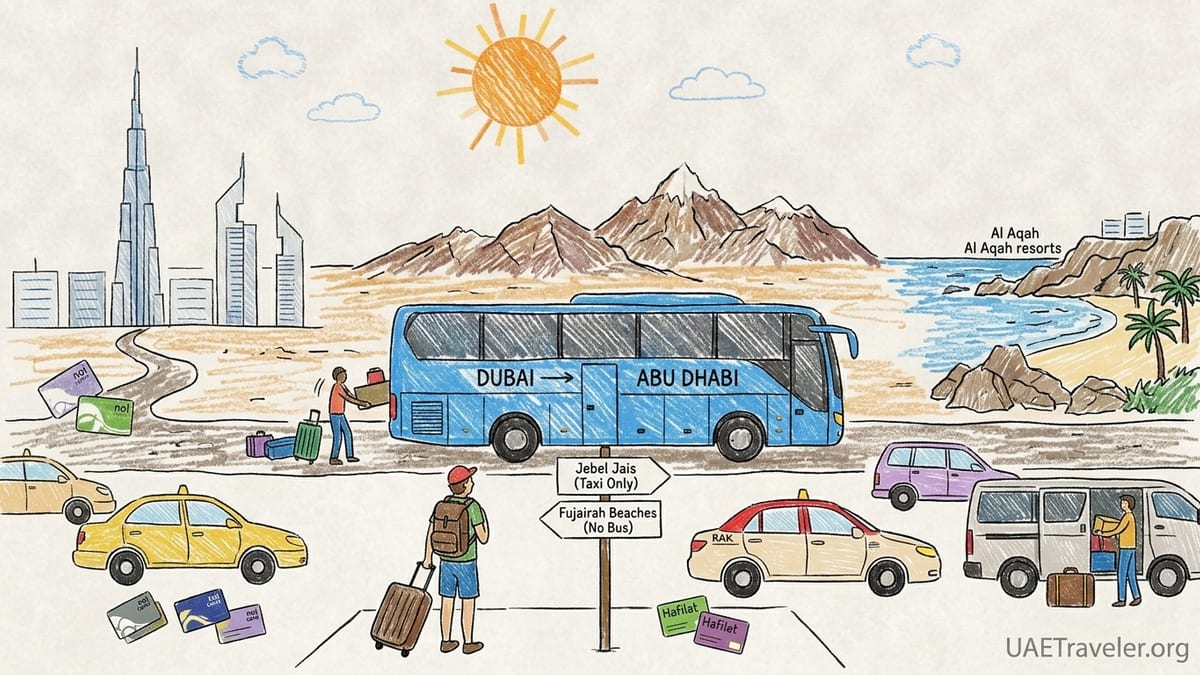
Why I Tried to See All Seven Emirates Without a Car
I went into this trip as a fan of public transport. Dubai’s metro and tram, Abu Dhabi’s clean buses and the cheap intercity routes linking the big cities had lulled me into optimism. I set myself a challenge: connect all seven emirates in one journey using only buses, shared taxis and my feet. No rental car, no private driver, no friends with SUVs.
The skeleton of the route looked sensible. From Dubai to Abu Dhabi on the RTA E100 or E101, to Sharjah on one of the frequent E3xx buses, to Ras Al Khaimah on the RAK intercity service, and across to Fujairah on the E700 from Etisalat Bus Station in Dubai. Bus fares between major hubs are low by international standards. Dubai to Abu Dhabi is around 25 dirhams each way, paid on a Nol card, and Dubai to Fujairah is about 25 dirhams on the E700 with a journey time of roughly two and a half hours. Buses between Dubai and Sharjah are cheaper again, around 12 dirhams for routes like the E303, E307 and E308.
On paper, this made the UAE look like a public-transport playground, an archipelago of air-conditioned bus stations. But the more I connected those hubs into a real trip, the more a pattern emerged. Getting to “Ras Al Khaimah” is not the same as getting to Jebel Jais. Reaching “Fujairah” is not the same as stepping onto the sand at Al Aqah. Arriving in Hatta does not put you in the mountain exclave of Masfout. The buses existed. The problem was what came after.
I did make it through all seven emirates on public transport and taxis, but I would not do it the same way again. The lessons were in the details: missed shuttles, card systems that did not talk to each other, taxi meters sprinting into triple digits and my luggage becoming a recurring character in every transfer.
The Easy Wins: Dubai, Abu Dhabi, Sharjah and Ras Al Khaimah by Bus
Let us start with what actually works well. If your trip revolves around Dubai, Abu Dhabi, Sharjah and Ras Al Khaimah city, the intercity bus network is genuinely useful.
Dubai to Abu Dhabi is the standout success story. Dubai’s Roads and Transport Authority runs at least two core routes to Abu Dhabi’s central bus station: E100 from Al Ghubaiba Bus Station and E101 from Ibn Battuta. The fare is about 25 dirhams each way and the journey typically takes around 1 hour 45 minutes, depending on traffic. You pay with your Nol card in Dubai, while Abu Dhabi’s internal buses use the Hafilat card system, so there is a subtle trap here: the card in your pocket may not work on the next bus, and the ticket machines you need are not always obvious when you arrive tired in a new city.
Dubai to Sharjah feels almost like an urban commute rather than an intercity journey. Routes such as E303, E307 and E308 link Dubai (Union or Al Ghubaiba) with Sharjah’s Al Jubail bus station for around 12 dirhams. Buses run frequently, but rush-hour traffic can turn a short timetable into a slow crawl. Still, for a day of museums and souqs in Sharjah, this is public transport at its best: simple, cheap and relatively predictable, provided you avoid peak times.
Ras Al Khaimah is also well connected from Dubai. The main intercity bus from Dubai (often departing from Union or Al Jubail, depending on the operator) takes about two hours to reach RAK city. Fares hover in the mid 20s to low 30s in dirhams one way, which is still excellent value. For a city stay at a corniche hotel, or a beach break near Al Hamra or Al Marjan Island that offers its own shuttle, you can absolutely base your itinerary on that bus. Within RAK itself, local taxis are heavily used, and fares inside the city are reasonable by Gulf standards for short hops between hotels, malls and the old town.
Where the Network Frays: When “Reaching the Emirate” Is Not Enough
The trouble began every time I tried to go beyond the city core. My bus tickets and timetables kept promising that I was “in Fujairah” or “in Ras Al Khaimah,” but my actual destinations were beaches, wadis, mountains and mangroves far from the station.
Jebel Jais is the clearest example. Ras Al Khaimah city lies on the coast; Jebel Jais, the country’s best-known mountain road and zipline destination, is roughly 45 minutes inland by car. When I arrived at RAK bus station from Dubai, I had two choices. One was to line up at the taxi rank and swallow the cost of a long metered ride. Travellers have reported paying over 120 dirhams each way for this run, and my own taxi meter was on track for three figures before I had even reached the visitor parking. The other option involves hotel-based shuttles and special services that do not originate at the bus station at all.
Ras Al Khaimah’s tourism authorities have introduced shuttles between resort areas like Al Hamra and Al Marjan Island and Jebel Jais, with one recent service priced at about 15 dirhams per person for a round trip, payable by card on the bus. It is a great deal if you are staying at one of the partner hotels along the coast. But for a bus passenger arriving at the central station with a backpack, it is another layer of logistics: first a taxi to the resort pickup point, then the shuttle to the mountain, then the same in reverse. That extra taxi connection often erases the savings of having used the long-distance bus in the first place.
A similar pattern appears on the east coast. The E700 bus from Dubai’s Etisalat Bus Station runs through the desert and mountains to Fujairah Bus Station. The fare is around 25 dirhams and the journey takes roughly two and a half to three hours. Buses run daily, and for people heading to central Fujairah it is a very good link. But when I tried to tag on a beach stay at Al Aqah, south of Dibba, the arithmetic changed. The resorts that line this stretch of coast are around 45 to 60 minutes by taxi from Fujairah city. My metered taxi to Al Aqah came out well over 100 dirhams, and when I asked about a return the driver estimated a similar amount. My cheap mountain bus ride had morphed into a 250 to 300 dirham round trip, before I had even added airport transfers.
The Hardest Places: Masfout, Mountain Roads and Remote Heritage
The most instructive parts of this trip were not the big cities at all. They were the outlying corners that look so temptingly close on a map: Masfout, Al Ain’s nearby mountain roads, little mangrove inlets outside the main towns and heritage sites that appear on tourism brochures but not on bus maps.
Masfout, Ajman’s mountain exclave, is a striking example. Online route planners will tell you that you can get there from Ajman or Dubai using a chain of buses and a final segment by taxi. One common suggestion is to travel from Ajman to Dubai’s Union Bus Station, continue on RTA route E16 to Hatta, then find onward transport into the Masfout valley. The bus components of this journey might cost in the region of 40 to 60 dirhams total, but the snag is the last link. Local information makes it clear that there is, in practice, no regular public bus between Hatta and Masfout. You rely on taxis or lifts, and those taxis quickly become expensive on mountain roads with long distances and no guarantee of a return fare.
When I looked at the total journey time from coastal Ajman to Masfout, the difference was stark. Buses and transfers could take five hours or more, including waits between services. A direct taxi for the roughly 110 kilometre route, by contrast, was quoted at around 240 to 300 dirhams one way by Ajman drivers. That is not pocket change, but split between three or four people it begins to look more competitive with five hours of buses, especially if you value your time and sanity. The same logic applies from Dubai via Hatta for anyone eyeing Masfout for its hiking trails and cooler summer weather.
On another day, chasing mangroves and boardwalks near Umm Al Quwain, I discovered that “nearest bus stop” can still mean several hot kilometres of roadside walking. Rideshare options were scarce, and local taxis, when they did appear, were reluctant to quote fixed prices to isolated corners of coast where they might not find a fare back. In some emirates, taxi regulators publish per-kilometre rates, but that does not help when the driver simply tells you there is a minimum spend for an out-of-the-way run.
Heritage villages and museums presented their own quirks. In Sharjah and Abu Dhabi, key museums cluster close enough to city routes that you can walk or use cheap crosstown buses. But smaller heritage forts, inland oases and eco-centres are often on the outskirts of towns or in neighbouring municipalities. The bus map might show you a route towards the general area, but by the time you have stitched it together with a taxi from the last practical stop, the price advantage has evaporated.
Real-World Mistakes: Cards, Connections and Luggage
Using only public transport in the UAE is not just a question of geography. Each emirate’s system has its own rules and payment cards. On a multi-emirate trip this is a recipe for small but cumulative mistakes, and I made most of them.
The first was assuming my Dubai Nol card was a magic key. It works beautifully within Dubai and on RTA-operated intercity buses departing the city. But once you arrive in Abu Dhabi, local buses use the Hafilat card. Sharjah has its own cards for some services, and other emirates rely more heavily on cash or simple flat fares for taxis. I found myself standing next to a bus in Abu Dhabi that was ready to depart for Saadiyat Island, having just discovered my Nol card was useless and the nearest Hafilat machine was inside a mall across a busy road. I caught the next bus instead, thirty minutes of beach time gone.
Luggage magnified every small mistake. Intercity buses are geared up for travellers with suitcases, and there is usually space in underfloor compartments or behind the driver. The problem is the transfers. In Dubai’s intercity bus stations, you sometimes walk a fair distance between metro station, ticket office, waiting area and bay, often outdoors and without luggage trolleys. In Sharjah’s busy Al Jubail hub, I dragged a wheeled suitcase across several lanes of taxi chaos, trying not to lose sight of the small sign for the next bus I needed. Each connection added its own little choreography of bags on and off, security checks and queueing.
One particular misstep cost me an entire afternoon in Fujairah. I had planned to take the E700 early from Dubai, drop my luggage at a city hotel and head out by taxi to Al Aqah for the day. What I had not factored in was the first bus leaving later than I thought, and slower than my optimistic schedule. A traffic delay meant I arrived in Fujairah much closer to midday than mid-morning. By the time I had checked in, negotiated a taxi to the coast and reached the beach, half my planned sightseeing window had evaporated. The total transport cost for that “cheap” day trip ended up being about 25 dirhams each way on the bus plus roughly 220 dirhams in taxis, for an effective transport bill near 270 dirhams, not counting local rides back to dinner.
At the other end of the spectrum, I missed a Jebel Jais shuttle because I had assumed it would leave from somewhere near the RAK bus station. In reality, the service I needed departed from a cluster of hotels on Al Marjan Island. By the time I had grasped that detail and found a taxi, the morning departure had already gone, and the next one in the schedule was several hours away. I ended up paying for a direct taxi to the mountain and mentally assigning the cost to the “research” section of this article.
What It Really Costs: Buses, Taxis, Couples and Families
When people talk about “saving money with buses,” they often quote the headline fare. Dubai to Abu Dhabi for 25 dirhams sounds incredible. Dubai to Fujairah for 25 dirhams is equally compelling. The reality is that on a whole trip, the bus is only part of the financial story.
To turn my scattered receipts into something useful, I ran through three hypothetical versions of my seven-emirate loop, based closely on what I actually paid: one solo traveller, one couple and one family of four with two older children. All of them start in Dubai, visit Abu Dhabi, Sharjah, Ras Al Khaimah, Fujairah and Ajman by public transport, and add the specific “hard” places that caused the biggest last-mile pain: Jebel Jais, an Al Aqah beach stay and a foray towards Masfout.
For the solo traveller, long-distance bus fares for this loop might add up to around 300 to 400 dirhams over a week, using services like E100/E101, the Dubai-Sharjah E3xx routes, the RAK bus and the E700 to Fujairah. Local buses and metros in Dubai and Abu Dhabi could add perhaps another 100 to 150 dirhams. So far, so reasonable. The shock comes when you layer on taxis to mountains, beaches and outlying towns. My own long taxi segments to Jebel Jais and back, plus to and from Al Aqah, easily reached 600 to 800 dirhams in total, even with some rides shared.
For a couple, the picture flips. The bus fares double, but the taxi fares remain the same per vehicle. Two people taking the bus from Dubai to Fujairah pay 50 dirhams instead of 25, but the 220 dirhams in taxis to Al Aqah does not change. The same applies to Jebel Jais: the bus to RAK is cheap for two, but the long taxi up the mountain stays near 120 to 150 dirhams per direction regardless of how many are in the back seat. A pair of travellers can easily find themselves spending 900 to 1,200 dirhams on taxis over the course of a week if they chase mountains and remote beaches without a car.
For a family of four, those numbers become hard to justify. Four seats on the E700 will cost roughly 100 dirhams one way, which is still good value, but if that leads to a 220-dirham taxi to and from a resort, the blended cost no longer looks so appealing. Two long taxi runs to mountains or remote beaches can push the family’s taxi spend over 1,000 dirhams in just a few days. At that point, a rental car at perhaps 120 to 180 dirhams per day plus fuel begins to look not only more flexible but potentially cheaper, especially over a week or more.
Private drivers sit between these options. A pre-booked car and driver for a full-day outing to Jebel Jais or to Al Aqah might run around 600 to 800 dirhams, sometimes more for hotel-arranged SUVs. That sounds steep until you divide it by four or share it with friends. A guided excursion that includes transport, like a Jebel Jais zipline package with pickup from Dubai, may look expensive at first glance but folds all that last-mile headache into one line on the bill. After my third long-distance taxi meter sprinted into three digits, those package prices started to seem much more rational.
The Compromise: When Buses Shine, When Tours Help and When to Rent a Car
By the end of my no-car experiment, I had abandoned the idea that there was a single “best” way to get around the UAE. Instead, a pattern of compromises emerged, and it is one I would use if I were planning the same seven-emirate trip again.
First, I would absolutely keep using intercity buses along the main corridors. Dubai to Abu Dhabi, Dubai to Sharjah and Dubai to Ras Al Khaimah city are excellent value and comfortable. If your trip is mostly city based, you can rely heavily on these routes and use taxis sparingly for short in-town hops. Dubai’s Nol system makes fare payment simple inside its own network, and Abu Dhabi’s Hafilat card works well once you know you need it and have loaded it.
Second, I would outsource some last-mile problems to guided excursions. If your heart is set on Jebel Jais, consider a tour that includes transport from Dubai or from your resort in RAK, especially if you are more than one person. For the east coast, hotel-organised day trips that bundle Fujairah’s forts, wadis and Al Aqah’s beaches into one circuit can work out cheaper than stringing together buses and taxis. The same logic applies to wildlife and mangrove experiences that start from remote launch points outside town.
Third, and this is the part I resisted most, I would rent a car for at least part of the trip. If you only plan to visit downtown Abu Dhabi from Dubai, you do not need one. But if your itinerary includes Masfout, Jebel Jais, scattered heritage forts and out-of-town beaches in the same week, a short car rental centered on those days can transform the experience. It turns five-hour, three-bus odysseys into 90-minute drives and three-figure taxi runs into manageable fuel bills.
Crucially, I would stop thinking of “public transport versus car” as a binary choice. The UAE rewards flexibility. Fly into Dubai, use the metro, tram and buses to settle in and explore the city. Take the bus to Abu Dhabi for a couple of days of museums and the Grand Mosque. Then, when your route starts to involve names like Masfout, Hatta, Al Aqah or Jebel Jais, pick up a rental car or join a well-reviewed tour. You will still experience the strengths of the public systems without being at their mercy in the places they were never really designed to serve.
The Takeaway
Traveling across all seven emirates without a car taught me two truths at once. The first is that the UAE’s intercity bus network is better than many visitors expect, and in the big city corridors it can be a joy to use. The second is that those buses alone will not deliver you smoothly to the mountain roads, cool valleys and hidden beaches that so many people come here to see.
I do not regret my bus-heavy experiment. It forced me to notice details many travellers gloss over: which stations have shade, where you buy which card, how long it really takes to change buses with luggage in tow. It also showed me exactly where public transport currently stops being practical and private wheels start to make sense.
If you want a realistic, not ideological, approach, build your trip around what each mode does best. Use buses for what they are brilliant at: linking the emirate capitals cheaply and cleanly. Lean on tours and shuttles to bridge the biggest gaps to mountains and remote coasts. And when the map turns pale and the bus lines thin out, accept that a short-term car rental is not a failure of travel purity but a sensible tool in a country that was largely designed around the road.
FAQ
Q1. Is it really possible to visit all seven emirates without renting a car?
Yes, it is possible to step foot in all seven emirates using only buses and taxis, but some segments become slow, awkward and surprisingly expensive, especially when mountains, exclaves and remote beaches are involved.
Q2. Which intercity bus routes in the UAE are most useful for tourists?
The most helpful routes for visitors are Dubai to Abu Dhabi (E100/E101), Dubai to Sharjah (E3xx routes like E303, E307 and E308), Dubai to Ras Al Khaimah and Dubai to Fujairah on the E700. These link the main urban areas where most hotels and attractions are concentrated.
Q3. How much does it cost to go from Dubai to Abu Dhabi by bus?
A one-way ticket between Dubai and Abu Dhabi on routes like E100 or E101 is around 25 dirhams per person. The trip usually takes about 1 hour 45 minutes, depending on traffic and the departure point in Dubai.
Q4. Is there public transport all the way to Jebel Jais?
There is no regular city bus from Ras Al Khaimah bus station directly to the Jebel Jais viewpoint. You either take a taxi from the city, which can exceed 120 dirhams each way, or use hotel-based shuttles and special mountain services that require extra transfers.
Q5. Can I reach Al Aqah beach resorts by bus from Dubai?
You can reach Fujairah city by bus on the E700 from Dubai, but the final stretch to Al Aqah is by taxi. That taxi ride can cost well over 100 dirhams each way, so the last-mile segment often ends up costing more than the long-distance bus.
Q6. Is Masfout accessible by public transport from Ajman or Dubai?
Reaching Masfout without a car is theoretically possible using a combination of buses towards Hatta and then a taxi, but in practice there is no simple, regular public bus service into the Masfout valley. Travellers usually rely on private cars or relatively expensive taxis for the last stretch.
Q7. Do I need different payment cards for buses in different emirates?
Yes. Dubai uses the Nol card, Abu Dhabi uses the Hafilat card for its city buses, and other emirates have their own systems or rely more on cash and taxis. A Nol card will not automatically work on internal buses in another emirate, so you may need to buy or load separate cards.
Q8. For a couple or family, is public transport still cheaper than renting a car?
For simple city-to-city trips, buses usually remain cheaper, especially for solo travellers. But for couples and families who also want mountains, remote beaches and scattered heritage sites, the cumulative cost of long taxi rides can approach or exceed the price of a rental car over several days.
Q9. When does it make sense to book guided excursions instead of going independently?
Guided excursions make sense when your destination is remote, involves several stops or would otherwise require multiple taxis. Jebel Jais trips, combined Fujairah and Al Aqah tours, and mangrove or desert excursions often work better and sometimes cheaper as organised outings, especially for two or more people.
Q10. If I want to mix buses and a rental car, how should I plan it?
A practical strategy is to rely on buses and metros for Dubai, Abu Dhabi and Sharjah, then schedule a short car rental specifically for the days you plan to visit Jebel Jais, Masfout, Al Aqah or other out-of-town sites. That way you benefit from the strengths of public transport without being trapped by its limitations in the most remote areas.