


Choosing how to split your time between Dubai and Abu Dhabi is one of the biggest planning questions for a UAE trip. The two cities are only about 140 kilometres apart, yet offer distinct skylines, beaches, museums and deserts. This guide lays out three clear itineraries for 5, 7 and 10 days, shows when it makes sense to change hotels between cities, and helps you build a realistic budget with current ticket and transport examples for travel in late 2026 and early 2027.
Key Planning Decisions: Routes, Airports and Where to Sleep
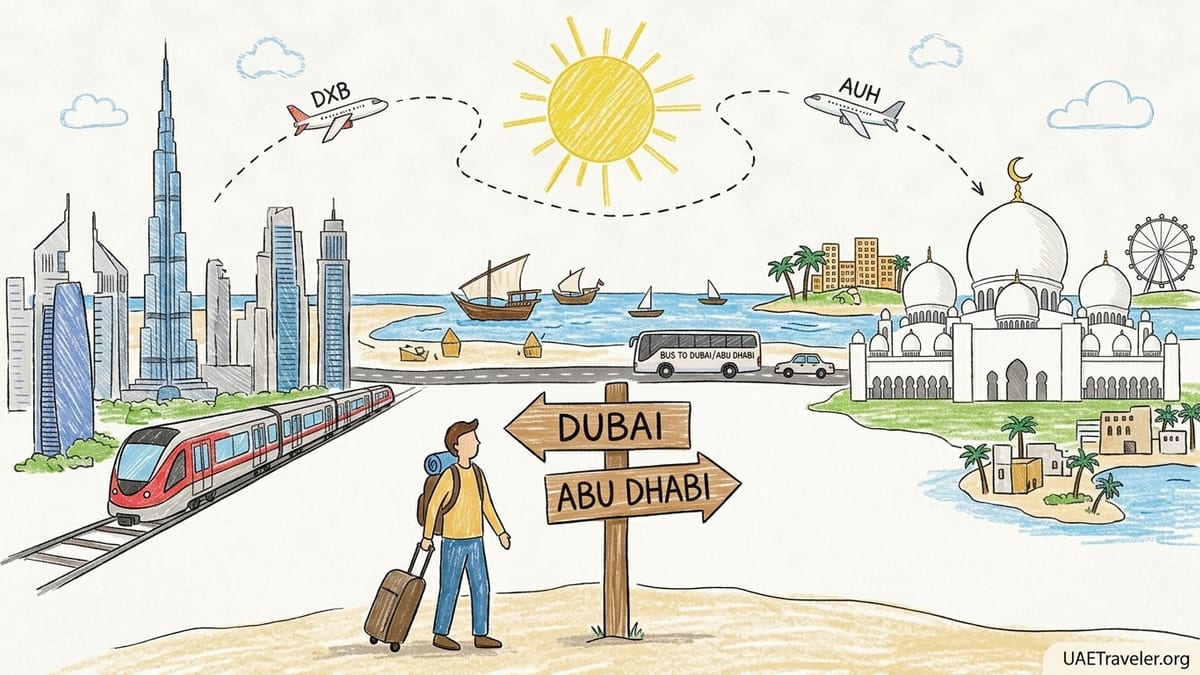
The first choice is your flight route. Most international visitors land at Dubai International Airport, one of the world’s busiest hubs, with frequent long haul connections across Europe, Asia and North America. Dubai Airport connects to the city on the Red Line of the Dubai Metro in roughly 25 minutes to Burj Khalifa and Dubai Mall, for a fare that is generally under 10 dirhams in standard class, or you can take an official airport taxi with a higher starting fare than city taxis. Abu Dhabi International Airport is smaller but growing, with direct services from Europe and Asia and convenient road access to both downtown Abu Dhabi and Dubai.
A popular option is an open jaw ticket, flying into Dubai and out of Abu Dhabi, or the reverse. This avoids backtracking along the E11 highway and lets you finish your trip closer to your final hotel. The two airports are linked to their city centres by taxis and buses, and to each other by intercity buses and taxis. As of late 2026, Dubai to Abu Dhabi by public bus such as the E101 or E102 typically takes around one hour and forty minutes from Ibn Battuta or Al Ghubaiba bus stations to central Abu Dhabi, and costs in the range of 25 dirhams per person each way, paid by Nol or cash depending on the route.
If you prefer door to door comfort, a regulated Dubai taxi to a central Abu Dhabi hotel usually costs in the region of 280 to 350 dirhams depending on traffic and tolls at Salik gates according to recent fare comparisons and transfer operators. That can be cost effective for two to four people with luggage compared with four individual bus tickets plus local taxis. Private car transfers arranged through hotels or specialist operators tend to start slightly higher, often from around 350 dirhams per car for a sedan and more for larger SUVs or vans.
Where you sleep depends on trip length. For five days, many travellers base entirely in Dubai and do Abu Dhabi as a long day trip, which is feasible but long. With seven days, you can justify two hotels, spending four nights in Dubai and three in Abu Dhabi. With ten days, splitting your stay is strongly recommended so you are not spending several hours every time you want to change city, and you can match neighbourhoods to your daily plans such as Old Dubai and Downtown first, then Saadiyat and Yas Island in Abu Dhabi.
City Layout: How Dubai and Abu Dhabi Fit Together
Dubai is stretched along the coast, which affects how you plan sightseeing days. Old Dubai clusters around Deira and Bur Dubai on either side of Dubai Creek, with the Gold and Spice Souks, Al Fahidi Historical Neighbourhood and traditional abras across the water. Downtown Dubai lies further southwest along Sheikh Zayed Road, centred on Burj Khalifa, Dubai Mall and the Dubai Fountain. Beyond that, Dubai Marina and Jumeirah Beach Residence form a dense cluster of skyscrapers, waterfront promenades and beach clubs, while the Palm Jumeirah arcs into the Gulf with resort hotels and rooftop bars. Desert experiences depart from various city locations in the late afternoon.
Abu Dhabi, by contrast, is more compact and island based. The central Corniche area and downtown sit on Abu Dhabi Island, with an attractive waterfront. Sheikh Zayed Grand Mosque lies inland on the mainland, directly off the highways linking to Dubai. Saadiyat Island is northeast of downtown and has become Abu Dhabi’s cultural and beach hub, home to Louvre Abu Dhabi and several upscale beach resorts. Yas Island, closer to the airport and the Dubai road, focuses on entertainment with theme parks including Ferrari World Yas Island, SeaWorld Yas Island, Yas Waterworld Yas Island and Warner Bros. World Yas Island, along with Yas Mall and the Formula 1 circuit.
Travel time between major clusters matters, especially in extreme heat from roughly May to September when walking between attractions becomes difficult. In Dubai it is roughly 20 to 30 minutes by Metro or taxi from Old Dubai to Downtown, and another 20 to 30 minutes from Downtown to Dubai Marina or the Palm, depending on traffic. In Abu Dhabi, driving from downtown Corniche hotels to the Grand Mosque is often about 20 minutes outside rush hour, from downtown to Saadiyat Island around 15 minutes, and downtown to Yas Island around 30 minutes. From the perspective of an itinerary, that means you should cluster Old Dubai and the Creek together, Downtown around Burj Khalifa and Dubai Mall together, and the Marina and Palm together, then build your Abu Dhabi days around the Grand Mosque, Louvre Abu Dhabi and Saadiyat, and Yas Island’s theme parks.
One key update for October 2026 visitors is that Dubai’s Museum of the Future has temporarily closed to the public. The museum announced in September 2026 that it would shut while exhibitions and the visitor journey are completely reimagined, with a planned reopening in the first quarter of 2027 to coincide with its fifth anniversary. The striking torus building on Sheikh Zayed Road still makes a memorable photo stop from nearby but you cannot visit the interior on this itinerary period, so swap it for other experiences such as Al Shindagha Museum in Old Dubai or a visit to Sky Views Observatory near Downtown.
Five Day Itinerary: Classic Highlights with a Taste of Both Cities
With only five days, you want an efficient route that minimises hotel changes. The most practical pattern for many travellers is to stay all five nights in Dubai, using the city as your base, and dedicate one long day to Abu Dhabi. This avoids packing and check in time and works especially well if you are flying in and out of Dubai. Consider staying in Downtown Dubai or Business Bay for quick access to Burj Khalifa, Dubai Mall and road links to both Old Dubai and Abu Dhabi.
On Day 1, focus on Old Dubai and Dubai Creek. After arriving and dropping your bags, head to Al Fahidi Historical Neighbourhood in the late afternoon when the heat eases slightly. You can walk the narrow alleys, visit museums such as the Coffee Museum and step into a traditional wind tower building. Take an inexpensive abra boat across Dubai Creek from Bur Dubai to Deira for 1 dirham per person in cash, then wander the Gold and Spice Souks as the city lights come on. Dinner can be at a creekside restaurant in Al Seef or a simple Lebanese or Indian restaurant in Bur Dubai, with a budget of around 50 to 80 dirhams per person for mains and a drink in casual spots.
Day 2 revolves around Downtown. Take the Metro Red Line to Burj Khalifa or Dubai Mall Station or a taxi if you want to minimise walking in the heat. Inside the mall you can easily spend a morning window shopping and using air conditioned walkways. Many visitors pre book tickets to At the Top in Burj Khalifa. Recent price checks for 2026 show standard off peak adult tickets to levels 124 and 125 starting around 179 dirhams when bought directly for non prime hours, with higher prices for sunset times, holidays and access to the higher SKY level. It is worth paying a little extra for a timed sunset slot if this is your once in a lifetime visit. Plan an early dinner inside the mall or at Souk Al Bahar, where midrange restaurants often charge around 80 to 120 dirhams for a main dish, before watching the evening Dubai Fountain shows outside.
Day 3 is your Abu Dhabi day trip. Arrange an early private transfer from your Dubai hotel to Abu Dhabi’s Sheikh Zayed Grand Mosque, leaving around 7.30 in the morning to arrive around 9.30. Tours and taxis usually drop you at the visitor centre car park connected to the mosque by underground walkways lined with cafes and small shops. Dress modestly following the mosque’s dress code, which emphasises covered shoulders and knees for all visitors and headscarves for women. As of September 2026 local news reported the introduction of an entry fee for general visitors to support operations and preservation. Exact amounts can change and should be checked on the official Sheikh Zayed Grand Mosque Centre website before you travel, but plan room in your budget for a modest admission per adult. After exploring the mosque and its reflective pools for one to two hours, take a taxi about 20 to 25 minutes to Louvre Abu Dhabi on Saadiyat Island.
At Louvre Abu Dhabi, general admission tickets checked in late 2026 were around 70 dirhams for adults, with some discounts for children and certain cardholders. A visit typically takes two to three hours if you include the main galleries, dome walkways and a café break. Combine this with a late lunch at the museum café or in nearby Saadiyat resorts. In the late afternoon, transfer back to Dubai, which might take about ninety minutes to two hours depending on Abu Dhabi and Dubai traffic. Because this day is long, an organised small group tour that combines the Grand Mosque and Louvre Abu Dhabi with hotel pick up and drop off can be worthwhile if you prefer not to manage buses and taxis in the heat.
Days 4 and 5 are for Dubai Marina, Palm Jumeirah and the desert. Spend one day around Dubai Marina Walk and JBR, perhaps with morning pool time at your hotel and lunch along the waterfront. In the late afternoon take a stroll under the shade of towers, or visit one of the nearby beach clubs. On the final day, book a desert safari that includes hotel pick up in mid afternoon, dune driving in nearby conservation areas or desert terrain, camel rides and a barbecue dinner with entertainment, returning to your hotel around 9 or 10 at night. Reputable operators usually charge from about 200 to 350 dirhams per adult for group safaris, with higher prices for more exclusive conservation based and private tours.
Seven Day Itinerary: Museums, Beach Time and Two City Stays
A full week allows you to stay in both cities and build in slower days focused on museums and the beach. A logical split is four nights in Dubai and three in Abu Dhabi, flying into Dubai and out of Abu Dhabi. In Dubai, you might stay the first two nights in Old Dubai or along Dubai Creek to immerse yourself in traditional areas, then two nights in Dubai Marina or on the Palm Jumeirah for beach access. In Abu Dhabi, basing yourself on Saadiyat Island yields an appealing combination of beach and culture within a short drive of downtown.
Days 1 and 2 mirror the earlier Old Dubai and Downtown pattern, but with more time for museums. After exploring the Al Fahidi neighbourhood, you can add Al Shindagha Museum along the Creek, which tells Dubai’s maritime and trading history in air conditioned galleries. On the Downtown day, once you have scheduled your Burj Khalifa visit, consider indoor alternatives such as the Dubai Aquarium and Underwater Zoo inside Dubai Mall. While ticket combinations and prices change frequently, a standard admission to the aquarium tunnel and exhibits typically falls somewhere in the 150 to 200 dirham range for adults at the time of writing, with higher prices for additional experiences. These activities help you avoid the worst midday heat.
On Day 3, transfer hotels within Dubai from an Old Dubai or Downtown base to Dubai Marina or the Palm. The Metro and tram combination from Burj Khalifa or Business Bay to Dubai Marina can take about 30 to 40 minutes including transfers, while a taxi on Sheikh Zayed Road is usually around 20 to 25 minutes off peak. Spend the afternoon by your hotel pool or on JBR Beach. Evening options include a marina boat dinner cruise or rooftop drinks on the Palm. For a midrange stay, look at chain hotels such as Hilton Dubai Jumeirah or Rove Dubai Marina, where late 2026 advance sale rates for November and February often sit in the approximate range of 450 to 800 dirhams per night including taxes for standard rooms, depending on exact dates.
Day 4 is your transfer to Abu Dhabi. Check out in the late morning and either take a private car or taxi directly from your Dubai Marina hotel to a Saadiyat Island resort, usually taking about 75 to 90 minutes door to door outside the busiest commuter rush. If you wish to save money, you can take the Metro or tram to Ibn Battuta, connect to an intercity bus to Abu Dhabi, alight at the Abu Dhabi Bus Station, then take a local taxi to Saadiyat. The total journey typically takes around two and a half hours including transfers and waiting time, but costs can stay under 60 to 70 dirhams per person depending on how you pay for the bus and local taxis. Once in Saadiyat, check into your resort and spend the rest of the day on the beach, where hotel daybeds, shaded pools and sea breezes temper the heat better than city pavements.
Days 5 and 6 are for Abu Dhabi’s cultural highlights and city atmosphere. Dedicate a full day to Louvre Abu Dhabi and Saadiyat’s beach. Start early at the museum to avoid midday heat on the outdoor walkways and under the dome’s “rain of light”. After a late lunch, retreat to your hotel pool or beach and return to the museum area in the evening if you wish to dine at one of the concession restaurants. Reserve another day for Sheikh Zayed Grand Mosque and Qasr Al Watan, the presidential palace. A practical sequence is to take a taxi from Saadiyat or downtown to the mosque in the morning, spend one to two hours there, then ride another taxi for about 20 minutes to Qasr Al Watan.
Recent guidance from official tourism sources and booking portals indicates Qasr Al Watan general adult tickets hovering around the 65 to 85 dirham mark, depending on whether they include the palace and gardens only or add a combined ticket option with the evening Palace in Motion light and sound show. You enter through a visitor centre, then cross by shuttle bus to the main palace building, whose great hall, library and exhibits can absorb two hours or more if you linger. Families should plan meal breaks at the on site cafés between attractions, where a casual lunch of sandwiches and drinks often runs 60 to 100 dirhams per person. On Day 7, relax on Saadiyat’s beach or by the pool, and perhaps visit the Corniche or a downtown mall before flying out of Abu Dhabi in the evening.
Ten Day Itinerary: Theme Parks, Desert and Deeper Exploration
With ten days you can design a slower paced route that includes both cities, resort time, a desert camp and world class theme parks without feeling rushed. A balanced split is six nights in Dubai and four in Abu Dhabi. Within Dubai, consider three nights near Old Dubai or Downtown for culture and shopping, and three nights in Dubai Marina or on the Palm for beaches and easy access to yacht cruises and Dubai Harbour. In Abu Dhabi, two nights on Saadiyat Island and two nights on Yas Island let you focus on both culture and entertainment.
Early days in Dubai can follow the Old Dubai, Creek and Downtown framework already described, with extra time for neighbourhoods such as Jumeirah for cafes and local beaches. On one of the mid trip days, dedicate a full afternoon and evening to a higher end desert experience. Some operators based in Dubai Conservation Reserve limit vehicles and include nature drives, falconry displays and gourmet dinners in more secluded settings, which can cost 900 to 1500 dirhams per person or more but deliver a very different feel from high volume desert camps. If your budget is more modest, you can still find reputable shared safaris in the 250 to 400 dirham range that avoid overly aggressive dune bashing and focus on sunset views, short camel rides and dinner.
Another Dubai day can be shaped around extreme heat alternatives and indoors attractions such as ski slopes at Mall of the Emirates, indoor skydiving centres or large aquariums. These options appeal especially to families travelling in summer, when afternoon outdoor time is limited. For example, two hour sessions at indoor snow parks often fall somewhere between 220 and 350 dirhams per adult including equipment hire, based on recent price checks, and less for shorter kids sessions or non ski activities. Combined with shopping malls and indoor play areas, this creates a full day that keeps you largely in air conditioned spaces with short taxi hops between them.
On Day 7, transfer to Abu Dhabi, ideally by private car given you may be carrying more luggage on a longer trip. Check into a Saadiyat Island resort for two nights. Spend one day revisiting Louvre Abu Dhabi with a slower pace, perhaps joining a public tour or temporary exhibition, then unwind on the beach or at the hotel spa. The other Saadiyat day can include a short trip into downtown for the Corniche and Heritage Village, before you change hotels to Yas Island in the evening.
The last three days revolve around Yas Island’s theme parks and the Grand Mosque. Yas Island resorts often sell packages including park access. For example, a two or three park pass valid over several days might offer entry to Ferrari World Yas Island, Warner Bros. World Yas Island and Yas Waterworld Yas Island at a lower combined price than buying each ticket separately at the gate, where individual adult tickets frequently sit in the 330 to 400 dirham range per park based on recent promotion comparisons. SeaWorld Yas Island tickets are usually in a similar band. Booking a multi park pass can save several hundred dirhams for a family of four over three days, and also simplify logistics with shuttle buses connecting hotels and parks.
On your final full day, schedule Sheikh Zayed Grand Mosque if you have not visited earlier in the trip, ideally in the late afternoon when the white marble glows softly in the low sun and temperatures drop. Because taxis from Yas Island to the mosque usually take about 25 to 30 minutes, you can combine this visit with a farewell dinner at a hotel restaurant along the canal or mainland. Depart from Abu Dhabi Airport on Day 10, a short taxi ride from Yas Island that normally costs less than transfers to central Abu Dhabi.
Hotel Strategies, Transport Logistics and Heat Smart Sightseeing
For first time visitors, one of the biggest worries is whether moving hotels wastes time. On a five day schedule, it usually does, unless your flight out of Abu Dhabi makes the city a mandatory last stop. In that case, consider four nights in Dubai and one night on Yas Island, using the final day for a quick Grand Mosque and Yas Island visit. On seven and ten day itineraries, changing hotels between cities gives you more efficient sightseeing, because you can schedule Abu Dhabi days without a two hour journey each way from Dubai. Within each city, however, limit yourself to one change at most to avoid spending every other morning packing.
In terms of neighbourhoods and hotel categories, couples often appreciate Downtown Dubai hotels such as Address Downtown or more affordable towers in Business Bay for city views and nightlife, then a quieter resort on Saadiyat. Families might prioritise apartment style hotels in Dubai Marina or JBR with kitchenettes and laundry, then kid friendly properties on Yas Island that include access to theme parks or shuttle buses. Midrange, well reviewed three and four star chains in Dubai, including brands such as Rove or Hilton Garden Inn, can often be booked in the 250 to 550 dirham range per night in the shoulder seasons like November and March if you reserve well in advance and avoid major events. In Abu Dhabi, centrally located international brands can sometimes undercut Dubai prices by 10 to 20 percent on comparable dates.
Public transport is excellent in Dubai along the main Red and Green Metro lines and supplemented by trams and buses. Purchasing a Nol card at the airport or major stations lets you tap in and out on Metro and buses, with fares calculated by zones and standard single rides across a couple of zones often under 8 dirhams. Abu Dhabi has a growing network of buses, but for short stays most visitors use taxis and ride hailing services such as Uber and Careem, where city rides within Abu Dhabi Island often range from about 15 to 40 dirhams depending on distance and traffic. In both cities, air conditioned metro stations and malls provide respite from the heat and are worth using as anchor points even if you complete the last short legs by taxi.
Extreme heat shapes your day. Plan outdoor walking in winter months during early morning and late afternoon, and in summer try to cluster outdoor segments around sunrise and just before sunset. Always carry water and consider UV protective clothing or umbrellas. In Dubai, long air conditioned corridors in malls and along certain promenade sections mean you can see more than you might expect without prolonged exposure. In Abu Dhabi, shaded beachfront promenades on the Corniche and Saadiyat, as well as shaded mosque walkways and museum domes, provide some relief but still require sensible sun behaviour.
Budgeting: Economy, Midrange and Luxury Cost Examples
To create a realistic sense of total costs, it helps to build sample daily budgets for different travel styles. For an economical traveller in a shoulder season month, sharing a room, you might find budget hotels or basic serviced apartments in Dubai and Abu Dhabi for somewhere in the 180 to 300 dirham per night range including taxes if you book well ahead and stay slightly away from prime waterfront areas. Daily public transport and a couple of taxi rides could cost 30 to 60 dirhams per person, while casual meals from local cafeterias, food courts and small restaurants can be kept around 80 to 120 dirhams per day if you choose shawarma, biryani and similar dishes.
For this economy profile, a five day Dubai and Abu Dhabi itinerary might see a total spend of about 2500 to 3500 dirhams per person not counting flights. That rough band includes five nights of accommodation shared between two, several local attraction tickets such as Burj Khalifa At the Top, Louvre Abu Dhabi and a group desert safari, plus intercity buses and taxis. A seven day version with more museum time and one theme park day on Yas Island might rise into the 3500 to 5000 dirham range per person, while a ten day trip with two or three theme park entries and higher end desert experience could move above 5500 dirhams or more depending on exact ticket combinations and travel season.
Midrange travellers staying in well located four star hotels or good international chains can expect nightly room rates in popular months from around 350 to 800 dirhams including taxes, with higher spikes during large conferences and events. Meals at midscale restaurants, including some hotel venues, might average 60 to 120 dirhams for a main course, plus drinks and service. Adding taxis, Metro rides and attraction tickets, a reasonable midrange daily spend including accommodation for two people can land in the 700 to 1200 dirham zone, depending on whether you are hitting an expensive day like multiple theme parks or a quieter beach day.
Luxury travellers staying in five star beachfront resorts on the Palm, Saadiyat or Yas, and booking business class flights, private transfers and premium experiences should budget significantly more. Five star resorts in prime winter months can easily start above 1300 dirhams per night and climb much higher for suites and sea view rooms. Fine dining at hotel restaurants can reach 300 dirhams or more per person for three courses without drinks. Private car transfers between Dubai and Abu Dhabi, private desert safaris and VIP theme park access add further layers. It is not difficult for a couple to spend upwards of 8000 to 12000 dirhams on a ten day luxury stay excluding flights, especially if booking top tier experiences and peak holiday dates.
Ticket combinations can meaningfully reduce costs. In Dubai, combo tickets bundling Burj Khalifa and aquarium access, or other pairs of attractions, often shave a portion off buying separately. In Abu Dhabi, Yas Island theme park passes that cover two or three parks over multiple days are almost always better value than single park purchases if you plan more than one visit. Before booking, compare official websites and authorised resellers for current promotions and check validity dates. Avoid buying tickets from unofficial street sellers or unverified online marketplaces to reduce risk of problems at entry.
The Takeaway
Dubai and Abu Dhabi work best together when you treat them as complementary rather than interchangeable. For a quick first look, five days based in Dubai with one long Abu Dhabi day delivers a clear highlights reel, especially if you are focused on Burj Khalifa, Old Dubai, the Grand Mosque and Louvre Abu Dhabi. With seven days, splitting between cities lets you slow down enough to enjoy museums and beaches without constant highway shuttling. At ten days, you can thoughtfully fit in theme parks, a memorable desert night and relaxed resort time.
Couples who enjoy dining, rooftop bars and art often gravitate to Downtown Dubai plus Saadiyat Island, where they can pair city lights with Louvre Abu Dhabi and quiet beaches. Families usually appreciate Dubai Marina or JBR paired with Yas Island, giving them playgrounds, casual restaurants and easy access to theme parks. First time visitors uncertain about local norms can lean on hotel concierges and official visitor information desks for up to date guidance on dress codes, public transport and current opening hours.
Some travellers are better served by focusing on a single city. If you have three or four nights only, or are visiting in the peak of summer and dislike long drives, consider staying solely in Dubai, with its denser cluster of attractions, and save Abu Dhabi for a future trip. Conversely, travellers whose highest priorities are museums, calmer beaches and theme parks might base entirely in Abu Dhabi, particularly on Saadiyat or Yas, and visit Dubai only briefly if flight schedules require.
Whichever itinerary length you choose, planning your days around logical city clusters, realistic travel time, the current closure of the Museum of the Future and the reality of desert climate will make your Dubai and Abu Dhabi journey feel smooth rather than stressful. Treat this guide as a framework, then adjust hotel categories, attraction choices and meal styles to match your budget and travel personality.
FAQ
Q1: Is it better to fly into Dubai and out of Abu Dhabi, or use the same airport?
For itineraries of seven days or longer, flying into Dubai and out of Abu Dhabi, or vice versa, often makes more sense because you avoid backtracking along the highway and can finish the trip near your final hotel. On a five day itinerary with a focus on Dubai, using Dubai International Airport both ways is usually simpler and sometimes cheaper on long haul routes.
Q2: How long does it take to travel between Dubai and Abu Dhabi, and what does it cost?
By road, the journey is usually around one and a half to two hours depending on traffic. Intercity buses from Dubai bus stations to Abu Dhabi typically cost around 25 dirhams per person each way, while a regulated taxi or private transfer between central hotels generally runs somewhere around 280 to 350 dirhams per car in late 2026, with higher tariffs for larger vehicles.
Q3: Is the Museum of the Future open during October 2026?
No. The Museum of the Future announced a temporary closure to visitors from early September 2026 while it redesigns its exhibitions and visitor experience. It is expected to reopen with a new narrative in the first quarter of 2027, so travellers in October 2026 should treat it as a landmark to view from outside rather than a visitable attraction.
Q4: Should I stay overnight in Abu Dhabi or just do a day trip from Dubai?
If you have five days total, a long day trip can work, but you will have an early start and late return. With seven or ten days, staying at least two or three nights in Abu Dhabi, ideally on Saadiyat or Yas Island, allows you to visit the Grand Mosque, Louvre Abu Dhabi, Qasr Al Watan and theme parks without repeated long highway journeys and gives you more relaxed mornings and evenings.
Q5: How should I dress for Sheikh Zayed Grand Mosque and other cultural sites?
All visitors should dress modestly, with shoulders and knees covered and loose fitting clothing. Women are expected to cover their hair inside the mosque, either with their own scarf or one borrowed when available. Tight, transparent or heavily ripped clothing is not appropriate. These rules apply regardless of temperature, so carry a light scarf or long layer even in summer.
Q6: Are combined tickets and passes really cheaper than buying single attraction tickets?
Often yes, particularly for Burj Khalifa and aquarium combinations in Dubai and multi park passes on Yas Island in Abu Dhabi. For example, a two or three park Yas pass spread over several days typically costs less per park than buying each ticket individually. However, you should still compare current official prices and check that you will realistically use everything included before paying for a bundle.
Q7: How can I plan around the extreme heat in the UAE?
Plan outdoor activities such as walking in Old Dubai, mosque visits or desert stops for early morning or late afternoon. Use air conditioned spaces like malls, museums and hotels in the middle of the day, and rely on taxis, Metro and trams rather than long walks. Always carry water and sun protection, and consider adjusting your travel month to November through March if you are sensitive to high temperatures.
Q8: What are typical daily budgets for different travel styles in Dubai and Abu Dhabi?
Economy travellers who share rooms and use public transport can often manage on roughly 500 to 700 dirhams per day including accommodation, meals and some tickets. Midrange visitors staying in four star hotels and mixing taxis, Metro and paid attractions might spend in the 900 to 1500 dirham per day band for two people. Luxury travellers in five star resorts with private tours and fine dining usually spend significantly more.
Q9: Is it safe and practical to use public transport with luggage between cities?
Dubai’s Metro and buses are modern, air conditioned and safe, and Abu Dhabi’s intercity buses are similarly comfortable. It is practical to use them with wheeled suitcases if you are comfortable navigating stations and short walks or taxi rides at each end. For families with young children, elderly travellers or those carrying multiple bags, a direct taxi or private car between hotels is often less stressful.
Q10: Which travellers should focus on only one city instead of combining Dubai and Abu Dhabi?
Travellers with very limited time, such as three or four nights, or those visiting during the hottest months who dislike long drives may be better concentrating on one city. Visitors who prioritise urban skylines, shopping malls and a wide variety of dining may lean towards Dubai only, while those most interested in quieter beaches, major museums and theme parks could reasonably base only in Abu Dhabi for a short trip.