


I learned the hard way that a twelve-hour connection in Dubai does not equal twelve hours of sightseeing. On paper, my itinerary from London to Bangkok looked perfect: land in Dubai at 06:00, depart at 18:00, and somehow squeeze in Burj Khalifa, Dubai Mall, Old Dubai and the dhow boats on Dubai Creek, plus sunset at Dubai Marina. In my notebook I had drawn a neat timeline with color-coded metro rides and a smug note: “Plenty of time, even with queues.” What I actually got, after immigration lines, baggage decisions, airport traffic and the need to be back at the gate well before departure, was barely six usable hours in the city and a mad dash through DXB security at the end. That naively over-optimistic stopover became the template for this guide, which challenges the idea that a twelve-hour layover is a free full day in Dubai.
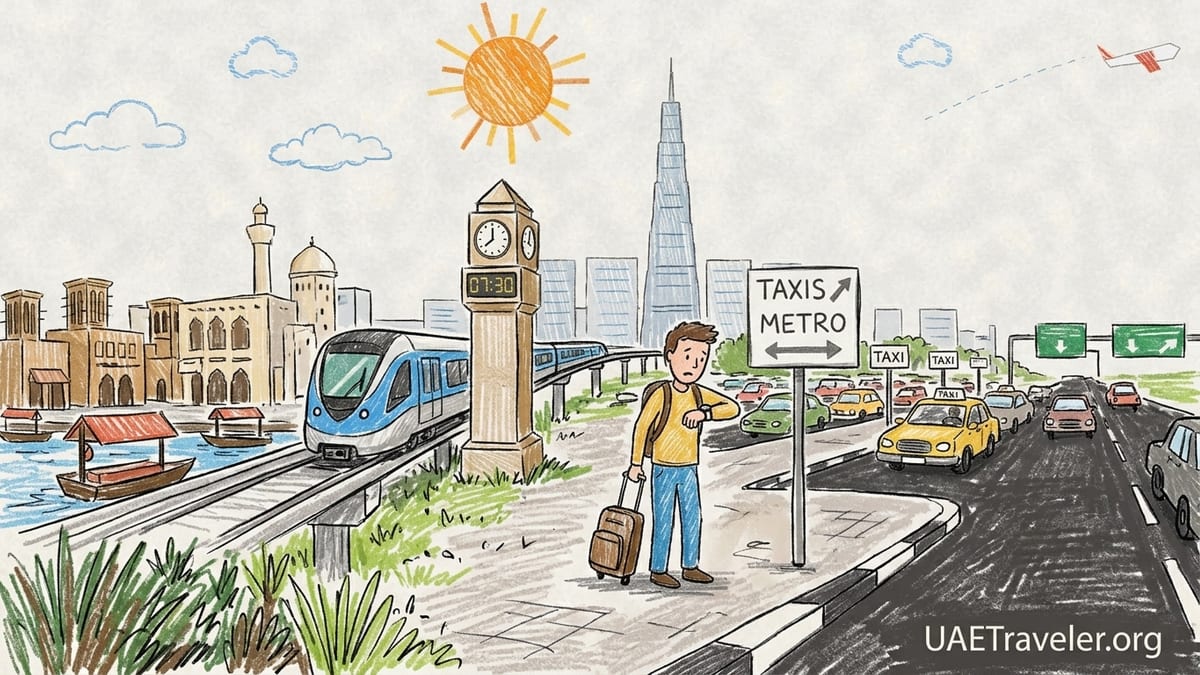
How a Perfect Dubai Stopover Fell Apart
On my flight into Dubai, the crew handed out landing cards and I started timing everything. The aircraft door opened at 06:10. I assumed I would be on the Metro by 07:00. Instead, it was 06:30 before we even started moving down the aisle. A full wide-body aircraft takes time to empty, and economy passengers seated toward the back can lose twenty to thirty minutes just waiting to disembark.
At Dubai International Airport, the walk from many long-haul gates in Terminal 3 to immigration is not short. Moving walkways help, but it still took me almost fifteen minutes at a normal pace. Then came passport control. Even with plenty of smart gates and counters, queues fluctuate with banked arrivals. On my “perfect” layover, I cleared immigration around 07:20. That was more than an hour after touchdown, and I had not yet figured out money, data, or how I would handle my cabin bag for the day.
The optimistic version of my plan had me stepping out of the airport by 07:00. The real timestamp on my first taxi receipt was 07:42. That forty-minute gap was swallowed by a restroom stop, buying a Nol card for the Metro that I ultimately did not use, debating whether to store my carry-on, and queuing a few minutes at the taxi rank behind other passengers who had exactly the same idea. Before I saw a single Dubai landmark, my twelve-hour layover had shrunk to about nine and a half hours.
There was a second shock later in the day. I had cheerfully planned to be back at DXB one hour before departure, like a short-hop European flight. At check-in for my outbound Emirates leg, the agent gently reminded me that the airline recommends arriving at least three hours before departure for international flights from Dubai. By the time I accounted for that, security, and walking time to a far gate, my practical city window was closer to six hours. My grand circuit of Dubai suddenly looked reckless.
Why Twelve Hours on the Ticket Is Not Twelve Hours in the City
A stopover is really a chain of small but non-negotiable chunks of time. If you underestimate any of them, the itinerary collapses. It helps to think of a connection in stages: arrival and disembarkation, immigration and customs, baggage decisions, transport into the city, sightseeing, return transport, airport security, and finally a safety buffer at the gate.
On arrival, most long-haul Emirates flights reach Dubai in busy waves. From wheels down to walking into the arrivals hall, one to one and a half hours is normal for many travelers. That includes taxiing, waiting to disembark, walking to passport control and clearing immigration. Even if you are among the first off the aircraft, you cannot control how many other wide-bodies landed just before you.
Immigration itself varies considerably by nationality. Citizens of dozens of countries, including the United States and much of Western Europe, qualify for visa-free entry or a visa on arrival into the United Arab Emirates, provided they meet entry requirements. Others must arrange a transit or visit visa in advance, sometimes through the airline or a hotel, and cannot simply decide on the day to leave the airport. If you need to collect and re-check baggage because you are on separate tickets, that can add another thirty to sixty minutes while you wait at the carousel, clear customs, and then find your next airline’s desk.
The journey into Dubai is another hidden time sink. Dubai Metro’s Red Line links Terminals 1 and 3 with the city, but trains do not run twenty-four hours. Recent timetables show services starting around five in the morning and running until around midnight on most days, with some earlier closing on certain nights and extended hours on Fridays and during events. If your flight lands at 02:00, the Metro is not an option and you will rely on taxis or ride-hailing. The drive from DXB to Downtown Dubai is usually around twenty to thirty minutes outside heavy traffic, but queues for taxis and congestion near major malls can extend that. Every stage chips away at the layover that once looked generous on your booking screen.
How Much City Time Do You Really Get: 8, 12, 18 and 24 Hours
When travelers ask if they can “see Dubai” on a layover, what they really need is an honest estimate of usable city time. That is the time between leaving the airport and starting the journey back, after subtracting formalities and mandatory buffers. It is almost always less than you think.
On an eight-hour connection, you might disembark about thirty minutes after landing, spend another forty-five minutes to an hour at immigration, and walk out of arrivals roughly ninety minutes after touchdown. If your onward flight closes boarding about forty minutes before departure and you responsibly aim to be back at the airport two hours ahead, you will begin your return journey around three hours before the next flight. That leaves about three and a half hours outside at most, perhaps less than three once you account for transport into and out of town. An eight-hour layover with a proper immigration exit is usually enough for a single district close to the airport, like a quick look at Dubai Creek and a meal, not a multi-stop sightseeing tour.
On a twelve-hour connection, the math improves but not dramatically. Landing at 06:00 and departing at 18:00, you might realistically step into a taxi by 07:30 and aim to be back at the terminal by 15:00 to 15:30 for a 18:00 flight. This allows six to seven hours in the city if traffic and queues are kind. It is enough for one or two major stops with a sit-down meal, but not for a serious attempt to tick off Burj Khalifa, Dubai Mall, Old Dubai and Dubai Marina in one continuous loop.
Eighteen-hour layovers, especially those that stretch into the evening, begin to feel like genuine city breaks. You could spend a relaxed afternoon downtown, take an evening boat on Dubai Creek, and sleep overnight either at an airport hotel or in a central district like Downtown or the Marina. There is room in the schedule for delays and a proper shower. A full twenty-four-hour stopover, if your nationality and visa situation allow, is when the classic Dubai checklist finally makes sense: one cluster of sights in the morning and a different area at sunset or after dark, with rest and recovery built in.
The crucial difference between these scenarios is not the number printed on your itinerary but the proportion of that time you can comfortably spend away from the airport without introducing real risk. Many of the horror stories you hear in airport lounges come from travelers who treated an eight- or twelve-hour layover as if it were an eighteen-hour mini-holiday.
The Classic Overreach: Burj Khalifa, Dubai Mall, Old Dubai and Marina
Most first-timers to Dubai gravitate toward the same four highlights. The Burj Khalifa and Dubai Mall share a central location in Downtown Dubai. Old Dubai, with its abra boats, souks and historic quarters along Dubai Creek, lies to the north around Deira and Bur Dubai. Dubai Marina sits in the opposite direction along the coast, ringed by towers, restaurants and the beachside Jumeirah Beach Residence. On a full day with no flight to catch, linking all four is ambitious but realistic. On a short layover, it is a recipe for anxiety.
Timed attractions quietly dictate much of this. Tickets for Burj Khalifa’s viewing decks are sold in specific time slots, and popular sunset periods sell out in advance on busy days. Arriving half an hour late can mean missing your window or being moved to a later, less appealing time, which may not fit your flight. Dubai Fountain shows outside Dubai Mall run to a set schedule in the evening, so missed connections there cannot simply be shifted by an hour on a whim.
Transport between these areas takes longer than their positions on a stylized tourist map suggest. By Metro, you ride the Red Line from Airport Terminal 1 or 3 to Burj Khalifa/Dubai Mall station for Downtown, then back past the airport and onward toward DMCC or Dubai Marina stations for the Marina. To reach Old Dubai, you usually need to change from the Red Line to the Green Line at an interchange such as Union or BurJuman, then continue to stations like Al Fahidi or Al Ras near the historic districts. Each segment can take twenty to forty minutes including walking and waiting. Insert queues for Burj Khalifa and a leisurely lunch at Dubai Mall, and most twelve-hour layover plans that attempt all four zones collapse into rushed snapshots taken from taxi windows.
The cost dimension matters too. Dubai’s official taxis are fairly priced for a major city but not trivial if you are zigzagging between far-flung neighborhoods. Airport taxis carry a higher starting fare than city cabs, and the per-kilometer rate has risen in recent years in line with fuel prices. A round trip from DXB to the Marina and back, with detours via Downtown and Old Dubai, can easily approach or exceed what you might pay for a simple airport hotel room on a longer layover. When everything must be paid in cash or via card while you are slightly jet-lagged and time-pressured, it becomes harder to make rational trade-offs.
Emirates Dubai Connect: Not a Free Hotel for Everyone
Many travelers have heard that Emirates will give you a complimentary hotel room if your connection in Dubai is long. This is partly true, but the airline’s Dubai Connect service is ringed with conditions. It is not a blanket perk for anyone with an awkward layover, and it should never be assumed without checking your exact booking.
First, your ticket has to be on Emirates stock and on specific fare types. Deeply discounted economy tickets often do not qualify, even on the same route where a more flexible fare might. Second, your itinerary must use the shortest possible connection in Dubai for the fare you bought. In practice, this means you cannot deliberately pick a ten- or fifteen-hour connection if there is a shorter one available in the same fare family and then expect Dubai Connect to cover a hotel. There is also a minimum transit time, which is different for economy versus business and first class, and a maximum transit duration beyond which the program does not apply.
Even if you meet those time and fare rules, room availability for Dubai Connect is limited on busy dates. The airline uses a contracted pool of rooms at specific hotels rather than opening the entire city inventory. Anecdotally, some travelers report mismatches between what the website initially shows as eligible and what is confirmed later in the booking process, especially when multiple fare classes and connection options exist. The terms and conditions also state that you must meet all immigration requirements to enter the United Arab Emirates, which places the responsibility for visas and entry permission firmly on the traveler.
When Dubai Connect is confirmed, it can be excellent value. The package may include transfers and meals at the hotel, and the convenience of having everything arranged through the airline is considerable if you are exhausted or unfamiliar with the city. Compared with booking your own hotel, however, there are trade-offs. You usually have less choice over location and property style, you cannot easily stack loyalty benefits from your preferred chain, and changing flights later may void the eligibility.
For some itineraries, intentionally booking a slightly longer stopover and arranging your own hotel can be the better option. Airport-area hotels, both chain and independent, often run competitive nightly rates outside peak exhibitions and events. Paying for a room yourself buys flexibility: you can pick a property near a Metro station for easier sightseeing, adjust plans without involving the airline, and split your rest and exploring time in a way that suits your body clock rather than a fixed voucher window.
Visas, Nationalities and the Right to Leave the Airport
Another mistake I made when planning my first Dubai layover was assuming that everyone on my ticket could breeze through passport control as easily as I could on a visa-on-arrival passport. In reality, the United Arab Emirates operates a tiered system. Nationals of dozens of countries, including much of Europe, parts of Latin America, and others, can enter without a pre-arranged visa for periods that vary by nationality. Citizens of some Asian and African states now enjoy simplified entry for short visits as well, following recent policy updates. However, many travelers still require a pre-arranged transit or visit visa even for a few hours outside the airport.
If you fall into that second category, your airline or hotel may be able to help arrange a 48- or 96-hour transit visa tied to your confirmed onward ticket. Processing times, fees and eligibility can change, and sometimes applications must be lodged several days before travel. There are also rules about the validity of your passport, the need for a confirmed onward flight, and, for some schemes, possessing certain visas or residence permits for other countries. Relying on generic advice from forums without checking current official information for your nationality is risky.
Even travelers who qualify for visa-free entry should remember that immigration officers always have discretion. You can be asked for proof of your onward ticket, evidence of sufficient funds, or details of where you plan to stay if you intend to remain overnight. If there is any doubt about your intentions, being able to show your e-ticket, hotel reservation, and a clear explanation of your plan helps. Leaving the secure transit area at DXB is a privilege that depends on both policy and individual circumstances, not a right attached automatically to every boarding pass.
For groups, the slowest visa situation sets the pace. If one member needs a pre-arranged transit visa that did not come through, everyone may end up remaining airside. If a child’s passport lacks the required validity, they may not be allowed to cross the border, which can turn a carefully planned family outing into a stressful airport vigil. When evaluating whether a layover is suitable for exploring Dubai, visa and entry rules should be your first filter, not an afterthought.
A Realistic Six-Hour City Outing
When your connection genuinely leaves you around six hours of possible time in the city, restraint is the key to enjoying Dubai rather than sprinting through it. Instead of plotting a grand loop, choose one compact area. For many travelers, Downtown Dubai hits the sweet spot of accessibility and impact: it combines the Burj Khalifa, Dubai Mall, restaurants, and the fountains in a tight cluster.
Imagine you land at 09:00 and depart at 21:00 on one ticket, with no checked bags to retrieve. If all goes well, you might exit arrivals between 10:15 and 10:30. Taking a taxi from DXB to Downtown could have you in front of Dubai Mall by around 11:00. From there, a pre-booked midday slot for the Burj Khalifa observation deck gives you views without cross-city transfers. You can then linger over lunch in the mall, walk around the lake, and browse a couple of exhibits or shops before returning to the airport by taxi around 16:00, arriving back at DXB between 16:30 and 17:00. That leaves a comfortable margin for check-in, security and finding your gate by 19:30 or 20:00.
In this scenario, you have experienced modern Dubai’s most famous icon, eaten well, and stretched your legs after a long flight without ever glancing nervously at your watch. You have not tried to fit in Old Dubai’s alleyways or a Marina sunset, but you have avoided the stressful chain of delayed trains, extended taxi rides and missed time slots that often afflict over-ambitious itineraries. Crucially, every element can absorb a twenty- or thirty-minute delay without jeopardizing your flight.
Travelers with different interests can adapt this pattern. Aviation enthusiasts might head only to Old Dubai, splitting their time between the creekside abras and the textile and spice souks, all within a relatively small radius reached by taxi. Others may prefer a simple beachside interlude closer to the airport instead of downtown towers. What matters is that the outing has one anchor neighborhood, minimal transfers, and a clear decision time for starting the journey back to DXB.
If your usable city time is less than six hours, the bar should be even higher. A meal and a short walk in one place is often the wisest choice. When you factor in the mental cost of worrying about your flight, a quiet lounge with a shower inside DXB can be just as restorative as a rushed tour outside.
When an Overnight Stopover Transforms the Experience
The character of a Dubai layover changes completely once you add an overnight. With eighteen to twenty-four hours between flights, you are no longer trying to compress the essence of the city into a handful of frantic hours. Instead, you can divide your time between rest and exploration in a way that respects your body clock and your onward journey.
A simple but rewarding pattern is to arrive in the afternoon, check into an airport-area or Downtown hotel, and spend the evening in Old Dubai. A taxi or a Metro-and-Green-Line combination brings you to stations near Dubai Creek and the Al Fahidi Historical Neighbourhood. You can wander the narrow lanes, visit small museums, cross the creek on a traditional wooden boat, and have dinner with a view of the water. Returning to your hotel for a full night’s sleep means you wake up better adjusted for your next long-haul segment.
The following morning, you can tackle a different district. After breakfast, check out but leave your bags with the hotel concierge. A short taxi ride or Metro trip brings you to Downtown Dubai or the Marina for a few relaxed hours. Because your onward flight is later in the day or evening, you can aim to be back at the airport three hours ahead without feeling cheated. If your nationality allows it and you can enter without complicated visas, this kind of split-venue overnight stopover often delivers a far richer sense of the city than any frantic dash on a shorter connection.
An overnight also makes more financial sense when you compare it with repeated taxi journeys on a tight schedule. One or two well-planned transfers, perhaps combined with Metro rides, stretch your budget further than multiple cross-town trips under time pressure. With a room to return to, you can shower, change clothes and recharge devices properly rather than juggling everything in airport restrooms and crowded waiting areas.
The Takeaway
The central lesson from my failed twelve-hour Dubai layover is simple: respect the friction. Every airport has its own rhythms of queues and transfers, and Dubai is no exception. When you add up disembarkation, immigration, transport, security and the sensible buffers around a long-haul flight, the free time shrinks dramatically. A twelve-hour connection might yield six or seven usable hours outside on a good day. An eight-hour one may barely justify leaving the terminal at all.
Trying to stitch Burj Khalifa, Dubai Mall, Old Dubai and Dubai Marina into a single short stopover is less a badge of efficient travel and more a gamble with your onward flight. Timed attractions, Metro operating hours, taxi traffic and immigration rules are indifferent to wishful thinking. Tools like Emirates Dubai Connect are helpful but conditional, not a universal right. Visas and nationalities matter. So do your own energy levels after overnight flights.
If you treat Dubai as a place to sample thoughtfully, choosing one neighborhood for a short outing or designing an overnight stopover that gives you both rest and exploration, the city rewards you. If you treat a printed layover duration as a blank canvas for every sight you have ever seen on social media, you will likely remember Dubai for its queues and taxi dashboards rather than its skyline and creek. In the long run, the most satisfying stopovers are the ones that leave you wanting to return, not relieved to leave.
FAQ
Q1. Is a 12-hour layover in Dubai enough to see the main sights?
For most travelers, a 12-hour connection only allows around six to seven usable hours in the city, which is enough for one main area like Downtown Dubai, not a full tour of Burj Khalifa, Old Dubai and Dubai Marina in a single outing.
Q2. Can I leave Dubai Airport on an 8-hour layover?
You can physically leave the airport if your nationality and visa status allow, but once you subtract immigration, transport and a safe pre-departure buffer, you may have less than three hours outside, which often makes staying airside more sensible unless you have a very specific nearby plan.
Q3. How long before departure should I be back at Dubai International Airport?
For international flights, airlines such as Emirates advise arriving at least three hours before departure, which means planning to re-enter the terminal about three hours ahead and allowing extra time for security and walking to distant gates.
Q4. Is Emirates Dubai Connect available on all long layovers?
No, Dubai Connect is only offered on eligible Emirates tickets that meet specific fare type, minimum and maximum transit time rules, and that use the shortest possible connection in Dubai for that fare; it is not an automatic free hotel for every long stopover.
Q5. Are taxis or the Metro better during a short Dubai layover?
Taxis are usually faster and run at all hours, which is important on tight schedules or overnight arrivals, while the Metro is cheaper but limited by operating hours and requires more walking and possible line changes between districts.
Q6. Do all nationalities get visa-free entry for a Dubai stopover?
No, some passport holders enjoy visa-free or visa-on-arrival entry, while others must arrange a transit or visit visa in advance; eligibility depends on your nationality and current UAE policy, so you must check official information before planning to leave the airport.
Q7. Can I realistically visit Burj Khalifa and Dubai Marina on the same short layover?
Combining Downtown Dubai and the Marina is possible on a longer stopover, but on a connection that yields only six or seven city hours it becomes rushed, with significant time spent in taxis or on the Metro instead of actually enjoying either area.
Q8. Is it worth booking my own hotel instead of relying on Dubai Connect?
If your fare does not qualify for Dubai Connect, or if you want more control over hotel location, loyalty points and schedule, paying for your own airport or city hotel on an overnight stopover can be better value and gives more flexibility.
Q9. What is a good plan for a six-hour outing from Dubai Airport?
A focused visit to one compact area works best, such as taking a taxi to Downtown Dubai for a timed Burj Khalifa visit, a meal at Dubai Mall and a short walk, before returning calmly to the airport with a generous margin.
Q10. When is it smarter to stay inside Dubai Airport during a layover?
Staying airside is usually wiser if your usable city time is under four to five hours, if your visa situation is unclear, if you have separate tickets that require re-checking bags, or if you arrive during hours when public transport is not running and you feel too tired to enjoy a rushed excursion.