


I learned how unrealistic the classic Dubai to Abu Dhabi day trip is in the most uncomfortable way possible: standing in the Sheikh Zayed Grand Mosque parking lot at 4:10 p.m., eating a squashed gas-station sandwich, while our guide announced we had exactly 20 minutes inside the mosque before we had to race across the city to catch sunset photos at Qasr Al Watan. We had left Dubai before 9 a.m. and yet somehow, by late afternoon, I had spent far more time in vehicles and queues than in the places I had come to see. That day changed how I look at almost every Dubai to Abu Dhabi itinerary you see in brochures and on booking sites.
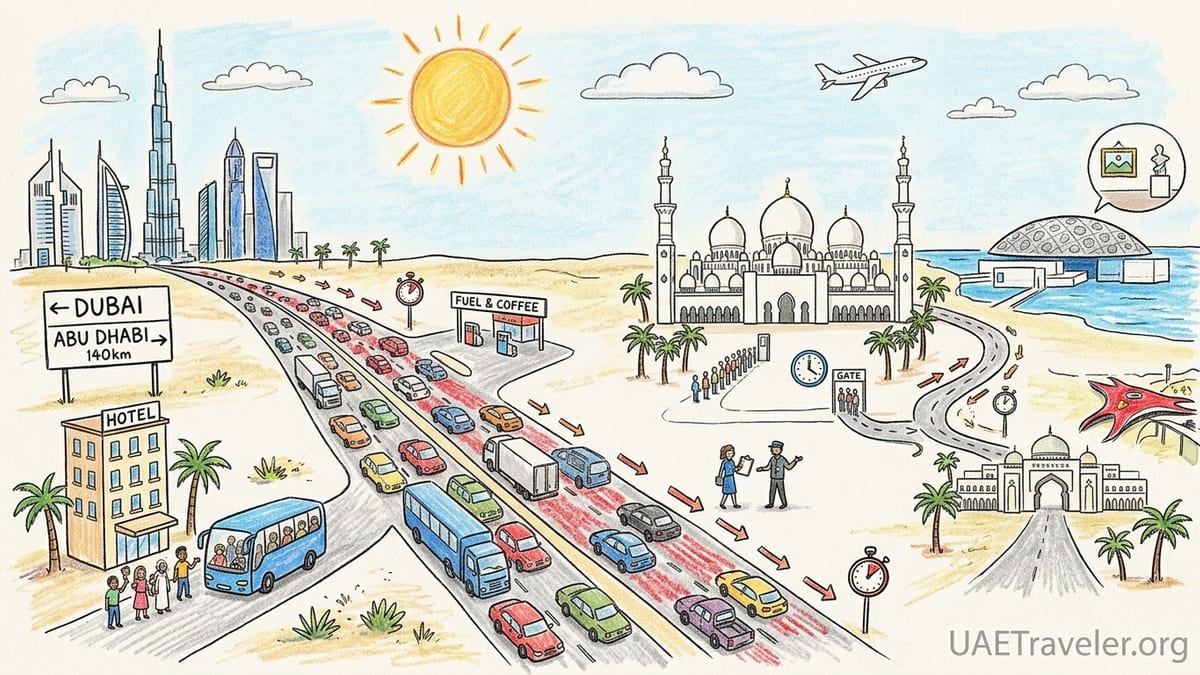
How I Discovered the Limits of the Classic Day Trip
The plan had looked completely reasonable on paper. Depart Dubai Marina at 8:30 a.m., reach Sheikh Zayed Grand Mosque by late morning, continue to Qasr Al Watan, quick stop at Emirates Palace, a dash along the Corniche, then finish on Yas Island before returning to Dubai after dinner. A popular online tour portal listed something almost identical and promised things like “See all the highlights in one unforgettable day.” Sitting at my desk with Google Maps open, it looked doable. Distances are short, roads are excellent, and nothing appeared that far from anything else.
The reality began to unravel before we even reached Abu Dhabi. Traffic leaving Dubai on Sheikh Zayed Road slowed us to a crawl. The nominal one hour and fifteen minute drive quietly became almost two hours and ten minutes, including a fuel and coffee stop that nobody had planned but everybody needed. By the time we rolled into the mosque parking complex, morning had become midday, and the lightest part of the day had been spent watching the same beige sound barriers streak past the minibus windows.
Inside the mosque complex, the time drain turned from minutes into chunks of an hour. The walk from the parking to the visitor center, modest security checks, clothing adjustments for a few people in the group, then the internal electric buggy shuttle to the main courtyard all consumed time. None of this was unreasonable. It is simply how a major religious and cultural site that welcomes thousands of visitors per day must operate. Yet every ten minute delay came directly out of the time we thought we would be spending under the courtyard’s marble colonnades, not out of the driving time we had underestimated in the first place.
By early afternoon, when our guide began hurrying everyone back to the vehicle after less than an hour inside one of the most remarkable mosques in the world, it was already clear that we were losing the day to logistics. What surprised me most was not the traffic or the security procedures. It was how normal our experience was compared with what many commercial tours currently advertise. The problem, I realized, was not that our day had gone wrong. The problem was that the basic idea of doing everything between Dubai and Abu Dhabi in one calendar day is flawed from the start.
What Crammed Dubai–Abu Dhabi Itineraries Actually Look Like in Practice
Scroll through major booking platforms today and you will see remarkably similar full-day tours from Dubai promising the “best of Abu Dhabi” in a single outing. Many try to combine Sheikh Zayed Grand Mosque, a photo stop at Emirates Palace, a drive past or short break on the Corniche, an hour or less at Qasr Al Watan, plus a stop at the Louvre Abu Dhabi or even a quick spin onto Yas Island to see the Formula 1 track or Ferrari World entrance. The advertised tour duration is often in the range of nine to eleven hours, door to door, including the return to Dubai.
Now set aside the marketing language and break down a typical day. The road distance from central Dubai to Abu Dhabi city is roughly 140 kilometers. On a clear run, that means around one hour and twenty minutes each way in a car. In practice, especially when you include pickup rounds at several Dubai hotels in a group coach, early traffic on Sheikh Zayed Road, and a rest stop in a service station, the journey in the morning can easily be one hour and forty five minutes or a bit more. The return in the evening, when many vehicles leave Abu Dhabi at roughly the same time, can be just as slow.
On a coach tour that needs to gather guests from Jumeirah, Downtown and the Marina, the day might begin around 8:00 a.m., but you may not actually clear Dubai’s city limits until after 9:00 a.m. That immediately pushes a “morning at the mosque” into late morning. Add in thirty to forty five minutes to disembark, walk through the mosque visitor process and regroup, and you are lucky to be standing in the main courtyard much before 11:00 a.m. With a fixed end-of-day return time, every delay tightens the schedule for the rest of the itinerary.
The attempt to include Louvre Abu Dhabi, Qasr Al Watan and even part of Yas Island on the same day is where things start to slip from optimistic into unrealistic. The Louvre sits on Saadiyat Island northeast of downtown, Qasr Al Watan is inside the Presidential Palace complex on the Abu Dhabi corniche side, and Yas Island lies to the east, closer to the Dubai direction but still a detour. On a map, those distances are short. In real life, each movement demands highway time, parking, shuttle systems or internal transfers, and the inevitable bathroom or coffee breaks that come with a bus full of real people rather than theoretical travelers.
Crunching the Actual Time: Roads, Queues and Rushed Visits
Consider a hypothetical “see it all” day trip that tries to tick the mosque, Louvre Abu Dhabi, Qasr Al Watan, a Corniche stop, Emirates Palace photos, and a Yas Island drive-through before heading back to Dubai. Let us assume a small group tour in a minibus that leaves a single Dubai pickup point at 8:30 a.m. and aims to return by 7:30 p.m.
The initial Dubai to Sheikh Zayed Grand Mosque transfer, allowing for moderate traffic and a short stop at a highway service area, might be around one hour and forty five minutes. Arrival at the mosque could be around 10:15 a.m. Disembarking, walking to the entrance, moving through security, and adjusting dress codes can very easily take thirty minutes. That puts you at roughly 10:45 a.m. If the guide allots one hour inside before meeting again at 11:45 a.m., a portion of that hour still goes to walking corridors and moving between photo points. You are not spending sixty minutes quietly contemplating the main prayer hall.
Leaving the mosque complex and driving to the Louvre Abu Dhabi, with its location on Saadiyat Island, typically takes around twenty five to thirty five minutes in light traffic from the Grand Mosque area. By the time the group has reassembled, boarded and departed, it could be 12:00 p.m. Arrival at the Louvre parking or drop-off point then lands somewhere around 12:30 p.m. From there, guests still need to walk to the museum entrance and clear security. Even if that is a swift fifteen to twenty minutes, it can easily be close to 12:50 p.m. before anyone stands under the famous dome.
Several commercial tour descriptions schedule one to one and a half hours at the Louvre Abu Dhabi. On paper that sounds fair. In reality, after you deduct ten to fifteen minutes at entry and similar time at the end to regroup and return to the vehicle, the group might have just about an hour in the galleries. This is a world-class museum with a permanent collection that covers works from ancient civilizations to modern art, plus temporary exhibitions. Moving through it in under sixty minutes reduces what could be a half-day cultural experience into something closer to a forced march past labels you will not read.
From the Louvre to Qasr Al Watan, the transfer involves crossing back toward the heart of Abu Dhabi and into the Presidential Palace compound. A practical driving time from Saadiyat Island to the palace gate might be around twenty to thirty minutes, but buses also need to navigate parking and dedicated entry processes. Factoring in a short buffer, it is realistic to think that even a prompt group might not be inside the Qasr Al Watan visitor center much before 3:00 p.m. If their ticket slot allows only a limited window, guides feel pressure to move people quickly through the palace’s richly detailed halls and calligraphy-lined corridors, often in under an hour. That leaves very little time to absorb the building’s architectural subtleties, let alone read about the role of the Federal Supreme Council or the symbolism in the Great Hall.
How Much Do You Really “See” When You Only Stop for Photos
This squeezed schedule has consequences that are more serious than simply feeling rushed. At a certain point, these day trips stop being visits and become a sequence of very short photo stops. Tour operators will sometimes describe five minutes outside Emirates Palace or ten minutes at a Corniche viewpoint as a “visit,” but taking a selfie in front of a gate is not the same as entering a building or walking a waterfront promenade.
At Emirates Palace, for example, some tours now explicitly specify a “photo stop” rather than access to the interior. Security policies, event closures and the hotel’s own priorities mean that even when drop-off at the entrance is possible, groups may not have time to sit for a coffee in the gilded lobby or explore the landscaped grounds toward the beach. That is not necessarily the operator’s fault, but it is misleading if travelers later say, “We visited Emirates Palace,” when in truth they spent longer lining up for a group shot in the parking lot than they did experiencing anything beyond the facade.
The same applies to Louvre Abu Dhabi. Serious art lovers who plan trips around exhibitions or national collection loans are often startled when they discover that the “museum visit” built into their tour is eighty minutes from bus door back to bus door, including bathroom stops and exits through the gift shop. They might encounter Leonardo da Vinci’s enigmatic portrait, ancient manuscripts or a sculpture that moved them, but their time to digest and reflect is overshadowed by the need to keep moving. This style of visit serves travelers whose main goal is to say they have been, not those who derive meaning from close-looking at objects and careful reading of exhibition texts.
All of this would matter less if the marketing language were more honest. If tours clearly stated, “You will have approximately forty minutes of free time inside the museum galleries,” expectations could adjust accordingly. Instead, many itineraries still describe these stops as if travelers will gain deep understanding of Emirati history, Islamic architecture or global art in fractions of an hour. That does a disservice both to the sites and to guests who genuinely care about what they are going to see.
Group Coach, Private Driver, Rental Car or Overnight: A Hard Comparison
There are four main ways travelers currently attempt the Dubai to Abu Dhabi day trip. Each has merits, but none can escape the fundamental constraint that there are only so many usable hours between breakfast and bedtime. Understanding what you gain and lose with each option helps to set realistic expectations, and in many cases suggests that staying overnight in Abu Dhabi is the better investment.
Group coach tours are usually the cheapest and simplest. Hotel pickups, pre-arranged timings and inclusive admission tickets remove a lot of planning headaches. You can expect to sit back in air conditioning and let someone else navigate the highways and parking facilities. The trade-off comes in flexibility. Departure times from every stop are dictated by the oldest, slowest or latest member of the group. Guides need to hold back time for toilet breaks and snack queues. A traveler who wants to linger in the prayer hall at Sheikh Zayed Grand Mosque or spend twenty minutes contemplating a single gallery at the Louvre will quickly find that the bus timetable does not care.
Private tours in a sedan or minivan offer better efficiency and comfort. Without the need to collect ten or fifteen other people around Dubai, your day can start earlier and end later if you wish. A driver or driver-guide can adjust the sequence to respond to real-time traffic patterns, and photo stops can be lengthened or skipped depending on your interests. However, the drive time itself is not substantially shorter. You may shave thirty minutes off pickups and slightly reduce time lost in regrouping, but you are still looking at roughly three to four hours of your day inside a vehicle. For some travelers that is acceptable. For others, it is a poor trade for hurried museum visits.
Driving yourself with a rental car appeals to independent travelers who prefer full control. Highways between Dubai and Abu Dhabi are in excellent condition, signage is clear, and there are plenty of modern service stations with fuel, food and clean facilities. However, you must budget extra mental energy and time for parking logistics at each attraction. The Grand Mosque has a large underground parking and shuttle system. Qasr Al Watan requires navigating the palace complex approach. Yas Island attractions have their own parking and entry flows. Each of those small navigational moments chips away a few minutes here and there. If you misread a sign or miss an exit, recovering from that mistake can cost the very buffer that would have made your schedule tenable.
An overnight stay in Abu Dhabi removes the harshest time pressure from the equation. With a hotel base on Yas Island, Saadiyat or the Corniche, you can split major sights across two days and visit them in the most pleasant parts of the morning or late afternoon. It also makes it far easier to experience lesser-known corners, such as smaller heritage sites near Al Hosn or quieter stretches of the Corniche beach. The hotel cost may look like an extra line item, but it transforms what would have been an exhausting point-to-point marathon into a more balanced experience of the capital.
A Realistic One-Day Itinerary That Actually Works
Despite these criticisms, I do not think every Dubai to Abu Dhabi day trip is doomed. It is possible to have a meaningful day in Abu Dhabi if you are willing to be ruthless about limiting what you attempt. The key is to choose at most two major sites and one gentle stop, and accept that everything else you might wish to see belongs to a future trip or an overnight stay.
A workable example for a first-time visitor who values culture would look something like this. Leave Dubai early, with a private driver or rental car, aiming to depart your hotel around 7:30 a.m. That early start helps you stay ahead of heavier highway traffic. Drive directly to Sheikh Zayed Grand Mosque, without detours or coffee stops, which should put you in the underground parking area in roughly one hour and thirty minutes if conditions are normal. Plan to be at the mosque from around 9:00 a.m. to 11:00 a.m., which allows a full two hours from the start of the visitor process to the final photographs in the courtyard.
From there, continue into central Abu Dhabi and choose either the Louvre Abu Dhabi or Qasr Al Watan, not both. If you choose the Louvre, aim to arrive around midday, then give yourself a full two and a half to three hours for lunch and galleries combined. That means you could enjoy a proper sit-down meal in the museum cafe and still have time for at least one of the main chronological routes through the exhibits. If you choose Qasr Al Watan instead, plan for around two hours inside the palace complex, with enough time to walk the Great Hall, the House of Knowledge and the gardens without feeling rushed.
On the same day, you might add a short, relaxing interlude at the Corniche. This does not need to be a full beach day. It can simply be a thirty to forty five minute stroll or a coffee stop at a waterside cafe to look back at the Abu Dhabi skyline. By choosing a Corniche break rather than trying to push on to Yas Island, you keep your movements compact within the core of the city. That makes it easier to begin the drive back to Dubai by late afternoon, perhaps around 4:30 p.m., putting you back at your Dubai hotel in the early evening.
The difference between this lean itinerary and a maximalist one is not only how many places you check off. It affects how you will remember the day. In the realistic version, you might recall the quiet shimmer of sunlight on the mosque’s marble, the sound of the muezzin’s call, a particular painting that captured your imagination at the Louvre, or the feel of the sea breeze on the Corniche. In the rushed version, your dominant memories are more likely to be of seat numbers, meeting points and the guide’s raised voice reminding everyone that they are late.
A Clearly Better Two-Day Plan Centered on Abu Dhabi
If your schedule and budget allow even a single night in Abu Dhabi, the quality of your experience improves so dramatically that it becomes hard to recommend the one-day option to anyone who cares deeply about the sites themselves. A simple two-day structure might use Yas Island or Saadiyat as a base for those who want easy access to attractions, or a Corniche hotel for travelers who prefer a more traditional city backdrop.
On Day One, you can arrive from Dubai at a humane pace, perhaps leaving in mid-morning and stopping en route for a relaxed coffee. After checking into your hotel, you might devote the afternoon to a single major cultural site, such as Louvre Abu Dhabi. With several hours at your disposal, you can follow the chronological galleries, revisit particular rooms, and spend time under the intricate dome watching patterns of light shift on the water outside. Rather than feeling pushed along by a timetable, you choose your own rhythm. Dinner can be unhurried, whether that means dining on Saadiyat, at the marina near the Corniche or in a neighborhood restaurant that does not appear in tour brochures.
Day Two could open with an early visit to Sheikh Zayed Grand Mosque. Staying overnight means you can arrive soon after opening, when temperatures are softer and the crowds lighter. You can take advantage of guided explanations, step aside for photographs without jostling, and spend real time in the inner courtyards. Later in the morning, you might continue to Qasr Al Watan and explore its grand halls while still relatively fresh. Splitting the day between just these two sites already yields more depth than most day trips can offer.
With an overnight stay, you also gain freedom to explore beyond the headline attractions. You might wander the restored Al Hosn Fort and the surrounding cultural quarter, duck into a small cafe on a side street, or take an evening walk along the Corniche when the heat eases and families come out. If theme parks interest you, Yas Island becomes a separate half-day experience rather than a rushed photo opportunity. You can allocate anywhere from three to eight hours to a single park like Ferrari World or Warner Bros. World and still sleep in Abu Dhabi that night.
When it is finally time to return to Dubai, you can choose a departure that aligns with your energy rather than your fear of missing a hotel pickup. You may still face the same highway traffic, but it will not come on top of a ten-hour day of hurried stops. Instead, it rounds off a short stay in a capital city that you have actually had time to meet.
The Takeaway
After watching my own ambitious Abu Dhabi day trip collapse under the weight of its promises, and comparing that experience with the structure of many current commercial tours, I have come to a blunt conclusion. The problem is not that the Dubai to Abu Dhabi journey is inherently difficult. The roads are smooth, vehicles are comfortable, and both cities are accustomed to visitors. The problem is the persistent belief that travelers can genuinely “see” Abu Dhabi in the gaps between transfers, security checks and photo stops.
If your primary goal is to collect a handful of quick impressions and you are comfortable with a day that includes long stretches in vehicles, then a well-chosen day trip that focuses on just one or two key sites can work. Opt for the mosque and one major cultural stop, keep your expectations modest and accept that you are sampling, not immersing. In that scenario, choose a small group or private arrangement and commit to an early start from Dubai.
However, if you care deeply about Islamic architecture, want to read the inscriptions in the Great Hall at Qasr Al Watan, or hope to engage seriously with the masterpieces inside Louvre Abu Dhabi, the one-day model does not serve you well. Too many itineraries substitute a few hurried photographs at the threshold of great buildings for actual time inside them. For those travelers, spending at least one night in Abu Dhabi is not an indulgence. It is the only way to align your ambitions with the hours that a real journey contains.
In the end, the choice is less about money than about honesty with yourself. If you simply wish to say you have been, the classic Dubai to Abu Dhabi day trip will give you enough images to fill a social feed. If you hope to understand, even a little, where you are, then stop trying to fold Abu Dhabi into the margins of a Dubai vacation. Give the capital at least two days of its own, and you may find that what you remember is not the inside of a bus, but the way the late-afternoon light fell on white marble, blue sea and the domes of a city that deserved more than a drive-by.
FAQ
Q1. Is it really possible to visit Abu Dhabi from Dubai in a single day?
Yes, it is physically possible to travel from Dubai to Abu Dhabi and back in one day, but you must limit what you try to see. Attempting more than the Grand Mosque plus one major attraction usually results in rushed visits and long hours in transit rather than meaningful time at the sites.
Q2. How long does it actually take to drive between Dubai and Abu Dhabi?
The direct road journey between central Dubai and central Abu Dhabi typically takes around one hour and twenty minutes in clear traffic, but with hotel pickups, moderate congestion and a short rest stop, many travelers experience closer to one hour and forty five minutes each way.
Q3. Can I combine Sheikh Zayed Grand Mosque, Louvre Abu Dhabi and Qasr Al Watan in a day trip?
You can technically visit all three in one day, but doing so from Dubai usually leaves less than an hour inside each site after transfers and entry processes. For travelers who care about architecture and art, that level of rushing is rarely satisfying.
Q4. Are group coach tours from Dubai to Abu Dhabi worth it?
Group coach tours can be cost effective and convenient, especially if you want everything pre-arranged. The trade-off is limited flexibility and strictly timed stops, which can feel frustrating if you would prefer to linger at the mosque or inside a museum.
Q5. Is hiring a private driver better than joining a group tour?
A private driver or private tour typically saves time on pickups and allows you to adjust the schedule to your interests. However, it does not eliminate the basic limitation that you will still spend several hours of the day on the road between the two cities.
Q6. Does it make sense to drive myself from Dubai to Abu Dhabi for a day?
Self driving offers flexibility and can be comfortable on the modern highways, but you must allow extra time and attention for parking and navigation at each site. Small delays and wrong turns can quickly erode the limited hours you have in the city.
Q7. What is a realistic one day itinerary if I only have time for a day trip?
A realistic plan is to visit Sheikh Zayed Grand Mosque in the morning, then choose either Louvre Abu Dhabi or Qasr Al Watan for the afternoon, with perhaps a short stop at the Corniche before returning to Dubai in the late afternoon or early evening.
Q8. How many hours should I spend at Louvre Abu Dhabi to appreciate it properly?
If you are interested in the art and the architecture, plan for at least two and a half to three hours inside Louvre Abu Dhabi. This gives time to walk one of the main gallery routes, appreciate temporary exhibitions if available, and enjoy the building’s waterfront setting.
Q9. Is staying overnight in Abu Dhabi really that much better?
Spending just one night in Abu Dhabi transforms the experience. It allows you to split the key sights across two days, visit them at calmer times of day, and explore beyond the headline attractions without feeling constantly rushed.
Q10. Who is the Dubai to Abu Dhabi day trip best suited for?
The day trip suits travelers who want a brief overview and are comfortable with a fast pace and limited time inside each attraction. Travelers who care more about depth than checklists should strongly consider staying overnight in Abu Dhabi instead of trying to fit everything into a single day.