


I went to Abu Dhabi for a very practical reason: a cheaper flight home. A sale fare routed me through the UAE capital with a two-night layover, and instead of treating it as dead time between planes, I decided to see how much of the city I could realistically experience in 48 hours. What followed was a mix of awe, miscalculations about distance and timing, and a much clearer sense of what deserves priority if you only have two days in Abu Dhabi.
Arrival, First Impressions and Why I Chose My Hotel
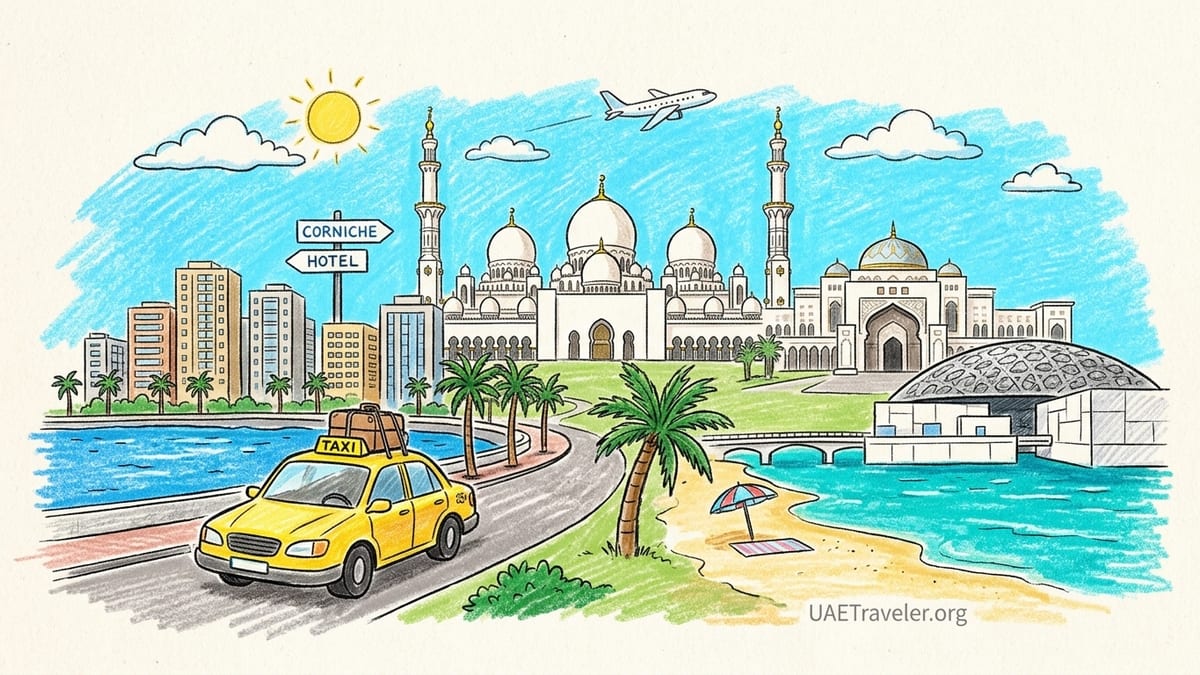
My flight landed at Abu Dhabi International Airport late morning, just before midday. Immigration was efficient, and I was landside in about 30 minutes. I had no checked luggage, which helped. Outside arrivals, I followed the signs for taxis and joined the official taxi queue. There is an airport surcharge added to the meter, but it is clearly visible. Into the city, most central hotels near the Corniche or Al Markaziyah take around 30 to 40 minutes by car, depending on traffic. My taxi to a mid-range hotel near the Corniche cost roughly the equivalent of 20 to 25 US dollars.
I chose to stay close to the Corniche rather than on Saadiyat Island or Yas Island because I wanted a base that felt like the actual city, not just a resort enclave. My hotel was a business-style property a few blocks back from the waterfront, in a neighborhood of mid-rise apartment blocks, small groceries, and cafeterias serving shawarma and karak tea. I expected something anonymous and functional, but the location turned out to be ideal for walking to the Corniche in the evenings and catching taxis easily during the day.
The room itself was exactly what I needed for a short city stay: strong air conditioning, blackout curtains and a comfortable bed. The view was mostly other buildings and a slice of water in the distance. What mattered much more was that taxis were constantly available outside, and I could be at either Sheikh Zayed Grand Mosque or Qasr Al Watan in about 20 to 25 minutes in normal traffic. For a two-day visit, that balance between local feel and connectivity worked well.
If I had chosen a resort hotel on Saadiyat Island, I would have had a nicer beach at my doorstep but longer travel times to most sights. Conversely, staying out by the airport would have simplified arrival and departure but made every sightseeing trip feel like a commute. Being in the central city was the right call for this particular layover-style trip.
Planning Day 1: Mosque, Palace and the Reality of Distances
I planned my first full day around what I considered Abu Dhabi’s two essential landmarks: Sheikh Zayed Grand Mosque and Qasr Al Watan, the presidential palace complex that is open to visitors. On paper they looked easy to combine, followed by a sunset stroll along the Corniche and a late local dinner. What I underestimated was how much time security, internal transfers and simply appreciating the spaces would actually take.
Before leaving home, I checked the official information for Sheikh Zayed Grand Mosque. Visitors are strongly encouraged to pre-register online by creating a visitor profile and obtaining an entry pass. That process is straightforward, but it does require entering passport details. Dress codes are strict. Shoulders and legs must be covered, and women must cover their hair. There are abayas and other coverings available on site, but I preferred to arrive properly dressed to move more quickly through security.
From my Corniche-area hotel, I took a regular city taxi mid-morning. Ride-hailing apps operate in Abu Dhabi, but for this first journey the hotel staff simply flagged a cab from the street. The trip to the mosque took around 25 minutes and cost the equivalent of roughly 10 to 12 US dollars. Traffic flowed well until the final approach, where tour buses and taxis converged on the visitor parking and drop-off area.
My optimistic plan allowed two hours at the mosque. In reality, from arriving at the entrance to leaving the complex, I was there just over three hours. Security screening involved X-ray scanners similar to airport procedures, though less formal, and there were separate lanes for tour groups and independent visitors. Even with pre-registration, there was a small queue to verify the QR code and check dress code compliance. By the time I emerged onto the main courtyard, I was very glad I had not tried to squeeze this into a single rushed hour.
Inside Sheikh Zayed Grand Mosque: Space, Detail and Crowd Management
The first sight of the mosque’s courtyard genuinely exceeded my expectations. The sheer white marble, floral inlays underfoot and the reflection of the four minarets against a clear sky make it feel both monumental and surprisingly serene. Even with a steady flow of visitors and groups, the scale of the space prevents it from ever feeling fully crowded. I had been to large religious buildings before, including several major cathedrals in Europe, but the combination of modern engineering and traditional Islamic design vocabulary here felt distinct.
Movement inside the mosque is structured, partly for preservation and partly for security. There are roped routes, and staff members gently direct visitors along a prescribed path from the main courtyard into the prayer halls and back out. Photography is widely allowed, although certain areas have signs requesting no photos, and staff may occasionally remind people to be respectful. I kept my phone in my pocket for the first 15 minutes just to absorb the proportions of the main courtyard and the contrast between light and shadow under the colonnades.
The interior highlights, including the immense chandelier and the intricate carpet in the main prayer hall, warranted more time than I gave them. I found myself glancing at the clock, conscious that I still wanted to reach Qasr Al Watan that same afternoon. Guided tours are offered, and I noticed small groups being led by official guides who provided context about the building’s construction and design symbolism. I regretted not timing my visit to join one. Instead, I moved at my own pace, reading only a few of the informational displays near the exits, and lost an opportunity to understand more about the decorative choices.
Looking back, I would allocate a full three hours just for the mosque, and I would plan my arrival either at opening time or in the late afternoon to avoid the most intense midday light and heat. Trying to sandwich it between a late breakfast and an early afternoon palace visit made the experience slightly more rushed than it deserved.
Afternoon at Qasr Al Watan and a Sunset Walk on the Corniche
From Sheikh Zayed Grand Mosque, I called a taxi using a ride-hailing app directly to Qasr Al Watan. The drive between the two landmarks took about 20 minutes and cost roughly 8 to 10 US dollars. Qasr Al Watan operates dedicated visitor hours and requires an entry ticket that can be purchased on site or online. I bought mine at the ticket counter, joining a short queue of families and small tour groups. Prices are clearly posted at the entrance in both local currency and English.
One element that ate into my schedule at Qasr Al Watan was the internal transport. The visitor entrance and ticketing area are separate from the actual palace building, and there is a shuttle bus that moves people from one to the other. The ride itself is only a few minutes, but there was a wait to board due to a cluster of arrivals. From passing through security at the gate to finally entering the main palace hall took around 35 to 40 minutes. This was exactly the kind of hidden time cost I had not properly budgeted when planning my day on paper.
Inside, Qasr Al Watan is all about scale and ornament: soaring domes, vast chandeliers and intricate geometric patterns. Exhibits explain the functioning of the UAE’s political institutions, display diplomatic gifts and showcase calligraphy and other crafts. I stayed approximately two hours, which was enough for a full circuit of the main halls and exhibits but too short to linger in the library or the gardens. I also skipped the evening light show because I wanted to see the Corniche at sunset and I had an early start the next day.
Another taxi ride brought me back toward the Corniche just as the sun was softening. The waterfront promenade runs for several kilometers, with separate paths for walking, jogging and cycling. From my hotel, it was a ten-minute stroll to reach the water. I walked a short section between landscaped parks and the sea, watching families picnic and office workers winding down after their day. I had originally imagined renting a bike and covering a longer stretch, but after several hours on my feet between the mosque and the palace, I was content with a slower walk and a chance to process the day.
A Memorable Food Stop and How Much Dinner Actually Cost
That evening, I skipped the hotel restaurant in favor of a popular Lebanese restaurant a short taxi ride from the Corniche. I had asked both the hotel receptionist and a local colleague for somewhere that balanced good food with reasonable pricing, and this place came up twice. The dining room was bright, busy and filled with a mix of families and small groups of friends. I ordered a spread that included hummus, fattoush, grilled chicken and fresh bread from the oven, along with a mint lemonade.
The bill for one person came to an amount that converted to around 20 to 25 US dollars, including service. For a main evening meal in a comfortable sit-down restaurant in central Abu Dhabi, that felt fair. I could certainly have eaten more cheaply at one of the small cafeterias near my hotel, where shawarma and a drink would have cost less than half that, but for my only full evening in the city I wanted a meal that felt like a deliberate choice rather than convenience.
This dinner break also revealed something important about pacing. By the time I sat down, it was already late, and the intention of an unhurried evening on the Corniche with multiple stops had quietly evaporated. I realized that on a short visit, it is better to pick one evening activity and commit to it fully instead of trying to sample several. In my case, that meant enjoying a proper meal and a modest walk, rather than racing from restaurant to shisha lounge to waterfront viewpoint.
If food is a priority, Abu Dhabi rewards a bit of research and local advice. There are upscale options inside hotels and malls, but I found that stepping a street or two away from the most obvious areas opened up more relaxed, mid-priced choices. With only two days, I was not able to explore the Indian restaurants or Emirati specialties that I had bookmarked in advance, which remains one of my regrets from this trip.
Day 2 on Saadiyat Island: Louvre Abu Dhabi and Beach Time
For my second day, I devoted most of my time to Saadiyat Island, home to cultural institutions and a stretch of attractive beach. The headline attraction, Louvre Abu Dhabi, had been on my list for years. Before traveling, I confirmed the current opening hours on its official channels and noted that tickets could be purchased both online and on site. I opted to buy on arrival to keep flexibility in case I was too tired from the previous day.
From my central hotel, the taxi ride to Louvre Abu Dhabi took around 20 minutes and cost in the range of 8 to 12 US dollars. The approach across the bridge to Saadiyat provides a brief sense of distance from the denser city. The museum complex appears low and wide, dominated by the distinctive dome that filters light into patterns across the outdoor walkways. Security at entry was similar to other major museums: a bag scan and visual check, friendly but thorough.
I have been to the Louvre in Paris, and the comparison is inevitable, but Louvre Abu Dhabi stands on its own. Rather than overwhelming visitors with sheer volume, it presents a more curated narrative across cultures and time periods. I appreciated the chronological and thematic flow, moving from ancient artifacts to more recent works, with clear explanatory panels in English and Arabic. The building itself is also part of the experience. I spent at least 30 minutes simply wandering the shaded outdoor passages, watching the reflections of the water and the play of light through the dome.
My original plan had allocated two to three hours for the museum. In practice, I stayed close to four, including a short coffee break at the café. I read perhaps half of the labels in detail and paused properly with certain works, but I did not manage every temporary exhibition space. Art enthusiasts could easily spend an entire day here. If I had tried to add another major indoor attraction immediately afterward, I would have been rushing both.
Comparing Louvre Abu Dhabi and Other Museums, Plus Saadiyat’s Beach
Having visited several major museums in Europe and North America, including the Louvre in Paris and the British Museum in London, I found Louvre Abu Dhabi more manageable in scale for a short visit. It offers enough depth to be intellectually satisfying, but it does not require mapping out tactics just to cover a single wing. The narrative emphasis on intercultural connections also felt distinct, rather than simply grouping works by nation or period.
From a practical standpoint, facilities inside the museum are modern and efficient. There are lockers, clean restrooms on multiple levels and several options for food and drink. I grabbed a coffee and a small pastry at the café between sections, which cost roughly what you might expect in a major European museum café. Seating areas along the waterfront side of the building are also pleasant places to pause without spending additional money.
After leaving the museum mid-afternoon, I took a short taxi ride to one of Saadiyat’s public beach access points. The contrast between the controlled interior of the museum and the open horizon of the Gulf was refreshing. The sand was pale and fine, the water a gradient of soft blues. There are sun loungers and umbrellas available for rent, plus basic facilities such as showers and changing rooms. I did not rent a full setup, choosing instead to walk the shoreline for an hour and sit on the sand with my feet in the water.
Here again, I felt the constraints of a short stay. I would have liked to spend more time in the water, but with an evening flight the following day and some work to catch up on, I kept my beach time modest. Saadiyat’s atmosphere is calmer than some resort areas I have visited elsewhere in the region and would lend itself very well to a half-day of genuine relaxation if your schedule allows.
What Felt Rushed, What I Skipped and Lessons for a 2-Day Stay
Looking back over my two days, several things clearly felt rushed. Sheikh Zayed Grand Mosque deserved more contemplative time and possibly a guided tour. Qasr Al Watan also would have benefited from at least another hour for the library and the gardens, and I entirely missed the evening sound and light show. On Saadiyat, I only scratched the surface of the beach and did not visit any other galleries beyond Louvre Abu Dhabi.
In terms of outright omissions, I did not make it to Yas Island at all. I had considered a quick look at Yas Marina or even a roller coaster ride at Ferrari World, but the distances and time required made that unrealistic on a two-day cultural and city-focused itinerary. Similarly, I skipped the large shopping malls as destinations in themselves, seeing them only in passing from the taxi. For some visitors, those would be central attractions. For me, they became easy sacrifices to protect time at the mosque, palace and museum.
The main lesson I drew is that Abu Dhabi looks deceptively compact on a map, especially when you zoom out and see everything stitched together by highways and bridges. In practice, moving between airport, city center, mosque, palace, Saadiyat and Yas involves a series of taxi rides that add up in both time and money. None of the individual fares were unreasonable, but each transfer eats 20 to 30 minutes once you factor in waiting, traffic lights and navigation within large complexes.
For someone planning a similar two-day visit, I would recommend limiting yourself to one or two major sights per day and one clearly defined evening plan. Overpacking the schedule risks reducing extraordinary places to mere checkpoints. My own miscalculation was subtle rather than dramatic, but I felt it in the slightly hurried pace at some of the very locations I had been most excited about.
If You Are Coming from Dubai Instead of Abu Dhabi Airport
My experience was anchored around arriving and departing through Abu Dhabi International Airport, but many visitors reach the city as a side trip from Dubai. That changes a few practical details. The distance between central Dubai and central Abu Dhabi is significant, and even with modern highways, the road journey usually takes around 90 minutes to two hours each way by car, depending on traffic and exact starting point. There are intercity buses as well, which can be cost-effective but take longer when you include waiting and potential transfers to reach specific attractions.
If I were planning this as a two-day extension from Dubai, I would seriously consider spending at least one night in Abu Dhabi rather than trying to commute both days. A hotel near the Corniche or in Al Markaziyah would still be my choice, because it offers a feeling of being in the city itself while keeping taxi rides to key sights reasonable. You could, for example, leave Dubai early in the morning, arrive in Abu Dhabi late morning or around midday, check in and still have time for a late afternoon visit to either Sheikh Zayed Grand Mosque or Qasr Al Watan.
Another adjustment I would make is grouping attractions more tightly. On a Dubai-based visit, one day could be focused on the mosque and the palace, with an evening near the Corniche. The second day could be devoted fully to Saadiyat Island, with Louvre Abu Dhabi and beach time before returning to Dubai in the early evening. Trying to insert Yas Island theme parks or extensive mall visits into that framework would almost certainly stretch the schedule to breaking point.
The additional cost of intercity travel also matters. While individual prices vary based on operator and booking timing, a private car or taxi between Dubai and Abu Dhabi is not trivial. If budget is a concern, the official intercity bus becomes attractive, but it drops you at central terminals, from which you will still need local taxis to reach the mosque, palace or Saadiyat. That layering of transport segments reinforces the case for at least one overnight stay in Abu Dhabi if you want more than a superficial glimpse.
The Takeaway: What I Would Change Next Time
Two days in Abu Dhabi gave me a strong first impression without feeling like I had exhausted the city. The blend of monumental religious architecture, political symbolism, contemporary art and simple seaside calm made the layover feel like a deliberate mini-trip rather than just a stop between flights. At the same time, the experience exposed exactly how little slack there is in a 48-hour itinerary once you factor in security procedures, internal transfers and the desire to eat and rest like a human being.
If I were to repeat the trip, I would make three concrete changes. First, I would book an earlier arrival or a later departure if possible, gaining a few extra usable hours. Second, I would pre-book timed entry where available, especially for any guided experiences at Sheikh Zayed Grand Mosque and tickets for Louvre Abu Dhabi, to reduce uncertainty and potential queuing. Third, I would accept from the beginning that Yas Island and serious mall exploration belong to a future visit rather than trying to wedge them into this one.
In terms of accommodation, I would still choose to stay near the Corniche, but I might opt for a property a little closer to the waterfront itself, or one with an outdoor pool that I would actually have time to use. Being able to wake up and take a quick early walk by the sea before diving into a day of sightseeing would add a layer of calm that my current schedule only hinted at.
As for priorities, if you only have two days, I would place Sheikh Zayed Grand Mosque and Louvre Abu Dhabi firmly at the top of the list, each with generous time allocations. Qasr Al Watan and the Corniche would follow, with Saadiyat’s beach as the ideal bonus if you can spare an afternoon. The combination of those experiences gave me both a sense of Abu Dhabi’s present identity and a desire to return with more than just a layover to work with.
FAQ
Q1. Is two days really enough to see Abu Dhabi’s main sights?
Two days is enough to experience a focused selection of Abu Dhabi’s highlights, such as Sheikh Zayed Grand Mosque, Qasr Al Watan and Louvre Abu Dhabi, but you will need to be selective and accept that places like Yas Island or extensive mall visits may have to wait for another trip.
Q2. How much time should I allow for Sheikh Zayed Grand Mosque?
Based on my visit, you should allow at least three hours from arrival at the entrance to departure, including security, walking the prescribed visitor route, taking photos and spending time inside the prayer halls.
Q3. Do I need to pre-register to visit Sheikh Zayed Grand Mosque?
Current procedures encourage visitors to pre-register online and obtain an entry pass before arriving. This helps speed up the check-in process, but you will still pass through security and dress code checks at the site.
Q4. What is the dress code at Sheikh Zayed Grand Mosque?
The dress code requires modest clothing that covers shoulders and legs, and women must cover their hair. There are coverings available on site, but arriving properly dressed makes entry smoother and quicker.
Q5. How long did you spend at Louvre Abu Dhabi, and was it enough?
I spent around four hours at Louvre Abu Dhabi, including a short café break. That was enough for a satisfying first visit, but art enthusiasts could comfortably spend most of a day there.
Q6. Is it better to stay near the Corniche, Saadiyat, or Yas Island for a short trip?
For a two-day cultural-focused visit, I found staying near the Corniche ideal because it provided a sense of the everyday city and kept taxi journeys to major sights manageable, while Saadiyat and Yas would be stronger choices for beach resorts or theme park trips.
Q7. How expensive are taxis in Abu Dhabi for getting between sights?
On my trip, most individual taxi rides within the city, such as between the Corniche, Sheikh Zayed Grand Mosque, Qasr Al Watan and Saadiyat, ranged roughly between 8 and 12 US dollars, with the airport trip costing more due to distance and surcharges.
Q8. Can I visit Abu Dhabi as a day trip from Dubai?
It is possible to visit Abu Dhabi on a long day trip from Dubai, but the road journey of 90 minutes to two hours each way limits how much you can see. I would recommend at least one night in Abu Dhabi to properly enjoy the main sights.
Q9. Did you feel rushed trying to see the mosque and Qasr Al Watan on the same day?
Yes, combining both in one day left me with less time than I wanted at each, especially once I accounted for security, internal shuttles and time simply absorbing the architecture, so I would plan a slightly slower pace next time.
Q10. What would you book in advance if you returned to Abu Dhabi?
On a return visit, I would pre-book any available guided tour or timed entry for Sheikh Zayed Grand Mosque, purchase Louvre Abu Dhabi tickets ahead of time and choose my hotel near the Corniche with more intention, possibly securing a room with easier waterfront access.